Iran's hardline stance may hinder a potential US-led war, causing oil prices to fluctuate.
2026-04-30 21:33:51
On Thursday (April 30), during the Asian and European sessions, international oil prices experienced wide fluctuations, rising in the morning before falling back, and then falling back after hitting a low in the evening. The Brent crude oil July contract traded around 109.87.
Currently, the dispute between the United States and Iran over control of the Strait of Hormuz has reached a fever pitch, and the fragile ceasefire agreement has only provided a ceasefire effect.
The blockade and counter-blockade actions by both sides have created a vicious cycle: the US Navy has implemented a maritime blockade to cut off Iran's oil export channels in order to deplete its economic resources, which in turn has forced Iran to face production shutdown pressure due to saturated crude oil inventories;
Iran retaliated by blocking the Strait of Hormuz, firmly controlling this key global energy transport hub, and the tense standoff between the two sides has led to a continuous escalation of regional security risks.
Iran’s Supreme Leader Mojtaba Khamenei issued a written statement through a state television anchor, a routine he has followed since the February 28 attack that killed his father, former Supreme Leader Ali Khamenei, and injured himself.
He stated bluntly that two months have passed since the United States launched a large-scale military mobilization in the region, and the US has suffered a "shameful defeat," declaring that "a new chapter is being turned in the Persian Gulf and the Strait of Hormuz, and the Gulf region will have a bright future without the presence of the United States."
The statement was highly provocative, referring to the United States as "Satan," stating that "the only foothold for foreign powers in the Persian Gulf is the seabed," and explicitly declaring that nuclear and missile capabilities are Iran's "core strategic assets," which, along with nanotechnology and biotechnology, are considered treasures by the 90 million Iranian people. Iran will resolutely defend its territory and airspace with the determination to do so, and there is absolutely no room for negotiation or compromise.
Moheber, an advisor to Iran's Supreme Leader, further reinforced his hardline stance on social media, stating that Iran controls the transportation of 20% of the world's oil and more than 18 trillion cubic meters of natural gas. He added, "A maritime blockade will not send Iran back to the Stone Age, but it will certainly plunge the hegemonic regime into an ice age."
Iran's foreign minister, taking advantage of Persian Gulf Day (commemorating the 400th anniversary of the expulsion of Portuguese colonists), affirmed Trump's use of the correct name "Persian Gulf" while condemning any attempt to confuse the name of the Strait of Hormuz as a "terrible mistake," thus demonstrating Iran's sovereignty over the strait.
It is worth noting that Iran has long claimed that its nuclear program is for peaceful purposes, but after the United States withdrew from the nuclear agreement, it enriched uranium to a near-weapon-grade level of 60%, an action that has aroused widespread concern in the international community. In its recent negotiation proposal, it advocates postponing nuclear program negotiations.
Faced with the deadlock over the Strait of Hormuz, President Trump previously declared that the Strait of Hormuz was "fully open and ready for navigation," but actual shipping has yet to resume.
In response, the U.S. government launched a new initiative called the "Freedom of the Sea Architecture," which, through internal State Department telegrams, instructed embassies around the world to urge diplomats to push foreign governments to join a U.S.-led international coalition to restart commercial shipping across the Straits through information sharing, diplomatic coordination, and sanctions enforcement.
Meanwhile, the Trump administration's foreign policy actions are hampered by domestic legal constraints.
Under the War Powers Act of 1973, the president's foreign military action without congressional authorization may not last more than 60 days, or he must withdraw his troops within 30 days.
The "Operation Epic Fury" against Iran, launched on March 2, is nearing its 60-day legal deadline of May 1. The White House is urgently consulting with congressional lawmakers, requesting a 30-day reauthorization of the war.
The issue has sparked intense debate within Congress: while Republican lawmakers do not support the Democratic-proposed bill to end hostilities, a growing number of Republicans believe Congress should fulfill its constitutional mandate to authorize war and oppose the president's sole command of the conflict; Democrats, on the other hand, continue to exert pressure, criticizing the military action as "illegal" as it was not authorized by Congress.
Several senators have made it clear that the 60-day period is a legal red line, and the White House needs to go through a formal authorization process; otherwise, Congress will block military action. The White House, however, has accused lawmakers of using this as an opportunity for "political showmanship" and attempting to weaken legal constraints by arguing that "the ceasefire period is not included in the 60-day cycle."
Meanwhile, with the crucial midterm elections approaching and domestic economic pressures triggered by soaring oil prices, the Trump administration's Iran policy is facing increasing scrutiny.
The Strait of Hormuz, as a narrow outlet to the Persian Gulf, carries one-fifth of the world's crude oil and natural gas trade, and its strategic value is irreplaceable.
Iran has made it clear that it will continue to control the Strait of Hormuz, claiming jurisdiction over the waterway (located within the territorial waters of Iran and Oman) . It has previously charged some passing ships a high toll of $2 million per vessel and plans to implement a "new legal framework and management model," which it claims will benefit countries in the region.
However, this claim has been widely opposed by the international community: most countries around the world recognize the Strait of Hormuz as an international public waterway that should be subject to the principle of freedom of navigation, and prohibit any country from unilaterally charging passage fees or blocking it.
The Gulf Arab states, led by the UAE, reacted strongly, condemning Iran's control measures as piracy that seriously disrupted international shipping order.
The power struggle between the US and Iran over control of the Strait of Hormuz has made navigational safety on this vital energy route highly uncertain, further complicating the regional situation.
Fears of supply disruptions caused the benchmark price of Brent crude oil for June delivery to surge to $126 per barrel in recent trading, setting a new record high.
The United States is currently facing crucial congressional questioning regarding the extension of military operations, while Iran continues to raise the price of its bargaining chips.
For the global economy, the surge in energy prices has further exacerbated downward pressure, posing a severe challenge to energy security in various countries. The future trend of oil prices will be closely linked to the direction of the US-Iran standoff and the progress of the resumption of navigation in the Taiwan Strait, becoming a key variable affecting the global economic recovery.
From a technical perspective, if there is no substantial improvement in the strait blockade, oil prices are expected to continue rising based on the 5-day moving average, with the nearest support level currently around 97.8.
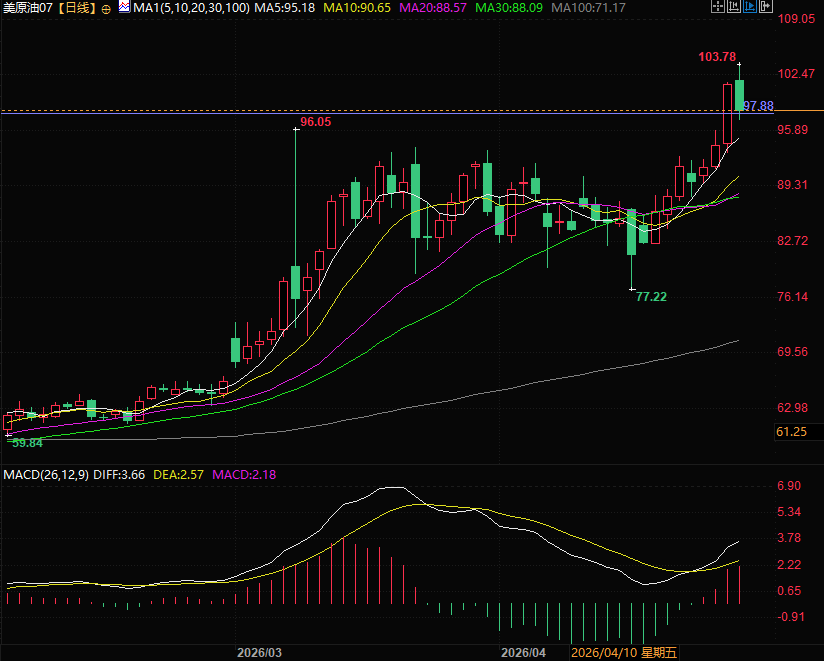
(Brent crude oil July contract daily chart, source: EasyForex)
At 21:29 Beijing time, the Brent crude oil July contract was trading at $98.28 per barrel.
Currently, the dispute between the United States and Iran over control of the Strait of Hormuz has reached a fever pitch, and the fragile ceasefire agreement has only provided a ceasefire effect.
The blockade and counter-blockade actions by both sides have created a vicious cycle: the US Navy has implemented a maritime blockade to cut off Iran's oil export channels in order to deplete its economic resources, which in turn has forced Iran to face production shutdown pressure due to saturated crude oil inventories;
Iran retaliated by blocking the Strait of Hormuz, firmly controlling this key global energy transport hub, and the tense standoff between the two sides has led to a continuous escalation of regional security risks.
Iran's leadership has taken a hard line, defending its core interests and strategic assets.
Iran’s Supreme Leader Mojtaba Khamenei issued a written statement through a state television anchor, a routine he has followed since the February 28 attack that killed his father, former Supreme Leader Ali Khamenei, and injured himself.
He stated bluntly that two months have passed since the United States launched a large-scale military mobilization in the region, and the US has suffered a "shameful defeat," declaring that "a new chapter is being turned in the Persian Gulf and the Strait of Hormuz, and the Gulf region will have a bright future without the presence of the United States."
The statement was highly provocative, referring to the United States as "Satan," stating that "the only foothold for foreign powers in the Persian Gulf is the seabed," and explicitly declaring that nuclear and missile capabilities are Iran's "core strategic assets," which, along with nanotechnology and biotechnology, are considered treasures by the 90 million Iranian people. Iran will resolutely defend its territory and airspace with the determination to do so, and there is absolutely no room for negotiation or compromise.
Moheber, an advisor to Iran's Supreme Leader, further reinforced his hardline stance on social media, stating that Iran controls the transportation of 20% of the world's oil and more than 18 trillion cubic meters of natural gas. He added, "A maritime blockade will not send Iran back to the Stone Age, but it will certainly plunge the hegemonic regime into an ice age."
Iran's foreign minister, taking advantage of Persian Gulf Day (commemorating the 400th anniversary of the expulsion of Portuguese colonists), affirmed Trump's use of the correct name "Persian Gulf" while condemning any attempt to confuse the name of the Strait of Hormuz as a "terrible mistake," thus demonstrating Iran's sovereignty over the strait.
It is worth noting that Iran has long claimed that its nuclear program is for peaceful purposes, but after the United States withdrew from the nuclear agreement, it enriched uranium to a near-weapon-grade level of 60%, an action that has aroused widespread concern in the international community. In its recent negotiation proposal, it advocates postponing nuclear program negotiations.
The US faces internal and external troubles: Trump's new measures encounter obstacles, and congressional authorization struggle intensifies.
Faced with the deadlock over the Strait of Hormuz, President Trump previously declared that the Strait of Hormuz was "fully open and ready for navigation," but actual shipping has yet to resume.
In response, the U.S. government launched a new initiative called the "Freedom of the Sea Architecture," which, through internal State Department telegrams, instructed embassies around the world to urge diplomats to push foreign governments to join a U.S.-led international coalition to restart commercial shipping across the Straits through information sharing, diplomatic coordination, and sanctions enforcement.
Meanwhile, the Trump administration's foreign policy actions are hampered by domestic legal constraints.
Under the War Powers Act of 1973, the president's foreign military action without congressional authorization may not last more than 60 days, or he must withdraw his troops within 30 days.
The "Operation Epic Fury" against Iran, launched on March 2, is nearing its 60-day legal deadline of May 1. The White House is urgently consulting with congressional lawmakers, requesting a 30-day reauthorization of the war.
The issue has sparked intense debate within Congress: while Republican lawmakers do not support the Democratic-proposed bill to end hostilities, a growing number of Republicans believe Congress should fulfill its constitutional mandate to authorize war and oppose the president's sole command of the conflict; Democrats, on the other hand, continue to exert pressure, criticizing the military action as "illegal" as it was not authorized by Congress.
Several senators have made it clear that the 60-day period is a legal red line, and the White House needs to go through a formal authorization process; otherwise, Congress will block military action. The White House, however, has accused lawmakers of using this as an opportunity for "political showmanship" and attempting to weaken legal constraints by arguing that "the ceasefire period is not included in the 60-day cycle."
Meanwhile, with the crucial midterm elections approaching and domestic economic pressures triggered by soaring oil prices, the Trump administration's Iran policy is facing increasing scrutiny.
The struggle for control of the Strait of Hormuz: a clash between unilateral control and international rules.
The Strait of Hormuz, as a narrow outlet to the Persian Gulf, carries one-fifth of the world's crude oil and natural gas trade, and its strategic value is irreplaceable.
Iran has made it clear that it will continue to control the Strait of Hormuz, claiming jurisdiction over the waterway (located within the territorial waters of Iran and Oman) . It has previously charged some passing ships a high toll of $2 million per vessel and plans to implement a "new legal framework and management model," which it claims will benefit countries in the region.
However, this claim has been widely opposed by the international community: most countries around the world recognize the Strait of Hormuz as an international public waterway that should be subject to the principle of freedom of navigation, and prohibit any country from unilaterally charging passage fees or blocking it.
The Gulf Arab states, led by the UAE, reacted strongly, condemning Iran's control measures as piracy that seriously disrupted international shipping order.
The power struggle between the US and Iran over control of the Strait of Hormuz has made navigational safety on this vital energy route highly uncertain, further complicating the regional situation.
The crude oil market is experiencing severe volatility, putting pressure on the global economy.
Fears of supply disruptions caused the benchmark price of Brent crude oil for June delivery to surge to $126 per barrel in recent trading, setting a new record high.
The United States is currently facing crucial congressional questioning regarding the extension of military operations, while Iran continues to raise the price of its bargaining chips.
For the global economy, the surge in energy prices has further exacerbated downward pressure, posing a severe challenge to energy security in various countries. The future trend of oil prices will be closely linked to the direction of the US-Iran standoff and the progress of the resumption of navigation in the Taiwan Strait, becoming a key variable affecting the global economic recovery.
From a technical perspective, if there is no substantial improvement in the strait blockade, oil prices are expected to continue rising based on the 5-day moving average, with the nearest support level currently around 97.8.
(Brent crude oil July contract daily chart, source: EasyForex)
At 21:29 Beijing time, the Brent crude oil July contract was trading at $98.28 per barrel.
- Risk Warning and Disclaimer
- The market involves risk, and trading may not be suitable for all investors. This article is for reference only and does not constitute personal investment advice, nor does it take into account certain users’ specific investment objectives, financial situation, or other needs. Any investment decisions made based on this information are at your own risk.