May 1st Financial Breakfast: Japanese authorities intervened in the foreign exchange market; gold prices rebounded to the $4630 mark; hedge funds locked in profits at the end of the month; oil prices fell by nearly 3%.
2026-05-01 06:41:44
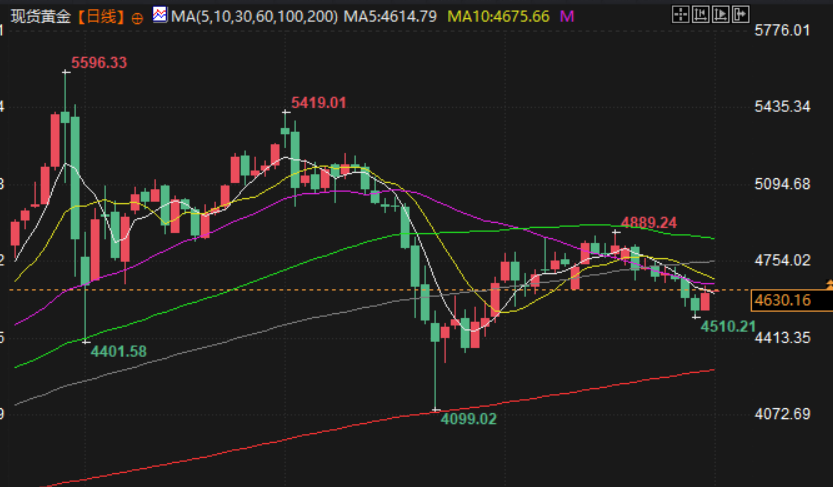
On Friday (May 1, Beijing time) in early Asian trading, spot gold was trading around $4,630 per ounce. Gold prices rose nearly 2% on Thursday, driven by a weaker dollar and lower oil prices, but still recorded their second consecutive monthly decline due to inflation concerns stemming from the situation in Iran. US crude oil was trading around $105.75 per barrel. Oil prices fell nearly 3% on Thursday as hedge funds locked in profits at the end of the month, but the situation in Iran continued to support oil prices.

U.S. stocks closed higher on Thursday, with the S&P 500 and Nasdaq posting their biggest monthly gains since November 2020 and April 2020, respectively, and the Dow Jones Industrial Average also recording its best monthly performance since November 2024. Investors temporarily ignored the oil supply shocks caused by geopolitical tensions, supported by a series of strong corporate earnings and economic data.
On that day, the Dow Jones Industrial Average rose 1.62%, the S&P 500 rose 1.02%, and the Nasdaq Composite rose 0.89%. Industrial stocks led the gains, driven by Caterpillar, while technology stocks were pressured by concerns about capital expenditures at Meta and Microsoft.
Alphabet surged 10.0% on record gains in its cloud business, while Amazon rose 0.8%; Meta and Microsoft fell 8.7% and 3.9%, respectively. Caterpillar shares soared 9.9% to a record high, driven by demand for power generation and construction equipment; Eli Lilly shares rose 9.8% after strong demand for its weight-loss drug led it to raise its earnings forecast.
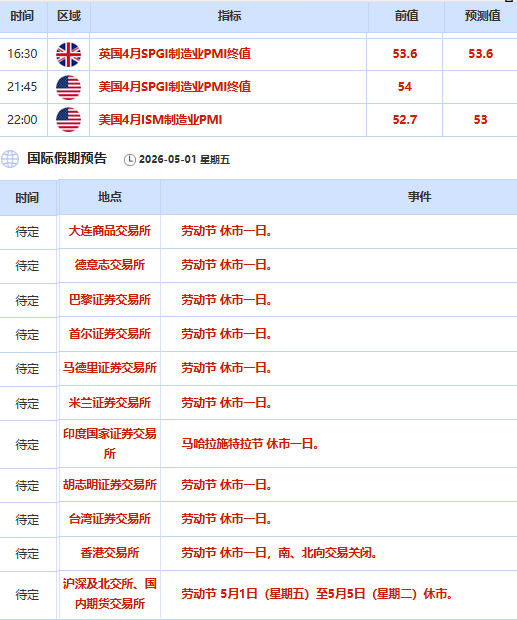
Economic data showed that the US grew by 2.0% in the first quarter, and initial jobless claims fell to their lowest level since 1969. However, energy prices kept inflation above 3%, weakening market expectations for a near-term interest rate cut by the Federal Reserve. The Fed kept interest rates unchanged in its most divided vote since 1992, acknowledging the uncertainty caused by the Middle East conflict. Despite no easing of tensions between Iran and the US, lower oil prices and robust economic growth helped the market achieve a strong close.
Gold prices rose more than 1.7% to $4,618.67 an ounce on Thursday, driven by a weaker dollar and a decline in oil prices, but still recorded their second consecutive monthly decline due to inflation concerns stemming from the situation in Iran. U.S. gold futures closed up 1.5% at $4,629.60. The weaker dollar was supported by Japan's first intervention in the currency market in nearly two years to support the yen, while global oil prices retreated after hitting a four-year high, easing inflationary pressures from soaring energy prices.
The Federal Reserve kept interest rates unchanged and expressed concern about inflation, while the Bank of England also held rates steady and warned of a potential sharp rate hike scenario resulting from a war with Iran. The US March PCE increase was in line with expectations.
Citigroup believes that selling pressure on gold may remain significant in the short term, but remains optimistic in the medium term, maintaining its three-month target price of $4,300 and its six- to twelve-month target price of $5,000. Furthermore, the Reserve Bank of India's gold holdings have risen to 16.7% of its foreign exchange reserves. Spot silver, platinum, and palladium also rose by nearly 3%, 5.3%, and 4.9%, respectively.
Oil prices fell on Thursday after hitting a four-year high above $126 a barrel, mainly due to market concerns that a war between the US and Iran could lead to a prolonged disruption of Middle Eastern supplies. Brent crude futures (the near-month contract) closed down 3.41% at $114.01 a barrel, after hitting a new high of $126.41 during the session, the highest since March 2022, while the more actively traded July contract closed up $0.44 at $110.88. WTI crude futures closed down 1.69% at $105.07, after rising as high as $110.93 during the session. Despite the decline, both benchmark crudes rose for the fourth consecutive month, reflecting concerns that the Iranian conflict could cause a prolonged disruption to global oil supplies.
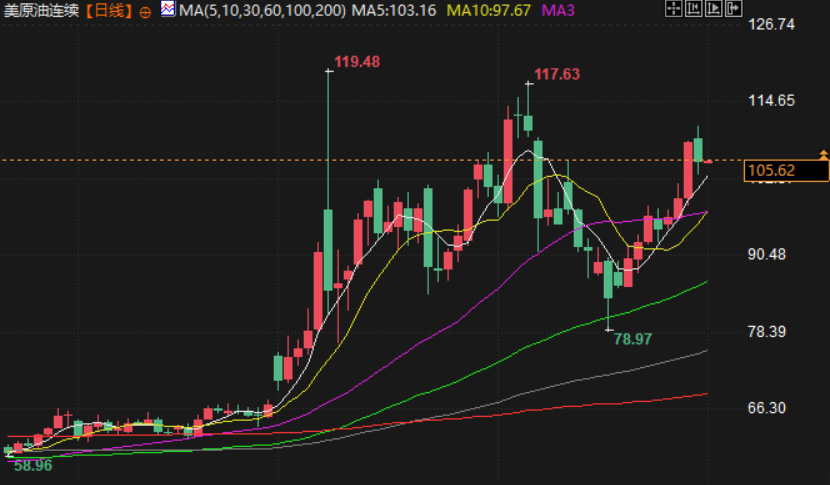
There was no obvious trigger for the decline in oil prices from their highs. Analysts believe it may be related to two large sell orders for the June Brent contract, volatility before the contract expired, and hedge funds locking in profits at the end of the month.
Meanwhile, a U.S. official revealed that President Trump will be briefed on a new round of military strikes against Iran in an effort to push for negotiations; Iran, in turn, warned of “long and painful” retaliation if the U.S. launches another attack and reiterated its control over the Strait of Hormuz, making the prospect of reopening the waterway bleak.
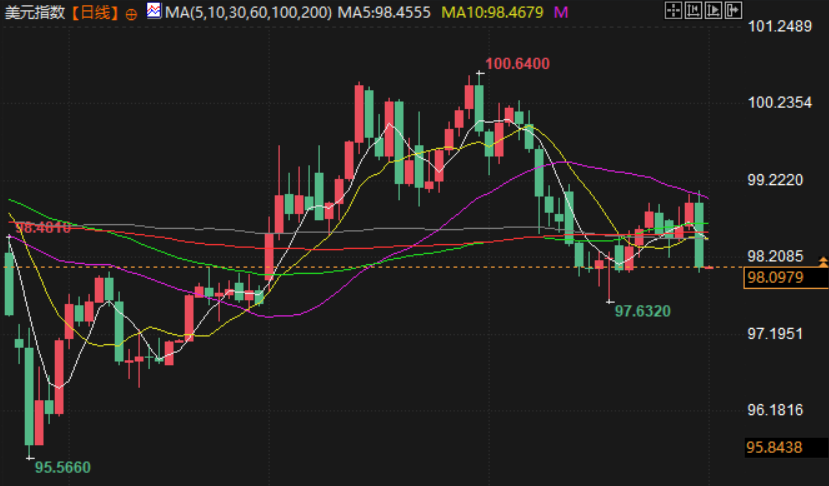
The dollar plunged on Thursday, primarily due to Japanese intervention to support the yen. The dollar fell as much as 3% against the yen to 155.5 yen, its biggest one-day drop since late December 2024. Japanese Finance Minister Satsuki Katayama had previously issued his strongest intervention signal to date, stating that the time for "decisive" action was approaching. Two sources familiar with the matter revealed that Japanese officials had bought yen after it fell to its lowest level since July 2024. As a result, the dollar index fell 0.80% to 98.06, ending a two-day winning streak.
Meanwhile, the European Central Bank kept interest rates unchanged as expected, but held extensive discussions on raising rates to address inflation soaring to 3%; the Bank of England also kept interest rates unchanged and discussed scenarios of the economic impact of a war with Iran.
Regarding the risk of war in the Middle East, the United States is attempting to break the deadlock by imposing a maritime blockade on Iranian oil exports, with President Trump receiving a briefing on plans for a new round of military strikes.
The Federal Reserve kept interest rates unchanged this week, but internal divisions emerged, with one policymaker advocating for a rate cut and three others believing the policy statement should no longer convey an accommodative stance. In other currencies, the euro rose 0.51% to $1.1733, the pound rose 0.98% to $1.36075, and the dollar fell 1.28% to 0.78110 Swiss francs.
Trump claims that only a few people know the actual progress of the US-Iran negotiations.
U.S. President Donald Trump said on April 30 that, apart from himself and a very few others, no one knows the actual progress of the negotiations between the U.S. and Iran. (Xinhua)
S&P is considering shortening the observation period for its indices from 12 months to 6 months.
S&P Dow Jones Indices said it is seeking market participants' feedback on a proposal to shorten the observation period for inclusion of candidate companies in the S&P Composite 1500 Index from 12 months to 6 months. The proposed adjustment only affects the eligibility criteria for inclusion in the S&P 500, S&P MidCap 400, and S&P SmallCap 600 indices and will not automatically result in the inclusion of mega-cap companies in the S&P 500.
The UAE has banned its citizens from traveling to Iran, Lebanon, and Iraq.
The UAE Ministry of Foreign Affairs announced on the evening of April 30 that, given the current situation in the region, it is prohibiting its citizens from traveling to Iran, Lebanon, and Iraq. In a statement, the Ministry urged all UAE citizens currently in these countries to leave the country as soon as possible and return to the UAE to ensure their safety. The Ministry stated that it will continue to monitor the situation of its citizens abroad and ensure their safety, emphasizing the importance of complying with relevant instructions and reminders in such situations. Furthermore, the Ministry urged its citizens in Iran, Lebanon, and Iraq to contact the Ministry of Foreign Affairs through designated emergency contact methods, stating that this is one of the preventative measures taken by the country to ensure the safety of its citizens. (Xinhua)
US media: The Trump administration is again piecing together an international coalition over the Strait of Hormuz.
According to a report by The Wall Street Journal on April 30, the Trump administration is pushing for a new international coalition to restore free navigation in the Strait of Hormuz. The report states that the U.S. State Department sent an internal cable to embassies on April 29 proposing an initiative called the "Freedom of the Sea Architecture" and instructing U.S. diplomats to urge host governments to join the initiative, stating that it would "enhance our collective capabilities." According to the cable, the "Freedom of the Sea Architecture" international coalition would be jointly led by the U.S. State Department and U.S. Central Command, responsible for sharing intelligence, coordinating diplomatic operations, and enforcing sanctions. The State Department would "act as the command hub for diplomatic operations," while Central Command would provide "real-time maritime situational awareness" for commercial shipping and coordinate intelligence sharing among the militaries of partner countries. Although the "Freedom of the Sea Architecture" itself is not a military coalition, the cable still instructed U.S. officials to inquire with their foreign counterparts whether they would be willing to join the coalition as "diplomatic partners and/or military partners." Furthermore, the coalition "will complement other maritime security task forces." The report says the U.S. hopes other countries will also participate in the current and future management of the Strait of Hormuz. (Xinhua)
Trump claims he has "destroyed" Iran's nuclear capabilities.
On April 30, local time, US President Trump stated at a White House press conference that recent US military actions had "destroyed" Iran's nuclear capabilities and significantly weakened its overall military strength. He claimed that the Iranian navy and air force were "virtually nonexistent," approximately 82% of its drone factories were weakened, nearly 90% of its missile factories were damaged, and most missile systems had been destroyed. Trump stated that the US completed key strike missions in a short period of time and emphasized that without action, Iran "could acquire nuclear weapons," which "must never be allowed to happen." Trump stated that current negotiations with Iran are stalled, but Iran "very much wants to reach an agreement." He claimed that the details of the negotiations are only in the hands of a very small number of high-ranking US officials. Trump stated that Iran has suffered severe blows in the recent conflict, with its "leadership and military almost destroyed" and its naval vessels "almost entirely sunk." He said this situation complicates the negotiations because "it's even difficult to determine who is in charge." Trump said that under economic sanctions and military pressure, Iran's economy is facing serious difficulties, with a sharp decline in oil revenues. He emphasized that the US goal is to force Iran to abandon its nuclear weapons development while pushing for a swift resolution to the situation through negotiations. When asked whether the Iranian team would participate in the 2026 World Cup, Trump said he "did not object," stating that the decision could be made by FIFA and that he would "let them participate." Iran has not yet responded to these comments. (CCTV News)
Trump's remarks, fueled by discontent with European allies, suggest he is considering reducing troop deployments in Spain and Italy.
On April 30, local time, US President Trump stated at a White House press conference that some European allies had "not provided help" on the Iran issue, specifically naming Spain and Italy for their "poor performance." He claimed that the US "does not rely on other countries" in handling the Middle East situation, and stated that he had previously tested the willingness of allies, but most countries chose "not to intervene." Trump pointed out that the US has "complete control" over the Iran issue, stating that military operations can be carried out without external support, and reiterated that Iran "cannot possess nuclear weapons." He stated that US military operations have dealt a serious blow to Iran, claiming that its military strength has been "weakened." Furthermore, Trump criticized the performance of some European countries on the Ukraine issue and questioned Germany's current policy, believing that it faces multiple challenges on immigration, energy, and regional security issues. When asked whether he would adjust the deployment of troops in Europe as he had with Germany, Trump said "very likely," hinting at possibly considering withdrawing some US troops from Spain and Italy. (CCTV News)
The US and Venezuela resume direct civilian flights after a seven-year hiatus.
On the morning of April 30 local time, an American Airlines flight took off from Miami, Florida, bound for Caracas, the capital of Venezuela. This was the first direct flight between the two countries after a seven-year hiatus in civil aviation. Venezuela severed diplomatic relations with the United States in January 2019 due to continued US interference in Venezuela's internal affairs. On January 3 this year, the United States launched a large-scale military strike against Venezuela, forcibly taking President Maduro and his wife into custody and bringing them to the United States. On March 5, the governments of the United States and Venezuela announced their agreement to restore diplomatic and consular relations. (Xinhua)
Trump's 60-day war authorization will expire on May 1st.
From March 2nd, when the US government formally notified Congress of its intention to launch a military strike against Iran, to May 1st, a full 60 days had passed. According to the War Powers Act of 1973, the US president has a 60-day grace period to deploy troops without congressional approval. If the president provides a written explanation to Congress that continued troop deployment is necessary, a 30-day extension can be granted, limited to the safe withdrawal of troops and prohibiting further offensive military action. On the 29th, US Defense Secretary Hergsays was questioned by Congress. This was his first congressional questioning since the US-Israel military action against Iran began in late February. Hergsays' statements regarding the US strike on Iranian nuclear facilities were contradictory, drawing criticism from Democratic lawmakers. US Department of Defense officials stated on the 29th that the estimated US expenditure on the war against Iran has reached $25 billion. Representative Adam Smith, the ranking Democrat on the House Armed Services Committee, stated that Hergsays needs to explain the Trump administration's objectives in launching this war, adding, "We have seen the cost, and the cost has been very, very high." (CCTV)
OPEC+ representatives expect another symbolic production increase is likely in June.
Three OPEC+ representatives revealed that the organization is likely to agree to a symbolic production increase again in June following the UAE's unexpected withdrawal. Two representatives stated that the seven major oil-producing countries, led by Saudi Arabia and Russia, are expected to raise their production quotas by 188,000 barrels per day at a video conference on Sunday; however, this increase cannot be implemented due to blockages in the Strait of Hormuz. According to Interfax news agency, Russian Deputy Prime Minister Alexander Novak stated that the UAE's withdrawal from OPEC will not immediately trigger a price war because the conflict in Iran restricts oil-producing countries' ability to release supply.
The Trump administration's investigation into Powell has concluded, and the U.S. Department of Justice is preparing to appeal the Federal Reserve's subpoena ruling.
The U.S. Department of Justice plans to appeal a federal judge's ruling that prevented prosecutors from using a grand jury subpoena during their investigation into the Federal Reserve's cost overruns in construction. U.S. Attorney Jeanine Pirro stated that the appeal is necessary because if the ruling remains in effect, it would weaken a key investigative tool for prosecutors. Although the investigation into the Federal Reserve and Chairman Jerome Powell has been closed, the Justice Department will still seek an appeal. Senator Thom Tillis stated that the appeal aims to challenge the basis of the ruling, not to reopen the investigation.
Iran claims 40% of its trade can be diverted to land transport.
The chairman of the Container Committee of the Iranian Shipping Association stated on April 30 that despite attempts by adversaries to cut off Iran's maritime routes through a maritime blockade, Iran is well-prepared for such situations due to past experience. He indicated that 40% of Iran's trade can be diverted to land transport. For example, up to 15% of the country's transit freight volume can be transferred to the International North-South Transport Corridor (INSTC), a transport route connecting Russia, Central Asia, Iran, India, and other countries. (CCTV News)
Iranian President: Iran has completely lost trust in the United States
Iranian President Pezechzian stated during a phone call with Belarusian President Lukashenko on April 30 that Iran has completely lost trust in the United States. Pezechzian said that resolving differences through dialogue and diplomatic efforts has always been a priority, but the two attacks on Iran by the United States and Israel during previous negotiations, coupled with the possibility of similar actions recurring, have led to Iran's complete loss of trust in the United States. (Xinhua)
The Japanese government and central bank intervened in the foreign exchange market.
According to Japanese sources on April 30, unnamed government officials stated that after the yen's exchange rate fell below 160 yen to the dollar, the Japanese government and the Bank of Japan implemented foreign exchange intervention measures, buying yen and selling dollars to maintain the yen's exchange rate. Japanese sources said that influenced by high oil prices and declining expectations of a Federal Reserve interest rate cut, the yen's exchange rate briefly fell below 160 yen to the dollar, a new low since July 2024. Japanese officials subsequently issued a series of statements warning of speculative market behavior. It is understood that in July 2024, the yen's exchange rate briefly fell below 161.9 yen to the dollar, triggering foreign exchange intervention measures by the Japanese government and the central bank. (CCTV News)
The Israeli defense minister stated that "again" action against Iran may "soon" be taken.
Israeli media reported on the 30th that Israeli Defense Minister Katz stated that while Israel supports diplomatic efforts between the United States and Iran, Israel may "soon need to take action again" to ensure the elimination of the "existential threat" posed by Iran. (Xinhua)
Chinese scientists have uncovered the key physical "black box" limiting the efficiency of perovskite solar cells.
A Chinese research team has for the first time unveiled the key physical "black box" restricting the efficiency of formally structured perovskite solar cells, innovatively proposing a continuous gradient doping electron transport layer design. Based on this strategy, the solar cell device, certified by international authoritative institutions, achieved a steady-state photoelectric conversion efficiency of 27.17% and a reverse scanning efficiency of 27.50%, setting a new record for the highest photoelectric conversion efficiency of formally structured perovskite photovoltaic devices. This research was achieved by a team led by Professor Yuan Mingjian and Distinguished Researcher Jiang Yuanzhi from the College of Chemistry, Nankai University, in collaboration with a team led by Researcher Xu Jian from Beijing Institute of Technology. The relevant research results were published online in the international academic journal *Nature* on April 30th (Beijing time). (Xinhua News Agency)
China accelerates its development of quantum computing, with capital flowing into quantum technology.
As a key area leading a new round of technological revolution and industrial transformation, quantum technology encompasses several major fields, including quantum computing, quantum communication, and quantum measurement. Among them, quantum computing, which utilizes quantum technology to obtain stronger computing power, is considered the most disruptive and challenging direction. Reporters have learned that currently, domestic quantum computing hardware, software, and cloud services are accelerating their deployment and collaborative research efforts, striving to enable quantum computing to solve practical problems as soon as possible. Since the beginning of this year, several domestic quantum technology companies have announced large-scale financing, with nearly 10 cases of single financing exceeding 100 million yuan. Currently, capital is rapidly flowing into the quantum technology field. Market statistics show that in the first quarter of this year, the total amount of financing related to quantum technology in China has already exceeded the total amount for the entire year of 2025. (CCTV Finance)
Key Focus Today
stock market
U.S. stocks closed higher on Thursday, with the S&P 500 and Nasdaq posting their biggest monthly gains since November 2020 and April 2020, respectively, and the Dow Jones Industrial Average also recording its best monthly performance since November 2024. Investors temporarily ignored the oil supply shocks caused by geopolitical tensions, supported by a series of strong corporate earnings and economic data.
On that day, the Dow Jones Industrial Average rose 1.62%, the S&P 500 rose 1.02%, and the Nasdaq Composite rose 0.89%. Industrial stocks led the gains, driven by Caterpillar, while technology stocks were pressured by concerns about capital expenditures at Meta and Microsoft.
Alphabet surged 10.0% on record gains in its cloud business, while Amazon rose 0.8%; Meta and Microsoft fell 8.7% and 3.9%, respectively. Caterpillar shares soared 9.9% to a record high, driven by demand for power generation and construction equipment; Eli Lilly shares rose 9.8% after strong demand for its weight-loss drug led it to raise its earnings forecast.
Economic data showed that the US grew by 2.0% in the first quarter, and initial jobless claims fell to their lowest level since 1969. However, energy prices kept inflation above 3%, weakening market expectations for a near-term interest rate cut by the Federal Reserve. The Fed kept interest rates unchanged in its most divided vote since 1992, acknowledging the uncertainty caused by the Middle East conflict. Despite no easing of tensions between Iran and the US, lower oil prices and robust economic growth helped the market achieve a strong close.
Gold Market
Gold prices rose more than 1.7% to $4,618.67 an ounce on Thursday, driven by a weaker dollar and a decline in oil prices, but still recorded their second consecutive monthly decline due to inflation concerns stemming from the situation in Iran. U.S. gold futures closed up 1.5% at $4,629.60. The weaker dollar was supported by Japan's first intervention in the currency market in nearly two years to support the yen, while global oil prices retreated after hitting a four-year high, easing inflationary pressures from soaring energy prices.
The Federal Reserve kept interest rates unchanged and expressed concern about inflation, while the Bank of England also held rates steady and warned of a potential sharp rate hike scenario resulting from a war with Iran. The US March PCE increase was in line with expectations.
Citigroup believes that selling pressure on gold may remain significant in the short term, but remains optimistic in the medium term, maintaining its three-month target price of $4,300 and its six- to twelve-month target price of $5,000. Furthermore, the Reserve Bank of India's gold holdings have risen to 16.7% of its foreign exchange reserves. Spot silver, platinum, and palladium also rose by nearly 3%, 5.3%, and 4.9%, respectively.
oil market
Oil prices fell on Thursday after hitting a four-year high above $126 a barrel, mainly due to market concerns that a war between the US and Iran could lead to a prolonged disruption of Middle Eastern supplies. Brent crude futures (the near-month contract) closed down 3.41% at $114.01 a barrel, after hitting a new high of $126.41 during the session, the highest since March 2022, while the more actively traded July contract closed up $0.44 at $110.88. WTI crude futures closed down 1.69% at $105.07, after rising as high as $110.93 during the session. Despite the decline, both benchmark crudes rose for the fourth consecutive month, reflecting concerns that the Iranian conflict could cause a prolonged disruption to global oil supplies.
There was no obvious trigger for the decline in oil prices from their highs. Analysts believe it may be related to two large sell orders for the June Brent contract, volatility before the contract expired, and hedge funds locking in profits at the end of the month.
Meanwhile, a U.S. official revealed that President Trump will be briefed on a new round of military strikes against Iran in an effort to push for negotiations; Iran, in turn, warned of “long and painful” retaliation if the U.S. launches another attack and reiterated its control over the Strait of Hormuz, making the prospect of reopening the waterway bleak.
Foreign exchange market
The dollar plunged on Thursday, primarily due to Japanese intervention to support the yen. The dollar fell as much as 3% against the yen to 155.5 yen, its biggest one-day drop since late December 2024. Japanese Finance Minister Satsuki Katayama had previously issued his strongest intervention signal to date, stating that the time for "decisive" action was approaching. Two sources familiar with the matter revealed that Japanese officials had bought yen after it fell to its lowest level since July 2024. As a result, the dollar index fell 0.80% to 98.06, ending a two-day winning streak.
Meanwhile, the European Central Bank kept interest rates unchanged as expected, but held extensive discussions on raising rates to address inflation soaring to 3%; the Bank of England also kept interest rates unchanged and discussed scenarios of the economic impact of a war with Iran.
Regarding the risk of war in the Middle East, the United States is attempting to break the deadlock by imposing a maritime blockade on Iranian oil exports, with President Trump receiving a briefing on plans for a new round of military strikes.
The Federal Reserve kept interest rates unchanged this week, but internal divisions emerged, with one policymaker advocating for a rate cut and three others believing the policy statement should no longer convey an accommodative stance. In other currencies, the euro rose 0.51% to $1.1733, the pound rose 0.98% to $1.36075, and the dollar fell 1.28% to 0.78110 Swiss francs.
International News
Trump claims that only a few people know the actual progress of the US-Iran negotiations.
U.S. President Donald Trump said on April 30 that, apart from himself and a very few others, no one knows the actual progress of the negotiations between the U.S. and Iran. (Xinhua)
S&P is considering shortening the observation period for its indices from 12 months to 6 months.
S&P Dow Jones Indices said it is seeking market participants' feedback on a proposal to shorten the observation period for inclusion of candidate companies in the S&P Composite 1500 Index from 12 months to 6 months. The proposed adjustment only affects the eligibility criteria for inclusion in the S&P 500, S&P MidCap 400, and S&P SmallCap 600 indices and will not automatically result in the inclusion of mega-cap companies in the S&P 500.
The UAE has banned its citizens from traveling to Iran, Lebanon, and Iraq.
The UAE Ministry of Foreign Affairs announced on the evening of April 30 that, given the current situation in the region, it is prohibiting its citizens from traveling to Iran, Lebanon, and Iraq. In a statement, the Ministry urged all UAE citizens currently in these countries to leave the country as soon as possible and return to the UAE to ensure their safety. The Ministry stated that it will continue to monitor the situation of its citizens abroad and ensure their safety, emphasizing the importance of complying with relevant instructions and reminders in such situations. Furthermore, the Ministry urged its citizens in Iran, Lebanon, and Iraq to contact the Ministry of Foreign Affairs through designated emergency contact methods, stating that this is one of the preventative measures taken by the country to ensure the safety of its citizens. (Xinhua)
US media: The Trump administration is again piecing together an international coalition over the Strait of Hormuz.
According to a report by The Wall Street Journal on April 30, the Trump administration is pushing for a new international coalition to restore free navigation in the Strait of Hormuz. The report states that the U.S. State Department sent an internal cable to embassies on April 29 proposing an initiative called the "Freedom of the Sea Architecture" and instructing U.S. diplomats to urge host governments to join the initiative, stating that it would "enhance our collective capabilities." According to the cable, the "Freedom of the Sea Architecture" international coalition would be jointly led by the U.S. State Department and U.S. Central Command, responsible for sharing intelligence, coordinating diplomatic operations, and enforcing sanctions. The State Department would "act as the command hub for diplomatic operations," while Central Command would provide "real-time maritime situational awareness" for commercial shipping and coordinate intelligence sharing among the militaries of partner countries. Although the "Freedom of the Sea Architecture" itself is not a military coalition, the cable still instructed U.S. officials to inquire with their foreign counterparts whether they would be willing to join the coalition as "diplomatic partners and/or military partners." Furthermore, the coalition "will complement other maritime security task forces." The report says the U.S. hopes other countries will also participate in the current and future management of the Strait of Hormuz. (Xinhua)
Trump claims he has "destroyed" Iran's nuclear capabilities.
On April 30, local time, US President Trump stated at a White House press conference that recent US military actions had "destroyed" Iran's nuclear capabilities and significantly weakened its overall military strength. He claimed that the Iranian navy and air force were "virtually nonexistent," approximately 82% of its drone factories were weakened, nearly 90% of its missile factories were damaged, and most missile systems had been destroyed. Trump stated that the US completed key strike missions in a short period of time and emphasized that without action, Iran "could acquire nuclear weapons," which "must never be allowed to happen." Trump stated that current negotiations with Iran are stalled, but Iran "very much wants to reach an agreement." He claimed that the details of the negotiations are only in the hands of a very small number of high-ranking US officials. Trump stated that Iran has suffered severe blows in the recent conflict, with its "leadership and military almost destroyed" and its naval vessels "almost entirely sunk." He said this situation complicates the negotiations because "it's even difficult to determine who is in charge." Trump said that under economic sanctions and military pressure, Iran's economy is facing serious difficulties, with a sharp decline in oil revenues. He emphasized that the US goal is to force Iran to abandon its nuclear weapons development while pushing for a swift resolution to the situation through negotiations. When asked whether the Iranian team would participate in the 2026 World Cup, Trump said he "did not object," stating that the decision could be made by FIFA and that he would "let them participate." Iran has not yet responded to these comments. (CCTV News)
Trump's remarks, fueled by discontent with European allies, suggest he is considering reducing troop deployments in Spain and Italy.
On April 30, local time, US President Trump stated at a White House press conference that some European allies had "not provided help" on the Iran issue, specifically naming Spain and Italy for their "poor performance." He claimed that the US "does not rely on other countries" in handling the Middle East situation, and stated that he had previously tested the willingness of allies, but most countries chose "not to intervene." Trump pointed out that the US has "complete control" over the Iran issue, stating that military operations can be carried out without external support, and reiterated that Iran "cannot possess nuclear weapons." He stated that US military operations have dealt a serious blow to Iran, claiming that its military strength has been "weakened." Furthermore, Trump criticized the performance of some European countries on the Ukraine issue and questioned Germany's current policy, believing that it faces multiple challenges on immigration, energy, and regional security issues. When asked whether he would adjust the deployment of troops in Europe as he had with Germany, Trump said "very likely," hinting at possibly considering withdrawing some US troops from Spain and Italy. (CCTV News)
The US and Venezuela resume direct civilian flights after a seven-year hiatus.
On the morning of April 30 local time, an American Airlines flight took off from Miami, Florida, bound for Caracas, the capital of Venezuela. This was the first direct flight between the two countries after a seven-year hiatus in civil aviation. Venezuela severed diplomatic relations with the United States in January 2019 due to continued US interference in Venezuela's internal affairs. On January 3 this year, the United States launched a large-scale military strike against Venezuela, forcibly taking President Maduro and his wife into custody and bringing them to the United States. On March 5, the governments of the United States and Venezuela announced their agreement to restore diplomatic and consular relations. (Xinhua)
Trump's 60-day war authorization will expire on May 1st.
From March 2nd, when the US government formally notified Congress of its intention to launch a military strike against Iran, to May 1st, a full 60 days had passed. According to the War Powers Act of 1973, the US president has a 60-day grace period to deploy troops without congressional approval. If the president provides a written explanation to Congress that continued troop deployment is necessary, a 30-day extension can be granted, limited to the safe withdrawal of troops and prohibiting further offensive military action. On the 29th, US Defense Secretary Hergsays was questioned by Congress. This was his first congressional questioning since the US-Israel military action against Iran began in late February. Hergsays' statements regarding the US strike on Iranian nuclear facilities were contradictory, drawing criticism from Democratic lawmakers. US Department of Defense officials stated on the 29th that the estimated US expenditure on the war against Iran has reached $25 billion. Representative Adam Smith, the ranking Democrat on the House Armed Services Committee, stated that Hergsays needs to explain the Trump administration's objectives in launching this war, adding, "We have seen the cost, and the cost has been very, very high." (CCTV)
OPEC+ representatives expect another symbolic production increase is likely in June.
Three OPEC+ representatives revealed that the organization is likely to agree to a symbolic production increase again in June following the UAE's unexpected withdrawal. Two representatives stated that the seven major oil-producing countries, led by Saudi Arabia and Russia, are expected to raise their production quotas by 188,000 barrels per day at a video conference on Sunday; however, this increase cannot be implemented due to blockages in the Strait of Hormuz. According to Interfax news agency, Russian Deputy Prime Minister Alexander Novak stated that the UAE's withdrawal from OPEC will not immediately trigger a price war because the conflict in Iran restricts oil-producing countries' ability to release supply.
The Trump administration's investigation into Powell has concluded, and the U.S. Department of Justice is preparing to appeal the Federal Reserve's subpoena ruling.
The U.S. Department of Justice plans to appeal a federal judge's ruling that prevented prosecutors from using a grand jury subpoena during their investigation into the Federal Reserve's cost overruns in construction. U.S. Attorney Jeanine Pirro stated that the appeal is necessary because if the ruling remains in effect, it would weaken a key investigative tool for prosecutors. Although the investigation into the Federal Reserve and Chairman Jerome Powell has been closed, the Justice Department will still seek an appeal. Senator Thom Tillis stated that the appeal aims to challenge the basis of the ruling, not to reopen the investigation.
Iran claims 40% of its trade can be diverted to land transport.
The chairman of the Container Committee of the Iranian Shipping Association stated on April 30 that despite attempts by adversaries to cut off Iran's maritime routes through a maritime blockade, Iran is well-prepared for such situations due to past experience. He indicated that 40% of Iran's trade can be diverted to land transport. For example, up to 15% of the country's transit freight volume can be transferred to the International North-South Transport Corridor (INSTC), a transport route connecting Russia, Central Asia, Iran, India, and other countries. (CCTV News)
Iranian President: Iran has completely lost trust in the United States
Iranian President Pezechzian stated during a phone call with Belarusian President Lukashenko on April 30 that Iran has completely lost trust in the United States. Pezechzian said that resolving differences through dialogue and diplomatic efforts has always been a priority, but the two attacks on Iran by the United States and Israel during previous negotiations, coupled with the possibility of similar actions recurring, have led to Iran's complete loss of trust in the United States. (Xinhua)
The Japanese government and central bank intervened in the foreign exchange market.
According to Japanese sources on April 30, unnamed government officials stated that after the yen's exchange rate fell below 160 yen to the dollar, the Japanese government and the Bank of Japan implemented foreign exchange intervention measures, buying yen and selling dollars to maintain the yen's exchange rate. Japanese sources said that influenced by high oil prices and declining expectations of a Federal Reserve interest rate cut, the yen's exchange rate briefly fell below 160 yen to the dollar, a new low since July 2024. Japanese officials subsequently issued a series of statements warning of speculative market behavior. It is understood that in July 2024, the yen's exchange rate briefly fell below 161.9 yen to the dollar, triggering foreign exchange intervention measures by the Japanese government and the central bank. (CCTV News)
The Israeli defense minister stated that "again" action against Iran may "soon" be taken.
Israeli media reported on the 30th that Israeli Defense Minister Katz stated that while Israel supports diplomatic efforts between the United States and Iran, Israel may "soon need to take action again" to ensure the elimination of the "existential threat" posed by Iran. (Xinhua)
Domestic News
Chinese scientists have uncovered the key physical "black box" limiting the efficiency of perovskite solar cells.
A Chinese research team has for the first time unveiled the key physical "black box" restricting the efficiency of formally structured perovskite solar cells, innovatively proposing a continuous gradient doping electron transport layer design. Based on this strategy, the solar cell device, certified by international authoritative institutions, achieved a steady-state photoelectric conversion efficiency of 27.17% and a reverse scanning efficiency of 27.50%, setting a new record for the highest photoelectric conversion efficiency of formally structured perovskite photovoltaic devices. This research was achieved by a team led by Professor Yuan Mingjian and Distinguished Researcher Jiang Yuanzhi from the College of Chemistry, Nankai University, in collaboration with a team led by Researcher Xu Jian from Beijing Institute of Technology. The relevant research results were published online in the international academic journal *Nature* on April 30th (Beijing time). (Xinhua News Agency)
China accelerates its development of quantum computing, with capital flowing into quantum technology.
As a key area leading a new round of technological revolution and industrial transformation, quantum technology encompasses several major fields, including quantum computing, quantum communication, and quantum measurement. Among them, quantum computing, which utilizes quantum technology to obtain stronger computing power, is considered the most disruptive and challenging direction. Reporters have learned that currently, domestic quantum computing hardware, software, and cloud services are accelerating their deployment and collaborative research efforts, striving to enable quantum computing to solve practical problems as soon as possible. Since the beginning of this year, several domestic quantum technology companies have announced large-scale financing, with nearly 10 cases of single financing exceeding 100 million yuan. Currently, capital is rapidly flowing into the quantum technology field. Market statistics show that in the first quarter of this year, the total amount of financing related to quantum technology in China has already exceeded the total amount for the entire year of 2025. (CCTV Finance)
- Risk Warning and Disclaimer
- The market involves risk, and trading may not be suitable for all investors. This article is for reference only and does not constitute personal investment advice, nor does it take into account certain users’ specific investment objectives, financial situation, or other needs. Any investment decisions made based on this information are at your own risk.