Gold Trading Alert: A sharp V-shaped reversal near 4600! Significant progress in Iran negotiations, but a single statement from Trump has deterred bulls from taking a full-fledged gamble.
2026-05-04 07:57:23
Gold prices staged a sharp V-shaped reversal last Friday (May 1st), rebounding from a low of $4560 to $4660, closing nearly flat. Iran's new negotiating proposal sparked expectations of geopolitical easing, but Trump's hardline stance clouded the prospects of an agreement. The US military's "Freedom of Movement Control Order" in the Strait of Hormuz escalated tensions, and the market is focused on key US non-farm payroll data this week. Gold prices may continue their volatile pattern in the short term. On Monday (May 4th) in early Asian trading, spot gold was trading around $4615 per ounce.
Last Friday's gold market saw a scare for many bulls. Gold prices fell by more than 1% in early trading, quickly dropping to a low of $4,560. The trigger for this sell-off was Tehran's sudden submission of a new peace negotiation proposal to Pakistani mediators. This news quickly fueled market optimism about ending the war with Iran, and some of the funds that had previously flowed into gold due to safe-haven demand began to unwind.
However, to many people's surprise, gold did not plummet amid panic. Instead, it demonstrated remarkable resilience in the subsequent trading session, gradually recovering all lost ground and closing down only slightly by 0.12% at $4,616.13 per ounce. This "fall first, then rise, and close flat" trend precisely reflects the fact that the current market's pricing logic for gold has become exceptionally complex.
Chris Gaffney, President of Global Markets at EverBank, offered insightful commentary. He pointed out that positive news regarding negotiations to end the war with Iran did help gold recover from its early losses. However, his next statement was even more crucial: ending the war with Iran could prompt the Federal Reserve's Open Market Committee to resume interest rate cuts, leading to a depreciation of the dollar, which would be beneficial for gold prices.
This statement reveals a core contradiction in the current gold pricing mechanism. If geopolitical conflicts ease, short-term safe-haven demand will decrease, which is bearish for gold prices. However, if the easing of tensions allows the Federal Reserve room to cut interest rates, then in the medium to long term, a weaker dollar and lower real interest rates could become catalysts for a new round of gold price increases. Last Friday, the market clearly digested the impact of the first round of "safe-haven retreat" and quickly shifted its attention to this second logic.
If Friday's V-shaped reversal in gold prices already signaled a stalemate between bulls and bears, then the latest news over the weekend further exacerbated this uncertainty. Iran stated on Sunday that it had received a response from the United States to its latest peace talks proposal, but US President Trump's attitude was less than enthusiastic.
On Saturday (May 2), Trump made it clear on social media that he would soon review the plan proposed by Iran, but could not imagine it being accepted because Iran "has not paid a high enough price for what it has done to humanity and the world over the past 47 years." This strongly worded statement contrasted sharply with the market's previous optimism that negotiations might achieve a swift breakthrough.
Iran's 14-point proposal is quite extensive, including the withdrawal of US troops from the region surrounding Iran, lifting the blockade, unfreezing Iranian assets, paying compensation, lifting sanctions, ending the fighting on all fronts, including Lebanon, and establishing a new control mechanism for the Strait of Hormuz. More notably, Iran explicitly hopes to postpone nuclear negotiations to a later stage, prioritizing resolving the issues of ending the war and the shipping impasse.
Washington, on the other hand, has repeatedly demanded that Iran accept strict restrictions on its nuclear program until the war ends. The fundamental differences between the two sides on the negotiation framework mean that even with new proposals and responses, the road to a genuine agreement remains long and arduous.
Phil Flynn, senior analyst at Price Futures Group, put it bluntly: Iran's proposal gave the market hope that the US might have a way out. However, the existence of a way out and whether that way out is actually viable are two completely different things. This state of "hope existing but not yet realized" is precisely the environment gold prefers. It avoids triggering a full-blown safe-haven frenzy while continuously providing a floor for gold prices.
The foreign exchange market's movements last Friday were quite intriguing. The US dollar index fell to a near two-week low of 97.71, making dollar-denominated gold cheaper for buyers holding other currencies, thus contributing to gold's rebound. However, the dollar index recovered its losses in the late session, closing at 98.20, up 0.1%, which also caused gold prices to give back some of their gains in the final stages of the session.
The dollar's initial decline followed by a rise essentially reflects the market's fluctuating expectations regarding the Federal Reserve's policy path. If the situation in Iran truly eases, the likelihood of the Fed resuming interest rate cuts will indeed increase, which would be bearish for the dollar. However, on the other hand, if negotiations progress less than expected, or if Trump's hardline stance prevails, then safe-haven funds will flow back into the dollar.
Meanwhile, oil price performance also sent complex signals to the gold market. Oil prices plunged last Friday, with July Brent crude futures closing down 2.02% at $108.17 per barrel, and US crude futures falling by nearly 3%. The direct cause of the price drop was also Iran's negotiation proposal. However, it's worth noting that both Brent and US crude still recorded gains of over 8% this week, with the June Brent contract briefly touching $126.41 per barrel on Thursday, its highest level since March 2022.
This combination of a sharp single-day drop followed by a significant weekly gain indicates that the fundamental supply and demand dynamics of the crude oil market have not fundamentally changed. The Strait of Hormuz remains blocked, disrupting the transport of approximately one-fifth of the world's oil and liquefied natural gas supplies. The surge in oil prices at the beginning of the week already reflected deep market concerns about supply disruptions, while Friday's pullback was largely due to profit-taking and a recovery in sentiment.
For gold, oil price movements have a dual impact. On the one hand, falling oil prices help ease inflation expectations, potentially reducing gold's appeal as an inflation hedge. On the other hand, if oil prices are merely undergoing a technical adjustment due to negotiation expectations, but the actual supply disruptions remain unresolved, then inflationary pressures will inevitably return sooner or later. More importantly, the dampening effect of persistently high oil prices on the global economy is intensifying; this risk of stagflation is precisely a traditionally positive factor for gold.
Amidst the ongoing negotiations, the United States is escalating its actions in the Strait of Hormuz. On Sunday (May 3), Trump announced that the U.S. would begin operations on Monday morning local time to assist in rescuing ships stranded in the Strait of Hormuz. Subsequently, the U.S. Central Command further clarified that this mission, codenamed "Operation Freedom of Navigation," would commence on May 4 and aims to restore freedom of navigation for commercial vessels in the Strait of Hormuz.
The military resources deployed in this operation are considerable, including guided-missile destroyers, over 100 land-based and sea-based aircraft, multi-domain unmanned platforms, and approximately 15,000 personnel. However, a crucial detail is worth noting: US officials subsequently clarified that the operation does not currently involve US Navy warships escorting ships through the strait, but rather aims to facilitate coordination of vessel passage among various countries, insurance companies, and shipping organizations.
This subtle stance of "showing force but not directly escorting ships" precisely reflects the current dilemma the United States faces regarding Iran. On the one hand, Trump faces immense domestic political pressure; rising gasoline prices have become a key issue influencing the midterm elections, necessitating action to blockade the Strait of Hormuz. On the other hand, direct military intervention carries extremely high risks, and any misstep could break the ceasefire that has lasted for nearly a month.
Iran's response was equally strong. Ibrahim Aziz, chairman of the National Security and Foreign Policy Committee of the Iranian Islamic Parliament, stated explicitly that any US interference in the "new maritime administration regime" in the Strait of Hormuz would be considered a violation of the ceasefire agreement. This means that even if the US military's "freedom of navigation operations" are conducted under the guise of coordinated passage, Iran could interpret them as provocative acts.
This situation of "escalating action but avoiding direct confrontation" actually creates a relatively favorable environment for gold. It neither triggers a full-blown military conflict nor truly de-escalates tensions, and gold often receives sustained support in this "unresolved" state.
The latest market surveys show that both professional and retail investors are optimistic about gold's performance in the coming week. Kitco News' weekly gold survey indicates that of the 16 Wall Street analysts surveyed, 8 (50%) expect gold prices to rise, while only 5 are bearish. In contrast, among the 79 investors surveyed on Main Street, 36 (46%) believe gold prices will rise, while 30% are bearish.
This relatively optimistic sentiment is based on an important premise: the market believes that although the Iran negotiations have encountered setbacks, at least all parties are making efforts towards dialogue. At the same time, market expectations for a shift in Federal Reserve policy are gradually rising, providing macro-level support for gold.
However, it's important to be wary of the dense schedule of economic data releases coming week, which could significantly impact gold prices. Tuesday will see the release of the ISM Services PMI, and the market will be closely watching whether the services sector shows signs of weakness, similar to last Friday's manufacturing data. Wednesday's ADP employment report will provide forward guidance for Friday's main event—the April non-farm payrolls report. In addition, JOLTS job openings, weekly unemployment claims data, and the University of Michigan consumer sentiment index will also be released.
The importance of these data lies in the fact that they will largely determine whether the Federal Reserve has room to restart interest rate cuts this year. If the job market cools significantly or consumer confidence deteriorates, market expectations for rate cuts will further intensify, which would undoubtedly be beneficial for gold. Conversely, if the employment data continues to be resilient, the Fed may take a longer wait-and-see approach, and gold will face greater resistance to short-term price increases.
In summary, the core pricing logic of the current gold market clearly focuses on two variables. The first is the trajectory of the situation in Iran, which determines how the tug-of-war between short-term safe-haven demand and medium- to long-term expectations of interest rate cuts will evolve. The second is the performance of US economic data, which determines the actual scope of the Federal Reserve's policy path.
In the short term, the strong buying interest in gold around $4,560 is a noteworthy technical signal. The fact that gold prices almost completely recovered from a drop of over 1% last Friday indicates that there is still ample buying interest at this level. However, gold prices also encountered significant resistance above $4,660, and the late-session pullback suggests that bulls are also showing some restraint at the current level.
This situation of "resistance above and support below" is likely to continue for some time. Negotiations with Iran will not be completed overnight; a significant gap exists between Trump's "cost-benefit" rhetoric and Iran's "ceasefire first, nuclear talks later" approach, meaning geopolitical uncertainty will persist. Meanwhile, fluctuations in US economic data will continuously revise market expectations regarding Federal Reserve policy.
For gold investors, the most important thing right now is to abandon the illusion of a "one-sided market" and accept the reality that the market will fluctuate repeatedly within a relatively wide range. The previous low near $4560 can serve as an important support reference area, while the $4660 to $4700 range constitutes a short-term resistance area. What could truly break this balance is either a substantial breakthrough or deterioration in the situation with Iran, or a significant change in US employment and inflation data that exceeds expectations.
Before that, gold is more likely to exhibit a "two steps forward, one step back" oscillating upward trend. Every pullback triggered by geopolitical news could become a new entry opportunity, while every surge driven by rising expectations of interest rate cuts should be watched for the risk of weaker-than-expected data. In this volatile time, maintaining flexibility and patience may be more important than simply betting on whether to go long or short.
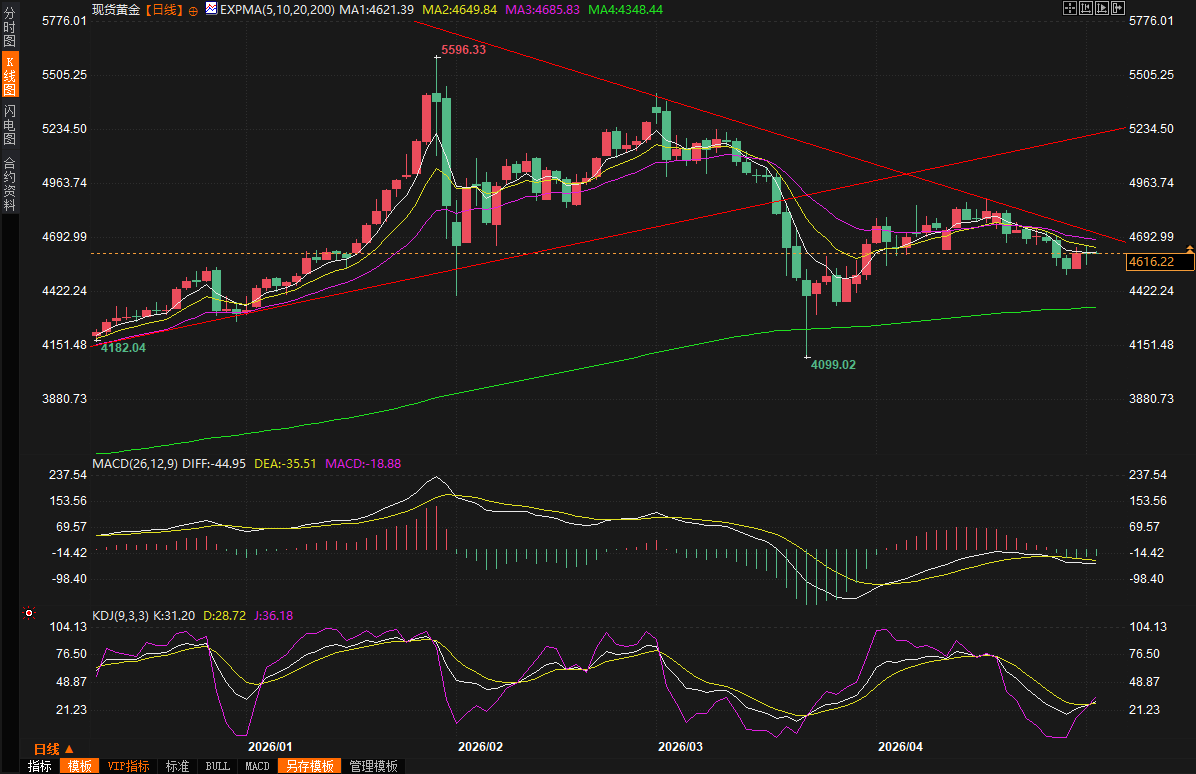
(Spot gold daily chart, source: FX678)
At 07:55 Beijing time, spot gold was trading at $4,616.34 per ounce.
A sudden easing of geopolitical tensions puts gold to a "false break" test.
Last Friday's gold market saw a scare for many bulls. Gold prices fell by more than 1% in early trading, quickly dropping to a low of $4,560. The trigger for this sell-off was Tehran's sudden submission of a new peace negotiation proposal to Pakistani mediators. This news quickly fueled market optimism about ending the war with Iran, and some of the funds that had previously flowed into gold due to safe-haven demand began to unwind.
However, to many people's surprise, gold did not plummet amid panic. Instead, it demonstrated remarkable resilience in the subsequent trading session, gradually recovering all lost ground and closing down only slightly by 0.12% at $4,616.13 per ounce. This "fall first, then rise, and close flat" trend precisely reflects the fact that the current market's pricing logic for gold has become exceptionally complex.
Chris Gaffney, President of Global Markets at EverBank, offered insightful commentary. He pointed out that positive news regarding negotiations to end the war with Iran did help gold recover from its early losses. However, his next statement was even more crucial: ending the war with Iran could prompt the Federal Reserve's Open Market Committee to resume interest rate cuts, leading to a depreciation of the dollar, which would be beneficial for gold prices.
This statement reveals a core contradiction in the current gold pricing mechanism. If geopolitical conflicts ease, short-term safe-haven demand will decrease, which is bearish for gold prices. However, if the easing of tensions allows the Federal Reserve room to cut interest rates, then in the medium to long term, a weaker dollar and lower real interest rates could become catalysts for a new round of gold price increases. Last Friday, the market clearly digested the impact of the first round of "safe-haven retreat" and quickly shifted its attention to this second logic.
The tug-of-war at the negotiating table reveals hidden motives in Trump's "cost" rhetoric.
If Friday's V-shaped reversal in gold prices already signaled a stalemate between bulls and bears, then the latest news over the weekend further exacerbated this uncertainty. Iran stated on Sunday that it had received a response from the United States to its latest peace talks proposal, but US President Trump's attitude was less than enthusiastic.
On Saturday (May 2), Trump made it clear on social media that he would soon review the plan proposed by Iran, but could not imagine it being accepted because Iran "has not paid a high enough price for what it has done to humanity and the world over the past 47 years." This strongly worded statement contrasted sharply with the market's previous optimism that negotiations might achieve a swift breakthrough.
Iran's 14-point proposal is quite extensive, including the withdrawal of US troops from the region surrounding Iran, lifting the blockade, unfreezing Iranian assets, paying compensation, lifting sanctions, ending the fighting on all fronts, including Lebanon, and establishing a new control mechanism for the Strait of Hormuz. More notably, Iran explicitly hopes to postpone nuclear negotiations to a later stage, prioritizing resolving the issues of ending the war and the shipping impasse.
Washington, on the other hand, has repeatedly demanded that Iran accept strict restrictions on its nuclear program until the war ends. The fundamental differences between the two sides on the negotiation framework mean that even with new proposals and responses, the road to a genuine agreement remains long and arduous.
Phil Flynn, senior analyst at Price Futures Group, put it bluntly: Iran's proposal gave the market hope that the US might have a way out. However, the existence of a way out and whether that way out is actually viable are two completely different things. This state of "hope existing but not yet realized" is precisely the environment gold prefers. It avoids triggering a full-blown safe-haven frenzy while continuously providing a floor for gold prices.
The dollar's initial decline followed by a rise, and the intriguing "two-way impact" on oil prices, are worth noting.
The foreign exchange market's movements last Friday were quite intriguing. The US dollar index fell to a near two-week low of 97.71, making dollar-denominated gold cheaper for buyers holding other currencies, thus contributing to gold's rebound. However, the dollar index recovered its losses in the late session, closing at 98.20, up 0.1%, which also caused gold prices to give back some of their gains in the final stages of the session.
The dollar's initial decline followed by a rise essentially reflects the market's fluctuating expectations regarding the Federal Reserve's policy path. If the situation in Iran truly eases, the likelihood of the Fed resuming interest rate cuts will indeed increase, which would be bearish for the dollar. However, on the other hand, if negotiations progress less than expected, or if Trump's hardline stance prevails, then safe-haven funds will flow back into the dollar.
Meanwhile, oil price performance also sent complex signals to the gold market. Oil prices plunged last Friday, with July Brent crude futures closing down 2.02% at $108.17 per barrel, and US crude futures falling by nearly 3%. The direct cause of the price drop was also Iran's negotiation proposal. However, it's worth noting that both Brent and US crude still recorded gains of over 8% this week, with the June Brent contract briefly touching $126.41 per barrel on Thursday, its highest level since March 2022.
This combination of a sharp single-day drop followed by a significant weekly gain indicates that the fundamental supply and demand dynamics of the crude oil market have not fundamentally changed. The Strait of Hormuz remains blocked, disrupting the transport of approximately one-fifth of the world's oil and liquefied natural gas supplies. The surge in oil prices at the beginning of the week already reflected deep market concerns about supply disruptions, while Friday's pullback was largely due to profit-taking and a recovery in sentiment.
For gold, oil price movements have a dual impact. On the one hand, falling oil prices help ease inflation expectations, potentially reducing gold's appeal as an inflation hedge. On the other hand, if oil prices are merely undergoing a technical adjustment due to negotiation expectations, but the actual supply disruptions remain unresolved, then inflationary pressures will inevitably return sooner or later. More importantly, the dampening effect of persistently high oil prices on the global economy is intensifying; this risk of stagflation is precisely a traditionally positive factor for gold.
The US military's "Operation Freedom" has begun, marking a new phase in the situation across the Taiwan Strait.
Amidst the ongoing negotiations, the United States is escalating its actions in the Strait of Hormuz. On Sunday (May 3), Trump announced that the U.S. would begin operations on Monday morning local time to assist in rescuing ships stranded in the Strait of Hormuz. Subsequently, the U.S. Central Command further clarified that this mission, codenamed "Operation Freedom of Navigation," would commence on May 4 and aims to restore freedom of navigation for commercial vessels in the Strait of Hormuz.
The military resources deployed in this operation are considerable, including guided-missile destroyers, over 100 land-based and sea-based aircraft, multi-domain unmanned platforms, and approximately 15,000 personnel. However, a crucial detail is worth noting: US officials subsequently clarified that the operation does not currently involve US Navy warships escorting ships through the strait, but rather aims to facilitate coordination of vessel passage among various countries, insurance companies, and shipping organizations.
This subtle stance of "showing force but not directly escorting ships" precisely reflects the current dilemma the United States faces regarding Iran. On the one hand, Trump faces immense domestic political pressure; rising gasoline prices have become a key issue influencing the midterm elections, necessitating action to blockade the Strait of Hormuz. On the other hand, direct military intervention carries extremely high risks, and any misstep could break the ceasefire that has lasted for nearly a month.
Iran's response was equally strong. Ibrahim Aziz, chairman of the National Security and Foreign Policy Committee of the Iranian Islamic Parliament, stated explicitly that any US interference in the "new maritime administration regime" in the Strait of Hormuz would be considered a violation of the ceasefire agreement. This means that even if the US military's "freedom of navigation operations" are conducted under the guise of coordinated passage, Iran could interpret them as provocative acts.
This situation of "escalating action but avoiding direct confrontation" actually creates a relatively favorable environment for gold. It neither triggers a full-blown military conflict nor truly de-escalates tensions, and gold often receives sustained support in this "unresolved" state.
Market sentiment is turning optimistic, but key data is on the horizon.
The latest market surveys show that both professional and retail investors are optimistic about gold's performance in the coming week. Kitco News' weekly gold survey indicates that of the 16 Wall Street analysts surveyed, 8 (50%) expect gold prices to rise, while only 5 are bearish. In contrast, among the 79 investors surveyed on Main Street, 36 (46%) believe gold prices will rise, while 30% are bearish.
This relatively optimistic sentiment is based on an important premise: the market believes that although the Iran negotiations have encountered setbacks, at least all parties are making efforts towards dialogue. At the same time, market expectations for a shift in Federal Reserve policy are gradually rising, providing macro-level support for gold.
However, it's important to be wary of the dense schedule of economic data releases coming week, which could significantly impact gold prices. Tuesday will see the release of the ISM Services PMI, and the market will be closely watching whether the services sector shows signs of weakness, similar to last Friday's manufacturing data. Wednesday's ADP employment report will provide forward guidance for Friday's main event—the April non-farm payrolls report. In addition, JOLTS job openings, weekly unemployment claims data, and the University of Michigan consumer sentiment index will also be released.
The importance of these data lies in the fact that they will largely determine whether the Federal Reserve has room to restart interest rate cuts this year. If the job market cools significantly or consumer confidence deteriorates, market expectations for rate cuts will further intensify, which would undoubtedly be beneficial for gold. Conversely, if the employment data continues to be resilient, the Fed may take a longer wait-and-see approach, and gold will face greater resistance to short-term price increases.
Conclusion: Gold stands at a crossroads; the struggle between two variables determines its direction.
In summary, the core pricing logic of the current gold market clearly focuses on two variables. The first is the trajectory of the situation in Iran, which determines how the tug-of-war between short-term safe-haven demand and medium- to long-term expectations of interest rate cuts will evolve. The second is the performance of US economic data, which determines the actual scope of the Federal Reserve's policy path.
In the short term, the strong buying interest in gold around $4,560 is a noteworthy technical signal. The fact that gold prices almost completely recovered from a drop of over 1% last Friday indicates that there is still ample buying interest at this level. However, gold prices also encountered significant resistance above $4,660, and the late-session pullback suggests that bulls are also showing some restraint at the current level.
This situation of "resistance above and support below" is likely to continue for some time. Negotiations with Iran will not be completed overnight; a significant gap exists between Trump's "cost-benefit" rhetoric and Iran's "ceasefire first, nuclear talks later" approach, meaning geopolitical uncertainty will persist. Meanwhile, fluctuations in US economic data will continuously revise market expectations regarding Federal Reserve policy.
For gold investors, the most important thing right now is to abandon the illusion of a "one-sided market" and accept the reality that the market will fluctuate repeatedly within a relatively wide range. The previous low near $4560 can serve as an important support reference area, while the $4660 to $4700 range constitutes a short-term resistance area. What could truly break this balance is either a substantial breakthrough or deterioration in the situation with Iran, or a significant change in US employment and inflation data that exceeds expectations.
Before that, gold is more likely to exhibit a "two steps forward, one step back" oscillating upward trend. Every pullback triggered by geopolitical news could become a new entry opportunity, while every surge driven by rising expectations of interest rate cuts should be watched for the risk of weaker-than-expected data. In this volatile time, maintaining flexibility and patience may be more important than simply betting on whether to go long or short.
(Spot gold daily chart, source: FX678)
At 07:55 Beijing time, spot gold was trading at $4,616.34 per ounce.
- Risk Warning and Disclaimer
- The market involves risk, and trading may not be suitable for all investors. This article is for reference only and does not constitute personal investment advice, nor does it take into account certain users’ specific investment objectives, financial situation, or other needs. Any investment decisions made based on this information are at your own risk.