Trump's dual pressure on Europe to take sides and the short-term rally in the dollar index cannot mask the long-term crisis.
2026-05-04 21:05:58
Trump used Europe's refusal to cooperate with the action against Iran as a pretext to exert pressure through a two-pronged approach: increasing the withdrawal of German troops and imposing a 25% tariff on EU automobiles. He both rebuilt his external deterrent prestige by adopting a strategic retrenchment posture and forced most NATO countries to compromise and open their military bases . Even though a few countries, such as Spain, stuck to their positions, he still successfully integrated European military resources, injecting more allied support into the Strait of Hormuz operation and the blockade of Iran, further amplifying the overall pressure effect on Iran .
European leaders collectively responded on Monday to the withdrawal of US troops from Germany, attempting to downplay the impact of the situation. However, the Trump administration's unexpected policy shift has put NATO in a passive position.
Just last week, the U.S. Department of Defense announced the withdrawal of 5,000 troops from Germany. On Saturday, Trump suddenly escalated the move, telling the media that "the withdrawal will be far more than 5,000 troops," without giving any official explanation. This unilateralist act caught the 32-nation military alliance off guard.
Trump's dual pressure campaign has finally yielded some results. NATO Secretary General Rutte stated clearly on May 4 that European countries have "grasped the message from Trump" and are fully implementing all bilateral troop deployment agreements, opening their bases and logistical support to the US military.
According to its disclosure, most NATO countries, including Montenegro, Croatia, Romania, Portugal, Greece, Italy, the United Kingdom, France, and Germany, have agreed to allow the US military to use its military bases to support operations related to Iraq.
At the same time, European countries also cooperated with the United States in "pre-deploying military assets such as minesweepers" near the Persian Gulf, paving the way for subsequent actions.
However, a few countries remain steadfast in their positions: Spain has consistently refused to allow the US military to use the Rota naval base and Moron de la Frontra air base to strike Iran, forcing US aircraft originally deployed in Spain to relocate to Germany and other locations; Italy has also not fully conceded, retaining restrictions on base use. It is worth noting that this is not the first time US pressure has been effective—in June 2025, under US pressure, the Danish parliament passed a bill allowing the US to establish military bases on its territory, further consolidating the US military presence in Europe.
In fact, this withdrawal is not an isolated incident, but a key step in the Trump 2.0 administration's strategic contraction of "focusing on the Western Hemisphere and building a larger Americas," which is underpinned by deep disagreements between the US and Europe on multiple issues.
On the one hand, the dispute between Trump and German Chancellor Merz over the US-Israel war against Iraq continues to escalate, with the US expressing deep dissatisfaction with the attitude of its European allies in refusing to get involved in the Middle East conflict;
On the other hand, core European countries such as France, Spain, and the United Kingdom have explicitly refused to allow the US military to use their bases and airspace to launch strikes against Iran, and have even refused to participate in the security and control of the Strait of Hormuz, which has isolated the Trump administration's Middle East strategy.
As a direct manifestation of the relative decline of global hegemony, the reduction of the United States' military presence in Europe was foreshadowed long ago.
According to a 2024 report by the Congressional Research Service, although the U.S. military still maintains at least 50 military bases in Europe, the withdrawal process has quietly begun since Trump took office again last year, with some U.S. troops withdrawing from Romania in October.
What is even more alarming is that the US had previously promised to coordinate troop withdrawal with NATO allies to avoid creating a regional security vacuum, but now it has unilaterally torn up the tacit agreement. This "act first, ask questions later" approach is essentially a blatant disregard for European security demands.
In addition to security pressure, the Trump administration also used trade as a tool to coerce Europe.
Following the security disagreements, Trump publicly accused the EU of failing to fulfill its obligations under the US-EU trade agreement and announced that starting next week, import tariffs on EU-made cars and trucks would be raised to 25%.
This move precisely targeted Germany, a pillar of the automotive industry, becoming another trigger for escalating tensions between the US and Germany. It also made Europe realize that, under the "America First" strategic framework, transatlantic alliances could give way to US domestic interests at any time.
Faced with dual pressure from the United States, Europe has been forced to accelerate its process of strategic autonomy.
Norwegian Prime Minister Støre stated that "Europe should assume more responsibility for its own security," while EU foreign policy chief Karas emphasized that "the European pillar within NATO must be strengthened."
NATO Secretary General Rutte attempted to downplay the impact, stating that Europe "has received signals from the United States" and revealing that European countries are prepositioning key military assets near the Middle East war zone, but provided no specific details, highlighting Europe's passivity and caution regarding its security autonomy.
European Commission President Ursula von der Leyen responded with concrete actions, highlighting the free trade agreements reached between the EU and Australia and India, as well as the progress of negotiations with Mexico, in an attempt to reduce over-reliance on the US market by building an independent free trade network.
European leaders view the Trump administration's sudden escalation of its troop withdrawal plan from Germany as a dual signal of the US's global strategic contraction and pressure on Europe. This not only exposes the rift in the transatlantic alliance but also means that Europe is forced to accelerate its process of strategic autonomy. Behind this geopolitical game, the core logic of the global foreign exchange market is being quietly reshaped, and the trend of the US dollar index is thus shrouded in complex variables.
In the short term, the geopolitical uncertainty caused by the United States' unilateral pressure and strategic retrenchment may provide temporary safe-haven support for the US dollar index; however, in the medium to long term, this practice of "abandoning allies to protect the homeland" is eroding the credibility of the US dollar.
Europe's accelerated process of strategic autonomy will inevitably be accompanied by a deep-seated "de-dollarization" strategy. Whether it is strengthening local currency settlement, reducing dollar asset allocation, or promoting diversified trade networks, all of these will weaken the dollar's dominant position in global trade and reserves.
As a core indicator reflecting the global credit of the US dollar, the long-term trend of the US dollar index may be under pressure. As the US strategic contraction evolves into systemic pressure on its allies, the US dollar's "safe asset" aura is fading, and this change will become the most noteworthy variable in the future foreign exchange market.
From a technical perspective, the US dollar index is fluctuating between 98.5 and 97.5, with an overall bearish trend and a resistance level around 98.47.
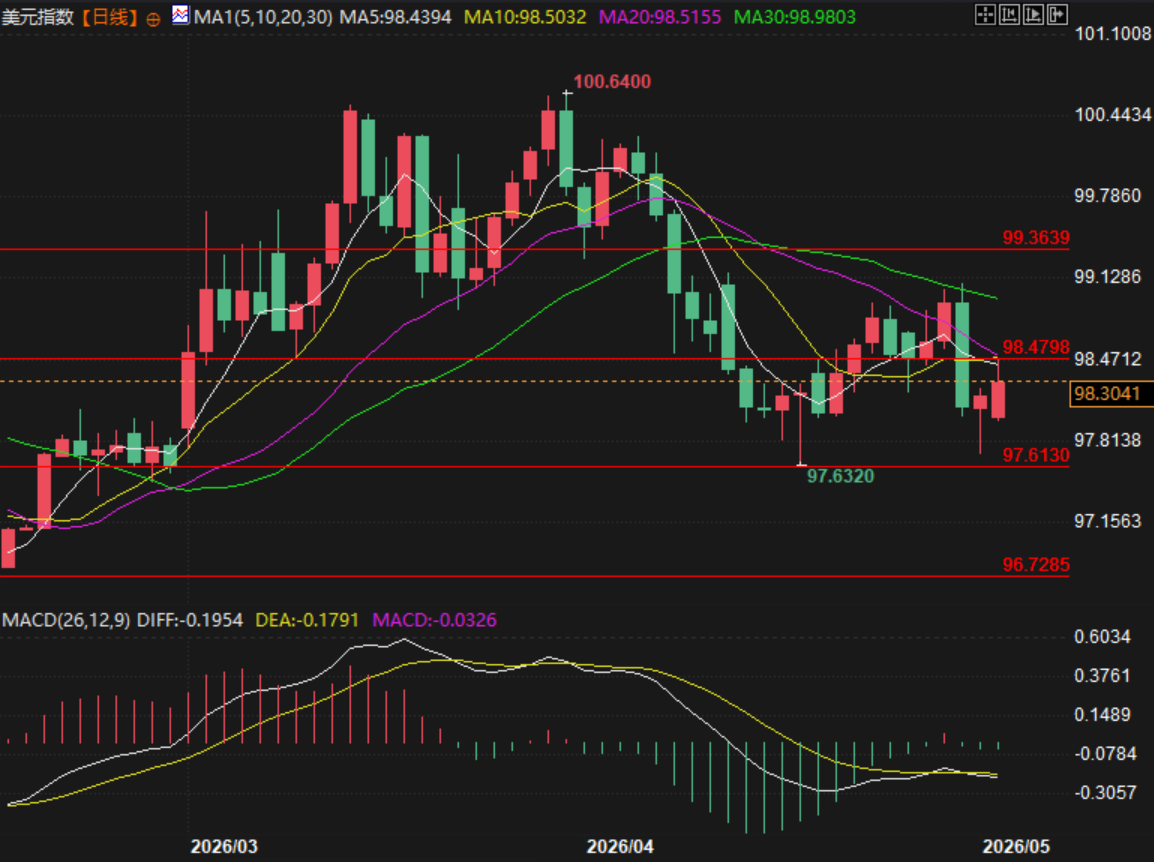
(US Dollar Index Daily Chart, Source: EasyForex)
At 21:02 Beijing time, the US dollar index is currently at 98.35.
Sudden Escalation of Troop Withdrawal: Trump's Unilateral Decision Caught NATO Off Guard
European leaders collectively responded on Monday to the withdrawal of US troops from Germany, attempting to downplay the impact of the situation. However, the Trump administration's unexpected policy shift has put NATO in a passive position.
Just last week, the U.S. Department of Defense announced the withdrawal of 5,000 troops from Germany. On Saturday, Trump suddenly escalated the move, telling the media that "the withdrawal will be far more than 5,000 troops," without giving any official explanation. This unilateralist act caught the 32-nation military alliance off guard.
Pressure Pays Off: Most European Countries Compromise, US Gains Access to Bases
Trump's dual pressure campaign has finally yielded some results. NATO Secretary General Rutte stated clearly on May 4 that European countries have "grasped the message from Trump" and are fully implementing all bilateral troop deployment agreements, opening their bases and logistical support to the US military.
According to its disclosure, most NATO countries, including Montenegro, Croatia, Romania, Portugal, Greece, Italy, the United Kingdom, France, and Germany, have agreed to allow the US military to use its military bases to support operations related to Iraq.
At the same time, European countries also cooperated with the United States in "pre-deploying military assets such as minesweepers" near the Persian Gulf, paving the way for subsequent actions.
However, a few countries remain steadfast in their positions: Spain has consistently refused to allow the US military to use the Rota naval base and Moron de la Frontra air base to strike Iran, forcing US aircraft originally deployed in Spain to relocate to Germany and other locations; Italy has also not fully conceded, retaining restrictions on base use. It is worth noting that this is not the first time US pressure has been effective—in June 2025, under US pressure, the Danish parliament passed a bill allowing the US to establish military bases on its territory, further consolidating the US military presence in Europe.
Behind the contraction: Multiple differences between the US and Europe and a shift in US strategy
In fact, this withdrawal is not an isolated incident, but a key step in the Trump 2.0 administration's strategic contraction of "focusing on the Western Hemisphere and building a larger Americas," which is underpinned by deep disagreements between the US and Europe on multiple issues.
On the one hand, the dispute between Trump and German Chancellor Merz over the US-Israel war against Iraq continues to escalate, with the US expressing deep dissatisfaction with the attitude of its European allies in refusing to get involved in the Middle East conflict;
On the other hand, core European countries such as France, Spain, and the United Kingdom have explicitly refused to allow the US military to use their bases and airspace to launch strikes against Iran, and have even refused to participate in the security and control of the Strait of Hormuz, which has isolated the Trump administration's Middle East strategy.
As a direct manifestation of the relative decline of global hegemony, the reduction of the United States' military presence in Europe was foreshadowed long ago.
According to a 2024 report by the Congressional Research Service, although the U.S. military still maintains at least 50 military bases in Europe, the withdrawal process has quietly begun since Trump took office again last year, with some U.S. troops withdrawing from Romania in October.
What is even more alarming is that the US had previously promised to coordinate troop withdrawal with NATO allies to avoid creating a regional security vacuum, but now it has unilaterally torn up the tacit agreement. This "act first, ask questions later" approach is essentially a blatant disregard for European security demands.
Trade coercion escalates: 25% tariffs precisely target Germany's vulnerabilities
In addition to security pressure, the Trump administration also used trade as a tool to coerce Europe.
Following the security disagreements, Trump publicly accused the EU of failing to fulfill its obligations under the US-EU trade agreement and announced that starting next week, import tariffs on EU-made cars and trucks would be raised to 25%.
This move precisely targeted Germany, a pillar of the automotive industry, becoming another trigger for escalating tensions between the US and Germany. It also made Europe realize that, under the "America First" strategic framework, transatlantic alliances could give way to US domestic interests at any time.
Europe is forced to retaliate: accelerating strategic autonomy and diversification.
Faced with dual pressure from the United States, Europe has been forced to accelerate its process of strategic autonomy.
Norwegian Prime Minister Støre stated that "Europe should assume more responsibility for its own security," while EU foreign policy chief Karas emphasized that "the European pillar within NATO must be strengthened."
NATO Secretary General Rutte attempted to downplay the impact, stating that Europe "has received signals from the United States" and revealing that European countries are prepositioning key military assets near the Middle East war zone, but provided no specific details, highlighting Europe's passivity and caution regarding its security autonomy.
European Commission President Ursula von der Leyen responded with concrete actions, highlighting the free trade agreements reached between the EU and Australia and India, as well as the progress of negotiations with Mexico, in an attempt to reduce over-reliance on the US market by building an independent free trade network.
Summary and Technical Analysis
European leaders view the Trump administration's sudden escalation of its troop withdrawal plan from Germany as a dual signal of the US's global strategic contraction and pressure on Europe. This not only exposes the rift in the transatlantic alliance but also means that Europe is forced to accelerate its process of strategic autonomy. Behind this geopolitical game, the core logic of the global foreign exchange market is being quietly reshaped, and the trend of the US dollar index is thus shrouded in complex variables.
In the short term, the geopolitical uncertainty caused by the United States' unilateral pressure and strategic retrenchment may provide temporary safe-haven support for the US dollar index; however, in the medium to long term, this practice of "abandoning allies to protect the homeland" is eroding the credibility of the US dollar.
Europe's accelerated process of strategic autonomy will inevitably be accompanied by a deep-seated "de-dollarization" strategy. Whether it is strengthening local currency settlement, reducing dollar asset allocation, or promoting diversified trade networks, all of these will weaken the dollar's dominant position in global trade and reserves.
As a core indicator reflecting the global credit of the US dollar, the long-term trend of the US dollar index may be under pressure. As the US strategic contraction evolves into systemic pressure on its allies, the US dollar's "safe asset" aura is fading, and this change will become the most noteworthy variable in the future foreign exchange market.
From a technical perspective, the US dollar index is fluctuating between 98.5 and 97.5, with an overall bearish trend and a resistance level around 98.47.
(US Dollar Index Daily Chart, Source: EasyForex)
At 21:02 Beijing time, the US dollar index is currently at 98.35.
- Risk Warning and Disclaimer
- The market involves risk, and trading may not be suitable for all investors. This article is for reference only and does not constitute personal investment advice, nor does it take into account certain users’ specific investment objectives, financial situation, or other needs. Any investment decisions made based on this information are at your own risk.