













Is Trump wielding the tariff stick again? What will happen to the Euro?
2026-05-04 21:31:01
On Monday, May 4th, the euro traded around 1.170 against the US dollar during the North American session. The Bollinger Band middle line at 1.1679 provided a short-term equilibrium reference, while the upper band at 1.1869 and the lower band at 1.1489 formed a trading range. Last Friday, US President Trump announced that if the EU did not fulfill its obligations under last year's agreement, he would impose a 25% tariff on EU cars and trucks next week, directly pushing up market pricing in an escalation of trade tensions. Meanwhile, the Eurozone's economic confidence index fell to a five-year low in April, and consumer confidence hit a three-year low. Although first-quarter GDP grew slightly by 0.1% quarter-on-quarter, signs of tightening domestic demand and credit conditions were evident. There is widespread pressure within the EU to expedite the implementation of the EU-side provisions of last year's agreement to mitigate the tariff threat.
Representatives from several EU governments and parliaments have reached a consensus to restart negotiations on Wednesday and finalize legislation this month to reduce tariffs on US industrial goods while including multiple safeguard measures. Trump's remarks on Friday stemmed from the EU's continued imposition of tariffs on US industrial goods for nine months, leading to an implementation deadlock in the agreement reached in Scotland last July. German Chancellor Friedrich Merz publicly stated that "the US is ready, Europe is not," and called for a swift agreement, as the German auto industry will be the first to suffer. Manfred Weber, leader of the European People's Party, emphasized that negotiations must be completed quickly so that the European Parliament can grant final approval this month. Trade Commission President Bernd Lange bluntly stated that Trump's actions were "unacceptable" and insisted on introducing safeguard measures to protect EU interests. Ignacio García Becero, a researcher at the Bruegel Institute, pointed out that the tariff threat is partly a pressure tactic, and the EU should not make hasty concessions, otherwise it could trigger unnecessary escalation.
These developments directly impact the euro's valuation through trade channels. The automotive and related supply chains account for a significant share of EU exports to the US; tariff increases will raise costs for European companies, compress profit margins, and thus weaken the support of the current account surplus for the euro. A swift agreement could lower market risk premiums and boost the euro; conversely, delays or escalations would amplify exchange rate volatility. Currently, market focus is on Wednesday's negotiation outcome; any substantial progress will alter risk pricing.
Economists at Societe Generale pointed out that business and consumer confidence both declined more than expected in April, with the Committee's economic confidence index hitting a five-year low and the consumer index falling to a three-year low. This contrasts sharply with the first-quarter GDP data: the Eurozone as a whole grew by 0.1% quarter-on-quarter, Germany by 0.3%, Spain by 0.6%, Italy by 0.2%, France by zero growth, and Ireland by a 2% contraction. The weakening confidence mainly stemmed from tighter credit conditions and uncertainty in external demand, but this did not immediately translate into actual output. Household and corporate balance sheets remain healthy, providing a buffer against a potential slowdown; investment in artificial intelligence, energy transition, and defense remains positive, and Germany's fiscal stimulus measures have further enhanced its resilience.
However, if confidence remains weak, retail sales and services PMIs may weaken further in the second quarter, putting greater pressure on domestic demand. In contrast, against the backdrop of diverging global growth, the Eurozone's open economy makes it more sensitive to external shocks. The European Central Bank's policy path may therefore become more cautious, and adjustments in interest rate expectations will affect the attractiveness of euro assets. Traders are continuously monitoring the final May PMI and German factory orders data to determine whether resilience can withstand the spillover effects of declining confidence.
Comparison of first-quarter GDP growth data of major Eurozone economies
The daily chart shows that the euro fell from a previous high of 1.200 to a low of 1.1410 against the US dollar, then rebounded, reaching a high of 1.1848 before profit-taking occurred, and it is currently trading around 1.170. The Bollinger Bands (26,2) form a clear channel with the middle band at 1.1679, the upper band at 1.1869, and the lower band at 1.1489. The price is slightly above the middle band, and the channel width shows signs of narrowing, suggesting a possible decrease in short-term volatility. The MACD (26,12,9) indicator shows DIFF 0.0020, DEA 0.0025, and MACD histogram -0.0011. Although the momentum is in positive territory, the histogram is negative, indicating a weakening of bullish momentum.
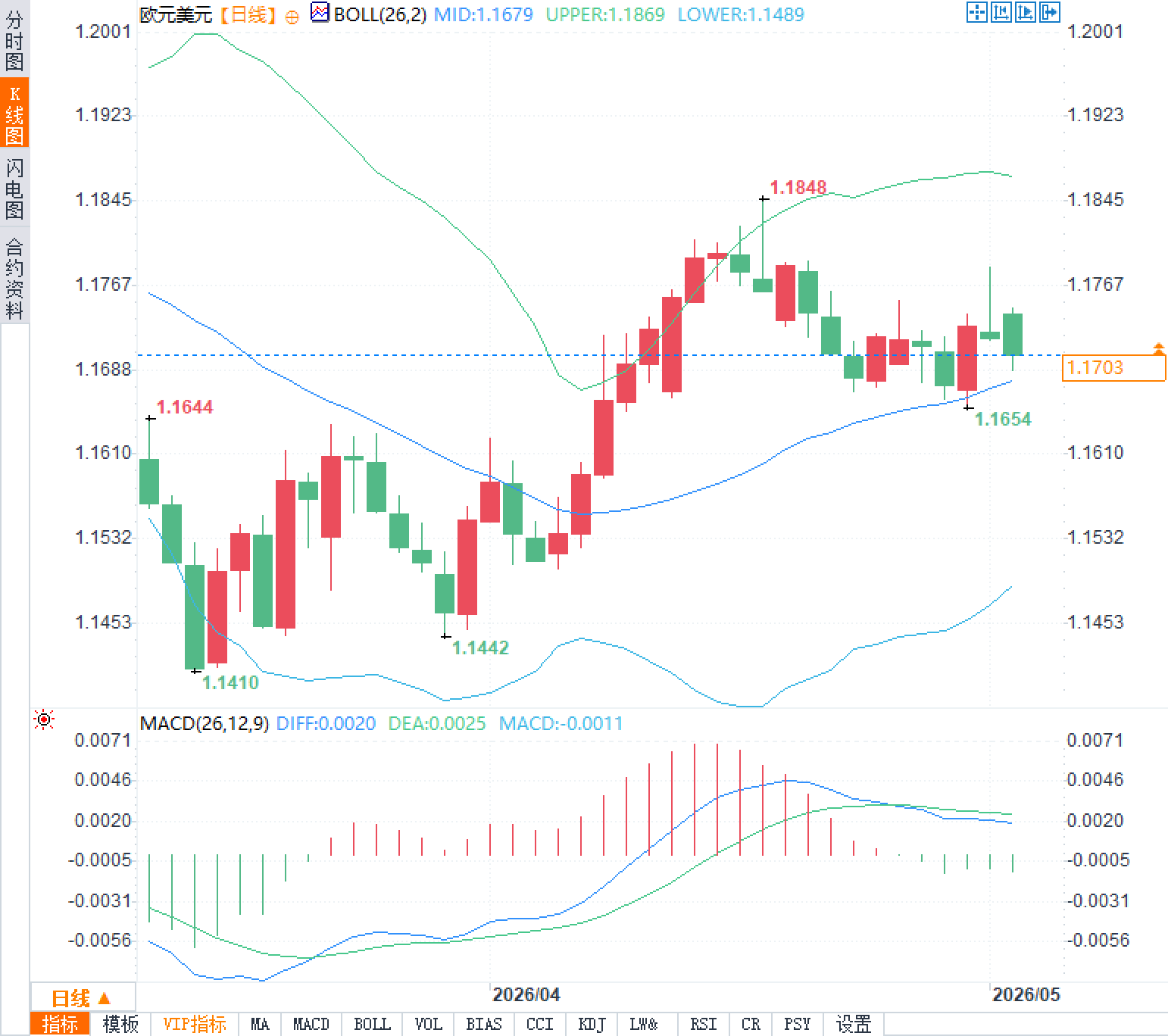
Regarding key price levels, 1.1654 provides short-term support; a break below this level could lead to a test of the lower Bollinger Band at 1.1489. Resistance is concentrated at 1.1848 and the upper Bollinger Band at 1.1869. Recent candlestick patterns show alternating bullish and bearish movements, with intertwined red and green bars reflecting increasing market divergence. If the price fails to effectively hold above the middle Bollinger Band, the risk of a pullback will increase. The overall pattern remains range-bound, and fundamental developments will be the key variable breaking the equilibrium.
In the current environment, the euro's position is constrained by trade policy, regional growth resilience, and global risk appetite. If accelerated legislation within the EU is successful, it will reduce the pressure on exporters from tariff uncertainty, benefiting euro-denominated assets; conversely, delays will weaken current account performance through cost channels. A healthy balance sheet and structural investments (artificial intelligence, energy, defense) in the Eurozone provide a medium- to long-term buffer, but if low confidence continues to spill over into actual demand, second-quarter growth may face downside risks.
The Federal Reserve's policy path and the dollar index's range-bound movement will continue to be external variables. Any better-than-expected US data could maintain the dollar's relative strength, indirectly suppressing the euro against the dollar. Traders are closely watching Wednesday's negotiations and May's PMI data; the speed of trade agreement implementation and the extent of confidence data recovery will jointly determine the euro's medium-term trend.
Risks of escalating trade frictions and the EU's response strategy
Representatives from several EU governments and parliaments have reached a consensus to restart negotiations on Wednesday and finalize legislation this month to reduce tariffs on US industrial goods while including multiple safeguard measures. Trump's remarks on Friday stemmed from the EU's continued imposition of tariffs on US industrial goods for nine months, leading to an implementation deadlock in the agreement reached in Scotland last July. German Chancellor Friedrich Merz publicly stated that "the US is ready, Europe is not," and called for a swift agreement, as the German auto industry will be the first to suffer. Manfred Weber, leader of the European People's Party, emphasized that negotiations must be completed quickly so that the European Parliament can grant final approval this month. Trade Commission President Bernd Lange bluntly stated that Trump's actions were "unacceptable" and insisted on introducing safeguard measures to protect EU interests. Ignacio García Becero, a researcher at the Bruegel Institute, pointed out that the tariff threat is partly a pressure tactic, and the EU should not make hasty concessions, otherwise it could trigger unnecessary escalation.
These developments directly impact the euro's valuation through trade channels. The automotive and related supply chains account for a significant share of EU exports to the US; tariff increases will raise costs for European companies, compress profit margins, and thus weaken the support of the current account surplus for the euro. A swift agreement could lower market risk premiums and boost the euro; conversely, delays or escalations would amplify exchange rate volatility. Currently, market focus is on Wednesday's negotiation outcome; any substantial progress will alter risk pricing.
The deeper implications of weak confidence data in the Eurozone
Economists at Societe Generale pointed out that business and consumer confidence both declined more than expected in April, with the Committee's economic confidence index hitting a five-year low and the consumer index falling to a three-year low. This contrasts sharply with the first-quarter GDP data: the Eurozone as a whole grew by 0.1% quarter-on-quarter, Germany by 0.3%, Spain by 0.6%, Italy by 0.2%, France by zero growth, and Ireland by a 2% contraction. The weakening confidence mainly stemmed from tighter credit conditions and uncertainty in external demand, but this did not immediately translate into actual output. Household and corporate balance sheets remain healthy, providing a buffer against a potential slowdown; investment in artificial intelligence, energy transition, and defense remains positive, and Germany's fiscal stimulus measures have further enhanced its resilience.
However, if confidence remains weak, retail sales and services PMIs may weaken further in the second quarter, putting greater pressure on domestic demand. In contrast, against the backdrop of diverging global growth, the Eurozone's open economy makes it more sensitive to external shocks. The European Central Bank's policy path may therefore become more cautious, and adjustments in interest rate expectations will affect the attractiveness of euro assets. Traders are continuously monitoring the final May PMI and German factory orders data to determine whether resilience can withstand the spillover effects of declining confidence.
Comparison of first-quarter GDP growth data of major Eurozone economies
| Country/Region | growth rate | Main driver or drag |
|---|---|---|
| Eurozone as a whole | 0.1% | Slightly below expectations, domestic demand remains weak. |
| Germany | 0.3% | Automotive and Industrial Support |
| Spain | 0.6% | Tourism consumption boost |
| Italy | 0.2% | Mild recovery |
| France | 0.0% | Stagnation, weak domestic demand |
| Ireland | -2.0% | Cardinal effect and contraction |
Technical Indicators and Price Trend Analysis
The daily chart shows that the euro fell from a previous high of 1.200 to a low of 1.1410 against the US dollar, then rebounded, reaching a high of 1.1848 before profit-taking occurred, and it is currently trading around 1.170. The Bollinger Bands (26,2) form a clear channel with the middle band at 1.1679, the upper band at 1.1869, and the lower band at 1.1489. The price is slightly above the middle band, and the channel width shows signs of narrowing, suggesting a possible decrease in short-term volatility. The MACD (26,12,9) indicator shows DIFF 0.0020, DEA 0.0025, and MACD histogram -0.0011. Although the momentum is in positive territory, the histogram is negative, indicating a weakening of bullish momentum.
Regarding key price levels, 1.1654 provides short-term support; a break below this level could lead to a test of the lower Bollinger Band at 1.1489. Resistance is concentrated at 1.1848 and the upper Bollinger Band at 1.1869. Recent candlestick patterns show alternating bullish and bearish movements, with intertwined red and green bars reflecting increasing market divergence. If the price fails to effectively hold above the middle Bollinger Band, the risk of a pullback will increase. The overall pattern remains range-bound, and fundamental developments will be the key variable breaking the equilibrium.
Combined Impact of Macroeconomic Factors and Future Outlook
In the current environment, the euro's position is constrained by trade policy, regional growth resilience, and global risk appetite. If accelerated legislation within the EU is successful, it will reduce the pressure on exporters from tariff uncertainty, benefiting euro-denominated assets; conversely, delays will weaken current account performance through cost channels. A healthy balance sheet and structural investments (artificial intelligence, energy, defense) in the Eurozone provide a medium- to long-term buffer, but if low confidence continues to spill over into actual demand, second-quarter growth may face downside risks.
The Federal Reserve's policy path and the dollar index's range-bound movement will continue to be external variables. Any better-than-expected US data could maintain the dollar's relative strength, indirectly suppressing the euro against the dollar. Traders are closely watching Wednesday's negotiations and May's PMI data; the speed of trade agreement implementation and the extent of confidence data recovery will jointly determine the euro's medium-term trend.
- Risk Warning and Disclaimer
- The market involves risk, and trading may not be suitable for all investors. This article is for reference only and does not constitute personal investment advice, nor does it take into account certain users’ specific investment objectives, financial situation, or other needs. Any investment decisions made based on this information are at your own risk.

