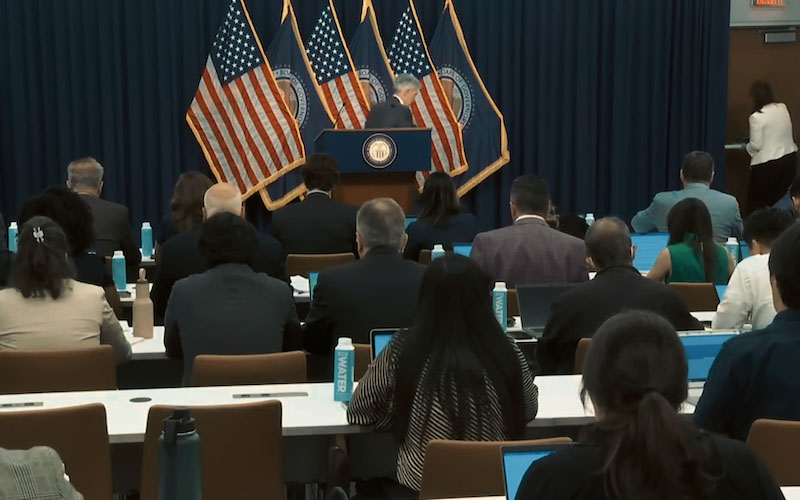
Federal Reserve's "number three" official, Williams, stated that policy is ready to address war uncertainty, and interest rate cuts should wait for inflation to ease.
2026-05-05 08:49:40
Williams, the third-ranking official at the Federal Reserve and president of the New York Fed, stated publicly on Monday (May 4th) that the Federal Reserve's monetary policy is currently well-positioned to address the high level of economic uncertainty caused by the wars in the Middle East. He also pointed out that once the current short-term surge in inflation is effectively contained, the Fed can refocus its attention on lowering interest rates. This statement, Williams' first public response since the Fed decided last week to maintain interest rates, reveals the policymakers' wait-and-see approach while having contingency plans in place amidst the complex situation.
In prepared remarks for a conference in New York City, Williams acknowledged that the outlook for the economy is quite uncertain, and that the risks to the Federal Reserve’s two core missions—stabilizing prices and maximizing employment—have both increased significantly in their respective directions.
He further explained that the extent and duration of the energy supply disruptions caused by the Middle East conflict, and the resulting rise in energy prices, will be key variables shaping the future global economic outlook. Currently, high inflationary pressures, a mixed job market, and the continued uncertainty brought about by the war together constitute "a series of unusual circumstances" facing Federal Reserve policymakers.
When discussing the specific direction of monetary policy, Williams told reporters that given the various uncertainties in the current environment, the Federal Reserve is unable to provide clear advance guidance on the direction of interest rate adjustments in the next few policy meetings.
However, he also reassured the market, emphasizing that based on any data he currently has, there are no signs of a need for an interest rate hike in the near future. In other words, despite persistently high inflation, raising interest rates is not yet a practical option for policymakers.
Regarding the domestic economic situation in the United States, Williams offered a relatively stable forecast. He believes that assuming the job market remains largely stable, economic growth this year will demonstrate considerable resilience, with the growth rate expected to remain between 2% and 2.5%. Meanwhile, the unemployment rate is expected to remain stable within the range of 4.25% to 4.5%. These figures indicate that despite ongoing external shocks, the endogenous growth momentum of the US economy has not been fundamentally weakened.
Regarding inflation, Williams predicts that due to the combined effects of tariffs and rising energy costs, the US inflation rate is likely to remain around 3% this year before gradually falling back to the Fed's long-term target of 2%.
He added that market inflation expectations are currently largely stable, but also warned that energy price increases could exceed current mainstream expectations. Therefore, policymakers need to remain patient and vigilant regarding the speed and path of the inflation decline.
Williams paid particular attention to developments in the energy market. He pointed out that market expectations for future oil price movements are relatively mild; however, under several possible scenarios, both oil prices and supply could experience more dramatic fluctuations than currently anticipated.
He further warned that Iran's involvement in war—a geopolitical variable—could trigger a larger and broader supply shock, thereby causing a more severe negative drag on global inflation and economic activity. This assessment suggests that risks on the energy side remain one of the biggest sources of uncertainty in the future path of monetary policy.
In last week's Federal Reserve interest rate decision, while the three regional Federal Reserve bank presidents supported the decision to keep interest rates unchanged, they voted against retaining the policy inclination to "lower borrowing costs in the next step" in the monetary policy statement.
In response, Williams stated that it is natural and normal for policymakers to have more differing opinions during a period of uncertainty and dramatic change.
However, he emphasized that although some members opposed maintaining the accommodative policy stance, the consensus within the Federal Reserve regarding the overall policy direction is actually far greater than the disagreements revealed by the voting results.
Williams himself fully supports the existing policy wording, noting that the outlook for interest rates in the statement outlines "a general profile between current interest rate levels and his personal expectations." He reiterated that the Fed will indeed need to cut rates at some point in the future as price pressures gradually return to target levels.
In a public speech in early May 2026, New York Fed President Williams systematically elaborated on the Fed's policy stance in the face of multiple pressures, including the Middle East war, energy price volatility, persistent inflation, and mixed signals from the job market.
Key messages include: current interest rates are considered sufficient to manage uncertainty; no clear forward guidance on interest rates can be provided in the short term, but rate hikes are not under consideration in the near term; inflation is expected to remain around 3% this year, and rate cuts will require easing inflationary pressures; there are unexpected downside risks in the energy market; and despite some internal dissent, consensus on the general direction of monetary policy remains strong. Overall, the Federal Reserve remains in a typical wait-and-see mode, and the key trigger for a policy shift will be whether inflation can sustainably decline from its current high levels.
Question 1: What exactly does Williams mean by "the risks to both missions have increased"?
Answer: The Federal Reserve's two missions are to control inflation and achieve maximum employment. Williams believes that the risks in both areas are increasing: On the inflation front, the Middle East wars have led to energy supply disruptions and price increases, coupled with the impact of tariffs, making inflationary pressures more persistent than expected and deviating from the 2% target; on the employment front, soaring energy prices could dampen demand from businesses and consumers, thereby dragging down economic activity and posing a downside risk to the job market. Therefore, the risks in both directions are widening, making the Fed's decision-making more difficult.
Question 2: Why is the Federal Reserve neither committing to cutting interest rates nor considering raising them at present?
Answer: This "wait-and-see" stance stems from the extreme uncertainty of the current economic environment. On the one hand, the inflation rate remains around 3%, above the target, and may continue to rise due to factors such as war and energy, theoretically requiring interest rate hikes to suppress it; but on the other hand, raising interest rates would further suppress economic activity and exacerbate potential risks in the job market. Meanwhile, Williams stated that he saw no signals of a near-term need for a rate hike, indicating that policymakers believe the current interest rate level is sufficiently restrictive. Given the uncertainty of the future situation, the Federal Reserve can only maintain the current interest rate for now, awaiting clearer data signals.
Question 3: What conditions does Williams believe need to be met for interest rate cuts?
Answer: Williams clearly stated that once the current surge in inflation eases, the Federal Reserve can refocus its attention on lowering interest rates. This means that a rate cut is contingent on inflation significantly declining and consistently moving towards the long-term target of 2%. He predicts that inflation will remain around 3% this year before gradually declining, so a rate cut is unlikely to happen anytime soon. Furthermore, the stability of the job market will also affect the timing of rate cuts—if employment deteriorates significantly, the Fed may ease policy earlier, but Williams currently assesses the employment situation as "basically stable."
Question 4: Through what specific channels do the Middle East wars affect the Federal Reserve's decision-making?
Answer: According to Williams' analysis, the Middle East war primarily affects the US economy and monetary policy through two channels. First, the energy price channel: the conflict leads to disruptions in oil supply, and especially if the Strait of Hormuz is closed, energy prices will surge, directly pushing up inflation. Second, the demand and employment channel: high energy prices will suppress consumer and business spending, thereby dragging down economic growth and posing risks to the job market. Williams specifically warned that Iran's involvement in the war could trigger a larger-scale supply shock, meaning that the uncertainty of the war is the fundamental reason why the Federal Reserve is currently unable to provide clear interest rate guidance.
Question 5: Does the division within the Federal Reserve mean that there may be a major shift in policy direction?
Answer: Williams believes the extent of the disagreement is exaggerated by appearances. Last week, three regional Fed presidents objected to retaining the phrase "a possible next step" in the statement, but this only reflects differing opinions on the specific wording of the policy inclination, not a fundamental rejection of the overall interest rate level or direction. Williams emphasizes that the current consensus on policy direction is far greater than the voting results suggest. In other words, the vast majority of policymakers agree to maintain the current interest rate and remain on the sidelines; whether future rate cuts or further increases occur are merely subtle differences in wording, not a split in the core policy direction. Therefore, investors should not overinterpret these individual internal disagreements.
The risks associated with dual missions are rising simultaneously.
In prepared remarks for a conference in New York City, Williams acknowledged that the outlook for the economy is quite uncertain, and that the risks to the Federal Reserve’s two core missions—stabilizing prices and maximizing employment—have both increased significantly in their respective directions.
He further explained that the extent and duration of the energy supply disruptions caused by the Middle East conflict, and the resulting rise in energy prices, will be key variables shaping the future global economic outlook. Currently, high inflationary pressures, a mixed job market, and the continued uncertainty brought about by the war together constitute "a series of unusual circumstances" facing Federal Reserve policymakers.
Interest Rate Outlook: No clear guidance in the short term, interest rate hikes not yet on the agenda
When discussing the specific direction of monetary policy, Williams told reporters that given the various uncertainties in the current environment, the Federal Reserve is unable to provide clear advance guidance on the direction of interest rate adjustments in the next few policy meetings.
However, he also reassured the market, emphasizing that based on any data he currently has, there are no signs of a need for an interest rate hike in the near future. In other words, despite persistently high inflation, raising interest rates is not yet a practical option for policymakers.
Economic fundamentals assessment: Growth remains resilient, and the job market remains generally stable.
Regarding the domestic economic situation in the United States, Williams offered a relatively stable forecast. He believes that assuming the job market remains largely stable, economic growth this year will demonstrate considerable resilience, with the growth rate expected to remain between 2% and 2.5%. Meanwhile, the unemployment rate is expected to remain stable within the range of 4.25% to 4.5%. These figures indicate that despite ongoing external shocks, the endogenous growth momentum of the US economy has not been fundamentally weakened.
Inflation trend: It will remain around 3% throughout the year; a decline will require patience.
Regarding inflation, Williams predicts that due to the combined effects of tariffs and rising energy costs, the US inflation rate is likely to remain around 3% this year before gradually falling back to the Fed's long-term target of 2%.
He added that market inflation expectations are currently largely stable, but also warned that energy price increases could exceed current mainstream expectations. Therefore, policymakers need to remain patient and vigilant regarding the speed and path of the inflation decline.
Potential shocks to the energy market: Market expectations are optimistic, but risks cannot be ignored.
Williams paid particular attention to developments in the energy market. He pointed out that market expectations for future oil price movements are relatively mild; however, under several possible scenarios, both oil prices and supply could experience more dramatic fluctuations than currently anticipated.
He further warned that Iran's involvement in war—a geopolitical variable—could trigger a larger and broader supply shock, thereby causing a more severe negative drag on global inflation and economic activity. This assessment suggests that risks on the energy side remain one of the biggest sources of uncertainty in the future path of monetary policy.
Differences and Consensus within the Federal Reserve: Beneath the apparent disagreements, the mainstream direction remains intact.
In last week's Federal Reserve interest rate decision, while the three regional Federal Reserve bank presidents supported the decision to keep interest rates unchanged, they voted against retaining the policy inclination to "lower borrowing costs in the next step" in the monetary policy statement.
In response, Williams stated that it is natural and normal for policymakers to have more differing opinions during a period of uncertainty and dramatic change.
However, he emphasized that although some members opposed maintaining the accommodative policy stance, the consensus within the Federal Reserve regarding the overall policy direction is actually far greater than the disagreements revealed by the voting results.
Williams himself fully supports the existing policy wording, noting that the outlook for interest rates in the statement outlines "a general profile between current interest rate levels and his personal expectations." He reiterated that the Fed will indeed need to cut rates at some point in the future as price pressures gradually return to target levels.
Editor's Summary
In a public speech in early May 2026, New York Fed President Williams systematically elaborated on the Fed's policy stance in the face of multiple pressures, including the Middle East war, energy price volatility, persistent inflation, and mixed signals from the job market.
Key messages include: current interest rates are considered sufficient to manage uncertainty; no clear forward guidance on interest rates can be provided in the short term, but rate hikes are not under consideration in the near term; inflation is expected to remain around 3% this year, and rate cuts will require easing inflationary pressures; there are unexpected downside risks in the energy market; and despite some internal dissent, consensus on the general direction of monetary policy remains strong. Overall, the Federal Reserve remains in a typical wait-and-see mode, and the key trigger for a policy shift will be whether inflation can sustainably decline from its current high levels.
Frequently Asked Questions
Question 1: What exactly does Williams mean by "the risks to both missions have increased"?
Answer: The Federal Reserve's two missions are to control inflation and achieve maximum employment. Williams believes that the risks in both areas are increasing: On the inflation front, the Middle East wars have led to energy supply disruptions and price increases, coupled with the impact of tariffs, making inflationary pressures more persistent than expected and deviating from the 2% target; on the employment front, soaring energy prices could dampen demand from businesses and consumers, thereby dragging down economic activity and posing a downside risk to the job market. Therefore, the risks in both directions are widening, making the Fed's decision-making more difficult.
Question 2: Why is the Federal Reserve neither committing to cutting interest rates nor considering raising them at present?
Answer: This "wait-and-see" stance stems from the extreme uncertainty of the current economic environment. On the one hand, the inflation rate remains around 3%, above the target, and may continue to rise due to factors such as war and energy, theoretically requiring interest rate hikes to suppress it; but on the other hand, raising interest rates would further suppress economic activity and exacerbate potential risks in the job market. Meanwhile, Williams stated that he saw no signals of a near-term need for a rate hike, indicating that policymakers believe the current interest rate level is sufficiently restrictive. Given the uncertainty of the future situation, the Federal Reserve can only maintain the current interest rate for now, awaiting clearer data signals.
Question 3: What conditions does Williams believe need to be met for interest rate cuts?
Answer: Williams clearly stated that once the current surge in inflation eases, the Federal Reserve can refocus its attention on lowering interest rates. This means that a rate cut is contingent on inflation significantly declining and consistently moving towards the long-term target of 2%. He predicts that inflation will remain around 3% this year before gradually declining, so a rate cut is unlikely to happen anytime soon. Furthermore, the stability of the job market will also affect the timing of rate cuts—if employment deteriorates significantly, the Fed may ease policy earlier, but Williams currently assesses the employment situation as "basically stable."
Question 4: Through what specific channels do the Middle East wars affect the Federal Reserve's decision-making?
Answer: According to Williams' analysis, the Middle East war primarily affects the US economy and monetary policy through two channels. First, the energy price channel: the conflict leads to disruptions in oil supply, and especially if the Strait of Hormuz is closed, energy prices will surge, directly pushing up inflation. Second, the demand and employment channel: high energy prices will suppress consumer and business spending, thereby dragging down economic growth and posing risks to the job market. Williams specifically warned that Iran's involvement in the war could trigger a larger-scale supply shock, meaning that the uncertainty of the war is the fundamental reason why the Federal Reserve is currently unable to provide clear interest rate guidance.
Question 5: Does the division within the Federal Reserve mean that there may be a major shift in policy direction?
Answer: Williams believes the extent of the disagreement is exaggerated by appearances. Last week, three regional Fed presidents objected to retaining the phrase "a possible next step" in the statement, but this only reflects differing opinions on the specific wording of the policy inclination, not a fundamental rejection of the overall interest rate level or direction. Williams emphasizes that the current consensus on policy direction is far greater than the voting results suggest. In other words, the vast majority of policymakers agree to maintain the current interest rate and remain on the sidelines; whether future rate cuts or further increases occur are merely subtle differences in wording, not a split in the core policy direction. Therefore, investors should not overinterpret these individual internal disagreements.
- Risk Warning and Disclaimer
- The market involves risk, and trading may not be suitable for all investors. This article is for reference only and does not constitute personal investment advice, nor does it take into account certain users’ specific investment objectives, financial situation, or other needs. Any investment decisions made based on this information are at your own risk.