Warning! Jun Mimura signals further intervention; EUR/JPY teeters precariously at 183.75; beware of a potential "guillotine" move.
2026-05-07 12:21:12
The euro/yen pair traded in a narrow range around 183.75 during Asian trading hours on Thursday (May 7). Investors remained largely on the sidelines as expectations continued to rise for possible further intervention in the foreign exchange market by the Japanese Ministry of Finance. Meanwhile, improved risk appetite provided some support for the euro, but the overall direction remained unclear.
I. With the shadow of Japanese intervention looming, Jun Mimura issues another verbal warning.
Jun Mimura, Japan's Vice Finance Minister for International Affairs and Chief Currency Diplomat, reiterated on Thursday that the country will closely monitor developments in the foreign exchange market. While he declined to comment on specific levels of intervention, his statement alone was enough to keep the market on high alert.
It is worth noting that although the Japanese government has not officially confirmed any market intervention in the past few trading days, the market generally believes that the strong rise of the Japanese yen on April 30 and May 6 was likely driven by official forces.
Pepperstone analysts stated, "Although they haven't made any official statements, we must assume that the Japanese Ministry of Finance has intervened again. Such huge market volatility without any apparent catalyst suggests there must be a 'silent hand' at work."
II. Improved risk appetite provides support for the euro.
Meanwhile, the euro remained strong overall, primarily due to improved risk appetite. Market expectations for the potential reopening of the Strait of Hormuz rose – according to Axios, Washington is close to reaching a one-page memorandum of understanding with Iran to end the war. This news boosted market sentiment and increased the euro's appeal.
Looking ahead, investors will be closely watching ECB President Christine Lagarde's speech scheduled for Friday for the latest clues on the outlook for monetary policy. However, regardless of Lagarde's signals, the shadow of Japanese intervention will continue to loom over the EUR/JPY exchange rate. If the yen experiences excessive one-sided volatility, the "silent hand" of the Japanese Ministry of Finance could intervene again at any time. The standoff between bulls and bears around 183.75 may just be the calm before the storm.
Currently, institutions are clearly divided on the EUR/JPY exchange rate, with the core disagreement lying in whether the weakness of the yen will continue and the extent to which the risk of Japanese intervention will suppress the exchange rate.
Optimists believe the interest rate advantage will continue to support the exchange rate at high levels. Bank of America (BofA) maintains a bullish outlook on the euro, driven primarily by higher real interest rates and positive institutional inflows. AInvest's technical analysis points out that although there was a pullback during the day, the price rebounded after finding support at 182.78, maintaining a healthy bullish structure. Furthermore, the fact that 71% of retail clients are shorting creates a contrarian indicator; if the price holds support, short covering could force short sellers to cover, triggering a short squeeze.
Cautious observers warn of intervention risks and stagflation concerns in the Eurozone. BNY Mellon points out that weakening economic activity and inflationary pressures in the Eurozone, coupled with rising stagflation risks, could limit the euro's performance. VT Markets technical analysis shows that prices remain below the 9-day and 50-day exponential moving averages, with the 14-day RSI at 40.9, indicating continued downward pressure. FXStreet believes that the risk of Japanese intervention is driving demand for the yen, suggesting a continued short-term bearish bias.
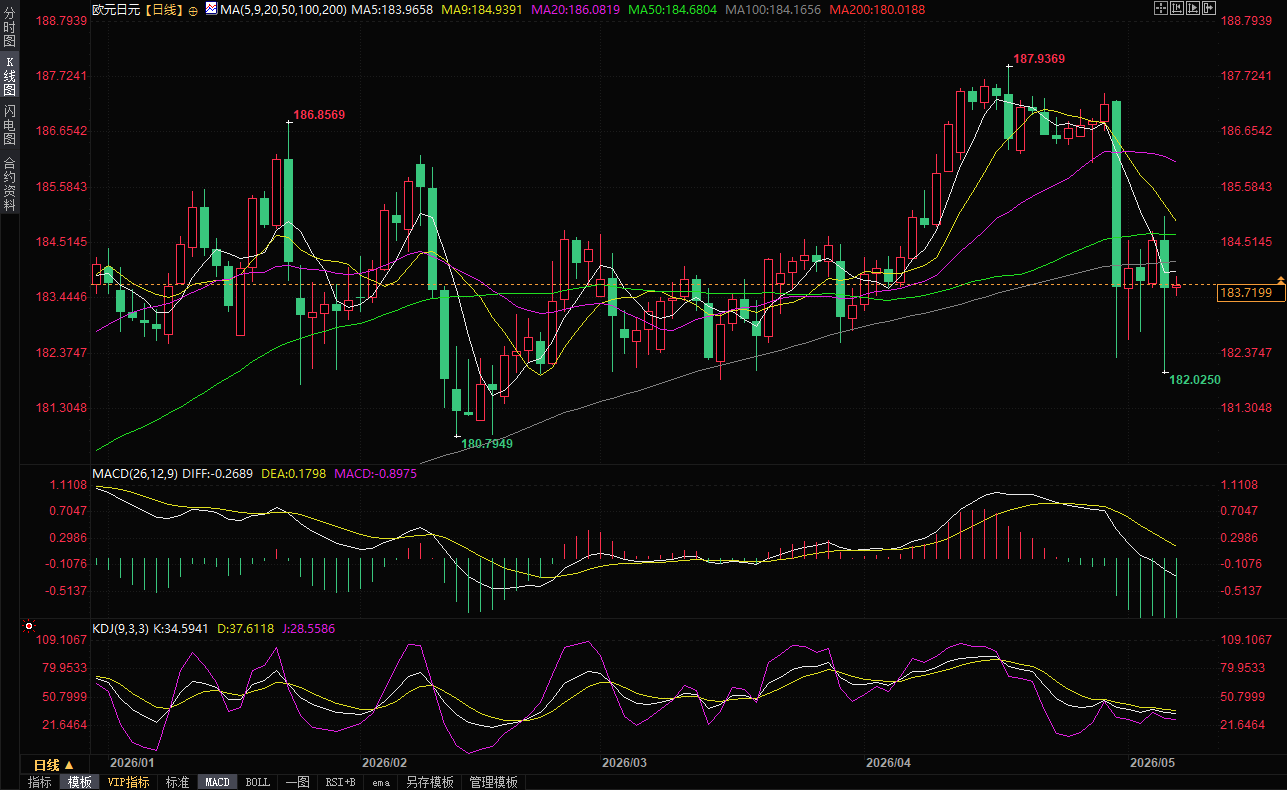
(EUR/JPY daily chart, source: FX678)
At 12:19 Beijing time, the euro was trading at 183.73/74 against the yen.
With two major forces locked in a stalemate, neither the bulls nor the bears dared to make any rash moves.
I. With the shadow of Japanese intervention looming, Jun Mimura issues another verbal warning.
Jun Mimura, Japan's Vice Finance Minister for International Affairs and Chief Currency Diplomat, reiterated on Thursday that the country will closely monitor developments in the foreign exchange market. While he declined to comment on specific levels of intervention, his statement alone was enough to keep the market on high alert.
It is worth noting that although the Japanese government has not officially confirmed any market intervention in the past few trading days, the market generally believes that the strong rise of the Japanese yen on April 30 and May 6 was likely driven by official forces.
Pepperstone analysts stated, "Although they haven't made any official statements, we must assume that the Japanese Ministry of Finance has intervened again. Such huge market volatility without any apparent catalyst suggests there must be a 'silent hand' at work."
II. Improved risk appetite provides support for the euro.
Meanwhile, the euro remained strong overall, primarily due to improved risk appetite. Market expectations for the potential reopening of the Strait of Hormuz rose – according to Axios, Washington is close to reaching a one-page memorandum of understanding with Iran to end the war. This news boosted market sentiment and increased the euro's appeal.
The market's focus will now be on Lagarde's speech, with the risk of intervention looming large.
Looking ahead, investors will be closely watching ECB President Christine Lagarde's speech scheduled for Friday for the latest clues on the outlook for monetary policy. However, regardless of Lagarde's signals, the shadow of Japanese intervention will continue to loom over the EUR/JPY exchange rate. If the yen experiences excessive one-sided volatility, the "silent hand" of the Japanese Ministry of Finance could intervene again at any time. The standoff between bulls and bears around 183.75 may just be the calm before the storm.
Currently, institutions are clearly divided on the EUR/JPY exchange rate, with the core disagreement lying in whether the weakness of the yen will continue and the extent to which the risk of Japanese intervention will suppress the exchange rate.
Optimists believe the interest rate advantage will continue to support the exchange rate at high levels. Bank of America (BofA) maintains a bullish outlook on the euro, driven primarily by higher real interest rates and positive institutional inflows. AInvest's technical analysis points out that although there was a pullback during the day, the price rebounded after finding support at 182.78, maintaining a healthy bullish structure. Furthermore, the fact that 71% of retail clients are shorting creates a contrarian indicator; if the price holds support, short covering could force short sellers to cover, triggering a short squeeze.
Cautious observers warn of intervention risks and stagflation concerns in the Eurozone. BNY Mellon points out that weakening economic activity and inflationary pressures in the Eurozone, coupled with rising stagflation risks, could limit the euro's performance. VT Markets technical analysis shows that prices remain below the 9-day and 50-day exponential moving averages, with the 14-day RSI at 40.9, indicating continued downward pressure. FXStreet believes that the risk of Japanese intervention is driving demand for the yen, suggesting a continued short-term bearish bias.
(EUR/JPY daily chart, source: FX678)
At 12:19 Beijing time, the euro was trading at 183.73/74 against the yen.
- Risk Warning and Disclaimer
- The market involves risk, and trading may not be suitable for all investors. This article is for reference only and does not constitute personal investment advice, nor does it take into account certain users’ specific investment objectives, financial situation, or other needs. Any investment decisions made based on this information are at your own risk.