Peace talks are just one page away, but bombers are already armed: This high-stakes gamble between the US and Iran puts oil prices at a critical juncture.
2026-05-07 13:47:33
Oil prices traded in a narrow range in Asian trading on Thursday (May 7), as investors continued to assess the latest developments in the Middle East and remained wary of the risk of renewed tensions between the US and Iran. At present, international benchmark Brent crude futures for July delivery rose 0.65% from Wednesday's settlement price to $101.95 per barrel; US WTI crude futures for June delivery rose 0.4% from Wednesday's settlement price to $95.50 per barrel.
I. Trump issues "higher-level" bombing threat
Despite reports that Washington and Tehran are close to reaching an agreement to end the war, US President Trump warned on Truth Social on Wednesday that Iran would face “higher-level” bombing if it does not agree to a peace deal. He stated that if Iran “agrees to the terms of the agreement” (although this may be a very hypothetical scenario), the military offensive codenamed “Operation Fury” will “end,” the US blockade of Iranian ports will be lifted, and the Strait of Hormuz will be “open to all parties, including Iran.”
But he immediately added, "If they don't agree, the bombing will begin, and sadly, it will be much higher in level and intensity than ever before."
II. Iran's response: Still under review, emphasizing "goodwill" as a prerequisite for negotiations.
As previously reported by Axios, the US and Iran were close to reaching a one-page, 14-point memorandum of understanding aimed at ending the war and establishing a framework for subsequent negotiations. However, after Trump's post, Iranian Foreign Ministry spokesman Bagai stated that Tehran was still reviewing the proposal and would respond to the mediators through Pakistan. Bagai also cited International Court of Justice precedents on the X platform, emphasizing that "negotiations" require at least a sincere attempt to resolve the dispute, and that "goodwill is necessary; negotiations are not arguments, nor are they commands, deception, blackmail, or coercion."
III. Duration of Conflict Becomes a Key Variable
Citigroup's U.S. equity strategist, Chronert, stated on CNBC that the duration of the conflict and its impact on persistently high oil prices will affect future growth expectations across multiple market segments and will also influence the Federal Reserve's thinking regarding interest rate dynamics. "The prolonged high oil prices are a significant issue."
Meanwhile, former U.S. Ambassador to Oman, Sievers, pointed out that the most immediate focus is on achieving the full reopening of the Strait of Hormuz to ensure smooth international trade and energy transport.
In summary, the US-Iran situation presents a contradictory picture of "progressing peace talks" and "escalating threats"—Trump's tough stance contrasts sharply with Axios's reports of progress on the agreement, while Iran's cautious responses indicate a weak foundation of trust between the two sides. Amid this tug-of-war, oil prices will continue to react sharply to any geopolitical news in the short term. Investors need to closely monitor: whether the US and Iran truly reach an agreement, whether the Strait of Hormuz can be reopened, and the potential impact of high oil prices on the Federal Reserve's policy path.
The core driving logic of current oil prices has shifted from "pure geopolitical speculation" to a fierce game of "cooling expectations for peace talks vs. the reality of low inventory," with institutional opinions showing a clear divergence.
Barclays has raised its 2026 Brent average price forecast to $100 (from $85), based on the core logic that the obstruction of the Strait of Hormuz has led to a supply gap of 6.6 million barrels per day in the oil market. If the obstruction continues until the end of May, oil prices may rise to $110.
Citigroup is even more aggressive, setting a short-term target of $120 for Brent crude oil in the 0-3 month range, which is expected to represent an upside of approximately 13%. Strategically, they recommend holding near-term crude oil exposure to hedge against geopolitical risks before the end of May.
Goldman Sachs maintained its 2026 forecasts of $83 for Brent crude and $78 for WTI, believing that weak global demand and easing supply disruptions are offsetting upward pressure. Goldman Sachs noted that global demand losses could exceed levels seen during the 2011 and 2022 oil price shocks, particularly as emerging market consumption is more price-sensitive. Nevertheless, global inventories are near eight-year lows, reducing the system's resilience to shocks.
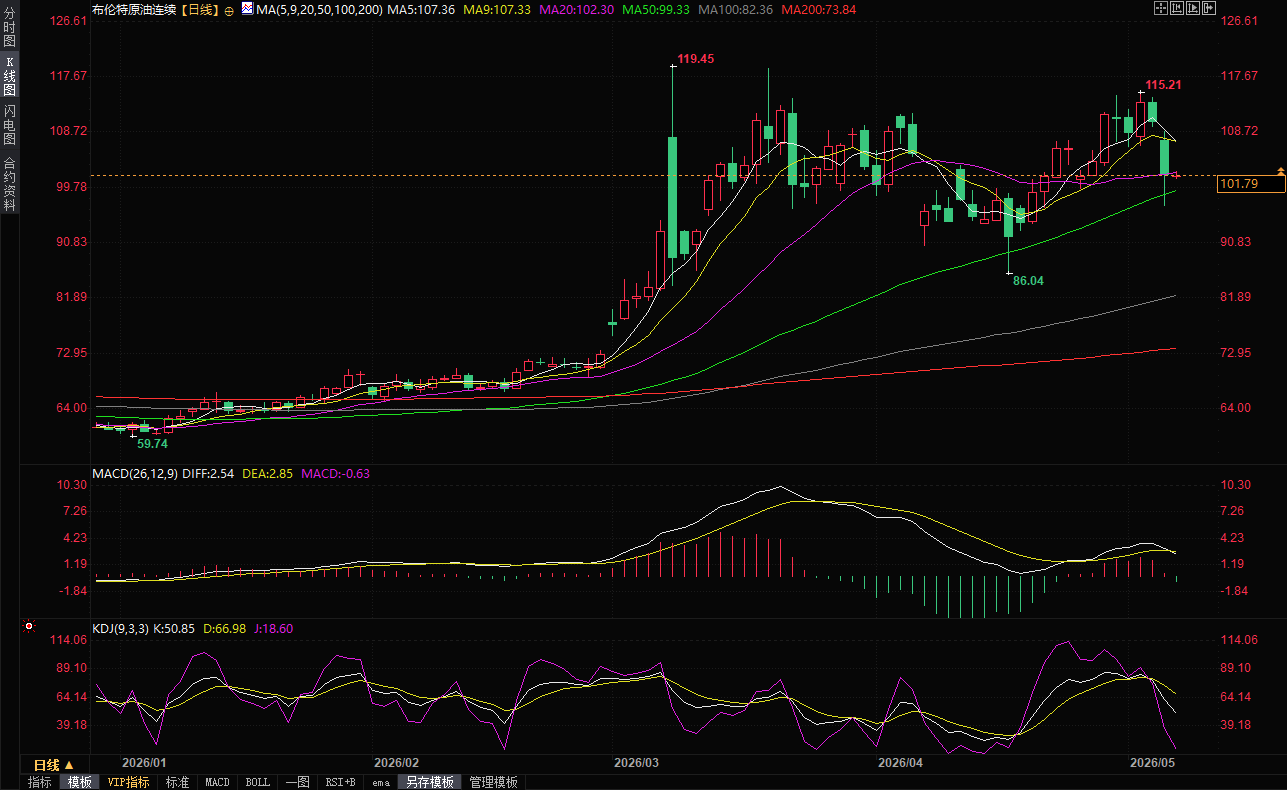
(Brent crude oil futures contract daily chart, source: FX678)
At 13:46 Beijing time, Brent crude oil was trading at $101.85 per barrel.
Two forces are locked in a tug-of-war, leaving oil prices at a crossroads.
I. Trump issues "higher-level" bombing threat
Despite reports that Washington and Tehran are close to reaching an agreement to end the war, US President Trump warned on Truth Social on Wednesday that Iran would face “higher-level” bombing if it does not agree to a peace deal. He stated that if Iran “agrees to the terms of the agreement” (although this may be a very hypothetical scenario), the military offensive codenamed “Operation Fury” will “end,” the US blockade of Iranian ports will be lifted, and the Strait of Hormuz will be “open to all parties, including Iran.”
But he immediately added, "If they don't agree, the bombing will begin, and sadly, it will be much higher in level and intensity than ever before."
II. Iran's response: Still under review, emphasizing "goodwill" as a prerequisite for negotiations.
As previously reported by Axios, the US and Iran were close to reaching a one-page, 14-point memorandum of understanding aimed at ending the war and establishing a framework for subsequent negotiations. However, after Trump's post, Iranian Foreign Ministry spokesman Bagai stated that Tehran was still reviewing the proposal and would respond to the mediators through Pakistan. Bagai also cited International Court of Justice precedents on the X platform, emphasizing that "negotiations" require at least a sincere attempt to resolve the dispute, and that "goodwill is necessary; negotiations are not arguments, nor are they commands, deception, blackmail, or coercion."
III. Duration of Conflict Becomes a Key Variable
Citigroup's U.S. equity strategist, Chronert, stated on CNBC that the duration of the conflict and its impact on persistently high oil prices will affect future growth expectations across multiple market segments and will also influence the Federal Reserve's thinking regarding interest rate dynamics. "The prolonged high oil prices are a significant issue."
Meanwhile, former U.S. Ambassador to Oman, Sievers, pointed out that the most immediate focus is on achieving the full reopening of the Strait of Hormuz to ensure smooth international trade and energy transport.
With a highly uncertain outlook, oil prices are expected to remain volatile in the short term.
In summary, the US-Iran situation presents a contradictory picture of "progressing peace talks" and "escalating threats"—Trump's tough stance contrasts sharply with Axios's reports of progress on the agreement, while Iran's cautious responses indicate a weak foundation of trust between the two sides. Amid this tug-of-war, oil prices will continue to react sharply to any geopolitical news in the short term. Investors need to closely monitor: whether the US and Iran truly reach an agreement, whether the Strait of Hormuz can be reopened, and the potential impact of high oil prices on the Federal Reserve's policy path.
The core driving logic of current oil prices has shifted from "pure geopolitical speculation" to a fierce game of "cooling expectations for peace talks vs. the reality of low inventory," with institutional opinions showing a clear divergence.
Barclays has raised its 2026 Brent average price forecast to $100 (from $85), based on the core logic that the obstruction of the Strait of Hormuz has led to a supply gap of 6.6 million barrels per day in the oil market. If the obstruction continues until the end of May, oil prices may rise to $110.
Citigroup is even more aggressive, setting a short-term target of $120 for Brent crude oil in the 0-3 month range, which is expected to represent an upside of approximately 13%. Strategically, they recommend holding near-term crude oil exposure to hedge against geopolitical risks before the end of May.
Goldman Sachs maintained its 2026 forecasts of $83 for Brent crude and $78 for WTI, believing that weak global demand and easing supply disruptions are offsetting upward pressure. Goldman Sachs noted that global demand losses could exceed levels seen during the 2011 and 2022 oil price shocks, particularly as emerging market consumption is more price-sensitive. Nevertheless, global inventories are near eight-year lows, reducing the system's resilience to shocks.
(Brent crude oil futures contract daily chart, source: FX678)
At 13:46 Beijing time, Brent crude oil was trading at $101.85 per barrel.
- Risk Warning and Disclaimer
- The market involves risk, and trading may not be suitable for all investors. This article is for reference only and does not constitute personal investment advice, nor does it take into account certain users’ specific investment objectives, financial situation, or other needs. Any investment decisions made based on this information are at your own risk.