Risk aversion subsided, and the US dollar index remained range-bound at low levels, awaiting the release of non-farm payroll data.
2026-05-07 14:23:26
The US dollar index (DXY) remained in a narrow range around 98.00 in early Asian trading on Thursday, with market sentiment temporarily cautious after recording a significant drop of nearly 0.5% in the previous trading day.
The recent continued pressure on the US dollar is mainly due to rising market expectations that the US and Iran may reach an agreement, which has weakened global safe-haven demand and driven a sharp decline in international oil prices.

As falling oil prices eased market concerns about renewed inflation, investors began to reassess the Federal Reserve's future monetary policy path, and market expectations for the Fed to maintain high interest rates for an extended period cooled significantly.
The decline in international oil prices is easing market inflationary pressures and weakening the recent upward momentum of the US dollar.
Previously, escalating tensions in the Middle East had driven international oil prices up rapidly and reinforced market expectations that the Federal Reserve would maintain a hawkish stance. However, as the market believes that global energy supply risks may ease, the safe-haven appeal of the US dollar has also declined.
Iran said on Wednesday that the US-proposed solution to end the conflict is "still under consideration." This comes after market reports indicated that the US had submitted a one-page memorandum of understanding to Iran, which included provisions for gradually restoring shipping through the Strait of Hormuz and easing US blockades on Iranian ports.
However, the two sides have not yet reached a formal final agreement, and detailed discussions on the Iranian nuclear issue are expected to take place later.
Meanwhile, US President Trump continued to issue tough statements. Trump warned that if Iran rejects the peace agreement, the US will launch a "higher-intensity" military strike.
Trump posted on social media that if Iran accepts the terms of the previously discussed agreement, the US military operation "may end."
The market is currently oscillating between "expectations of easing geopolitical tensions" and "uncertainty surrounding the Middle East conflict".
Despite the recent weakening of the dollar, some Federal Reserve officials remain wary of inflation risks. Chicago Fed President Goolsby stated that U.S. inflation has not continued to decline toward the Fed's 2% target; instead, it has shown signs of accelerating again since the start of the Middle East conflict.
This statement implies that the Federal Reserve remains highly concerned about inflation risks, and there is still considerable uncertainty regarding its future policy path.
The market's focus has gradually shifted to the upcoming US non-farm payroll data. If the US job market continues to be strong, it could provide renewed support for the dollar and reinforce market expectations that the Federal Reserve will maintain high interest rates.
Conversely, if employment data weakens significantly, it could further reinforce market bets on future interest rate cuts by the Federal Reserve, thereby pushing the dollar index further down.
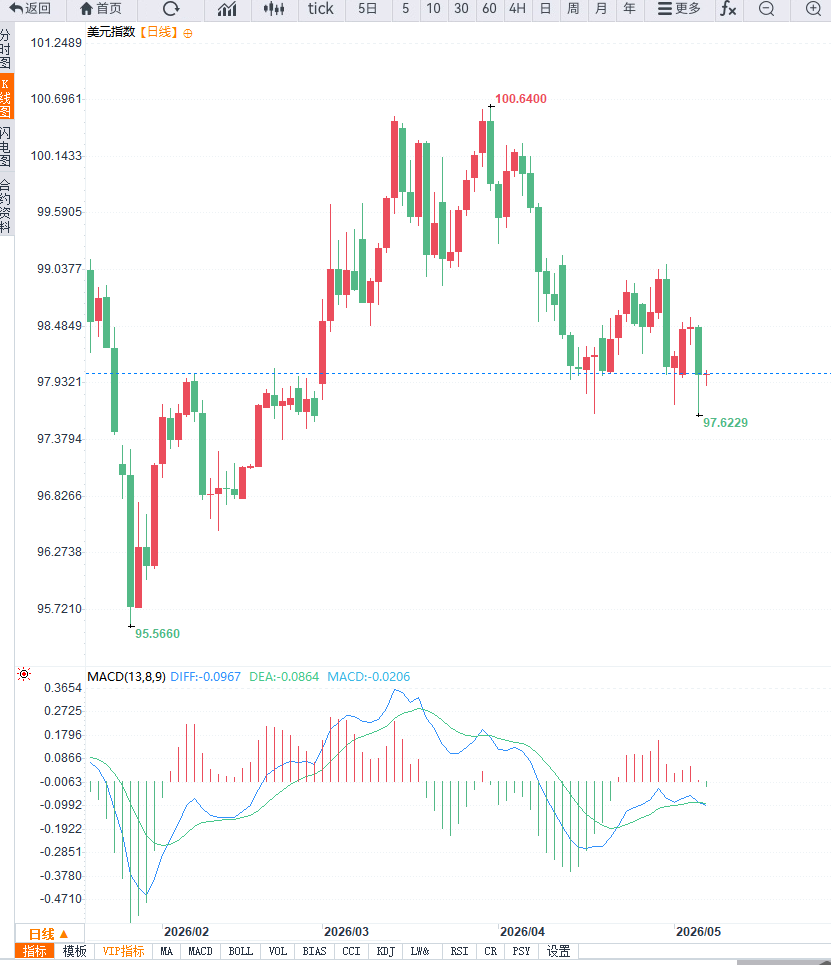
From a technical perspective, the daily chart of the US dollar index shows that after encountering significant selling pressure near the 100 level, the index has continued to decline and is currently consolidating around 98.00. The recent break below the key support levels of 99.20 and 98.50 indicates increased bearish pressure in the market. The area around 98.00 has become a crucial short-term support/resistance level for the dollar index. If it breaks below the 97.80 support area, the dollar index may further decline to the 97.20 or even 96.80 area. On the upside, the 98.60 and 99.00 areas constitute significant short-term resistance.
Short-term candlestick charts indicate that the market is currently consolidating in a weak, range-bound pattern, with investors awaiting further confirmation from US employment data and developments in the Middle East. From a comprehensive technical perspective, the US dollar index's medium-term trend has shifted from its previous high-level consolidation to a more bearish structure. The daily chart shows that bears are gradually gaining the upper hand, while the 4-hour chart reflects a lack of significant short-term rebound momentum.
Editor's Summary : The current trend of the US dollar index is mainly influenced by both "expectations of easing tensions between the US and Iran" and "uncertainty surrounding Federal Reserve policy." In the short term, if the situation in the Middle East continues to show signs of easing, the demand for the US dollar as a safe haven may further decrease, thus suppressing the dollar's performance. However, concerns within the Federal Reserve regarding inflation risks may still limit the dollar's decline. From a technical perspective, the US dollar index has entered a relatively weak adjustment phase, and market volatility may continue to rise in the future. Investors should pay close attention to US non-farm payroll data, changes in international oil prices, and the latest developments in the Middle East.
The recent continued pressure on the US dollar is mainly due to rising market expectations that the US and Iran may reach an agreement, which has weakened global safe-haven demand and driven a sharp decline in international oil prices.
As falling oil prices eased market concerns about renewed inflation, investors began to reassess the Federal Reserve's future monetary policy path, and market expectations for the Fed to maintain high interest rates for an extended period cooled significantly.
The decline in international oil prices is easing market inflationary pressures and weakening the recent upward momentum of the US dollar.
Previously, escalating tensions in the Middle East had driven international oil prices up rapidly and reinforced market expectations that the Federal Reserve would maintain a hawkish stance. However, as the market believes that global energy supply risks may ease, the safe-haven appeal of the US dollar has also declined.
Iran said on Wednesday that the US-proposed solution to end the conflict is "still under consideration." This comes after market reports indicated that the US had submitted a one-page memorandum of understanding to Iran, which included provisions for gradually restoring shipping through the Strait of Hormuz and easing US blockades on Iranian ports.
However, the two sides have not yet reached a formal final agreement, and detailed discussions on the Iranian nuclear issue are expected to take place later.
Meanwhile, US President Trump continued to issue tough statements. Trump warned that if Iran rejects the peace agreement, the US will launch a "higher-intensity" military strike.
Trump posted on social media that if Iran accepts the terms of the previously discussed agreement, the US military operation "may end."
The market is currently oscillating between "expectations of easing geopolitical tensions" and "uncertainty surrounding the Middle East conflict".
Despite the recent weakening of the dollar, some Federal Reserve officials remain wary of inflation risks. Chicago Fed President Goolsby stated that U.S. inflation has not continued to decline toward the Fed's 2% target; instead, it has shown signs of accelerating again since the start of the Middle East conflict.
This statement implies that the Federal Reserve remains highly concerned about inflation risks, and there is still considerable uncertainty regarding its future policy path.
The market's focus has gradually shifted to the upcoming US non-farm payroll data. If the US job market continues to be strong, it could provide renewed support for the dollar and reinforce market expectations that the Federal Reserve will maintain high interest rates.
Conversely, if employment data weakens significantly, it could further reinforce market bets on future interest rate cuts by the Federal Reserve, thereby pushing the dollar index further down.
From a technical perspective, the daily chart of the US dollar index shows that after encountering significant selling pressure near the 100 level, the index has continued to decline and is currently consolidating around 98.00. The recent break below the key support levels of 99.20 and 98.50 indicates increased bearish pressure in the market. The area around 98.00 has become a crucial short-term support/resistance level for the dollar index. If it breaks below the 97.80 support area, the dollar index may further decline to the 97.20 or even 96.80 area. On the upside, the 98.60 and 99.00 areas constitute significant short-term resistance.
Short-term candlestick charts indicate that the market is currently consolidating in a weak, range-bound pattern, with investors awaiting further confirmation from US employment data and developments in the Middle East. From a comprehensive technical perspective, the US dollar index's medium-term trend has shifted from its previous high-level consolidation to a more bearish structure. The daily chart shows that bears are gradually gaining the upper hand, while the 4-hour chart reflects a lack of significant short-term rebound momentum.
Editor's Summary : The current trend of the US dollar index is mainly influenced by both "expectations of easing tensions between the US and Iran" and "uncertainty surrounding Federal Reserve policy." In the short term, if the situation in the Middle East continues to show signs of easing, the demand for the US dollar as a safe haven may further decrease, thus suppressing the dollar's performance. However, concerns within the Federal Reserve regarding inflation risks may still limit the dollar's decline. From a technical perspective, the US dollar index has entered a relatively weak adjustment phase, and market volatility may continue to rise in the future. Investors should pay close attention to US non-farm payroll data, changes in international oil prices, and the latest developments in the Middle East.
- Risk Warning and Disclaimer
- The market involves risk, and trading may not be suitable for all investors. This article is for reference only and does not constitute personal investment advice, nor does it take into account certain users’ specific investment objectives, financial situation, or other needs. Any investment decisions made based on this information are at your own risk.