Easing tensions in the Middle East weighed on the US dollar, and USD/CAD remained range-bound at low levels.
2026-05-08 14:19:48
The US dollar/Canadian dollar pair (USD/CAD) saw a slight pullback during Friday's Asian trading session after rising for two consecutive days, trading around 1.3660. The US dollar index weakened overall, mainly due to the temporary easing of tensions in the Middle East, which improved market risk sentiment and reduced demand for the dollar as a safe haven.

The core drivers of the foreign exchange market recently remain geopolitical risks and commodity price movements. Previously, military tensions between the US and Iran had driven a temporary strengthening of the US dollar, but as both Israel and Iran signaled a de-escalation of the situation, market risk aversion has clearly subsided.
US President Trump stated that the ceasefire between the US and Iran remains in effect, which has somewhat alleviated market concerns about a further escalation of the Middle East conflict. The weakening US dollar is the main short-term factor driving the USD/CAD decline. As global risk appetite improves, funds are flowing out of safe-haven assets like the US dollar, leading to a temporary pullback in the US dollar index. However, the Canadian dollar itself is also under pressure, limiting the downside potential of USD/CAD. As a typical commodity currency, the Canadian dollar is highly correlated with oil prices, and the current decline in international oil prices is dragging down the Canadian dollar.
WTI crude oil prices retreated to around $95, primarily due to reduced market concerns about Middle East supply risks. Oil prices had previously risen due to tensions between the US and Iran, but as the conflict de-escalated, the supply premium gradually receded. Since Canada is one of the largest crude oil suppliers to the US, falling oil prices typically weaken the fundamental support for the Canadian dollar. Therefore, even with a weaker US dollar, the downside for USD/CAD remains limited.
From a domestic economic perspective, Canada's economic growth is slowing. The latest GDP data shows weakening economic momentum, and the market expects the Bank of Canada (BoC) to maintain a dovish policy stance to support economic growth. With inflationary pressures relatively manageable, the BoC lacks the incentive to further tighten monetary policy in the short term, which also limits the attractiveness of the Canadian dollar.
The market is currently closely watching Canada's upcoming April employment data. The market expects Canada to add approximately 15,000 jobs, with the unemployment rate projected to remain around 6.7%. Weak employment data could reinforce expectations of a Canadian economic slowdown, putting further pressure on the Canadian dollar; conversely, stronger-than-expected data could provide short-term support for a Canadian dollar rebound.
From the daily chart, USD/CAD remains in a high-level consolidation structure. The pair rebounded after finding support near 1.3600, but repeatedly encountered resistance above 1.3700, indicating significant technical pressure in that area. Technically, the daily MACD remains above the zero line, but the red bars are contracting, suggesting weakening upward momentum. The RSI has fallen back to around 55, indicating a shift in market sentiment from bullish to neutral. In terms of moving averages, the 5-day and 10-day moving averages are flattening, indicating a short-term consolidation phase, while the 20-day moving average around 1.3600 forms a significant support area. Currently, USD/CAD is caught in a two-way tug-of-war between a weakening US dollar and falling oil prices supporting the Canadian dollar. This makes it more likely that the pair will maintain range-bound trading in the short term rather than a one-sided trend. Overall, the short-term trend for USD/CAD is unclear, and the market is largely awaiting further guidance from Canadian employment data and oil price movements.
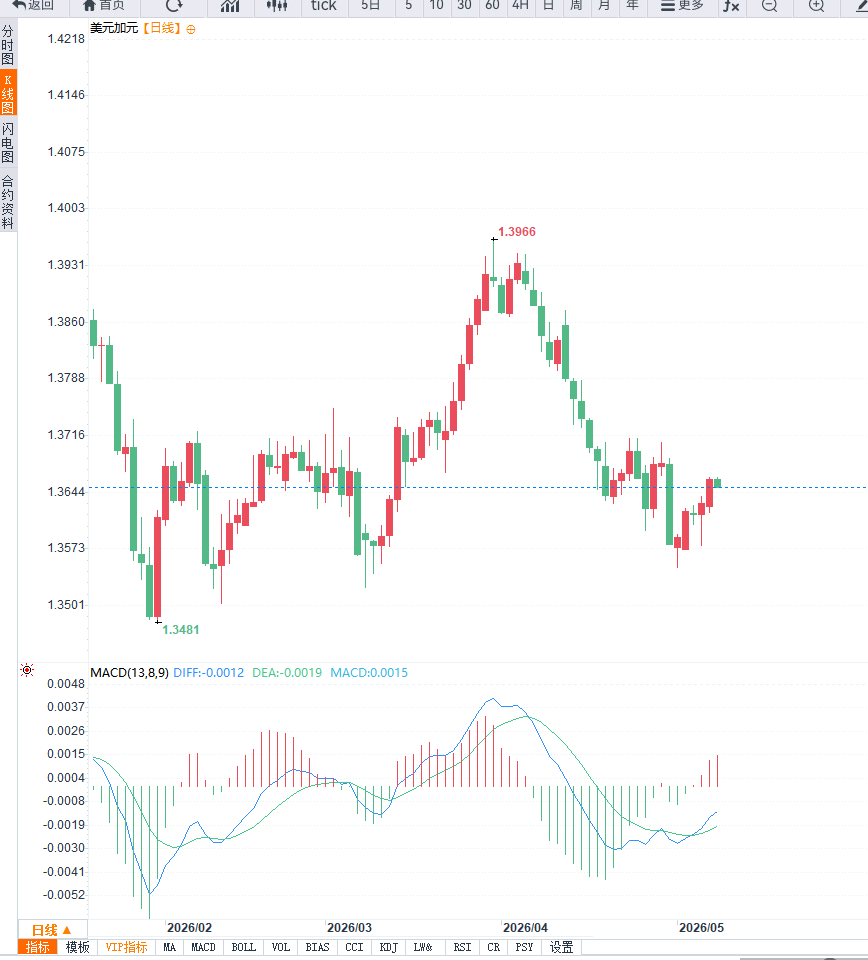
Editor's Summary : The USD/CAD pair is currently in a typical "macroeconomic hedging consolidation phase." The US dollar weakened due to easing geopolitical risks, but falling oil prices weakened support for the Canadian dollar, leaving the pair lacking a clear overall direction. Technically, the USD/CAD daily chart remains in a high-level consolidation pattern, while the 4-hour chart shows gradually weakening momentum. The future direction of the pair will mainly depend on three factors: US economic data, expectations for Federal Reserve policy, and international oil price movements. If Canadian employment data is weak and oil prices continue to fall, USD/CAD may maintain a slightly bullish consolidation; conversely, if the US dollar weakens further, the pair may fall back to test support below 1.36.
The core drivers of the foreign exchange market recently remain geopolitical risks and commodity price movements. Previously, military tensions between the US and Iran had driven a temporary strengthening of the US dollar, but as both Israel and Iran signaled a de-escalation of the situation, market risk aversion has clearly subsided.
US President Trump stated that the ceasefire between the US and Iran remains in effect, which has somewhat alleviated market concerns about a further escalation of the Middle East conflict. The weakening US dollar is the main short-term factor driving the USD/CAD decline. As global risk appetite improves, funds are flowing out of safe-haven assets like the US dollar, leading to a temporary pullback in the US dollar index. However, the Canadian dollar itself is also under pressure, limiting the downside potential of USD/CAD. As a typical commodity currency, the Canadian dollar is highly correlated with oil prices, and the current decline in international oil prices is dragging down the Canadian dollar.
WTI crude oil prices retreated to around $95, primarily due to reduced market concerns about Middle East supply risks. Oil prices had previously risen due to tensions between the US and Iran, but as the conflict de-escalated, the supply premium gradually receded. Since Canada is one of the largest crude oil suppliers to the US, falling oil prices typically weaken the fundamental support for the Canadian dollar. Therefore, even with a weaker US dollar, the downside for USD/CAD remains limited.
From a domestic economic perspective, Canada's economic growth is slowing. The latest GDP data shows weakening economic momentum, and the market expects the Bank of Canada (BoC) to maintain a dovish policy stance to support economic growth. With inflationary pressures relatively manageable, the BoC lacks the incentive to further tighten monetary policy in the short term, which also limits the attractiveness of the Canadian dollar.
The market is currently closely watching Canada's upcoming April employment data. The market expects Canada to add approximately 15,000 jobs, with the unemployment rate projected to remain around 6.7%. Weak employment data could reinforce expectations of a Canadian economic slowdown, putting further pressure on the Canadian dollar; conversely, stronger-than-expected data could provide short-term support for a Canadian dollar rebound.
From the daily chart, USD/CAD remains in a high-level consolidation structure. The pair rebounded after finding support near 1.3600, but repeatedly encountered resistance above 1.3700, indicating significant technical pressure in that area. Technically, the daily MACD remains above the zero line, but the red bars are contracting, suggesting weakening upward momentum. The RSI has fallen back to around 55, indicating a shift in market sentiment from bullish to neutral. In terms of moving averages, the 5-day and 10-day moving averages are flattening, indicating a short-term consolidation phase, while the 20-day moving average around 1.3600 forms a significant support area. Currently, USD/CAD is caught in a two-way tug-of-war between a weakening US dollar and falling oil prices supporting the Canadian dollar. This makes it more likely that the pair will maintain range-bound trading in the short term rather than a one-sided trend. Overall, the short-term trend for USD/CAD is unclear, and the market is largely awaiting further guidance from Canadian employment data and oil price movements.
Editor's Summary : The USD/CAD pair is currently in a typical "macroeconomic hedging consolidation phase." The US dollar weakened due to easing geopolitical risks, but falling oil prices weakened support for the Canadian dollar, leaving the pair lacking a clear overall direction. Technically, the USD/CAD daily chart remains in a high-level consolidation pattern, while the 4-hour chart shows gradually weakening momentum. The future direction of the pair will mainly depend on three factors: US economic data, expectations for Federal Reserve policy, and international oil price movements. If Canadian employment data is weak and oil prices continue to fall, USD/CAD may maintain a slightly bullish consolidation; conversely, if the US dollar weakens further, the pair may fall back to test support below 1.36.
- Risk Warning and Disclaimer
- The market involves risk, and trading may not be suitable for all investors. This article is for reference only and does not constitute personal investment advice, nor does it take into account certain users’ specific investment objectives, financial situation, or other needs. Any investment decisions made based on this information are at your own risk.