The US dollar index is nearing its February low, and the "fake peace" in the Middle East is eroding the safe-haven premium.
2026-05-08 20:27:45
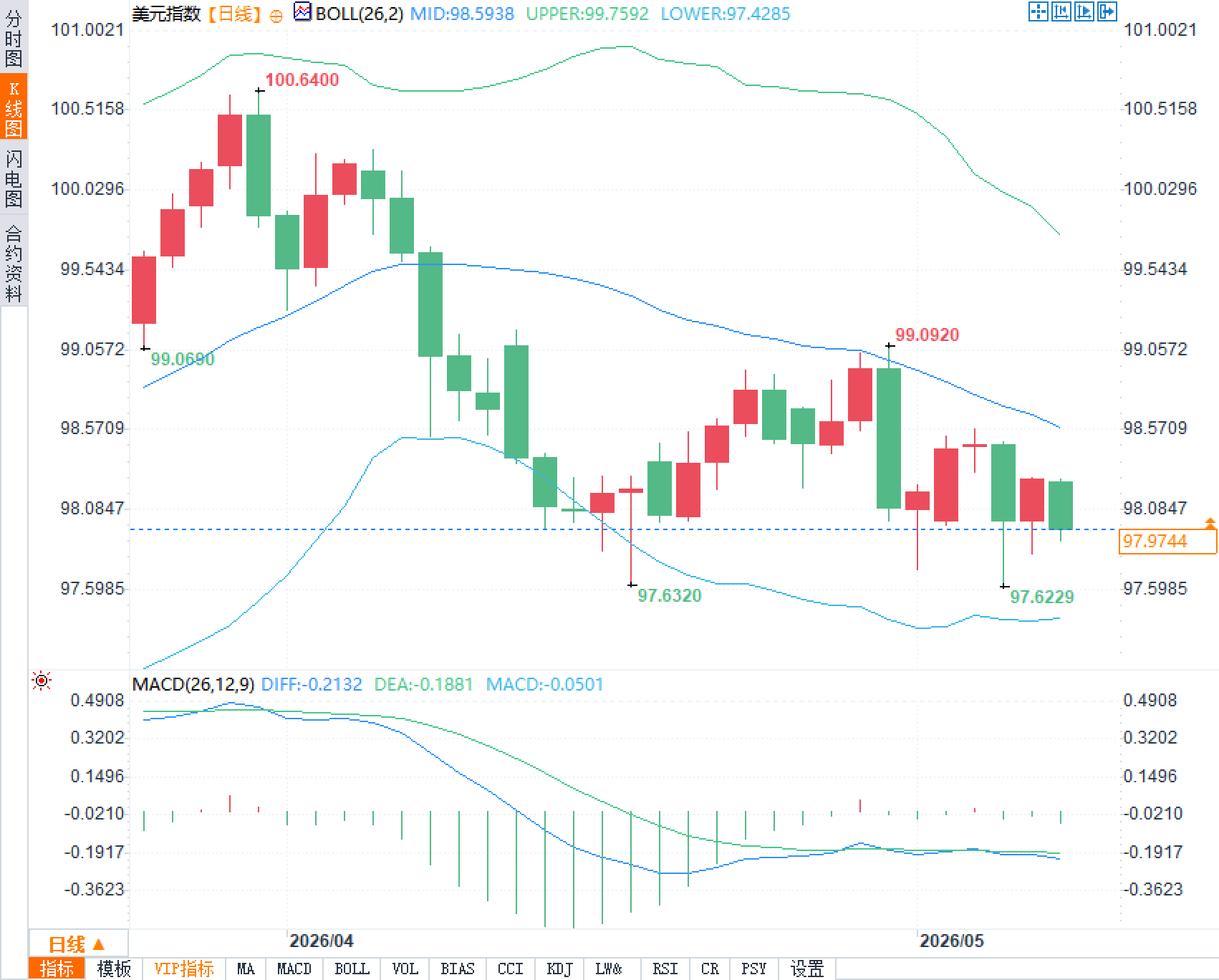
On Friday, May 8th, the US dollar index fluctuated downwards to around 97.97, and is on track for its second consecutive week of decline. The dollar recently touched a low of 97.623, its lowest level since February 27th. The market is cautiously optimistic about the Middle East ceasefire agreement. Although there have been occasional clashes since the agreement took effect on April 7th, the overall balance remains fragile, and US-Iran dialogue continues. Against this backdrop, safe-haven funds are flowing out of the dollar, risk appetite is recovering, and positioning has returned to historical averages, significantly weakening short-term support for the dollar.

The easing of tensions in the Middle East has directly impacted the safe-haven appeal of the US dollar. Following the ceasefire agreement, although there have been occasional clashes between the US and Iran in areas such as the Strait of Hormuz, they have not triggered a sharp surge in oil prices. With oil prices falling from their highs, monetary pressure on oil-import-dependent economies has eased, and the premium of the US dollar as a traditional safe-haven asset has rapidly diminished. Analysts point out that current positioning has returned to historical averages and no longer provides strong support for the dollar as it did a few weeks ago. ING FX strategist Francesco Pesole emphasizes that the dollar's outlook is binary, with stock market reactions likely having a greater impact on the dollar than oil price fluctuations themselves. Commerzbank FX analyst Volkmar Baur also believes that non-farm payroll data needs to be significantly weaker than expected to truly disrupt dollar volatility; otherwise, the Fed's policy outlook is likely to remain stable. Under this logic, the dollar index has fallen from its recent highs to its current range, with waning risk aversion being the dominant driver.
Technical indicators suggest the US dollar index is in a short-term weak position. The Bollinger Bands have a middle band at 98.5938, an upper band at 99.7592, and a lower band at 97.4285. The current price has fallen below the middle band and is approaching the lower band, with narrowing volatility suggesting further compression. In the MACD indicator, the DIFF is -0.2132, the DEA is -0.1881, and the MACD histogram is -0.0501, with the negative zone continuing to expand, indicating that downward momentum still dominates. The candlestick pattern shows a gradual convergence after high-level trading, and combined with the MACD death cross signal, if the price cannot effectively recover the 98.59 middle band in the short term, the technical factors will continue to put pressure on the bulls. Traders are watching the effectiveness of the support around the lower Bollinger Band at 97.43.
The euro/dollar rose 0.35% to 1.1765, showing slight strength this week and reflecting improved risk appetite in Europe. The dollar/yen traded in a narrow range around 156.78, with recent interventions and verbal warnings from Japanese authorities aimed at curbing a sharp depreciation of the yen. Tokyo emphasized daily communication with the US and that the frequency of intervention was unrestricted. Derek Halpenny, head of research at MUFG, noted that while tensions in the Strait of Hormuz increased the risk of an oil price rebound, they had not yet breached Japan's intervention line. The pound/dollar rose 0.40% to 1.3603, with comments from the British Prime Minister boosting market expectations for political stability. Overall, the rebound of non-US dollar currencies against the dollar resonated with the weakening of the dollar's safe-haven appeal.
Geopolitical easing weakens demand for the US dollar as a safe haven
The easing of tensions in the Middle East has directly impacted the safe-haven appeal of the US dollar. Following the ceasefire agreement, although there have been occasional clashes between the US and Iran in areas such as the Strait of Hormuz, they have not triggered a sharp surge in oil prices. With oil prices falling from their highs, monetary pressure on oil-import-dependent economies has eased, and the premium of the US dollar as a traditional safe-haven asset has rapidly diminished. Analysts point out that current positioning has returned to historical averages and no longer provides strong support for the dollar as it did a few weeks ago. ING FX strategist Francesco Pesole emphasizes that the dollar's outlook is binary, with stock market reactions likely having a greater impact on the dollar than oil price fluctuations themselves. Commerzbank FX analyst Volkmar Baur also believes that non-farm payroll data needs to be significantly weaker than expected to truly disrupt dollar volatility; otherwise, the Fed's policy outlook is likely to remain stable. Under this logic, the dollar index has fallen from its recent highs to its current range, with waning risk aversion being the dominant driver.
The US dollar index is showing downward technical signals.
Technical indicators suggest the US dollar index is in a short-term weak position. The Bollinger Bands have a middle band at 98.5938, an upper band at 99.7592, and a lower band at 97.4285. The current price has fallen below the middle band and is approaching the lower band, with narrowing volatility suggesting further compression. In the MACD indicator, the DIFF is -0.2132, the DEA is -0.1881, and the MACD histogram is -0.0501, with the negative zone continuing to expand, indicating that downward momentum still dominates. The candlestick pattern shows a gradual convergence after high-level trading, and combined with the MACD death cross signal, if the price cannot effectively recover the 98.59 middle band in the short term, the technical factors will continue to put pressure on the bulls. Traders are watching the effectiveness of the support around the lower Bollinger Band at 97.43.
Major non-US currencies correlate with the US dollar
| currency pairs | Weekly Changes | Current level | Key Driver |
|---|---|---|---|
| US Dollar Index | -0.22% | 97.97 | Demand for safe havens weakens |
| EUR/USD | +0.35% | 1.1765 | Risk sentiment improves |
| USD/JPY | Basically unchanged | 156.78 | Japan's intervention risk support |
| GBP/USD | +0.40% | 1.3603 | Signs of political stability in the UK |
The euro/dollar rose 0.35% to 1.1765, showing slight strength this week and reflecting improved risk appetite in Europe. The dollar/yen traded in a narrow range around 156.78, with recent interventions and verbal warnings from Japanese authorities aimed at curbing a sharp depreciation of the yen. Tokyo emphasized daily communication with the US and that the frequency of intervention was unrestricted. Derek Halpenny, head of research at MUFG, noted that while tensions in the Strait of Hormuz increased the risk of an oil price rebound, they had not yet breached Japan's intervention line. The pound/dollar rose 0.40% to 1.3603, with comments from the British Prime Minister boosting market expectations for political stability. Overall, the rebound of non-US dollar currencies against the dollar resonated with the weakening of the dollar's safe-haven appeal.
Frequently Asked Questions
Question 1: How will the expectation of a ceasefire in the Middle East affect the trend of the US dollar index?
A: While the ceasefire agreement is fragile, it has been largely maintained, and the ongoing US-Iran dialogue has significantly reduced market concerns about escalation. The decline in oil prices from their highs has eased pressure on oil-import-dependent currencies, leading to a rapid drop in the dollar's safe-haven premium. Simultaneously, positioning has returned to historical averages, further weakening the dollar's short-term support. This combination has driven the dollar index down this week, reaching a low of 97.623, its lowest level since February 27th.
Question 2: What warning signs do current technical indicators carry for the US dollar index?
A: The price is trading below the Bollinger Band middle line at 98.5938 and close to the lower line at 97.4285. The MACD negative zone is widening (DIFF -0.2132, MACD -0.0501), both indicating that downward momentum has not yet weakened. Recently, the price has fallen from its high to around 97.97. The candlestick pattern shows a gradual decline after a period of high-level consolidation. If the price cannot quickly recover the middle line, the technical factors will continue to put pressure on the bulls, and volatility may remain in a low, compressed state.
- Risk Warning and Disclaimer
- The market involves risk, and trading may not be suitable for all investors. This article is for reference only and does not constitute personal investment advice, nor does it take into account certain users’ specific investment objectives, financial situation, or other needs. Any investment decisions made based on this information are at your own risk.