Trump's single sentence caused oil prices to skyrocket and shipping in the Hormuz to be paralyzed.
2026-05-11 10:36:18
International oil prices surged on Monday (May 11). US President Trump's latest rejection of Iran's proposal to end the Middle East war led to the continued de facto closure of the Strait of Hormuz, exacerbating global energy supply tensions. Brent crude futures rose as high as $105.48 per barrel, while WTI crude climbed above $99.
I. Peace talks break down, supply blockade continues
Trump called Iran's response "completely unacceptable" on social media, risking the collapse of the fragile ceasefire maintained by both sides. Since the start of the conflict in late February, the Strait of Hormuz has been virtually closed, cutting off the supply of crude oil, natural gas, and fuel to global customers, driving up energy prices and exacerbating inflation fears. The International Energy Agency says the conflict is causing the largest supply shock in history.
II. Market Reaction and Institutional Views
ING's head of commodities strategy stated that optimism surrounding an imminent US-Iran agreement has faded, pushing up oil prices. Increased market concerns about a renewed escalation of the conflict suggest oil prices still have room to rise. The CEO of Saudi Aramco pointed out that if the Straits of Hormuz blockade continues for several weeks, the market will not return to normal until 2027.
III. Geopolitical conflicts continue to escalate
On Sunday, a cargo ship in the Persian Gulf was attacked and set on fire by a drone, the latest shipping attack since the ceasefire in early April. Israeli Prime Minister Netanyahu warned that the war against Iran is "not over" and that further weakening of its nuclear capabilities is still needed.
IV. Wall Street Expectations and Supply and Demand Pattern
A Goldman Sachs survey shows that most respondents expect shipping disruptions in the Straits to continue beyond the end of June. The spread between Brent crude futures contracts for the near month has widened to a backwardation structure of approximately $4 per barrel, indicating tight supply. Saudi Aramco has diverted some oil to the Red Sea port of Yanbu to offset losses.
From a technical perspective, if oil prices can effectively break through and hold above $105.50, they are expected to further challenge the $107-$110 range.
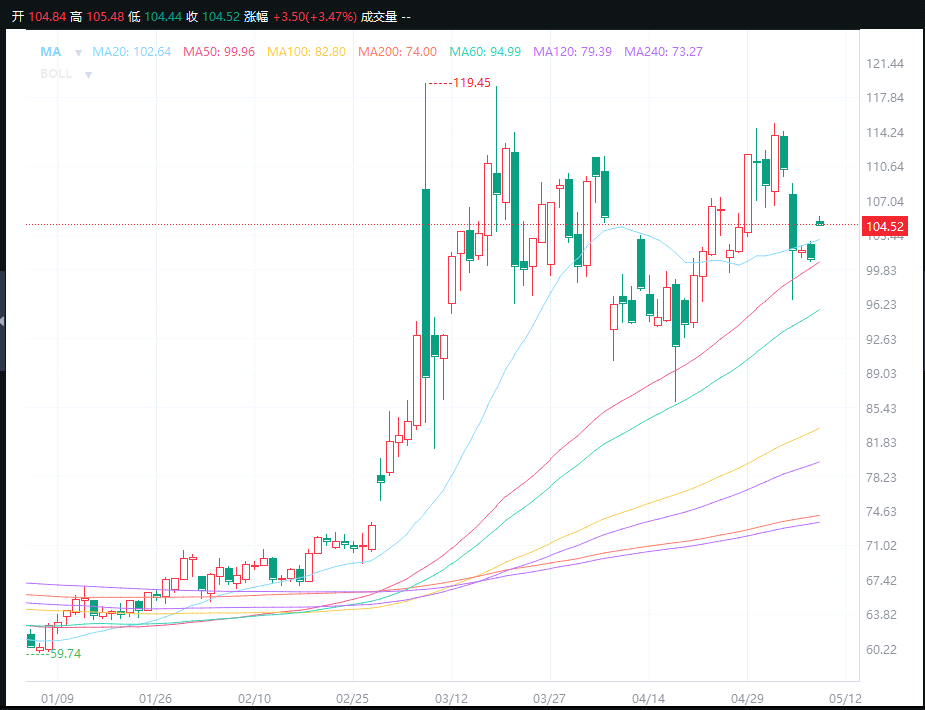
(Brent crude oil futures daily chart, source: FX678)
If there are signs of easing geopolitical tensions (such as the US and Iran resuming dialogue), be wary of a potential pullback due to profit-taking. The key support level to watch is the 20-day moving average (MA20) at 102.64. As long as this level holds, the bullish trend remains intact; a break below it could test the $100 psychological level.
In terms of trading strategy, the short-term approach is to buy on dips, focusing on support confirmation opportunities in the 102.50-103.00 range.
In summary, the prospects for US-Iran peace talks are bleak, the Strait of Hormuz remains blocked, and global energy supplies are facing unprecedented pressure. Market concerns about a renewed escalation of the conflict are rising, making oil prices more likely to rise than fall in the short term. Going forward, attention will be focused on the discussions regarding Iran between Trump and Xi Jinping this week, and whether Israel will take further military action. Until there is substantial improvement on the supply side, the high oil price environment is likely to continue.
At 10:33 Beijing time, Brent crude oil futures were trading at $104.78 per barrel.
I. Peace talks break down, supply blockade continues
Trump called Iran's response "completely unacceptable" on social media, risking the collapse of the fragile ceasefire maintained by both sides. Since the start of the conflict in late February, the Strait of Hormuz has been virtually closed, cutting off the supply of crude oil, natural gas, and fuel to global customers, driving up energy prices and exacerbating inflation fears. The International Energy Agency says the conflict is causing the largest supply shock in history.
II. Market Reaction and Institutional Views
ING's head of commodities strategy stated that optimism surrounding an imminent US-Iran agreement has faded, pushing up oil prices. Increased market concerns about a renewed escalation of the conflict suggest oil prices still have room to rise. The CEO of Saudi Aramco pointed out that if the Straits of Hormuz blockade continues for several weeks, the market will not return to normal until 2027.
III. Geopolitical conflicts continue to escalate
On Sunday, a cargo ship in the Persian Gulf was attacked and set on fire by a drone, the latest shipping attack since the ceasefire in early April. Israeli Prime Minister Netanyahu warned that the war against Iran is "not over" and that further weakening of its nuclear capabilities is still needed.
IV. Wall Street Expectations and Supply and Demand Pattern
A Goldman Sachs survey shows that most respondents expect shipping disruptions in the Straits to continue beyond the end of June. The spread between Brent crude futures contracts for the near month has widened to a backwardation structure of approximately $4 per barrel, indicating tight supply. Saudi Aramco has diverted some oil to the Red Sea port of Yanbu to offset losses.
From a technical perspective, if oil prices can effectively break through and hold above $105.50, they are expected to further challenge the $107-$110 range.
(Brent crude oil futures daily chart, source: FX678)
If there are signs of easing geopolitical tensions (such as the US and Iran resuming dialogue), be wary of a potential pullback due to profit-taking. The key support level to watch is the 20-day moving average (MA20) at 102.64. As long as this level holds, the bullish trend remains intact; a break below it could test the $100 psychological level.
In terms of trading strategy, the short-term approach is to buy on dips, focusing on support confirmation opportunities in the 102.50-103.00 range.
In summary, the prospects for US-Iran peace talks are bleak, the Strait of Hormuz remains blocked, and global energy supplies are facing unprecedented pressure. Market concerns about a renewed escalation of the conflict are rising, making oil prices more likely to rise than fall in the short term. Going forward, attention will be focused on the discussions regarding Iran between Trump and Xi Jinping this week, and whether Israel will take further military action. Until there is substantial improvement on the supply side, the high oil price environment is likely to continue.
At 10:33 Beijing time, Brent crude oil futures were trading at $104.78 per barrel.
- Risk Warning and Disclaimer
- The market involves risk, and trading may not be suitable for all investors. This article is for reference only and does not constitute personal investment advice, nor does it take into account certain users’ specific investment objectives, financial situation, or other needs. Any investment decisions made based on this information are at your own risk.