The situation in the Middle East has boosted demand for the safe-haven dollar, causing the dollar to return to the 157 level against the yen.
2026-05-11 13:12:53
The US dollar (USD/JPY) strengthened against the Japanese yen (JPY) during Monday's Asian trading session after a brief pullback, regaining the 157.00 level . Escalating geopolitical risks in the Middle East drove safe-haven flows into dollar assets, while strong US economic data further reinforced the short-term support for the dollar.

The United States and Iran continue to reject each other's ceasefire proposals, with significant differences remaining regarding their nuclear programs, highly enriched uranium, and shipping in the Strait of Hormuz. Iran has rejected US demands to dismantle its nuclear facilities and suspend uranium enrichment activities for 20 years. Market analysts point out that the current situation in the Middle East has reignited global risk aversion, and the US dollar's reserve currency status has once again attracted market funds.
As tensions continue in the Strait of Hormuz, international oil prices have risen again, and market concerns about renewed global inflation have intensified significantly. The rise in oil prices has prompted the market to reassess the duration of the Federal Reserve's high interest rates, becoming a key factor supporting the US dollar. Meanwhile, the US non-farm payroll data for April, released last week, significantly exceeded market expectations, further strengthening bullish sentiment towards the dollar. Data showed that the US added 115,000 non-farm jobs in April, far exceeding market expectations of 62,000; the unemployment rate remained at 4.3% . Following the data release, US Treasury yields rose again, and market bets on a rapid rate cut by the Federal Reserve this year have significantly decreased.
Some institutions believe that although the US job market is showing signs of slowing, the overall economic resilience remains strong, and the Federal Reserve lacks a reason to quickly shift to an easing stance in the short term. As a result, rising US Treasury yields have further widened the US-Japan interest rate differential, thus pushing the US dollar to remain high against the Japanese yen.
However, the yen is not entirely without support. Recently, market expectations for further intervention in the foreign exchange market by the Japanese government have continued to rise. Previous reports indicated that Japanese officials intervened in the foreign exchange market during the early May holidays to stabilize the yen. Jun Mimura, Japan's top foreign exchange official, has also stated explicitly that Japan has "no limit" on the number of times it intervenes in the foreign exchange market and maintains daily communication with the United States. The Japanese government's continued signals of intervention have made the market cautious about a further significant rise in the USD/JPY exchange rate. In addition, the Bank of Japan has recently released some hawkish signals. The Bank of Japan previously raised its inflation forecast, and the policy committee vote showed a 6-3 hawkish majority, leading the market to bet that the Bank of Japan may raise interest rates as early as June.
Market participants believe that if the Bank of Japan continues to signal interest rate hikes, it may alleviate the pressure on the yen's continued depreciation to some extent.
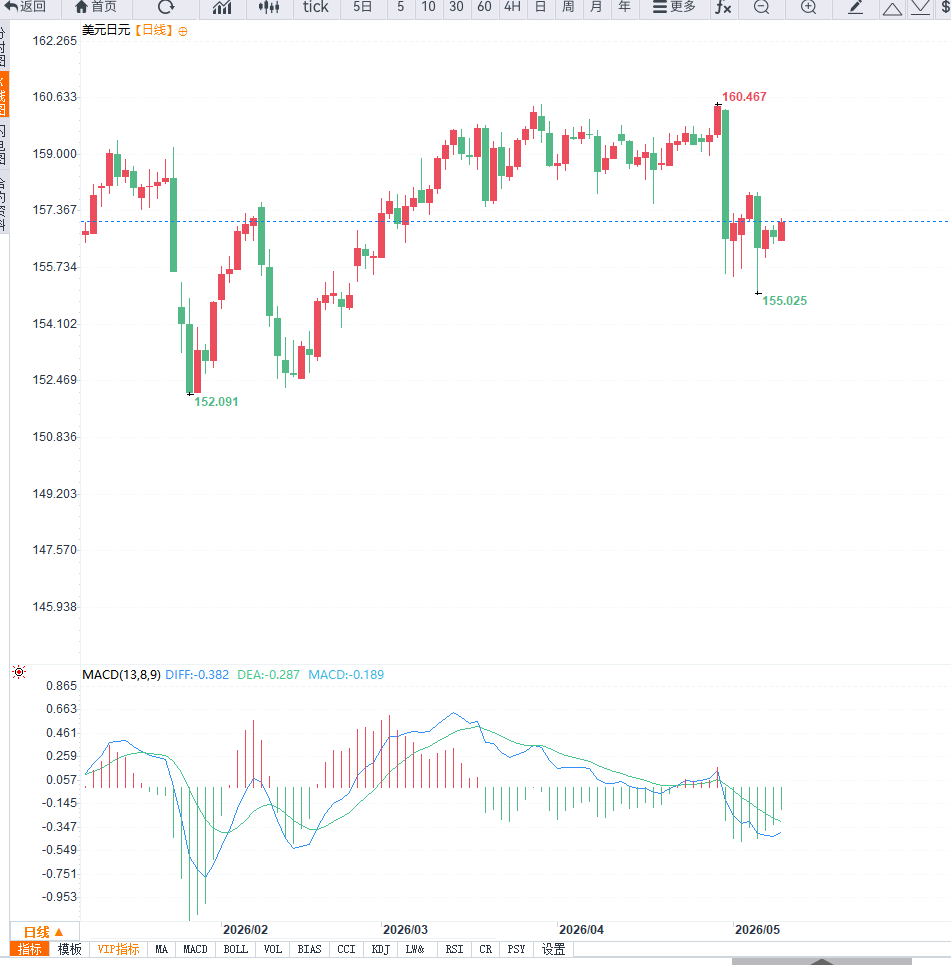
From a technical perspective, the USD/JPY pair maintains its medium-to-long-term upward trend on the daily chart. After regaining the 156 level, the bullish structure remains dominant. Observing the daily chart, the current price is trading within a major upward channel, with the 20-day moving average continuing to diverge upwards, indicating a still-strong medium-term trend. However, the 157.50-158.00 area has formed significant technical resistance. While the MACD indicator remains above the zero line, the expansion rate of the red bars has begun to slow, indicating a weakening of upward momentum. The RSI indicator remains around 65, approaching the overbought zone, showing that short-term chasing sentiment is becoming more cautious. The 156.00 area is currently a key support level on the daily chart; a break below this level could lead to a further pullback to around 154.80. On the upside, a break above 157.50 could potentially test 158.80 or even the 160 level.
Editor's Summary : The USD/JPY market is currently in a complex tug-of-war between a strong dollar and policy support for the yen. Middle East geopolitical risks are driving up demand for the dollar as a safe haven, while strong US employment data and rising US Treasury yields are further strengthening the dollar's interest rate advantage. However, the Japanese government's continued signals of intervention in the foreign exchange market, coupled with rising expectations of a Bank of Japan interest rate hike, are providing temporary support for the yen. From a technical perspective, USD/JPY remains strong in the medium term, but has entered a high-level consolidation phase in the short term. The market needs to focus on three key areas: first, whether the situation in the Middle East will escalate further; second, changes in expectations of a Fed rate cut; and third, whether the Japanese government will intervene in the foreign exchange market again. Overall, USD/JPY may maintain a wide range of high-level fluctuations in the short term, while market volatility may continue to rise.
The United States and Iran continue to reject each other's ceasefire proposals, with significant differences remaining regarding their nuclear programs, highly enriched uranium, and shipping in the Strait of Hormuz. Iran has rejected US demands to dismantle its nuclear facilities and suspend uranium enrichment activities for 20 years. Market analysts point out that the current situation in the Middle East has reignited global risk aversion, and the US dollar's reserve currency status has once again attracted market funds.
As tensions continue in the Strait of Hormuz, international oil prices have risen again, and market concerns about renewed global inflation have intensified significantly. The rise in oil prices has prompted the market to reassess the duration of the Federal Reserve's high interest rates, becoming a key factor supporting the US dollar. Meanwhile, the US non-farm payroll data for April, released last week, significantly exceeded market expectations, further strengthening bullish sentiment towards the dollar. Data showed that the US added 115,000 non-farm jobs in April, far exceeding market expectations of 62,000; the unemployment rate remained at 4.3% . Following the data release, US Treasury yields rose again, and market bets on a rapid rate cut by the Federal Reserve this year have significantly decreased.
Some institutions believe that although the US job market is showing signs of slowing, the overall economic resilience remains strong, and the Federal Reserve lacks a reason to quickly shift to an easing stance in the short term. As a result, rising US Treasury yields have further widened the US-Japan interest rate differential, thus pushing the US dollar to remain high against the Japanese yen.
However, the yen is not entirely without support. Recently, market expectations for further intervention in the foreign exchange market by the Japanese government have continued to rise. Previous reports indicated that Japanese officials intervened in the foreign exchange market during the early May holidays to stabilize the yen. Jun Mimura, Japan's top foreign exchange official, has also stated explicitly that Japan has "no limit" on the number of times it intervenes in the foreign exchange market and maintains daily communication with the United States. The Japanese government's continued signals of intervention have made the market cautious about a further significant rise in the USD/JPY exchange rate. In addition, the Bank of Japan has recently released some hawkish signals. The Bank of Japan previously raised its inflation forecast, and the policy committee vote showed a 6-3 hawkish majority, leading the market to bet that the Bank of Japan may raise interest rates as early as June.
Market participants believe that if the Bank of Japan continues to signal interest rate hikes, it may alleviate the pressure on the yen's continued depreciation to some extent.
From a technical perspective, the USD/JPY pair maintains its medium-to-long-term upward trend on the daily chart. After regaining the 156 level, the bullish structure remains dominant. Observing the daily chart, the current price is trading within a major upward channel, with the 20-day moving average continuing to diverge upwards, indicating a still-strong medium-term trend. However, the 157.50-158.00 area has formed significant technical resistance. While the MACD indicator remains above the zero line, the expansion rate of the red bars has begun to slow, indicating a weakening of upward momentum. The RSI indicator remains around 65, approaching the overbought zone, showing that short-term chasing sentiment is becoming more cautious. The 156.00 area is currently a key support level on the daily chart; a break below this level could lead to a further pullback to around 154.80. On the upside, a break above 157.50 could potentially test 158.80 or even the 160 level.
Editor's Summary : The USD/JPY market is currently in a complex tug-of-war between a strong dollar and policy support for the yen. Middle East geopolitical risks are driving up demand for the dollar as a safe haven, while strong US employment data and rising US Treasury yields are further strengthening the dollar's interest rate advantage. However, the Japanese government's continued signals of intervention in the foreign exchange market, coupled with rising expectations of a Bank of Japan interest rate hike, are providing temporary support for the yen. From a technical perspective, USD/JPY remains strong in the medium term, but has entered a high-level consolidation phase in the short term. The market needs to focus on three key areas: first, whether the situation in the Middle East will escalate further; second, changes in expectations of a Fed rate cut; and third, whether the Japanese government will intervene in the foreign exchange market again. Overall, USD/JPY may maintain a wide range of high-level fluctuations in the short term, while market volatility may continue to rise.
- Risk Warning and Disclaimer
- The market involves risk, and trading may not be suitable for all investors. This article is for reference only and does not constitute personal investment advice, nor does it take into account certain users’ specific investment objectives, financial situation, or other needs. Any investment decisions made based on this information are at your own risk.