Fatal Angle: The UAE's Tight or Loose Stance Sets the Tone for the US-Iran Conflict and Oil Price Trends
2026-05-15 20:49:51
On Friday (May 15), during the European and American trading sessions, oil prices experienced a volatile rise throughout the day before experiencing a slight pullback after reaching a high. WTI crude oil continued to rise above 104, while Brent crude oil rose above 108.
Oil bulls remained restrained during the US state visit to China, and as the event progressed without any significant negative impact on oil prices, they launched a counterattack.
Later that evening, Iranian Foreign Minister Araqchi signaled a de-escalation of the situation, saying that Iran had received a message from the United States indicating their desire to continue negotiations.
Iranian Foreign Minister Araqchi made a concerted effort to reassure the international community, reiterating that Iran does not seek to develop nuclear weapons and that its nuclear program will always remain within the scope of peaceful use. Following his remarks, oil prices fell slightly while gold prices rebounded.
However, the protagonist of this article is someone else entirely . Under the shadow of the rivalry between the two behemoths, the US and Iran, a bizarre "neighborhood feud" is unfolding in the Gulf region.
The protagonist of this drama is the United Arab Emirates.
If we turn back the clock to the beginning of the war, when Iran, in response to the strangulation by the US and Israel, unleashed a barrage of missiles and drones on the Gulf states along the Persian Gulf coast (where numerous US military bases were located).
Strangely, in the face of overwhelming artillery fire, the surrounding Arab powers displayed astonishing "restraint" and tacit understanding.
Saudi Arabia and Qatar not only refused to lend their airspace to the US military to bomb Iran, but also tried their best to maintain the fragile "re-establishment of diplomatic relations" after US bases were attacked.
They do not retaliate or make a fuss, and even secretly speak up for Iran diplomatically, condemning foreign forces for undermining stability in the Middle East.
Even more outrageous, during the US-Iran conflict, Kuwait's air defense system (Patriot missiles) even had a serious incident where it mistakenly shot down three US F-15 fighter jets, and the pilots even received "friendly greetings" from local Kuwaiti residents.
This reflects, in a way, that these Gulf states are resistant to and passively resist the US military in their military cooperation efforts.
However, among these neighbors who pretend to be ignorant, only the United Arab Emirates (UAE) has taken a completely opposite path, becoming deeply intertwined with the US and Israel and thus the "primary target."
Unlike Saudi Arabia, which pursues a fence-sitting diplomacy, the UAE's national security has been deeply intertwined with the United States and Israel since it signed the Abraham Accords and established diplomatic relations with Israel in 2020.
The UAE is home to both a massive US air force base and an intelligence network and the Iron Dome air defense system provided by Israel.
In Iran's eyes, the UAE is no longer an ordinary Arab neighbor, but an "outpost" planted by the US and Israel at the throat of the Strait of Hormuz.
For this reason, the UAE became the "first bird" to suffer the most damage and the most attacks in this conflict.
According to statistics, Iran and its proxies have launched more than 2,800 missiles and drones at the United Arab Emirates.
Dubai International Airport was bombed, luxury hotels caught fire, and oil tanks in Fujairah exploded in flames... The bombardment that originally belonged to Saudi Arabia and Kuwait almost fell on the head of the UAE.
Faced with a barrage of missiles that threatened to destroy the nation's economic foundation, the UAE made a decision that shocked the entire Middle East: to completely break with Iran and launch a full-scale attack. Previously, neither the UAE nor Israel had voluntarily acknowledged this, but on May 11, The Wall Street Journal and Bloomberg suddenly cited revelations from multiple informed officials, officially declassifying and "betraying" the UAE.
According to the latest intelligence reports, just last month, at a delicate moment when Trump was preparing to announce a temporary ceasefire agreement, the UAE secretly deployed its most advanced Western fighter jets to launch a devastating military strike against a large oil refinery on Lavan Island in the Persian Gulf .
The attack ignited a large-scale fire at the oil refinery. Although the fire has been extinguished, the facilities were severely damaged and production capacity was completely paralyzed. This attack directly and severely damaged Iran's already fragile energy lifeline, and the effects are still ongoing.
The UAE declared in this most extreme way that it would no longer be a defenseless party at the mercy of others, but would become a hunter directly involved in the war.
Why would the UAE, a perfectly wealthy nation, choose to be the first to stick its neck out? This is not merely arrogance, but a sophisticated balancing act of self-interest:
The Achilles' heel of a "flow-based" economy: Saudi Arabia relies on underground oil, and two missile strikes to Riyadh could not shake its fundamental position.
But the UAE (especially Dubai) relies on the myth of absolute security to attract global financial institutions, multinational headquarters, and luxury tourism.
Once the myth of security was shattered, foreign investment vanished instantly.
The UAE's only option is to "attack instead of defend," inflicting serious damage on Iran to force Tehran to hesitate and act rashly.
While Saudi Arabia and other countries were passively resisting the United States, the UAE became the only ally to pledge its allegiance.
By participating in this bloody conflict, the UAE hopes to gain a greater say in future US-Iran ceasefire negotiations and to obtain more advanced weapons (such as the F-35) and a robust defense commitment from Washington.
But the price behind this is fatal; the UAE has completely placed itself in opposition to the Shiite Crescent of Resistance.
If the ceasefire agreement fails and the situation spirals out of control again, the UAE, having lost its strategic depth, will face even more aggressive retaliation from Iran. The flames on Lawan Island could turn into thick smoke on the rooftop of the Dubai Financial Centre at any moment.
At the recent BRICS foreign ministers' meeting, this internal Gulf conflict was brought to the international multilateral stage, with Iran and the United Arab Emirates, two major member states, clashing fiercely on the spot.
The UAE was the first to publicly accuse Iran of long-term attacks on facilities within its borders and disrupting regional security. Iranian Foreign Minister Araqchi immediately responded strongly, directly naming the UAE for its secret involvement in the airstrikes on Iran's Lawan Island oil refinery and its collusion with the US and Israel to launch a military invasion against Iran. The two countries exchanged sharp words, creating a highly charged atmosphere.
Even within the BRICS multilateral cooperation framework, the UAE remains unwilling to curb its aggressive stance, insisting on taking a hard line against Iran, making bilateral conflicts public, and causing significant rifts within BRICS due to geopolitical differences in the Middle East.
Small countries caught between large countries, caught in a tug-of-war between intimidation and compromise, have made the UAE's early decision to take sides and act as a vanguard fraught with risk and controversy.
The political landscape of the US-Iran war is now fragmented.
At the recent BRICS summit, the UAE maintained its radical stance, indicating that the conflict between the US and Iran is not over. When the UAE begins to tone down its actions, it may be a sign of the approaching war.
The above story provides readers with a new perspective on the US-Iran conflict: the UAE's stance and its increasingly assertive approach. If the UAE's attitude weakens, it could mean that the US-Iran conflict is making more positive progress.
Even though Iran has repeatedly signaled a willingness to ease tensions, oil prices continue to rise, and there has been no clear sign of a change in the trend.
Technically, Brent crude oil has strengthened ahead of schedule, breaking through the 0.786 Fibonacci retracement level. The current support is at 106.43, which is a key resistance level from the previous period. We should observe whether the oil price can hold above this level. If it can, it is expected to continue to rise.
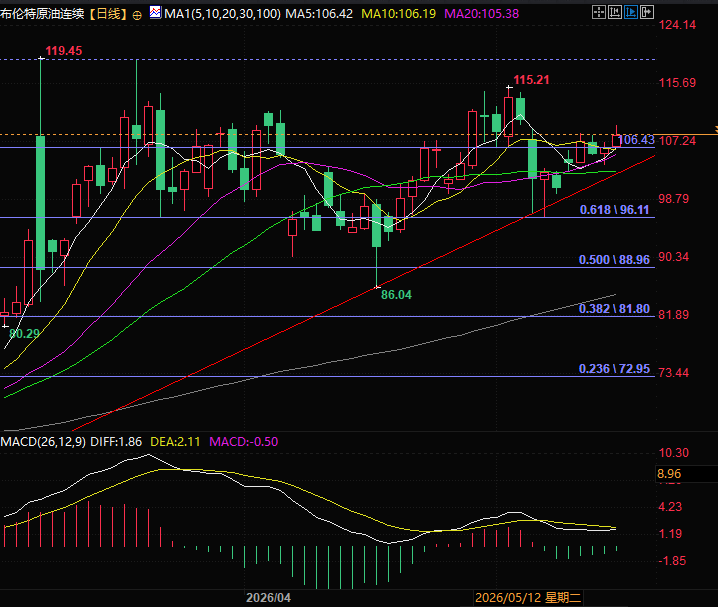
(Brent crude oil futures daily chart, source: EasyForex)
At 20:45 Beijing time, Brent crude oil futures were trading at $108.26 per barrel.
Oil bulls remained restrained during the US state visit to China, and as the event progressed without any significant negative impact on oil prices, they launched a counterattack.
Later that evening, Iranian Foreign Minister Araqchi signaled a de-escalation of the situation, saying that Iran had received a message from the United States indicating their desire to continue negotiations.
Iranian Foreign Minister Araqchi made a concerted effort to reassure the international community, reiterating that Iran does not seek to develop nuclear weapons and that its nuclear program will always remain within the scope of peaceful use. Following his remarks, oil prices fell slightly while gold prices rebounded.
However, the protagonist of this article is someone else entirely . Under the shadow of the rivalry between the two behemoths, the US and Iran, a bizarre "neighborhood feud" is unfolding in the Gulf region.
The protagonist of this drama is the United Arab Emirates.
The neighbors' "tacit understanding": taking the beating but letting the water go.
If we turn back the clock to the beginning of the war, when Iran, in response to the strangulation by the US and Israel, unleashed a barrage of missiles and drones on the Gulf states along the Persian Gulf coast (where numerous US military bases were located).
Strangely, in the face of overwhelming artillery fire, the surrounding Arab powers displayed astonishing "restraint" and tacit understanding.
Saudi Arabia and Qatar not only refused to lend their airspace to the US military to bomb Iran, but also tried their best to maintain the fragile "re-establishment of diplomatic relations" after US bases were attacked.
They do not retaliate or make a fuss, and even secretly speak up for Iran diplomatically, condemning foreign forces for undermining stability in the Middle East.
Even more outrageous, during the US-Iran conflict, Kuwait's air defense system (Patriot missiles) even had a serious incident where it mistakenly shot down three US F-15 fighter jets, and the pilots even received "friendly greetings" from local Kuwaiti residents.
This reflects, in a way, that these Gulf states are resistant to and passively resist the US military in their military cooperation efforts.
However, among these neighbors who pretend to be ignorant, only the United Arab Emirates (UAE) has taken a completely opposite path, becoming deeply intertwined with the US and Israel and thus the "primary target."
The past lives of the UAE and Iran
Unlike Saudi Arabia, which pursues a fence-sitting diplomacy, the UAE's national security has been deeply intertwined with the United States and Israel since it signed the Abraham Accords and established diplomatic relations with Israel in 2020.
The UAE is home to both a massive US air force base and an intelligence network and the Iron Dome air defense system provided by Israel.
In Iran's eyes, the UAE is no longer an ordinary Arab neighbor, but an "outpost" planted by the US and Israel at the throat of the Strait of Hormuz.
For this reason, the UAE became the "first bird" to suffer the most damage and the most attacks in this conflict.
According to statistics, Iran and its proxies have launched more than 2,800 missiles and drones at the United Arab Emirates.
Dubai International Airport was bombed, luxury hotels caught fire, and oil tanks in Fujairah exploded in flames... The bombardment that originally belonged to Saudi Arabia and Kuwait almost fell on the head of the UAE.
The Hidden Counterattack That Overturned the Table: Fires on Lawang Island
Faced with a barrage of missiles that threatened to destroy the nation's economic foundation, the UAE made a decision that shocked the entire Middle East: to completely break with Iran and launch a full-scale attack. Previously, neither the UAE nor Israel had voluntarily acknowledged this, but on May 11, The Wall Street Journal and Bloomberg suddenly cited revelations from multiple informed officials, officially declassifying and "betraying" the UAE.
According to the latest intelligence reports, just last month, at a delicate moment when Trump was preparing to announce a temporary ceasefire agreement, the UAE secretly deployed its most advanced Western fighter jets to launch a devastating military strike against a large oil refinery on Lavan Island in the Persian Gulf .
The attack ignited a large-scale fire at the oil refinery. Although the fire has been extinguished, the facilities were severely damaged and production capacity was completely paralyzed. This attack directly and severely damaged Iran's already fragile energy lifeline, and the effects are still ongoing.
The UAE declared in this most extreme way that it would no longer be a defenseless party at the mercy of others, but would become a hunter directly involved in the war.
A precise balance of interests and a fatal cost
Why would the UAE, a perfectly wealthy nation, choose to be the first to stick its neck out? This is not merely arrogance, but a sophisticated balancing act of self-interest:
The Achilles' heel of a "flow-based" economy: Saudi Arabia relies on underground oil, and two missile strikes to Riyadh could not shake its fundamental position.
But the UAE (especially Dubai) relies on the myth of absolute security to attract global financial institutions, multinational headquarters, and luxury tourism.
Once the myth of security was shattered, foreign investment vanished instantly.
The UAE's only option is to "attack instead of defend," inflicting serious damage on Iran to force Tehran to hesitate and act rashly.
While Saudi Arabia and other countries were passively resisting the United States, the UAE became the only ally to pledge its allegiance.
By participating in this bloody conflict, the UAE hopes to gain a greater say in future US-Iran ceasefire negotiations and to obtain more advanced weapons (such as the F-35) and a robust defense commitment from Washington.
But the price behind this is fatal; the UAE has completely placed itself in opposition to the Shiite Crescent of Resistance.
If the ceasefire agreement fails and the situation spirals out of control again, the UAE, having lost its strategic depth, will face even more aggressive retaliation from Iran. The flames on Lawan Island could turn into thick smoke on the rooftop of the Dubai Financial Centre at any moment.
The recent standoff between the UAE and Iran
At the recent BRICS foreign ministers' meeting, this internal Gulf conflict was brought to the international multilateral stage, with Iran and the United Arab Emirates, two major member states, clashing fiercely on the spot.
The UAE was the first to publicly accuse Iran of long-term attacks on facilities within its borders and disrupting regional security. Iranian Foreign Minister Araqchi immediately responded strongly, directly naming the UAE for its secret involvement in the airstrikes on Iran's Lawan Island oil refinery and its collusion with the US and Israel to launch a military invasion against Iran. The two countries exchanged sharp words, creating a highly charged atmosphere.
Even within the BRICS multilateral cooperation framework, the UAE remains unwilling to curb its aggressive stance, insisting on taking a hard line against Iran, making bilateral conflicts public, and causing significant rifts within BRICS due to geopolitical differences in the Middle East.
Summary and Technical Analysis:
Small countries caught between large countries, caught in a tug-of-war between intimidation and compromise, have made the UAE's early decision to take sides and act as a vanguard fraught with risk and controversy.
The political landscape of the US-Iran war is now fragmented.
At the recent BRICS summit, the UAE maintained its radical stance, indicating that the conflict between the US and Iran is not over. When the UAE begins to tone down its actions, it may be a sign of the approaching war.
The above story provides readers with a new perspective on the US-Iran conflict: the UAE's stance and its increasingly assertive approach. If the UAE's attitude weakens, it could mean that the US-Iran conflict is making more positive progress.
Even though Iran has repeatedly signaled a willingness to ease tensions, oil prices continue to rise, and there has been no clear sign of a change in the trend.
Technically, Brent crude oil has strengthened ahead of schedule, breaking through the 0.786 Fibonacci retracement level. The current support is at 106.43, which is a key resistance level from the previous period. We should observe whether the oil price can hold above this level. If it can, it is expected to continue to rise.
(Brent crude oil futures daily chart, source: EasyForex)
At 20:45 Beijing time, Brent crude oil futures were trading at $108.26 per barrel.
- Risk Warning and Disclaimer
- The market involves risk, and trading may not be suitable for all investors. This article is for reference only and does not constitute personal investment advice, nor does it take into account certain users’ specific investment objectives, financial situation, or other needs. Any investment decisions made based on this information are at your own risk.