The US dollar has risen for five consecutive days, approaching the 100 mark, while non-US currencies have collectively stagnated, but the Japanese yen's trend is a bit unusual.
2026-05-16 12:47:50
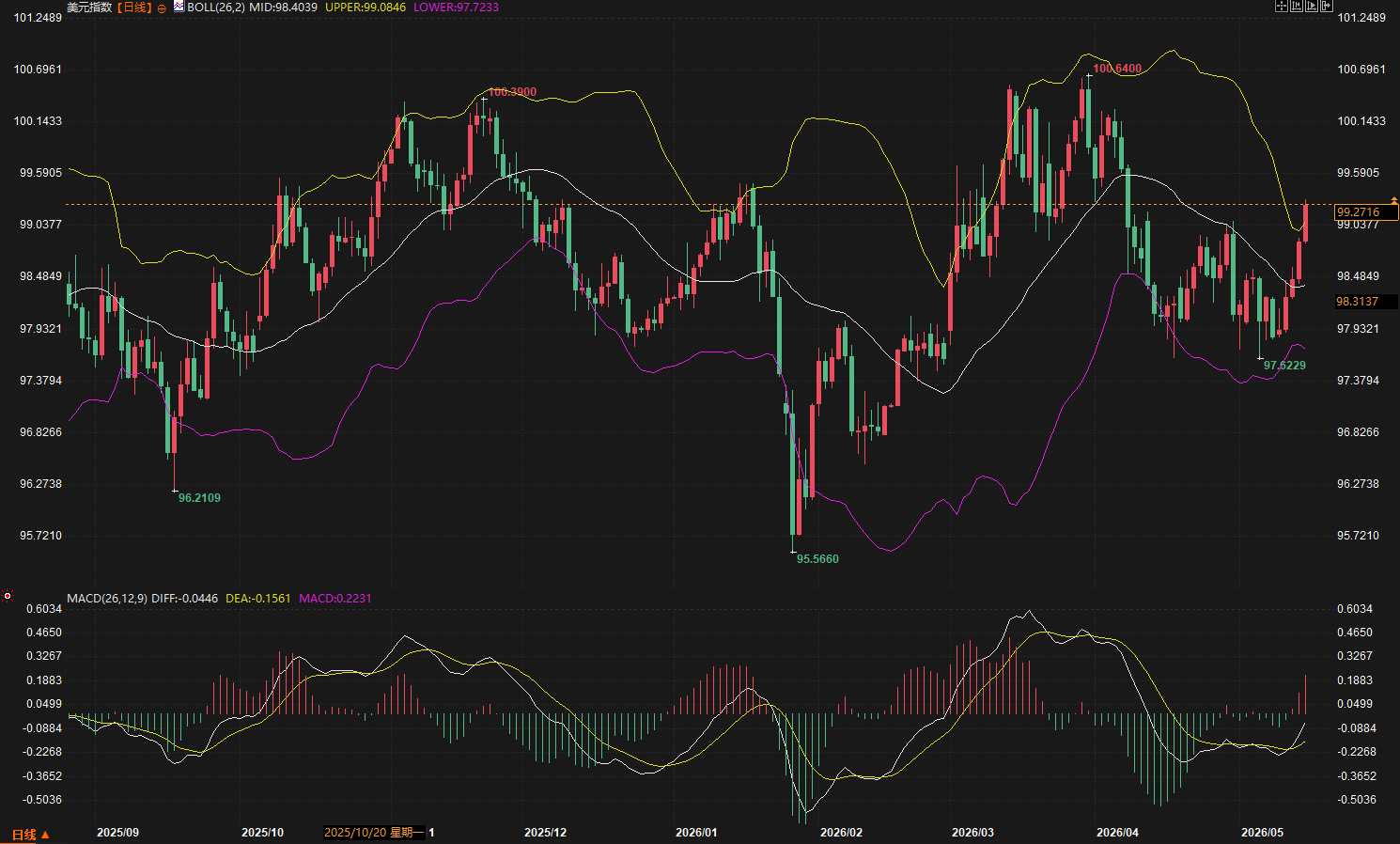
This week, the global foreign exchange market was dominated by a significant strengthening of the US dollar. The US dollar index rose 1.44% for the week, closing positive for five consecutive trading days, breaking through the Bollinger Band middle line at 98.40, with the MACD histogram expanding, establishing a short-term bullish trend. The British pound fell 2.35% against the US dollar for the week, the euro fell 1.38% against the US dollar, the US dollar rose 1.35% against the Japanese yen, and the US dollar rose 0.58% against the Canadian dollar. Overall, against the backdrop of increased volatility in risk assets, the US dollar's attributes as a major safe-haven and high-yield currency have been strengthened.

The US dollar index has risen for five consecutive trading days, briefly touching around 99.30, and ultimately closed the week at 99.27, marking its longest winning streak since late March. The cumulative gain for the week was approximately 1.5%, the largest weekly increase in nearly two months. Technically, the price has effectively broken above the Bollinger Band middle line at 98.40, and the MACD indicator shows continued expansion of the bullish histogram, indicating a clear short-term bullish trend. Resistance is located in the 99.80-100.00 range, while support lies around 98.80.
Summary of Economic Data and Events
Reports from major overseas institutions indicate that a sharp rise in US Treasury yields has boosted the US dollar. The benchmark 10-year Treasury yield rose to 4.599%, a one-year high. Economic data released earlier this week suggested that disruptions to energy supplies due to events in the Middle East have increased inflationary pressures. US crude oil prices surged to $105.38 per barrel, while Brent crude rose to $109.34 per barrel. Federal Reserve officials signaled their concern about inflation, with several officials emphasizing that curbing inflation is a top priority and not ruling out the possibility of adjusting policy if price pressures continue to intensify. New York Fed President Williams stated that given the current uncertainty, monetary policy is in a good position and there is no need to adjust interest rates at this time. The market's probability of a Fed rate hike of at least 25 basis points in December has risen from 14.3% a week ago to 49.5%.
Summary of analyst and institutional views
A well-known foreign media outlet quoted analysts as saying that the bond market is leading this trend, repricing inflation concerns. If energy prices remain high, long-term inflation expectations will need to be factored into prices. Some institutions believe that the recent strength of the US dollar may gradually fade and return to a weaker state, as the Federal Reserve has not yet fully confirmed its interest rate hike expectations. However, overall, the short-term bullish trend of the US dollar is still supported by inflationary pressures. Next week, the US dollar index is expected to test the 99.80-100.00 resistance level. If it breaks through, the upside potential will open up; otherwise, it may fall back and fluctuate.
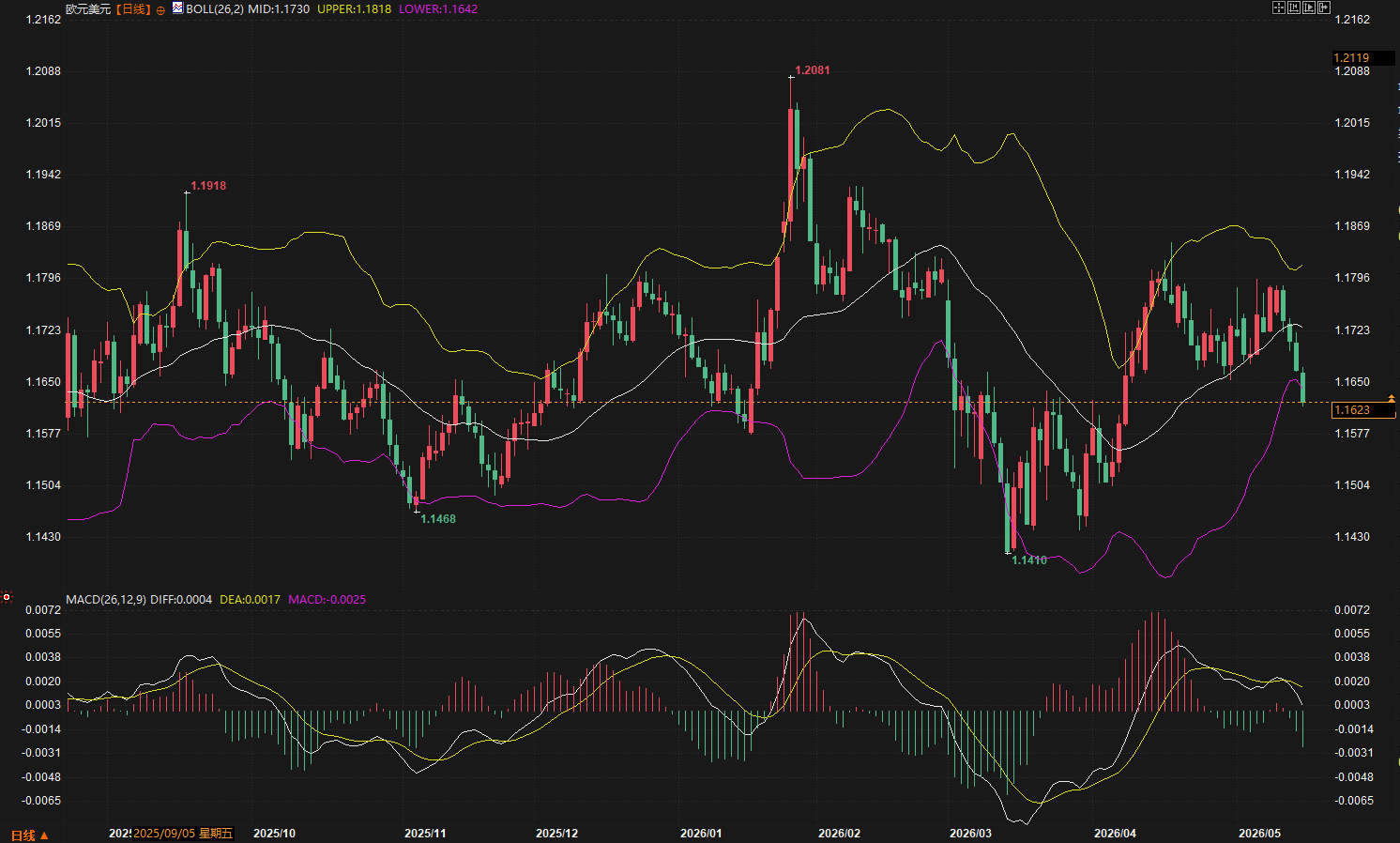
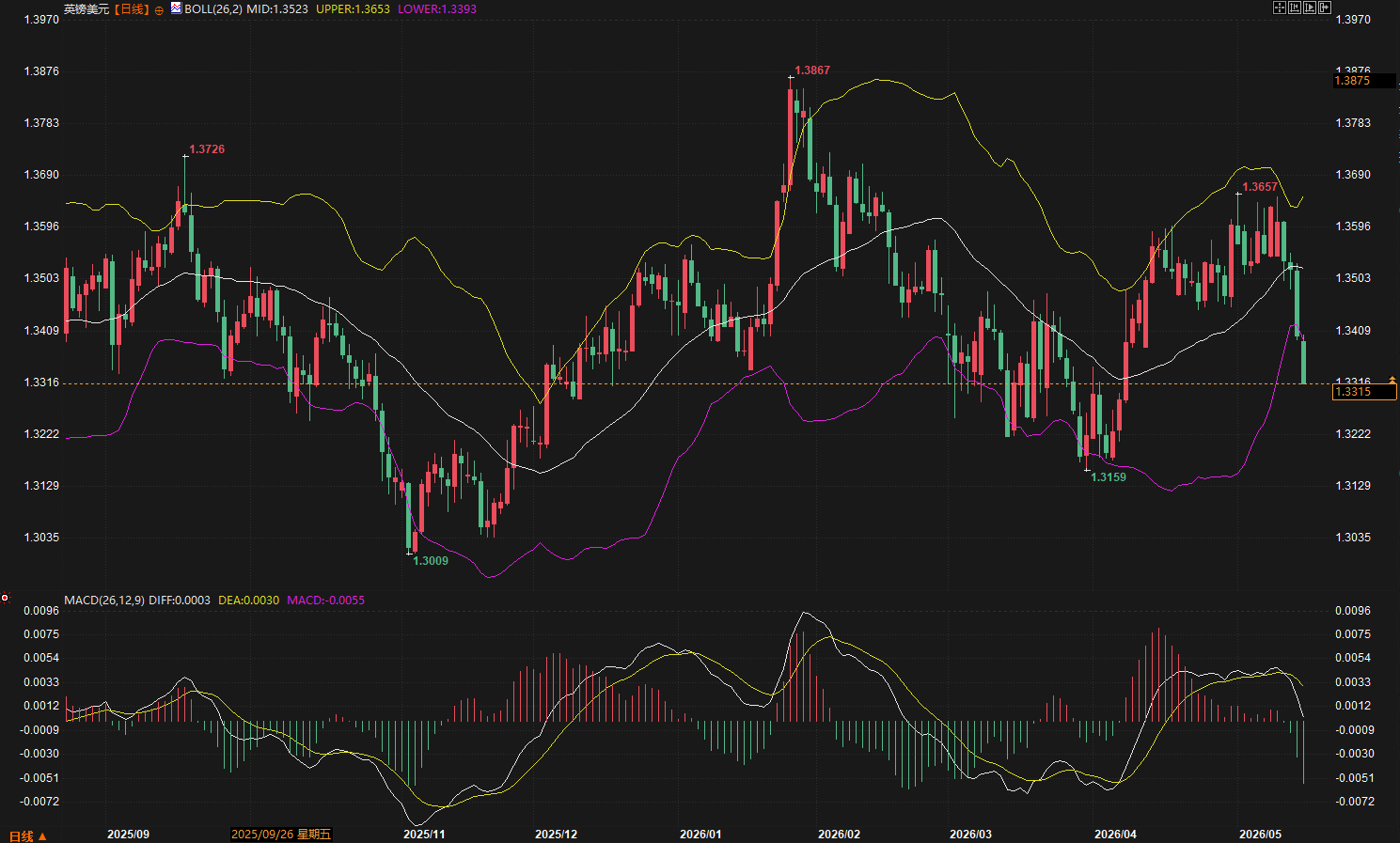
Both the euro and the pound sterling have continued their downward trend against the US dollar, breaking below the Bollinger Band's middle line and approaching the lower support level. The euro fell approximately 1.4% this week, marking its biggest drop in two months; the pound sterling fell more than 2% this week, its largest weekly decline in a considerable period. The MACD histogram continues to expand, indicating significant downward pressure in the short term.
Summary of Economic Data and Events
Eurozone and UK economic data were relatively calm, but volatility in global risk appetite and a strong US dollar exerted downward pressure. In the UK, political uncertainty further weighed on the pound. The impact of rising energy prices on imported inflation in European economies became a key market focus.
Summary of analyst and institutional views
Overseas institutions generally believe that the euro and the pound sterling will continue to face downward pressure in the short term. Support levels for the euro are seen at 1.1580-1.1600, and for the pound sterling at 1.3280-1.3300. A break below these levels would likely lead to further declines; otherwise, a rebound from oversold conditions is possible. The impact of statements from the European Central Bank on the spread of inflation should also be closely monitored.
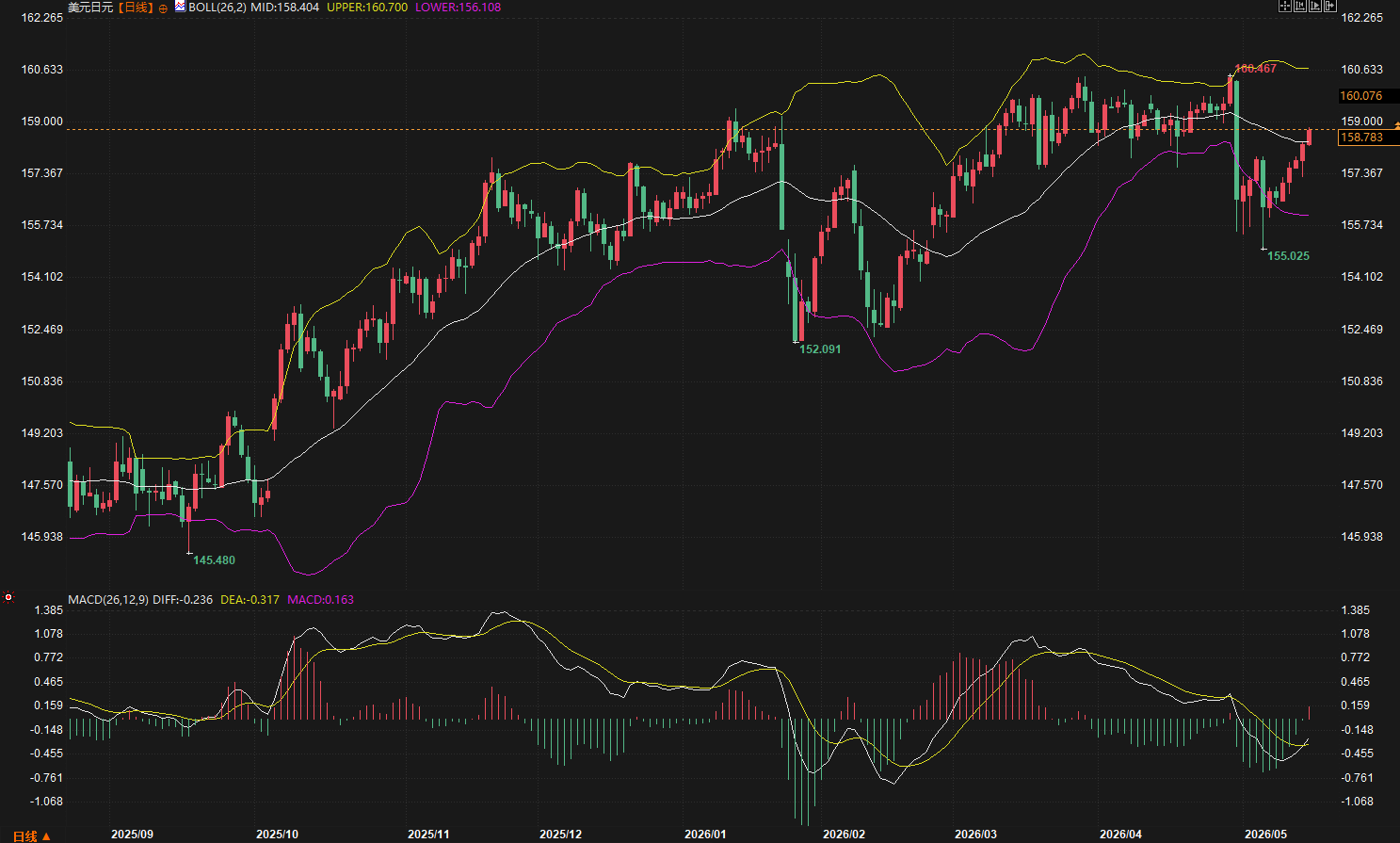
The USD/JPY pair experienced a rapid decline to around 155 during the week before forming a V-shaped reversal, returning above 158. A potential MACD golden cross is emerging, with the weekly chart showing a 1.35% increase. Japan's wholesale inflation rate accelerated in April, reaching its fastest pace in three years, providing a basis for the Bank of Japan's policy.
Summary of Economic Data and Events
Rising Japanese inflation data and a generally strong US dollar have combined to push the yen down by more than 1% this week, nearing the 160 mark again, sparking discussions about potential intervention.
Summary of analyst and institutional views
Analysts believe the rebound trend remains intact, and the price may challenge the 160 level next week. A firm hold above this level would open up further upside potential; otherwise, it will likely return to the 156-158 range. Continued attention should be paid to official statements from Japan and the possibility of actual intervention.
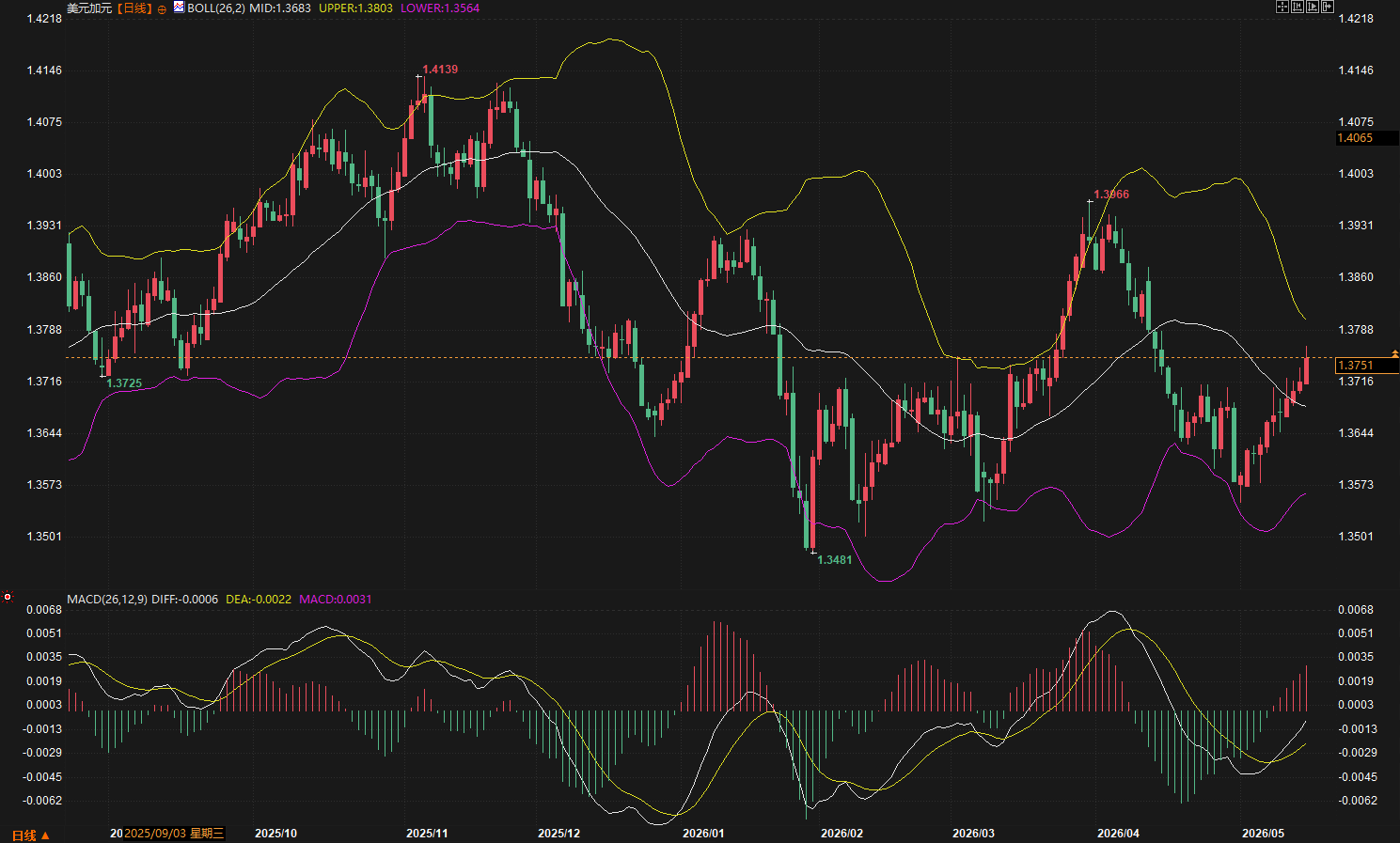
The USD/CAD pair is trending upwards, trading above the middle Bollinger Band. The MACD is near the zero line, indicating a relatively neutral trend. The pair is up 0.58% on the weekly chart.
Summary of Economic Data and Events
Significant fluctuations in crude oil prices have a direct impact on the Canadian dollar. Both US crude and Brent crude rose sharply this week, putting energy-exporting countries' currencies in a dual bind.
Summary of analyst and institutional views
Next week, the Canadian dollar will likely remain range-bound between 1.3700 and 1.3800, with close attention needed to the price action of crude oil. A significant rise in crude oil prices could put downward pressure on the Canadian dollar; otherwise, it will likely maintain its range-bound pattern. Resistance is at 1.3800, and support is at 1.3700.
This week, the core drivers of the foreign exchange market were inflation repricing triggered by rising energy prices and adjustments in Federal Reserve policy expectations. The US dollar index tested key resistance within an uptrend, putting pressure on non-US currencies, but with significant divergence among different instruments: the Japanese yen showed resilience with a rebound, the Canadian dollar fluctuated neutrally due to oil price influences, while the euro and pound sterling saw substantial declines. Looking ahead to next week, the market will continue to weigh developments in the Middle East, further statements from Federal Reserve officials, and key economic data. Overall, the strong dollar trend is unlikely to change in the short term, but investors should be wary of profit-taking and event-driven reversals at higher levels. Investors should remain flexible and pay attention to key technical levels and marginal changes in fundamentals.
Q1: What are the core driving factors behind the five-day winning streak of the US dollar index this week? Is this trend sustainable?
The US dollar index rose for the second consecutive week, reaching a new high, primarily driven by soaring US Treasury yields and a restructuring of inflation expectations. Energy prices rose due to external events, pushing the 10-year US Treasury yield to a one-year high. Market pricing in the Federal Reserve's policy path has shifted significantly, rapidly moving from expectations of rate cuts to a nearly 35 percentage point increase in the probability of rate hikes. This reflects the bond market's anticipation of long-term inflation risks. A well-known foreign media analysis points out that bond yields are leading the foreign exchange market, thereby strengthening the US dollar's safe-haven and yield attributes.
In terms of sustainability, the short-term bullish trend is clear, but it faces resistance at 99.80-100.00. If Fed officials continue to release hawkish signals, or energy prices remain high, the dollar is expected to expand further; conversely, if uncertainties related to the Middle East ease and inflation expectations decline, the dollar may experience a profit-taking pullback. Overall, the current pattern remains dominated by strong fluctuations, and the expected anchoring before the Fed's December meeting needs to be observed. Technically, the increasing volume of the MACD histogram provides support, but the risk of divergence at high levels should be noted.
Q2: What market logic is reflected in the sharp declines in both the euro and the pound sterling?
The euro and pound sterling saw the largest declines this week, with the euro experiencing its biggest weekly drop in two months and the pound also recording a significant correction. The main reason for this was the combined effect of the strong dollar's squeezing effect and the relatively weak fundamentals of the currencies themselves. The rising dollar index directly increased the depreciation pressure on non-dollar currencies against the dollar. Meanwhile, European economies are more sensitive to energy-imported inflation, and events in the Middle East amplified this vulnerability. Uncertainty in the UK's political environment further weakened the pound's safe-haven appeal.
Technically, both have broken below the Bollinger Band's middle line, and the MACD histogram is expanding, confirming a downward trend. Institutional views suggest that short-term downward pressure remains, and testing key support levels will be a prerequisite for a rebound. A break below 1.1580-1.1600 (Euro) and 1.3280-1.3300 (Pound) could open up further downside potential; conversely, a technical rebound may occur after the oversold condition. The market logic is essentially that risk repricing is causing funds to concentrate in the US dollar. The relative policy paths of the European Central Bank and the Bank of England also need to be observed. It is expected that the market will continue to experience pressure and volatility next week until a clear turning point emerges in external driving factors.
Q3: What is the significance of the V-shaped reversal in the USD/JPY exchange rate? Will the 160 level become a watershed?
The USD/JPY pair rebounded sharply after a dip during the week, returning above 158 and forming a classic V-shaped reversal, highlighting the transmission of the overall dollar strength to the yen. Accelerated wholesale inflation in Japan in April provided support for the central bank's policy, but the yen still faces depreciation pressure. This movement reflects the global capital's preference for dollar assets in an uncertain environment, while Japanese inflation data reinforced market expectations for the Bank of Japan's June action.
The 160 level holds significant symbolic meaning, having historically drawn official attention and potential intervention on numerous occasions. A sustained hold above this level could open up upside potential for USD/JPY, potentially testing higher targets; conversely, a pullback could see a return to the 156-158 range. The emerging MACD golden cross provides technical support, but the risk of intervention should be heeded. Overall, the upward trend remains intact, and next week's challenge of 160 will be a key point to watch. Investors should pay close attention to marginal changes in official Japanese statements.
Q4: How do crude oil price fluctuations affect the USD/CAD exchange rate? What are your predictions for next week's market movement?
The USD/CAD pair trended upwards this week, exhibiting a relatively neutral movement, primarily influenced by significant fluctuations in oil prices. As the currency of an energy-exporting country, the Canadian dollar shows a strong positive correlation with oil prices. The substantial rise in both US crude and Brent crude oil prices during the week boosted energy-related earnings but also amplified concerns about global growth. The strong US dollar exerted additional pressure on the Canadian dollar, causing it to fluctuate within the 1.37-1.38 range.
The Canadian dollar is likely to remain range-bound between 1.3700 and 1.3800 next week. Institutional analysts emphasize that crude oil prices will be the key variable: if crude oil prices continue to rise sharply, the Canadian dollar may come under downward pressure; if oil prices fall or stabilize, the USD/CAD pair will continue its range-bound trading pattern. The MACD's proximity to the zero line also confirms the current neutral stance. Investors should closely monitor the marginal impact of developments in the Strait of Hormuz on energy supply, as well as the influence of Federal Reserve policy expectations on the US dollar.
Q5: In summary, what are the main risks and trading logic in the foreign exchange market next week?
Next week, the core focus of the foreign exchange market will remain on inflation expectations, the Federal Reserve's policy path, and the evolution of geopolitical events. Key risks include: unexpected volatility in energy prices leading to accelerated inflation repricing; further statements from Federal Reserve officials strengthening or weakening expectations of interest rate hikes; and the outcome of battles at key technical resistance levels (such as the US dollar index at 99.80-100 and the Japanese yen at the 160 level).
The US dollar maintains a bullish trend, but profit-taking should be watched out for at higher levels. Among non-US dollar currencies, the Japanese yen has shown relatively strong resilience, while the euro and pound sterling face significant downward pressure, and the Canadian dollar is closely following the movement of crude oil prices. The overall environment remains event-driven, and attention should be paid to marginal changes in data and official speeches. From a long-term perspective, continued inflationary pressures will support the US dollar, but a recovery in global risk appetite may temporarily suppress its gains. The information gap in the market lies in differing assessments of the sustainability of events in the Middle East, which will be the core catalyst for short-term market volatility.
US Dollar Index: Weekly Performance Review
The US dollar index has risen for five consecutive trading days, briefly touching around 99.30, and ultimately closed the week at 99.27, marking its longest winning streak since late March. The cumulative gain for the week was approximately 1.5%, the largest weekly increase in nearly two months. Technically, the price has effectively broken above the Bollinger Band middle line at 98.40, and the MACD indicator shows continued expansion of the bullish histogram, indicating a clear short-term bullish trend. Resistance is located in the 99.80-100.00 range, while support lies around 98.80.
Summary of Economic Data and Events
Reports from major overseas institutions indicate that a sharp rise in US Treasury yields has boosted the US dollar. The benchmark 10-year Treasury yield rose to 4.599%, a one-year high. Economic data released earlier this week suggested that disruptions to energy supplies due to events in the Middle East have increased inflationary pressures. US crude oil prices surged to $105.38 per barrel, while Brent crude rose to $109.34 per barrel. Federal Reserve officials signaled their concern about inflation, with several officials emphasizing that curbing inflation is a top priority and not ruling out the possibility of adjusting policy if price pressures continue to intensify. New York Fed President Williams stated that given the current uncertainty, monetary policy is in a good position and there is no need to adjust interest rates at this time. The market's probability of a Fed rate hike of at least 25 basis points in December has risen from 14.3% a week ago to 49.5%.
Summary of analyst and institutional views
A well-known foreign media outlet quoted analysts as saying that the bond market is leading this trend, repricing inflation concerns. If energy prices remain high, long-term inflation expectations will need to be factored into prices. Some institutions believe that the recent strength of the US dollar may gradually fade and return to a weaker state, as the Federal Reserve has not yet fully confirmed its interest rate hike expectations. However, overall, the short-term bullish trend of the US dollar is still supported by inflationary pressures. Next week, the US dollar index is expected to test the 99.80-100.00 resistance level. If it breaks through, the upside potential will open up; otherwise, it may fall back and fluctuate.
Euro and Pound Sterling: Weekly Performance Review
Both the euro and the pound sterling have continued their downward trend against the US dollar, breaking below the Bollinger Band's middle line and approaching the lower support level. The euro fell approximately 1.4% this week, marking its biggest drop in two months; the pound sterling fell more than 2% this week, its largest weekly decline in a considerable period. The MACD histogram continues to expand, indicating significant downward pressure in the short term.
Summary of Economic Data and Events
Eurozone and UK economic data were relatively calm, but volatility in global risk appetite and a strong US dollar exerted downward pressure. In the UK, political uncertainty further weighed on the pound. The impact of rising energy prices on imported inflation in European economies became a key market focus.
Summary of analyst and institutional views
Overseas institutions generally believe that the euro and the pound sterling will continue to face downward pressure in the short term. Support levels for the euro are seen at 1.1580-1.1600, and for the pound sterling at 1.3280-1.3300. A break below these levels would likely lead to further declines; otherwise, a rebound from oversold conditions is possible. The impact of statements from the European Central Bank on the spread of inflation should also be closely monitored.
USD/JPY: Weekly Performance Review
The USD/JPY pair experienced a rapid decline to around 155 during the week before forming a V-shaped reversal, returning above 158. A potential MACD golden cross is emerging, with the weekly chart showing a 1.35% increase. Japan's wholesale inflation rate accelerated in April, reaching its fastest pace in three years, providing a basis for the Bank of Japan's policy.
Summary of Economic Data and Events
Rising Japanese inflation data and a generally strong US dollar have combined to push the yen down by more than 1% this week, nearing the 160 mark again, sparking discussions about potential intervention.
Summary of analyst and institutional views
Analysts believe the rebound trend remains intact, and the price may challenge the 160 level next week. A firm hold above this level would open up further upside potential; otherwise, it will likely return to the 156-158 range. Continued attention should be paid to official statements from Japan and the possibility of actual intervention.
USD/CAD: Weekly Performance Review
The USD/CAD pair is trending upwards, trading above the middle Bollinger Band. The MACD is near the zero line, indicating a relatively neutral trend. The pair is up 0.58% on the weekly chart.
Summary of Economic Data and Events
Significant fluctuations in crude oil prices have a direct impact on the Canadian dollar. Both US crude and Brent crude rose sharply this week, putting energy-exporting countries' currencies in a dual bind.
Summary of analyst and institutional views
Next week, the Canadian dollar will likely remain range-bound between 1.3700 and 1.3800, with close attention needed to the price action of crude oil. A significant rise in crude oil prices could put downward pressure on the Canadian dollar; otherwise, it will likely maintain its range-bound pattern. Resistance is at 1.3800, and support is at 1.3700.
Summary and Outlook
This week, the core drivers of the foreign exchange market were inflation repricing triggered by rising energy prices and adjustments in Federal Reserve policy expectations. The US dollar index tested key resistance within an uptrend, putting pressure on non-US currencies, but with significant divergence among different instruments: the Japanese yen showed resilience with a rebound, the Canadian dollar fluctuated neutrally due to oil price influences, while the euro and pound sterling saw substantial declines. Looking ahead to next week, the market will continue to weigh developments in the Middle East, further statements from Federal Reserve officials, and key economic data. Overall, the strong dollar trend is unlikely to change in the short term, but investors should be wary of profit-taking and event-driven reversals at higher levels. Investors should remain flexible and pay attention to key technical levels and marginal changes in fundamentals.
QA module
Q1: What are the core driving factors behind the five-day winning streak of the US dollar index this week? Is this trend sustainable?
The US dollar index rose for the second consecutive week, reaching a new high, primarily driven by soaring US Treasury yields and a restructuring of inflation expectations. Energy prices rose due to external events, pushing the 10-year US Treasury yield to a one-year high. Market pricing in the Federal Reserve's policy path has shifted significantly, rapidly moving from expectations of rate cuts to a nearly 35 percentage point increase in the probability of rate hikes. This reflects the bond market's anticipation of long-term inflation risks. A well-known foreign media analysis points out that bond yields are leading the foreign exchange market, thereby strengthening the US dollar's safe-haven and yield attributes.
In terms of sustainability, the short-term bullish trend is clear, but it faces resistance at 99.80-100.00. If Fed officials continue to release hawkish signals, or energy prices remain high, the dollar is expected to expand further; conversely, if uncertainties related to the Middle East ease and inflation expectations decline, the dollar may experience a profit-taking pullback. Overall, the current pattern remains dominated by strong fluctuations, and the expected anchoring before the Fed's December meeting needs to be observed. Technically, the increasing volume of the MACD histogram provides support, but the risk of divergence at high levels should be noted.
Q2: What market logic is reflected in the sharp declines in both the euro and the pound sterling?
The euro and pound sterling saw the largest declines this week, with the euro experiencing its biggest weekly drop in two months and the pound also recording a significant correction. The main reason for this was the combined effect of the strong dollar's squeezing effect and the relatively weak fundamentals of the currencies themselves. The rising dollar index directly increased the depreciation pressure on non-dollar currencies against the dollar. Meanwhile, European economies are more sensitive to energy-imported inflation, and events in the Middle East amplified this vulnerability. Uncertainty in the UK's political environment further weakened the pound's safe-haven appeal.
Technically, both have broken below the Bollinger Band's middle line, and the MACD histogram is expanding, confirming a downward trend. Institutional views suggest that short-term downward pressure remains, and testing key support levels will be a prerequisite for a rebound. A break below 1.1580-1.1600 (Euro) and 1.3280-1.3300 (Pound) could open up further downside potential; conversely, a technical rebound may occur after the oversold condition. The market logic is essentially that risk repricing is causing funds to concentrate in the US dollar. The relative policy paths of the European Central Bank and the Bank of England also need to be observed. It is expected that the market will continue to experience pressure and volatility next week until a clear turning point emerges in external driving factors.
Q3: What is the significance of the V-shaped reversal in the USD/JPY exchange rate? Will the 160 level become a watershed?
The USD/JPY pair rebounded sharply after a dip during the week, returning above 158 and forming a classic V-shaped reversal, highlighting the transmission of the overall dollar strength to the yen. Accelerated wholesale inflation in Japan in April provided support for the central bank's policy, but the yen still faces depreciation pressure. This movement reflects the global capital's preference for dollar assets in an uncertain environment, while Japanese inflation data reinforced market expectations for the Bank of Japan's June action.
The 160 level holds significant symbolic meaning, having historically drawn official attention and potential intervention on numerous occasions. A sustained hold above this level could open up upside potential for USD/JPY, potentially testing higher targets; conversely, a pullback could see a return to the 156-158 range. The emerging MACD golden cross provides technical support, but the risk of intervention should be heeded. Overall, the upward trend remains intact, and next week's challenge of 160 will be a key point to watch. Investors should pay close attention to marginal changes in official Japanese statements.
Q4: How do crude oil price fluctuations affect the USD/CAD exchange rate? What are your predictions for next week's market movement?
The USD/CAD pair trended upwards this week, exhibiting a relatively neutral movement, primarily influenced by significant fluctuations in oil prices. As the currency of an energy-exporting country, the Canadian dollar shows a strong positive correlation with oil prices. The substantial rise in both US crude and Brent crude oil prices during the week boosted energy-related earnings but also amplified concerns about global growth. The strong US dollar exerted additional pressure on the Canadian dollar, causing it to fluctuate within the 1.37-1.38 range.
The Canadian dollar is likely to remain range-bound between 1.3700 and 1.3800 next week. Institutional analysts emphasize that crude oil prices will be the key variable: if crude oil prices continue to rise sharply, the Canadian dollar may come under downward pressure; if oil prices fall or stabilize, the USD/CAD pair will continue its range-bound trading pattern. The MACD's proximity to the zero line also confirms the current neutral stance. Investors should closely monitor the marginal impact of developments in the Strait of Hormuz on energy supply, as well as the influence of Federal Reserve policy expectations on the US dollar.
Q5: In summary, what are the main risks and trading logic in the foreign exchange market next week?
Next week, the core focus of the foreign exchange market will remain on inflation expectations, the Federal Reserve's policy path, and the evolution of geopolitical events. Key risks include: unexpected volatility in energy prices leading to accelerated inflation repricing; further statements from Federal Reserve officials strengthening or weakening expectations of interest rate hikes; and the outcome of battles at key technical resistance levels (such as the US dollar index at 99.80-100 and the Japanese yen at the 160 level).
The US dollar maintains a bullish trend, but profit-taking should be watched out for at higher levels. Among non-US dollar currencies, the Japanese yen has shown relatively strong resilience, while the euro and pound sterling face significant downward pressure, and the Canadian dollar is closely following the movement of crude oil prices. The overall environment remains event-driven, and attention should be paid to marginal changes in data and official speeches. From a long-term perspective, continued inflationary pressures will support the US dollar, but a recovery in global risk appetite may temporarily suppress its gains. The information gap in the market lies in differing assessments of the sustainability of events in the Middle East, which will be the core catalyst for short-term market volatility.
- Risk Warning and Disclaimer
- The market involves risk, and trading may not be suitable for all investors. This article is for reference only and does not constitute personal investment advice, nor does it take into account certain users’ specific investment objectives, financial situation, or other needs. Any investment decisions made based on this information are at your own risk.