A single-day surge of 3% and a weekly jump of 10% – the US and Iran are exchanging increasingly harsh rhetoric. Will next week be a bull market frenzy or a meat grinder?
2026-05-16 14:22:08
This week, the international oil market was driven by tensions between the US and Iran, with both Brent crude and US crude recording significant gains. Oil prices rose more than 3% on Friday alone, with weekly gains reaching 7.84% and 10.48% respectively. Market concerns about the security situation around the Strait of Hormuz were the main driving factor. Although the number of ships passing through the strait has recently rebounded, overall uncertainty still dominates trading sentiment. Potential risks on the supply side and a recovery in demand expectations resonated, pushing oil prices in a volatile upward trend.

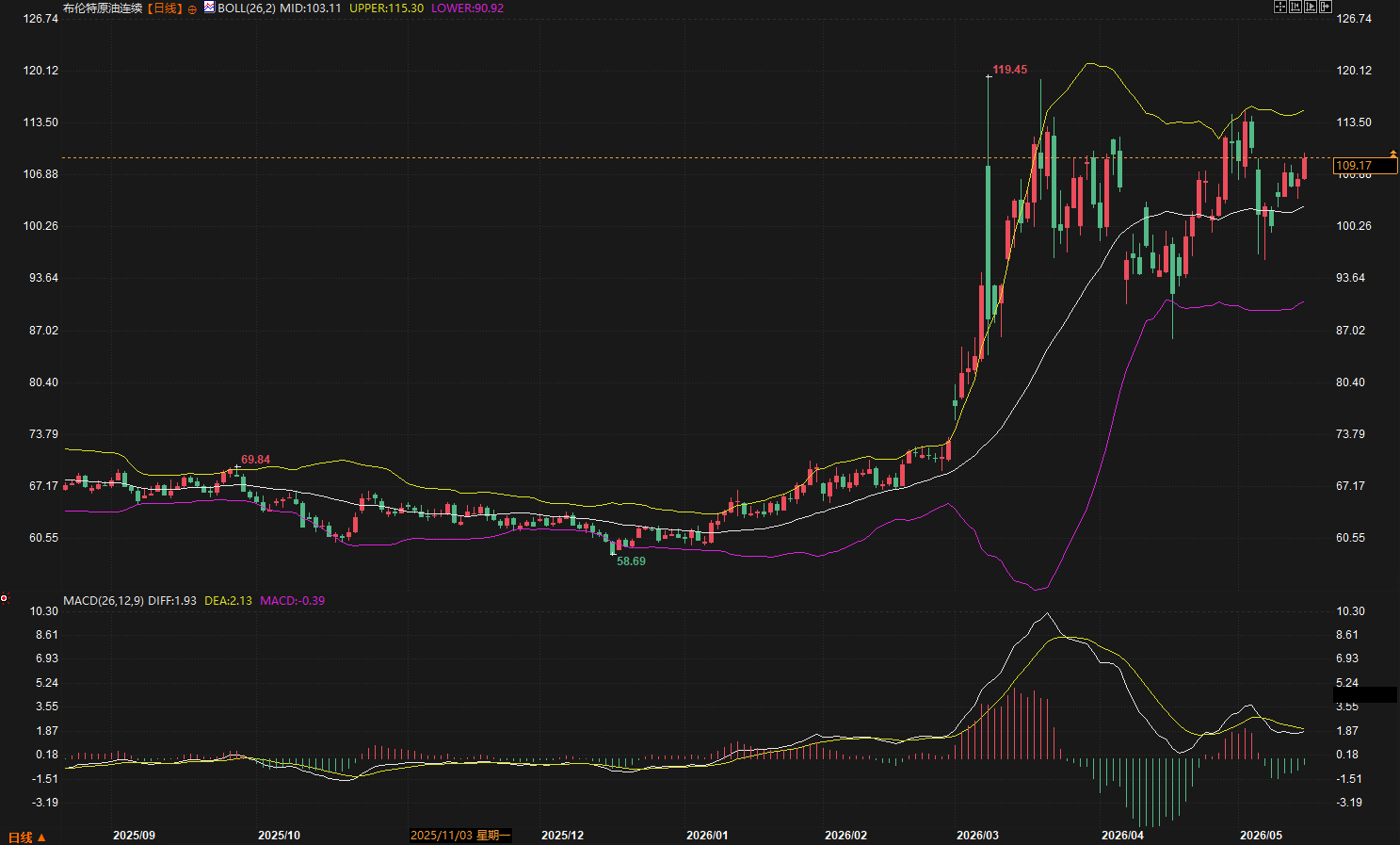
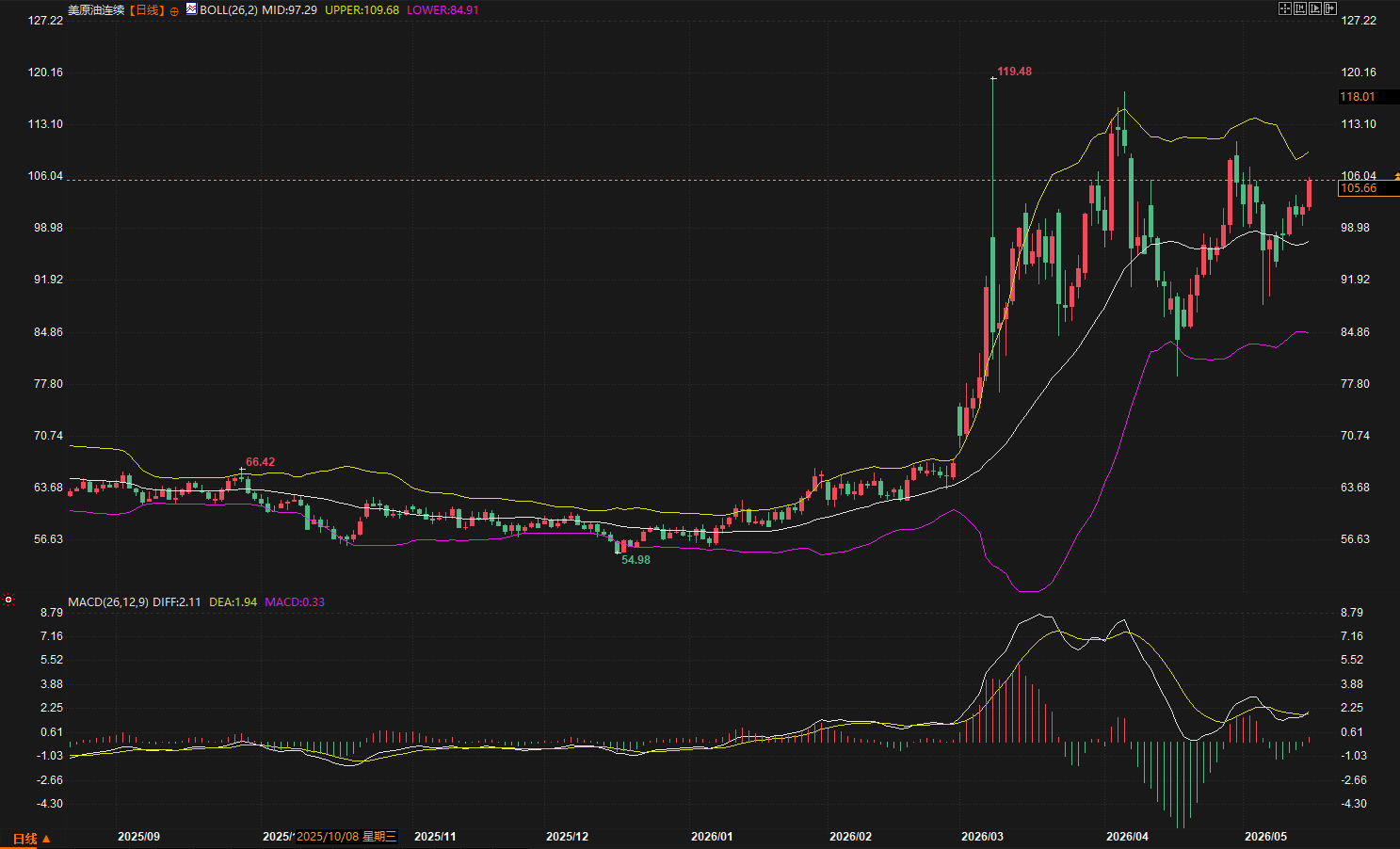
This week, crude oil futures exhibited a volatile upward trend with three positive and two negative days. Brent crude oil effectively held above the middle Bollinger Band, while US crude oil also traded above its middle band, demonstrating a clear short-term bullish pattern. Before the weekend close, oil prices continued their strong performance, with a single-day increase exceeding 3%, and weekly gains of 8.57% and 11.60% respectively, indicating a rapid rise in market risk appetite amid supply concerns. Overall, the price center steadily increased, and trading activity improved, reflecting participants' continued focus on the security of key Middle Eastern transportation routes.
This week's core events focused on US-Iran interactions. Trump publicly stated that his patience with Iran was nearing its end, emphasizing the need to reopen the Strait of Hormuz; Iran responded by saying it lacked trust in the US, while stating it was prepared but would retain diplomatic channels. Leading foreign media outlets pointed out that the Strait of Hormuz, as a crucial waterway for approximately one-fifth of the world's oil and liquefied natural gas, directly impacts the logistical efficiency of major exporting countries like Saudi Arabia, Iraq, and Qatar. Reports from the Iranian Revolutionary Guard indicated that 30 ships passed through the strait between Wednesday and Thursday, a significant improvement compared to pre-war levels. The fragile ceasefire agreement, coupled with the latest statements from both sides, has led to a further downward revision of market expectations regarding its sustainability.
Analysts at Commerzbank pointed out that rhetoric between the US and Iran has become increasingly confrontational again. Although the ceasefire remains in place, hopes for a swift reopening of the Strait of Hormuz have significantly diminished. Several major overseas institutions believe that the current rise in oil prices is primarily due to increased uncertainty on the supply side, rather than strong demand. Institutions generally observe that bullish technical signals are gradually strengthening, but profit-taking pressure after the geopolitical tensions ease should not be ignored. The overall view tends to be that supply risk premiums will continue to support oil prices at relatively high levels in the short term.
This week, the crude oil market rebounded significantly amid heightened tensions between the US and Iran. Navigation dynamics in the Strait of Hormuz and high-level statements became the core variables driving price fluctuations. Supply concerns confirmed the upward trend in oil prices, but the fragile ceasefire agreement also means that any diplomatic developments could quickly alter market sentiment. Next week, the oil market will continue to oscillate around the evolving situation in the region. Participants need to continuously monitor subsequent statements from both sides and changes in actual navigation data to grasp potential volatility. Overall, under the current circumstances, oil prices are likely to maintain a slightly bullish trend, but uncertainties remain prominent.
Q1: What were the core drivers behind this week's sharp rise in oil prices? Which factor carried more weight: supply concerns or demand recovery?
This week's oil price increase was primarily driven by supply-side risk premiums. The latest tough statements from both the US and Iran have directly amplified the potential disruption risk in the Strait of Hormuz, which handles one-fifth of global oil and gas transport; any fluctuations in this strait will quickly impact the pricing system. Although Iran has reported an increase in the number of ships passing through, it remains far below normal levels, and market confidence in the stability of the ceasefire agreement remains weak. In contrast, while demand recovery exists, it is a secondary factor. The general consensus among institutions is that the current rise is more of an expansion of risk premiums than strong confirmation from end-consumer data. This structure means that once geopolitical tensions substantially ease, oil prices may face rapid profit-taking pressure. Traders need to distinguish the nature of the driving forces and avoid simply equating short-term sentiment increases with trend reversals.
Q2: Are the strengthening bullish signals from the technical indicators sufficient to support a continued rise in oil prices?
Technical indicators show that the MACD histogram for Brent crude oil is contracting, while the MACD for WTI crude oil has turned positive, with a golden cross signal gradually emerging between the DIFF and DEA lines. Combined with the effective stabilization above the Bollinger Band's middle line, the short-term bullish trend remains intact. However, technical patterns alone cannot completely dictate price action. The current candlestick structure still falls within the range of upward oscillation rather than establishing a clear trend. The key lies in whether the price can confirm the validity of the breakout above the resistance level in subsequent trading. If geopolitical events continue to provide support, the technical signals will be strengthened by fundamentals; conversely, if high-level negotiations show positive progress, the technical indicators may quickly turn into a divergence. Therefore, technical analysis should be used as a supplementary tool, combined with event-driven logic, to form a more complete judgment framework.
Q3: What does the recovery in traffic volume in the Strait of Hormuz mean for oil prices? Can it quickly quell market concerns?
While the data of 30 vessels passing through shows some signs of recovery, it is still far from the daily level of 140 vessels, and the sustainability of this data needs to be verified over several days. The core market concern lies in the potential for recurring disruptions under the "fragile ceasefire," rather than the current number of vessels passing through in a single period. A well-known foreign media analysis points out that the Strait, as a key choke point, will not immediately lose its security premium due to short-term data improvements. From a trading perspective, the recovery in traffic volume can be seen as a marginal positive, but it is unlikely to completely reverse the pricing logic dominated by supply uncertainty. Investors need to observe the actual traffic trends over the next one to two weeks, and whether this is accompanied by more constructive diplomatic signals from both sides.
Q4: What impact will the statements made by Trump and the Iranian foreign minister have on the prospects for subsequent negotiations?
Both sides' latest statements reveal a hardline stance: the US emphasizes its waning patience and the necessity of reopening the Strait of Hormuz, while Iran highlights a lack of trust and its readiness to return to the battlefield. This confrontational posture reduces the probability of a swift and comprehensive agreement in the short term, and also makes the market cautious about any diplomatic breakthrough. Historical experience shows that such high-level statements often amplify volatility initially before leaving room for subsequent compromises. In the current environment, the prospects for negotiations remain uncertain, and any subtle adjustment in the stance of either side could trigger a significant reaction in oil prices. Participants should closely monitor signals released through official channels, rather than interpreting individual statements in isolation.
Q5: What key variables will the crude oil market face next week? How should participants construct their observation framework?
Key variables next week include: progress in US-Iran interactions, changes in actual navigation data in the Strait of Hormuz, statements from major oil-producing countries, and marginal adjustments to macroeconomic demand expectations. When constructing an observation framework, it is recommended to prioritize geopolitical events, use technical indicators as a second layer of verification, and demand data as a third reference dimension. This layered logic helps maintain clear judgment in a complex environment and avoids being misled by a single factor. Overall, the current oil market remains in an event-driven phase, and volatility is likely to remain high. Participants need to remain flexible and adjust their risk exposure management strategies promptly based on new information.
Weekly Market Review
This week, crude oil futures exhibited a volatile upward trend with three positive and two negative days. Brent crude oil effectively held above the middle Bollinger Band, while US crude oil also traded above its middle band, demonstrating a clear short-term bullish pattern. Before the weekend close, oil prices continued their strong performance, with a single-day increase exceeding 3%, and weekly gains of 8.57% and 11.60% respectively, indicating a rapid rise in market risk appetite amid supply concerns. Overall, the price center steadily increased, and trading activity improved, reflecting participants' continued focus on the security of key Middle Eastern transportation routes.
Summary of Economic Data/Events
This week's core events focused on US-Iran interactions. Trump publicly stated that his patience with Iran was nearing its end, emphasizing the need to reopen the Strait of Hormuz; Iran responded by saying it lacked trust in the US, while stating it was prepared but would retain diplomatic channels. Leading foreign media outlets pointed out that the Strait of Hormuz, as a crucial waterway for approximately one-fifth of the world's oil and liquefied natural gas, directly impacts the logistical efficiency of major exporting countries like Saudi Arabia, Iraq, and Qatar. Reports from the Iranian Revolutionary Guard indicated that 30 ships passed through the strait between Wednesday and Thursday, a significant improvement compared to pre-war levels. The fragile ceasefire agreement, coupled with the latest statements from both sides, has led to a further downward revision of market expectations regarding its sustainability.
Summary of Analyst/Institutional Views
Analysts at Commerzbank pointed out that rhetoric between the US and Iran has become increasingly confrontational again. Although the ceasefire remains in place, hopes for a swift reopening of the Strait of Hormuz have significantly diminished. Several major overseas institutions believe that the current rise in oil prices is primarily due to increased uncertainty on the supply side, rather than strong demand. Institutions generally observe that bullish technical signals are gradually strengthening, but profit-taking pressure after the geopolitical tensions ease should not be ignored. The overall view tends to be that supply risk premiums will continue to support oil prices at relatively high levels in the short term.
This week, the crude oil market rebounded significantly amid heightened tensions between the US and Iran. Navigation dynamics in the Strait of Hormuz and high-level statements became the core variables driving price fluctuations. Supply concerns confirmed the upward trend in oil prices, but the fragile ceasefire agreement also means that any diplomatic developments could quickly alter market sentiment. Next week, the oil market will continue to oscillate around the evolving situation in the region. Participants need to continuously monitor subsequent statements from both sides and changes in actual navigation data to grasp potential volatility. Overall, under the current circumstances, oil prices are likely to maintain a slightly bullish trend, but uncertainties remain prominent.
QA module
Q1: What were the core drivers behind this week's sharp rise in oil prices? Which factor carried more weight: supply concerns or demand recovery?
This week's oil price increase was primarily driven by supply-side risk premiums. The latest tough statements from both the US and Iran have directly amplified the potential disruption risk in the Strait of Hormuz, which handles one-fifth of global oil and gas transport; any fluctuations in this strait will quickly impact the pricing system. Although Iran has reported an increase in the number of ships passing through, it remains far below normal levels, and market confidence in the stability of the ceasefire agreement remains weak. In contrast, while demand recovery exists, it is a secondary factor. The general consensus among institutions is that the current rise is more of an expansion of risk premiums than strong confirmation from end-consumer data. This structure means that once geopolitical tensions substantially ease, oil prices may face rapid profit-taking pressure. Traders need to distinguish the nature of the driving forces and avoid simply equating short-term sentiment increases with trend reversals.
Q2: Are the strengthening bullish signals from the technical indicators sufficient to support a continued rise in oil prices?
Technical indicators show that the MACD histogram for Brent crude oil is contracting, while the MACD for WTI crude oil has turned positive, with a golden cross signal gradually emerging between the DIFF and DEA lines. Combined with the effective stabilization above the Bollinger Band's middle line, the short-term bullish trend remains intact. However, technical patterns alone cannot completely dictate price action. The current candlestick structure still falls within the range of upward oscillation rather than establishing a clear trend. The key lies in whether the price can confirm the validity of the breakout above the resistance level in subsequent trading. If geopolitical events continue to provide support, the technical signals will be strengthened by fundamentals; conversely, if high-level negotiations show positive progress, the technical indicators may quickly turn into a divergence. Therefore, technical analysis should be used as a supplementary tool, combined with event-driven logic, to form a more complete judgment framework.
Q3: What does the recovery in traffic volume in the Strait of Hormuz mean for oil prices? Can it quickly quell market concerns?
While the data of 30 vessels passing through shows some signs of recovery, it is still far from the daily level of 140 vessels, and the sustainability of this data needs to be verified over several days. The core market concern lies in the potential for recurring disruptions under the "fragile ceasefire," rather than the current number of vessels passing through in a single period. A well-known foreign media analysis points out that the Strait, as a key choke point, will not immediately lose its security premium due to short-term data improvements. From a trading perspective, the recovery in traffic volume can be seen as a marginal positive, but it is unlikely to completely reverse the pricing logic dominated by supply uncertainty. Investors need to observe the actual traffic trends over the next one to two weeks, and whether this is accompanied by more constructive diplomatic signals from both sides.
Q4: What impact will the statements made by Trump and the Iranian foreign minister have on the prospects for subsequent negotiations?
Both sides' latest statements reveal a hardline stance: the US emphasizes its waning patience and the necessity of reopening the Strait of Hormuz, while Iran highlights a lack of trust and its readiness to return to the battlefield. This confrontational posture reduces the probability of a swift and comprehensive agreement in the short term, and also makes the market cautious about any diplomatic breakthrough. Historical experience shows that such high-level statements often amplify volatility initially before leaving room for subsequent compromises. In the current environment, the prospects for negotiations remain uncertain, and any subtle adjustment in the stance of either side could trigger a significant reaction in oil prices. Participants should closely monitor signals released through official channels, rather than interpreting individual statements in isolation.
Q5: What key variables will the crude oil market face next week? How should participants construct their observation framework?
Key variables next week include: progress in US-Iran interactions, changes in actual navigation data in the Strait of Hormuz, statements from major oil-producing countries, and marginal adjustments to macroeconomic demand expectations. When constructing an observation framework, it is recommended to prioritize geopolitical events, use technical indicators as a second layer of verification, and demand data as a third reference dimension. This layered logic helps maintain clear judgment in a complex environment and avoids being misled by a single factor. Overall, the current oil market remains in an event-driven phase, and volatility is likely to remain high. Participants need to remain flexible and adjust their risk exposure management strategies promptly based on new information.
- Risk Warning and Disclaimer
- The market involves risk, and trading may not be suitable for all investors. This article is for reference only and does not constitute personal investment advice, nor does it take into account certain users’ specific investment objectives, financial situation, or other needs. Any investment decisions made based on this information are at your own risk.