Crude Oil Trading Alert: Escalating tensions in the Middle East fuel supply concerns, causing oil prices to retreat back to the upper limit of their consolidation range, awaiting stress testing.
2026-05-18 09:34:30
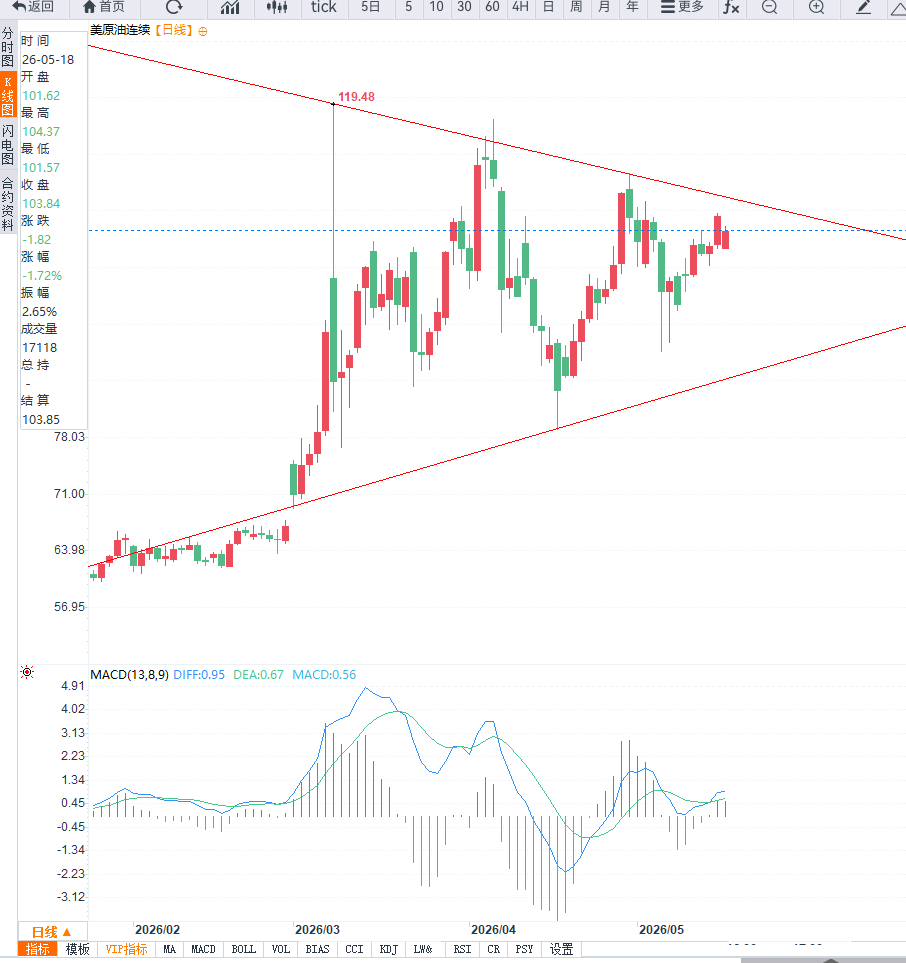
WTI crude oil prices continued their strong upward trend during Monday's Asian trading session, rising for the third consecutive trading day and hitting a two-week high. It is currently trading around $104.06, with a daily gain of approximately 3%. Increased market concerns about escalating geopolitical risks in the Middle East have become a key factor driving the continued rebound in international oil prices.

US President Trump recently issued a strong warning to Iran on social media, stating that "time is running out" and suggesting that the situation could deteriorate further if Iran does not take action. This statement quickly boosted market risk aversion and caused the energy market to re-induce the Middle East supply risk premium.
Meanwhile, Israel and the United States are advancing new military preparations, raising market concerns that the two sides may resume joint operations against Iran. As the Middle East is one of the world's most important energy export regions, any escalation of the situation could directly impact the global oil supply chain.
The Strait of Hormuz handles approximately 20% of global seaborne crude oil transport. The market is currently particularly focused on the safety of this shipping route. Any disruption to shipping could rapidly worsen the global energy market's supply shortage, a key reason for the recent sharp rebound in crude oil prices. Negotiations between the US and Iran have yet to yield substantial progress, with significant differences remaining between the two sides regarding the nuclear issue. Furthermore, continued US restrictions on Iranian ports have fueled market concerns about a further decline in Iranian crude oil exports. Against this backdrop, the risk premium in the global energy market continues to widen, driving funds back into the crude oil market.
From a market perspective, WTI crude oil has rebounded significantly from its monthly low near $87. Investors are beginning to reassess global oil supply risks, especially as the peak summer demand season approaches, with concerns about declining inventories and supply shortages intensifying. However, the continued strength of the US dollar is exerting some downward pressure on oil prices. Typically, a stronger dollar reduces the attractiveness of dollar-denominated commodities, thus impacting international buying demand. With the market re-betting that the Federal Reserve may maintain higher interest rates in 2026, the dollar index has risen to its highest level since early April.
The US dollar index rose to its highest level since April 7, limiting further gains in crude oil prices. Market concerns exist that if the dollar continues to strengthen, it could put profit-taking pressure on crude oil prices at their current high levels.
From a technical perspective, WTI crude oil has returned to a bullish trend on the daily chart. After breaking through the $100 and $101 levels, bullish momentum has clearly strengthened. In the short term, a new battleground between bulls and bears is forming around $105. If it can effectively hold above this level, the market may further test the $108-$112 range.
Observing the 4-hour chart, WTI crude oil is still maintaining an upward trend in the short term. The MACD indicator remains above the zero line, indicating that short-term market sentiment remains bullish, while the RSI indicator is gradually approaching the high zone, suggesting that the market may experience technical consolidation after the rapid rise. If the situation in the Middle East continues to deteriorate, oil prices may break through recent highs; however, if the US dollar continues to strengthen, it may trigger some short-term funds to exit the market.
Editor's Summary:
The international crude oil market has re-entered a phase dominated by geopolitical risks, with developments in the Middle East becoming the core variable determining short-term oil price direction. Shipping risks in the Strait of Hormuz, tensions between the US and Iran, and concerns about global supply disruptions have provided strong support for the crude oil market. Meanwhile, a stronger US dollar and expectations of higher interest rates from the Federal Reserve have limited the upside potential for oil prices. Going forward, the market will need to focus on whether the Middle East situation escalates further, changes in global inventories, and subsequent policy moves by major oil-producing countries. In this highly volatile environment, the crude oil market may continue its strong, volatile pattern in the short term.
US President Trump recently issued a strong warning to Iran on social media, stating that "time is running out" and suggesting that the situation could deteriorate further if Iran does not take action. This statement quickly boosted market risk aversion and caused the energy market to re-induce the Middle East supply risk premium.
Meanwhile, Israel and the United States are advancing new military preparations, raising market concerns that the two sides may resume joint operations against Iran. As the Middle East is one of the world's most important energy export regions, any escalation of the situation could directly impact the global oil supply chain.
The Strait of Hormuz handles approximately 20% of global seaborne crude oil transport. The market is currently particularly focused on the safety of this shipping route. Any disruption to shipping could rapidly worsen the global energy market's supply shortage, a key reason for the recent sharp rebound in crude oil prices. Negotiations between the US and Iran have yet to yield substantial progress, with significant differences remaining between the two sides regarding the nuclear issue. Furthermore, continued US restrictions on Iranian ports have fueled market concerns about a further decline in Iranian crude oil exports. Against this backdrop, the risk premium in the global energy market continues to widen, driving funds back into the crude oil market.
From a market perspective, WTI crude oil has rebounded significantly from its monthly low near $87. Investors are beginning to reassess global oil supply risks, especially as the peak summer demand season approaches, with concerns about declining inventories and supply shortages intensifying. However, the continued strength of the US dollar is exerting some downward pressure on oil prices. Typically, a stronger dollar reduces the attractiveness of dollar-denominated commodities, thus impacting international buying demand. With the market re-betting that the Federal Reserve may maintain higher interest rates in 2026, the dollar index has risen to its highest level since early April.
The US dollar index rose to its highest level since April 7, limiting further gains in crude oil prices. Market concerns exist that if the dollar continues to strengthen, it could put profit-taking pressure on crude oil prices at their current high levels.
From a technical perspective, WTI crude oil has returned to a bullish trend on the daily chart. After breaking through the $100 and $101 levels, bullish momentum has clearly strengthened. In the short term, a new battleground between bulls and bears is forming around $105. If it can effectively hold above this level, the market may further test the $108-$112 range.
Observing the 4-hour chart, WTI crude oil is still maintaining an upward trend in the short term. The MACD indicator remains above the zero line, indicating that short-term market sentiment remains bullish, while the RSI indicator is gradually approaching the high zone, suggesting that the market may experience technical consolidation after the rapid rise. If the situation in the Middle East continues to deteriorate, oil prices may break through recent highs; however, if the US dollar continues to strengthen, it may trigger some short-term funds to exit the market.
Editor's Summary:
The international crude oil market has re-entered a phase dominated by geopolitical risks, with developments in the Middle East becoming the core variable determining short-term oil price direction. Shipping risks in the Strait of Hormuz, tensions between the US and Iran, and concerns about global supply disruptions have provided strong support for the crude oil market. Meanwhile, a stronger US dollar and expectations of higher interest rates from the Federal Reserve have limited the upside potential for oil prices. Going forward, the market will need to focus on whether the Middle East situation escalates further, changes in global inventories, and subsequent policy moves by major oil-producing countries. In this highly volatile environment, the crude oil market may continue its strong, volatile pattern in the short term.
- Risk Warning and Disclaimer
- The market involves risk, and trading may not be suitable for all investors. This article is for reference only and does not constitute personal investment advice, nor does it take into account certain users’ specific investment objectives, financial situation, or other needs. Any investment decisions made based on this information are at your own risk.