Escalating tensions in the Middle East and rising expectations of a Federal Reserve interest rate hike have boosted the US dollar, keeping it near a one-month high against the Canadian dollar.
2026-05-18 13:24:11
During Monday's Asian trading session, the USD/CAD pair maintained a relatively strong trend, trading above 1.3700. Although still below the one-month high reached last week, the overall bullish pattern remains evident. The core factors currently driving the dollar's rise are primarily the market's increasing expectations of further tightening by the Federal Reserve and the continued strengthening of global risk aversion.
US President Trump warned Iran on social media on Sunday that "time is running out" and hinted at potential serious consequences if the situation does not improve. Meanwhile, Israel and the US are advancing new military preparations, raising market concerns that the two sides may resume joint operations against Iran. Due to the continued escalation of the Middle East situation, global energy supply risks have once again become a focus of market attention.
Escalating shipping risks in the Strait of Hormuz have pushed international crude oil prices to a two-week high. The Strait of Hormuz handles approximately 20% of global seaborne crude oil transport. Current shipping restrictions in the region are further exacerbating concerns about global energy supply and driving up international oil prices.
Generally, rising oil prices benefit the Canadian dollar because Canada is one of the world's major energy exporters, and higher international oil prices improve Canada's export revenue and terms of trade. Therefore, while the US dollar is generally stronger, rising oil prices also provide some support for the Canadian dollar, thus limiting further upside potential for the USD/CAD exchange rate. However, the current market's dominant logic still leans towards the US dollar.
With rising international energy prices, market concerns about a resurgence of global inflation have intensified significantly. Investors are beginning to reassess the Federal Reserve's future policy path and are betting that the Fed may maintain higher interest rates for an extended period. According to data from the CME Group's FedWatch tool, the market now expects a greater than 50% probability of further rate hikes by the Fed this year. This expectation has pushed the dollar index to its highest level since April 7.
The market has repriced in the possibility of a Federal Reserve rate hike, keeping the dollar index at a relatively high level. Meanwhile, persistent geopolitical risks have strengthened the dollar's safe-haven appeal. Amid increased global market volatility, a large influx of funds into dollar assets has further propelled the dollar's strength.
From a Canadian economic perspective, while rising oil prices provide some support, global economic uncertainty and a high-interest-rate environment could still impact Canadian exports and economic growth. Furthermore, with no major economic data releases from the US or Canada at the beginning of this week, market focus is primarily on developments in the Middle East, international oil prices, and the US dollar's performance.
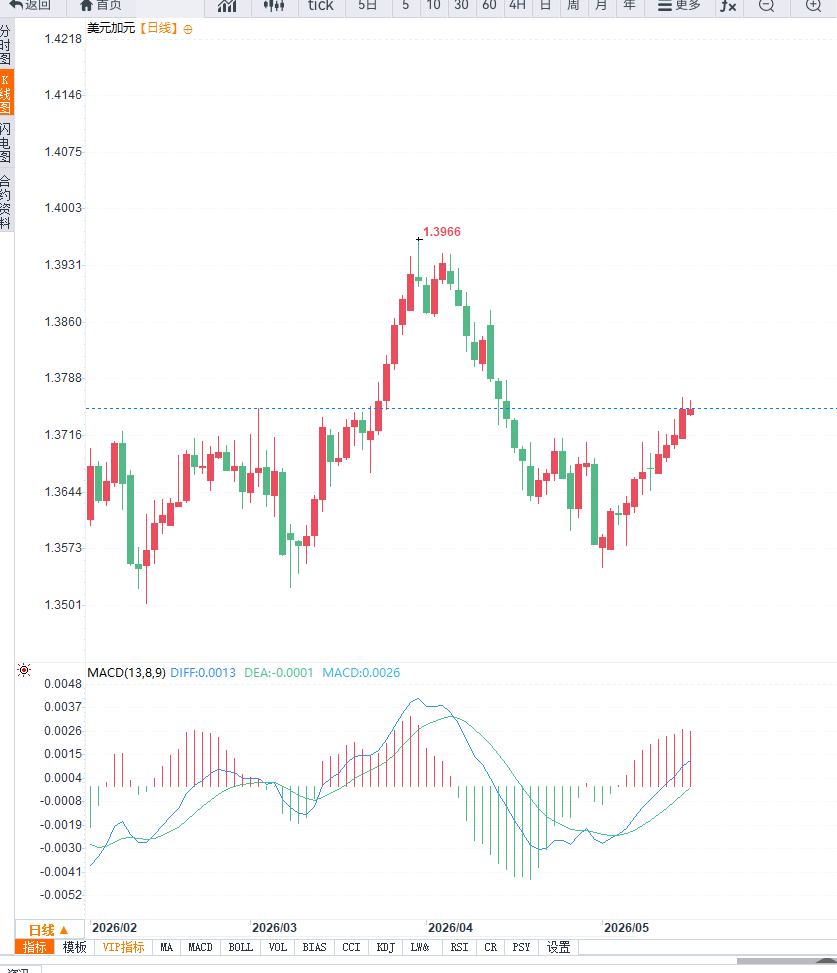
From a technical perspective, the USD/CAD pair is currently maintaining a clear upward structure on the daily chart. After breaking through 1.3700, bullish momentum has continued to strengthen. In the short term, the area around 1.3750 is a key resistance zone; a successful break above this level could lead to a further test of the 1.3800 level. Looking at the 4-hour chart, the USD/CAD pair remains in a slightly bullish, oscillating pattern. The MACD indicator is above the zero line, indicating that bullish sentiment still dominates the market, while the RSI indicator is gradually approaching high levels, suggesting a potential need for some technical consolidation in the short term. However, as long as the US dollar remains strong, the overall upward trend is likely to continue. Rising WTI crude oil prices are providing support for the Canadian dollar, but safe-haven buying of the US dollar continues to dominate the market.
The market will focus on whether the situation in the Middle East will escalate further, speeches by Federal Reserve officials, and changes in international energy prices. If oil prices continue to rise, the Canadian dollar may receive further support; however, if demand for the US dollar as a safe haven increases further, the USD/CAD pair may still have room to rise further.
Editor's Summary:
The current USD/CAD exchange rate is primarily influenced by both safe-haven buying of the US dollar and support from oil prices for the Canadian dollar. Escalating tensions in the Middle East have driven up international oil prices, reinforcing market expectations of a high-interest-rate policy from the Federal Reserve, thus supporting a continued strengthening of the US dollar. While Canada, as an energy exporter, benefits from high oil prices, overall market risk appetite is currently declining, and the US dollar still holds a significant advantage. In the short term, the USD/CAD exchange rate may maintain a high-level, slightly bullish trend. The market will focus on the evolution of Middle East risks and changes in Federal Reserve policy.
US President Trump warned Iran on social media on Sunday that "time is running out" and hinted at potential serious consequences if the situation does not improve. Meanwhile, Israel and the US are advancing new military preparations, raising market concerns that the two sides may resume joint operations against Iran. Due to the continued escalation of the Middle East situation, global energy supply risks have once again become a focus of market attention.
Escalating shipping risks in the Strait of Hormuz have pushed international crude oil prices to a two-week high. The Strait of Hormuz handles approximately 20% of global seaborne crude oil transport. Current shipping restrictions in the region are further exacerbating concerns about global energy supply and driving up international oil prices.
Generally, rising oil prices benefit the Canadian dollar because Canada is one of the world's major energy exporters, and higher international oil prices improve Canada's export revenue and terms of trade. Therefore, while the US dollar is generally stronger, rising oil prices also provide some support for the Canadian dollar, thus limiting further upside potential for the USD/CAD exchange rate. However, the current market's dominant logic still leans towards the US dollar.
With rising international energy prices, market concerns about a resurgence of global inflation have intensified significantly. Investors are beginning to reassess the Federal Reserve's future policy path and are betting that the Fed may maintain higher interest rates for an extended period. According to data from the CME Group's FedWatch tool, the market now expects a greater than 50% probability of further rate hikes by the Fed this year. This expectation has pushed the dollar index to its highest level since April 7.
The market has repriced in the possibility of a Federal Reserve rate hike, keeping the dollar index at a relatively high level. Meanwhile, persistent geopolitical risks have strengthened the dollar's safe-haven appeal. Amid increased global market volatility, a large influx of funds into dollar assets has further propelled the dollar's strength.
From a Canadian economic perspective, while rising oil prices provide some support, global economic uncertainty and a high-interest-rate environment could still impact Canadian exports and economic growth. Furthermore, with no major economic data releases from the US or Canada at the beginning of this week, market focus is primarily on developments in the Middle East, international oil prices, and the US dollar's performance.
From a technical perspective, the USD/CAD pair is currently maintaining a clear upward structure on the daily chart. After breaking through 1.3700, bullish momentum has continued to strengthen. In the short term, the area around 1.3750 is a key resistance zone; a successful break above this level could lead to a further test of the 1.3800 level. Looking at the 4-hour chart, the USD/CAD pair remains in a slightly bullish, oscillating pattern. The MACD indicator is above the zero line, indicating that bullish sentiment still dominates the market, while the RSI indicator is gradually approaching high levels, suggesting a potential need for some technical consolidation in the short term. However, as long as the US dollar remains strong, the overall upward trend is likely to continue. Rising WTI crude oil prices are providing support for the Canadian dollar, but safe-haven buying of the US dollar continues to dominate the market.
The market will focus on whether the situation in the Middle East will escalate further, speeches by Federal Reserve officials, and changes in international energy prices. If oil prices continue to rise, the Canadian dollar may receive further support; however, if demand for the US dollar as a safe haven increases further, the USD/CAD pair may still have room to rise further.
Editor's Summary:
The current USD/CAD exchange rate is primarily influenced by both safe-haven buying of the US dollar and support from oil prices for the Canadian dollar. Escalating tensions in the Middle East have driven up international oil prices, reinforcing market expectations of a high-interest-rate policy from the Federal Reserve, thus supporting a continued strengthening of the US dollar. While Canada, as an energy exporter, benefits from high oil prices, overall market risk appetite is currently declining, and the US dollar still holds a significant advantage. In the short term, the USD/CAD exchange rate may maintain a high-level, slightly bullish trend. The market will focus on the evolution of Middle East risks and changes in Federal Reserve policy.
- Risk Warning and Disclaimer
- The market involves risk, and trading may not be suitable for all investors. This article is for reference only and does not constitute personal investment advice, nor does it take into account certain users’ specific investment objectives, financial situation, or other needs. Any investment decisions made based on this information are at your own risk.