Soaring US Treasury yields reinforced expectations of a hawkish stance from the Federal Reserve, causing the dollar index to remain volatile at high levels.
2026-05-19 11:08:04
The US dollar index (DXY) rebounded after two consecutive days of correction during Tuesday's Asian trading session, currently hovering around 99.10. A sharp rise in US Treasury yields was the core factor supporting the dollar's rebound, as market expectations for the Federal Reserve to maintain high interest rates in the future are rekindling.
Data shows that the yield on the 10-year US Treasury note surged to 4.659% overnight, its highest level since February 2025, before falling back to around 4.591%. The yield's renewed approach to the 4.60% mark indicates a significant increase in market concerns about future inflationary pressures. Analysts believe that the recent sustained rise in international energy prices is reigniting market concerns about a rebound in US consumer inflation and may force the Federal Reserve to maintain high interest rates for an extended period.
International crude oil prices remain high, hovering around $100 per barrel. Due to ongoing tensions in the Middle East, the global energy supply chain faces uncertainty, and the market is concerned that high oil prices may further spread to transportation, manufacturing, and consumption sectors, thereby pushing up overall inflation. Against this backdrop, the bond market is beginning to re-induce higher interest rate risks.
Meanwhile, the market is also focused on policy changes within the Federal Reserve. Lou Bryan, market strategist at DRW Trading, pointed out that recent market volatility stems in part from investors observing how new Fed Chairman Kevin Warsh will address inflationary pressures. The market is particularly concerned about whether the Fed will maintain its policy independence and continue to prioritize controlling inflation. Currently, market expectations for the Fed to maintain high interest rates throughout the year have clearly intensified, with some institutions even beginning to reassess the possibility of further rate hikes. With the risk of high inflation not yet fully eliminated, the Fed's policy path remains one of the most crucial factors influencing global financial markets.
However, the upside potential of the US dollar remains limited in the short term by changes in risk sentiment. US President Trump announced a temporary halt to planned military action against Iran to allow more time for diplomatic negotiations. Following this announcement, market risk appetite improved, global stock market sentiment rebounded, and some safe-haven funds flowed out of the US dollar. Analysts believe that the current US dollar market is in a tug-of-war between "high yield support" and "declining safe-haven demand." On the one hand, the continued rise in US Treasury yields strengthens the dollar's attractiveness; on the other hand, the short-term easing of geopolitical tensions has weakened some safe-haven buying.
From a global market perspective, the recent strengthening of the US dollar has put pressure on some emerging market currencies. As US yields continue to rise, global funds are flowing back into dollar assets, causing volatility in some high-risk assets. At the same time, a strong dollar may also increase global financing costs and influence the direction of international capital flows.
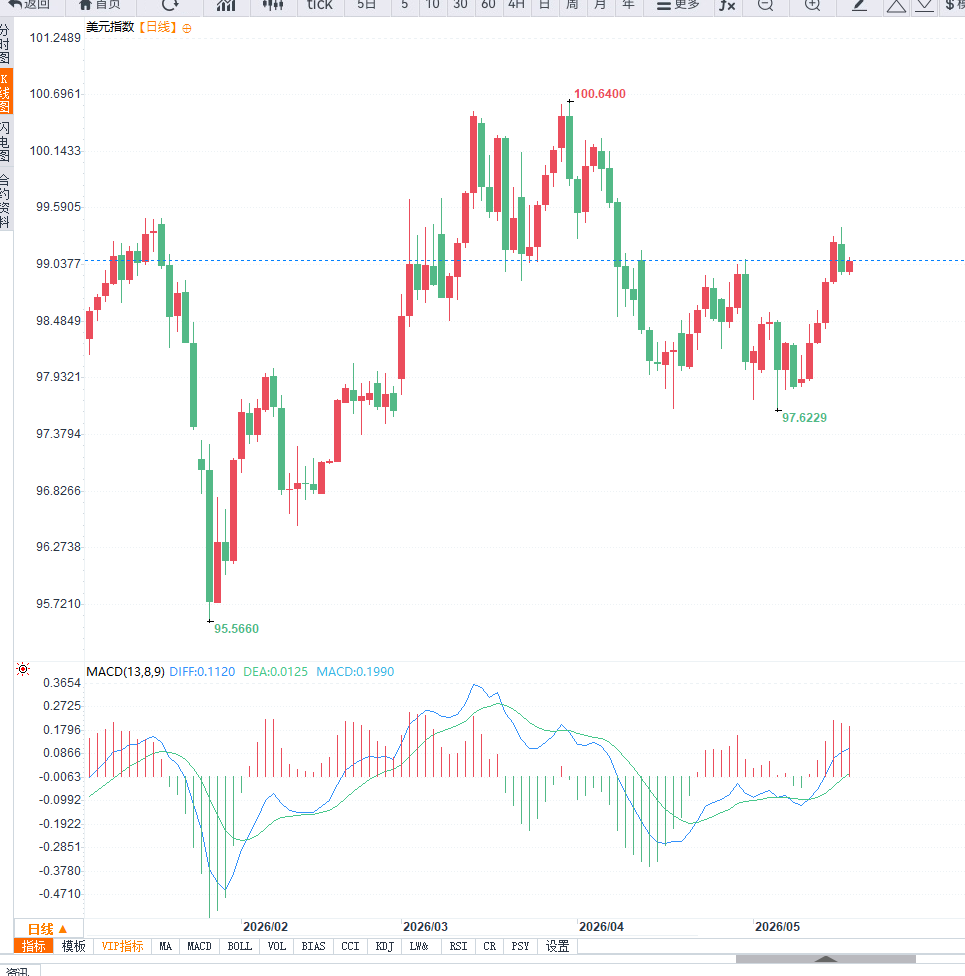
From a technical perspective, the US dollar index's daily chart structure is gradually stabilizing. The DXY rebounded after finding significant support near 98 and has now regained the 99 level. On the daily chart, a key support area has formed around 98.60, while the 99.80-100.20 area represents significant short-term resistance. If subsequent US economic data remains strong and US Treasury yields remain high, the dollar index may further test the 100 level. Technically, the daily MACD has begun to form a golden cross again, indicating a recovery in the dollar's medium-term momentum. The RSI indicator has rebounded from the neutral zone, suggesting improving bullish sentiment. However, due to profit-taking after the recent continuous rise in the dollar, market volatility may further increase.
From a 4-hour chart perspective, the US dollar index is showing a short-term oscillating rebound structure. The 4-hour MACD histogram has expanded again, indicating that short-term buying power has strengthened. However, there is some technical resistance in the 99.30 to 99.50 area. If risk sentiment continues to improve, the dollar may experience a phase of pullback.
In addition, the market will focus on US inflation data, speeches by Federal Reserve officials, and changes in US consumer spending. If core inflation in the US continues to exceed expectations, market expectations for further tightening of policy by the Federal Reserve may continue to strengthen, thereby supporting further strengthening of the US dollar.
Overall, the core drivers of the current dollar market remain rising US yields and expectations of high interest rates. Although the short-term easing of tensions in the Middle East has weakened some safe-haven demand, the dollar is expected to maintain a relatively strong position given the continued strength of the US economy and its interest rate advantage.
Editor's Summary : The core logic behind the current rebound in the US dollar index mainly stems from the rapid rise in US Treasury yields and the market's repricing of the Federal Reserve's hawkish stance. High international oil prices have fueled inflation concerns, prompting the market to reassess the future path of US interest rates, which provides significant support for the dollar. However, the temporary improvement in market risk appetite following Trump's suspension of military action against Iran has also limited the dollar's short-term gains. Going forward, the market will continue to oscillate around US inflation, US Treasury yields, and changes in the Middle East situation. If US inflation continues to exceed expectations, the dollar index may retest the 100 level; conversely, if risk sentiment further improves, the dollar may experience a technical correction.
Data shows that the yield on the 10-year US Treasury note surged to 4.659% overnight, its highest level since February 2025, before falling back to around 4.591%. The yield's renewed approach to the 4.60% mark indicates a significant increase in market concerns about future inflationary pressures. Analysts believe that the recent sustained rise in international energy prices is reigniting market concerns about a rebound in US consumer inflation and may force the Federal Reserve to maintain high interest rates for an extended period.
International crude oil prices remain high, hovering around $100 per barrel. Due to ongoing tensions in the Middle East, the global energy supply chain faces uncertainty, and the market is concerned that high oil prices may further spread to transportation, manufacturing, and consumption sectors, thereby pushing up overall inflation. Against this backdrop, the bond market is beginning to re-induce higher interest rate risks.
Meanwhile, the market is also focused on policy changes within the Federal Reserve. Lou Bryan, market strategist at DRW Trading, pointed out that recent market volatility stems in part from investors observing how new Fed Chairman Kevin Warsh will address inflationary pressures. The market is particularly concerned about whether the Fed will maintain its policy independence and continue to prioritize controlling inflation. Currently, market expectations for the Fed to maintain high interest rates throughout the year have clearly intensified, with some institutions even beginning to reassess the possibility of further rate hikes. With the risk of high inflation not yet fully eliminated, the Fed's policy path remains one of the most crucial factors influencing global financial markets.
However, the upside potential of the US dollar remains limited in the short term by changes in risk sentiment. US President Trump announced a temporary halt to planned military action against Iran to allow more time for diplomatic negotiations. Following this announcement, market risk appetite improved, global stock market sentiment rebounded, and some safe-haven funds flowed out of the US dollar. Analysts believe that the current US dollar market is in a tug-of-war between "high yield support" and "declining safe-haven demand." On the one hand, the continued rise in US Treasury yields strengthens the dollar's attractiveness; on the other hand, the short-term easing of geopolitical tensions has weakened some safe-haven buying.
From a global market perspective, the recent strengthening of the US dollar has put pressure on some emerging market currencies. As US yields continue to rise, global funds are flowing back into dollar assets, causing volatility in some high-risk assets. At the same time, a strong dollar may also increase global financing costs and influence the direction of international capital flows.
From a technical perspective, the US dollar index's daily chart structure is gradually stabilizing. The DXY rebounded after finding significant support near 98 and has now regained the 99 level. On the daily chart, a key support area has formed around 98.60, while the 99.80-100.20 area represents significant short-term resistance. If subsequent US economic data remains strong and US Treasury yields remain high, the dollar index may further test the 100 level. Technically, the daily MACD has begun to form a golden cross again, indicating a recovery in the dollar's medium-term momentum. The RSI indicator has rebounded from the neutral zone, suggesting improving bullish sentiment. However, due to profit-taking after the recent continuous rise in the dollar, market volatility may further increase.
From a 4-hour chart perspective, the US dollar index is showing a short-term oscillating rebound structure. The 4-hour MACD histogram has expanded again, indicating that short-term buying power has strengthened. However, there is some technical resistance in the 99.30 to 99.50 area. If risk sentiment continues to improve, the dollar may experience a phase of pullback.
In addition, the market will focus on US inflation data, speeches by Federal Reserve officials, and changes in US consumer spending. If core inflation in the US continues to exceed expectations, market expectations for further tightening of policy by the Federal Reserve may continue to strengthen, thereby supporting further strengthening of the US dollar.
Overall, the core drivers of the current dollar market remain rising US yields and expectations of high interest rates. Although the short-term easing of tensions in the Middle East has weakened some safe-haven demand, the dollar is expected to maintain a relatively strong position given the continued strength of the US economy and its interest rate advantage.
Editor's Summary : The core logic behind the current rebound in the US dollar index mainly stems from the rapid rise in US Treasury yields and the market's repricing of the Federal Reserve's hawkish stance. High international oil prices have fueled inflation concerns, prompting the market to reassess the future path of US interest rates, which provides significant support for the dollar. However, the temporary improvement in market risk appetite following Trump's suspension of military action against Iran has also limited the dollar's short-term gains. Going forward, the market will continue to oscillate around US inflation, US Treasury yields, and changes in the Middle East situation. If US inflation continues to exceed expectations, the dollar index may retest the 100 level; conversely, if risk sentiment further improves, the dollar may experience a technical correction.
- Risk Warning and Disclaimer
- The market involves risk, and trading may not be suitable for all investors. This article is for reference only and does not constitute personal investment advice, nor does it take into account certain users’ specific investment objectives, financial situation, or other needs. Any investment decisions made based on this information are at your own risk.