How will Trump's real estate strategy disrupt the global economy and the dollar's ebb and flow?
2026-05-19 19:22:03
During his visit to the White House and interview with Trump, Trump did not address the US-Iran issue or even the state visit, but instead first mentioned the restoration project of the Lincoln Memorial Reflection Pool.
Faced with a traditional solution that would cost $350 million and take four years to complete, he said the problem was similar to a swimming pool in a resort village, so he hired a contractor he knew to embed a leak-proof shell, solving the problem efficiently at a cost below budget.
When addressing the core issue of national debt, he employed the leverage mindset of a real estate developer, stating bluntly that the total value of America's natural resources and assets is as high as trillions of dollars, and even with a debt of 38 trillion dollars, it is still in a "low-leverage state".
This mindset also extended to the field of corporate support. When Intel was in trouble, he used the unpaid federal subsidies as leverage to directly negotiate and facilitate the government's acquisition of 9.9% of the equity. In just eight months, the government's shareholding value soared, successfully embedding the equity mindset from commercial transactions into public policy.
Tariff policy is a core tool for Trump to influence the US economic landscape, which he calls "the most beautiful word in the dictionary."
During his second term, he stated that tariffs were not only a tool to address trade imbalances, but also entrusted with the important mission of generating fiscal revenue.
In fiscal year 2025, U.S. customs tariff revenue will surge by 275.3% year-on-year, increasing by $133.9 billion, becoming a new and important source of revenue for the government.
Despite the Supreme Court ruling that some of the "Liberation Day tariffs" were unconstitutional, forcing him to adjust his implementation path and reducing expected annual revenue by nearly half from $600 billion, he still insisted on using tariffs to leverage trade negotiations, both boosting exports and consolidating the competitive advantage of American industries.
This "tariff-for-profit" strategy, coupled with the support of cabinet members with Wall Street backgrounds such as Commerce Secretary Lutnick, broke the shackles of traditional trade policies.
Faced with a persistently high government deficit, Trump abandoned the traditional path of raising taxes or cutting welfare benefits and instead explored innovative solutions.
In fiscal year 2025, the U.S. budget deficit will still reach $1.8 trillion, but it will be slightly less than the previous year, showing the initial effectiveness of policy adjustments.
Its core idea is "investment for returns": by holding equity in key companies such as Intel and U.S. Steel, the government avoids the fiscal pressure brought by direct financial relief and is expected to achieve long-term benefits through corporate value-added, thus finding a new path to alleviate $2.1 trillion in net operating costs.
He bluntly stated that, faced with a massive debt of $38 trillion, the partisan wrangling of traditional politicians is futile; only unconventional equity intervention and increased tariffs can simultaneously resolve the trade imbalance and debt problem.
The Iraq War became an unavoidable geopolitical challenge during Trump's presidency, and also had a significant impact on his economic policies.
This conflict, which he called an “episode,” directly exacerbated inflationary pressures by pushing up crude oil prices—Brent crude oil prices rose to $115 per barrel in April 2026, prompting Goldman Sachs to raise its full-year inflation forecast, expecting overall PCE inflation to reach 3.1% in 2026.
Every 10% increase in oil prices will push up overall PCE inflation by 0.2 percentage points. Coupled with the inflationary pressure on food prices brought about by rising fertilizer prices, this further weakens consumer confidence, causing the consumer confidence index to fall to a historic low in April 2026.
Despite Trump’s attempts to negotiate with the Iranian leadership as a “business adversary,” the complexity of the conflict goes far beyond commercial transactions. The resulting energy market volatility and geopolitical risks have become important variables that test the resilience of his economic policies.
Inflation has consistently been one of the core challenges during Trump's term. In April 2026, the Consumer Price Index rose to 3.8%, an increase of 0.5 percentage points from the previous month, a complex interplay of the impact of war and economic recovery.
To address this predicament, Trump pushed the Federal Reserve to nominate Kevin Walsh, who shares his views, as chairman, and advocated for lowering interest rates to alleviate the pressure of debt interest payments (currently, the United States needs to pay about $3 billion in debt interest every day).
On the other hand, energy policy adjustments are used to offset the impact of inflation, and technology companies are allowed to build their own power generation facilities to ensure the power supply for the AI industry. At the same time, the "Genesis Plan" is used to integrate resources and improve energy efficiency.
Although Goldman Sachs predicts that the Federal Reserve will still cut interest rates by 25 basis points each in September and December 2026, balancing inflation and interest rate cuts will remain an important issue for the Fed in the later stages of its administration.
In the global AI race, Trump has demonstrated a strategic level of importance, regarding it as a national priority comparable to the Manhattan Project.
His "Genesis Initiative" directs the Department of Energy to integrate supercomputers and data assets to build a national AI experimental platform. It also coordinates with companies such as OpenAI and SoftBank to invest $500 billion in the "Stargate" AI infrastructure project, which plans to build five new data centers with a total capacity of nearly 7 gigawatts within three years.
This model of collaboration between the government and the private sector not only addresses the enormous electricity demand of the AI industry (currently requiring twice the existing supply), but also allows the United States to maintain its leading position in the AI race through policy deregulation.
Trump emphasized that AI can not only drive technological breakthroughs in fields such as medicine, but is also the core of ensuring economic competitiveness, and the government's role is to create a "win-win" environment for businesses.
These seemingly disparate policy measures ultimately influence the global core currency indicator—the US dollar index—through changes in economic fundamentals.
The policy efficiency brought about by Trump's real estate thinking, the improvement of the trade account due to increased tariffs, the capital repatriation brought about by equity strategy, and the growth expectations brought about by the AI industry have collectively contributed to the support of the US dollar index.
The risk aversion triggered by the US-Iran war and the interest rate policy game brought about by inflation have made the US dollar index exhibit "counter-cyclical" characteristics.
As observed by the market, the US dollar index serves as a "weathervane" for global capital flows. Its fluctuations reflect both the growth differences between the United States and other economies, as well as the risks and opportunities of Trump's economic policies. When tariff revenue supports fiscal policy, AI investment attracts foreign investment, and equity returns improve the deficit, the dollar's reserve currency status is strengthened.
When war drives up inflation and policy uncertainty increases, the US dollar will maintain its resilience due to its safe-haven properties, becoming the most direct global feedback indicator of Trump's economic strategy.
From a technical perspective, the US dollar index is fluctuating wildly at the upper edge of its trading range, which is a key resistance level. The next support level to watch is the 5-day moving average, followed by the area around 98.35.
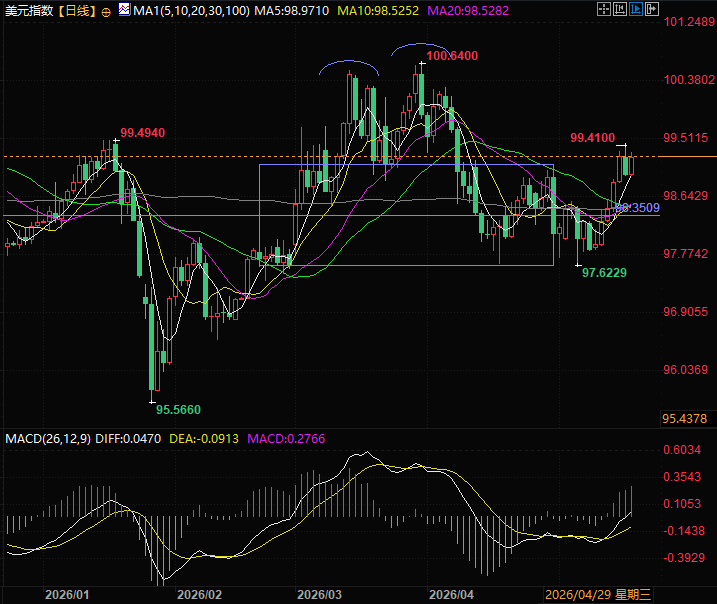
(US Dollar Index Daily Chart, Source: EasyForex)
At 19:20 Beijing time, the US dollar index is currently at 99.24.
Faced with a traditional solution that would cost $350 million and take four years to complete, he said the problem was similar to a swimming pool in a resort village, so he hired a contractor he knew to embed a leak-proof shell, solving the problem efficiently at a cost below budget.
When addressing the core issue of national debt, he employed the leverage mindset of a real estate developer, stating bluntly that the total value of America's natural resources and assets is as high as trillions of dollars, and even with a debt of 38 trillion dollars, it is still in a "low-leverage state".
This mindset also extended to the field of corporate support. When Intel was in trouble, he used the unpaid federal subsidies as leverage to directly negotiate and facilitate the government's acquisition of 9.9% of the equity. In just eight months, the government's shareholding value soared, successfully embedding the equity mindset from commercial transactions into public policy.
Tariffs as a powerful tool: a dual lever for addressing trade imbalances and increasing fiscal revenue.
Tariff policy is a core tool for Trump to influence the US economic landscape, which he calls "the most beautiful word in the dictionary."
During his second term, he stated that tariffs were not only a tool to address trade imbalances, but also entrusted with the important mission of generating fiscal revenue.
In fiscal year 2025, U.S. customs tariff revenue will surge by 275.3% year-on-year, increasing by $133.9 billion, becoming a new and important source of revenue for the government.
Despite the Supreme Court ruling that some of the "Liberation Day tariffs" were unconstitutional, forcing him to adjust his implementation path and reducing expected annual revenue by nearly half from $600 billion, he still insisted on using tariffs to leverage trade negotiations, both boosting exports and consolidating the competitive advantage of American industries.
This "tariff-for-profit" strategy, coupled with the support of cabinet members with Wall Street backgrounds such as Commerce Secretary Lutnick, broke the shackles of traditional trade policies.
Breaking the Deficit Impasse: Innovative Solutions Through Equity Intervention
Faced with a persistently high government deficit, Trump abandoned the traditional path of raising taxes or cutting welfare benefits and instead explored innovative solutions.
In fiscal year 2025, the U.S. budget deficit will still reach $1.8 trillion, but it will be slightly less than the previous year, showing the initial effectiveness of policy adjustments.
Its core idea is "investment for returns": by holding equity in key companies such as Intel and U.S. Steel, the government avoids the fiscal pressure brought by direct financial relief and is expected to achieve long-term benefits through corporate value-added, thus finding a new path to alleviate $2.1 trillion in net operating costs.
He bluntly stated that, faced with a massive debt of $38 trillion, the partisan wrangling of traditional politicians is futile; only unconventional equity intervention and increased tariffs can simultaneously resolve the trade imbalance and debt problem.
Geopolitical Impact: The Economic Chain Reaction of the Iraq War
The Iraq War became an unavoidable geopolitical challenge during Trump's presidency, and also had a significant impact on his economic policies.
This conflict, which he called an “episode,” directly exacerbated inflationary pressures by pushing up crude oil prices—Brent crude oil prices rose to $115 per barrel in April 2026, prompting Goldman Sachs to raise its full-year inflation forecast, expecting overall PCE inflation to reach 3.1% in 2026.
Every 10% increase in oil prices will push up overall PCE inflation by 0.2 percentage points. Coupled with the inflationary pressure on food prices brought about by rising fertilizer prices, this further weakens consumer confidence, causing the consumer confidence index to fall to a historic low in April 2026.
Despite Trump’s attempts to negotiate with the Iranian leadership as a “business adversary,” the complexity of the conflict goes far beyond commercial transactions. The resulting energy market volatility and geopolitical risks have become important variables that test the resilience of his economic policies.
Inflation Game: The Dilemma of Balancing Demands for Interest Rate Cuts and Policy
Inflation has consistently been one of the core challenges during Trump's term. In April 2026, the Consumer Price Index rose to 3.8%, an increase of 0.5 percentage points from the previous month, a complex interplay of the impact of war and economic recovery.
To address this predicament, Trump pushed the Federal Reserve to nominate Kevin Walsh, who shares his views, as chairman, and advocated for lowering interest rates to alleviate the pressure of debt interest payments (currently, the United States needs to pay about $3 billion in debt interest every day).
On the other hand, energy policy adjustments are used to offset the impact of inflation, and technology companies are allowed to build their own power generation facilities to ensure the power supply for the AI industry. At the same time, the "Genesis Plan" is used to integrate resources and improve energy efficiency.
Although Goldman Sachs predicts that the Federal Reserve will still cut interest rates by 25 basis points each in September and December 2026, balancing inflation and interest rate cuts will remain an important issue for the Fed in the later stages of its administration.
AI Strategy: A Competitive Breakthrough Based on National Priorities
In the global AI race, Trump has demonstrated a strategic level of importance, regarding it as a national priority comparable to the Manhattan Project.
His "Genesis Initiative" directs the Department of Energy to integrate supercomputers and data assets to build a national AI experimental platform. It also coordinates with companies such as OpenAI and SoftBank to invest $500 billion in the "Stargate" AI infrastructure project, which plans to build five new data centers with a total capacity of nearly 7 gigawatts within three years.
This model of collaboration between the government and the private sector not only addresses the enormous electricity demand of the AI industry (currently requiring twice the existing supply), but also allows the United States to maintain its leading position in the AI race through policy deregulation.
Trump emphasized that AI can not only drive technological breakthroughs in fields such as medicine, but is also the core of ensuring economic competitiveness, and the government's role is to create a "win-win" environment for businesses.
Final feedback: The correlation between policy moves and the US dollar index
These seemingly disparate policy measures ultimately influence the global core currency indicator—the US dollar index—through changes in economic fundamentals.
The policy efficiency brought about by Trump's real estate thinking, the improvement of the trade account due to increased tariffs, the capital repatriation brought about by equity strategy, and the growth expectations brought about by the AI industry have collectively contributed to the support of the US dollar index.
The risk aversion triggered by the US-Iran war and the interest rate policy game brought about by inflation have made the US dollar index exhibit "counter-cyclical" characteristics.
As observed by the market, the US dollar index serves as a "weathervane" for global capital flows. Its fluctuations reflect both the growth differences between the United States and other economies, as well as the risks and opportunities of Trump's economic policies. When tariff revenue supports fiscal policy, AI investment attracts foreign investment, and equity returns improve the deficit, the dollar's reserve currency status is strengthened.
When war drives up inflation and policy uncertainty increases, the US dollar will maintain its resilience due to its safe-haven properties, becoming the most direct global feedback indicator of Trump's economic strategy.
From a technical perspective, the US dollar index is fluctuating wildly at the upper edge of its trading range, which is a key resistance level. The next support level to watch is the 5-day moving average, followed by the area around 98.35.
(US Dollar Index Daily Chart, Source: EasyForex)
At 19:20 Beijing time, the US dollar index is currently at 99.24.
- Risk Warning and Disclaimer
- The market involves risk, and trading may not be suitable for all investors. This article is for reference only and does not constitute personal investment advice, nor does it take into account certain users’ specific investment objectives, financial situation, or other needs. Any investment decisions made based on this information are at your own risk.