Silver Analysis: Continued Concerns Over Fed Policy Put Pressure on Silver Prices
2026-05-19 20:23:47
On Tuesday (May 19th) during the European session, spot silver fell from $89.38 on May 13th to $73.86 on May 18th, remaining sluggish. As of 20:15 Beijing time, silver was trading at $76.097, down $1.543 on the day, a drop of 1.99%. This sharp decline is not a normal profit-taking after a significant rise; the market trend has long deviated from the usual correction pattern. A complete reversal in inflation expectations, a major shift in the Federal Reserve's monetary policy direction, and a strong return of the US dollar—multiple negative factors have converged, placing silver under full downward pressure.
The inflation pattern has been completely reversed.
The root cause of this round of market fluctuations lies in oil price trends. Influenced by the Middle East situation, Brent crude oil prices remained stable around $110 this week, while West Texas Intermediate (WTI) crude oil prices for June delivery remained in the $100-$105 range. The surge in oil prices has long exceeded the scope of energy supply and demand, directly pushing up overall inflation. Rising logistics and transportation costs, increased manufacturing production costs, and consequently higher prices for end-consumer goods have all contributed to this. US inflation data for April again exceeded market expectations, with a year-on-year increase of 3.8% or higher, marking the third consecutive month of record-breaking figures. Previously, the market unanimously bet on continued cooling inflation and predicted that the Federal Reserve would begin a rate-cutting cycle. Now, this trading logic has completely failed, with traders quickly closing their positions and exiting the market. Silver has become the asset class that reacted first to these market changes.
Why is an interest rate hike environment unfavorable for silver?
Silver is a non-interest-bearing asset, meaning it doesn't generate any interest income during the holding period. While many investors view precious metals as a long-term hedge against inflation, this logic itself isn't flawed. However, short-term market trends have been drastically different. Rising inflation fuels expectations of interest rate hikes, and once these hikes are implemented, US Treasury bonds become far more attractive than precious metals. Currently, the yield on 10-year US Treasury bonds has surpassed 4.63%, and the yield on 30-year Treasury bonds has risen above 5.1%. Investors can obtain stable returns by holding Treasury bonds, and silver, competing for market funds, has lost its competitive advantage, resulting in continued downward pressure on its short-term price.
The Federal Reserve's policy stance has reversed rapidly.
Analysis using the CME Group's Federal Reserve interest rate monitoring tool reveals that the shift in the Federal Reserve's monetary policy stance is the core factor halting the upward trend in silver prices. At the beginning of the year, the market widely anticipated a Fed rate cut, an expectation that provided strong support for silver's strength, helping prices rise to $89.38. Currently, futures market pricing indicates a near 50/50 probability of a Fed rate hike this year, with many institutions even raising their rate hike expectations for next year. The trading market typically anticipates market movements and doesn't wait for policy announcements to adjust positions. The current mainstream market view unanimously agrees that the Fed will maintain a high-interest-rate environment for an extended period, and long positions in silver previously built on expectations of rate cuts are now facing a concentrated liquidation.
The strengthening of the US dollar further exacerbated downward pressure.
Rising expectations of interest rate hikes have driven a global influx of funds into dollar assets, causing the dollar index to rebound rapidly from a multi-month low of 97.625 and approach the 100 mark. Global silver trading is denominated in dollars; the strengthening dollar significantly increases the cost of silver for holders of non-dollar currencies such as the euro and yen, directly weakening overseas demand for silver. In addition to the negative impact of yields, this adds further selling pressure to silver prices. On Monday, silver prices were simultaneously pressured by a triple negative factor.
Market sentiment amplified the decline.
Such market movements are nothing new: silver experiences a one-sided surge, the bullish logic seems impeccable, and a large influx of funds follows suit, as seen in the market from March to May this year. Expanding investment in the artificial intelligence industry, the urgent need for energy transition, and strong demand for materials in high-end manufacturing—multiple positive factors combined lead investors to blindly be bullish, no longer rationally assessing the risks of high prices. Once monetary policy shifts abruptly, a mass exodus of funds triggers a stampede. While the fundamental long-term supply shortage of silver remains unchanged, with highly consistent trading positions in the market, even without a long-term trend reversal, a rapid collapse in short-term sentiment is enough to trigger a deep correction, which is a true reflection of this recent sharp drop in silver prices.
The fundamental supply and demand situation for silver has not changed.
The silver market remains in a state of supply shortage. Industrial demand for silver from the photovoltaic industry, electronic components, and high-tech manufacturing sectors continues to outpace the growth rate of mined silver production, and the industry's supply and demand structure remained unchanged last week. However, the market's focus is currently completely detached from supply and demand fundamentals, with all funds closely watching the Federal Reserve's policy moves. Until the outlook for monetary policy becomes clearer, supply and demand gap data will be unlikely to influence silver price movements. In short, short-term market movements are driven by policy expectations, while long-term prices rely on supply and demand to support them; the market is currently entirely dominated by short-term logic.
Spot silver technical analysis
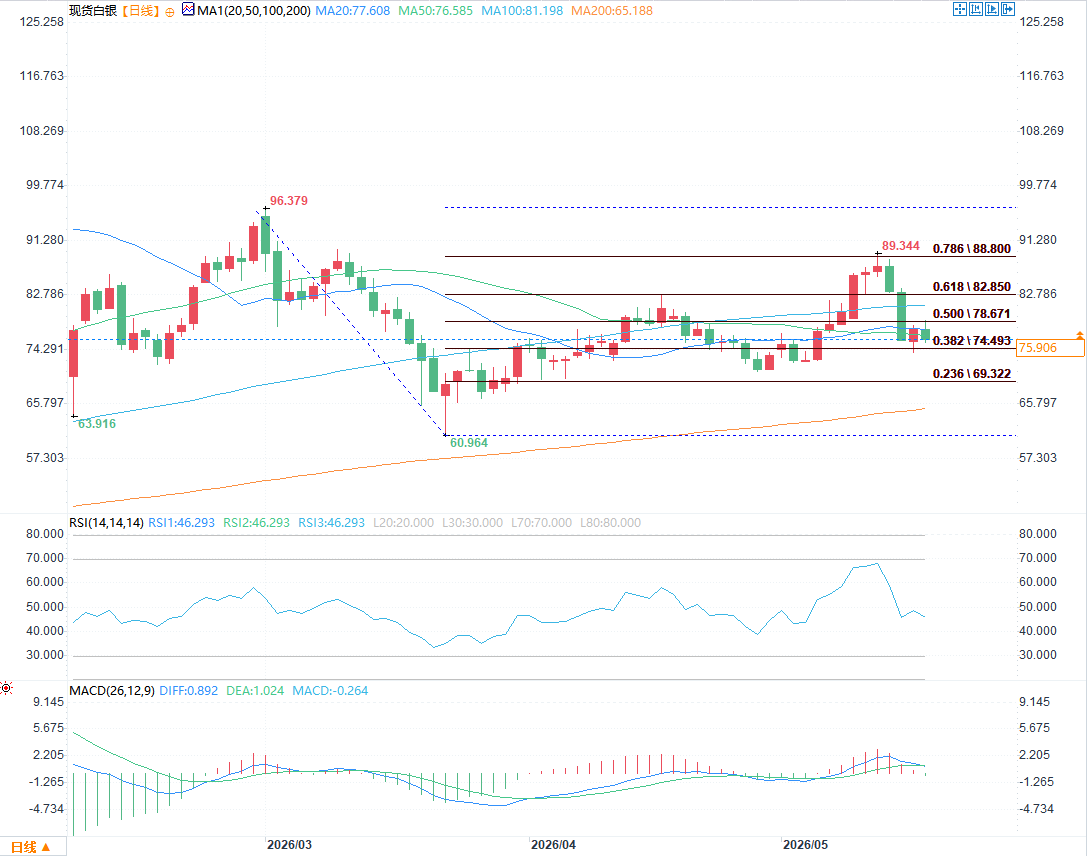
(Spot silver daily chart source: FX678)
From a daily chart perspective, since hitting a low of $61.00 on March 23, silver has formed a standard bullish structure with higher highs and higher lows, and the overall trend remains upward. A decisive break above the $89.38 high would confirm the resumption of the bullish trend; conversely, a break below the $70.86 support level would signal a shift from bullish to bearish.
The main pullback range in this round of price action was between $75.19 and $71.84, which highly coincides with the long-term Fibonacci key level of $74.63. After silver prices dipped to this range on Monday, bullish funds entered the market at $73.86, driving a slight recovery in the late session.
The current trading range for silver is defined as $89.38 to $73.86. If the bulls accumulate upward momentum, the price of silver is expected to rebound quickly to the pullback resistance range of $81.62-$83.45 in the short term. The situation of capital game in this range will directly determine the short-term direction of silver.
In terms of moving averages, the key level to watch today is the 50-day moving average at $76.63. The battle between bulls and bears at this level will set the tone for the overall market trend today. The 50-day moving average serves as a short-term watershed, while the 200-day moving average is a core indicator for defining long-term trends. Currently, this moving average still supports the overall bullish trend for silver.
The intraday trading strategy is clear: if the price holds above the 50-day moving average, the bulls will control the market, and silver prices are expected to test the $81.62 to $83.45 range; if it falls below this moving average, the price will likely retest the $75.19 to $71.84 support zone. If this support zone is broken again, the next support levels at $70.86 (the recent low) and $65.25 (the 200-day moving average) will present a direct challenge from the bears.
Key areas to watch in the future
The outlook for Federal Reserve monetary policy is the core factor determining the future direction of silver. Persistent high inflation continues to fuel market expectations of interest rate hikes, which in turn supports US Treasury yields. Rising yields stabilize the US dollar, and a strong dollar continues to suppress silver prices. This entire chain of negative factors remains intact, and no data is expected to fundamentally disrupt this pattern in the short term.
The 50-day moving average at $76.63 is the key level for today's price action; bulls must hold this level. A break below this level would see silver prices retest the $75.19-$71.84 support zone. A breach of this zone would then put pressure on the $70.86 low and the long-term moving average support at $65.25. Conversely, if bulls regain control, the first resistance zone for silver is expected to be between $81.62 and $83.45, where bears are likely to launch another attack.
The inflation pattern has been completely reversed.
The root cause of this round of market fluctuations lies in oil price trends. Influenced by the Middle East situation, Brent crude oil prices remained stable around $110 this week, while West Texas Intermediate (WTI) crude oil prices for June delivery remained in the $100-$105 range. The surge in oil prices has long exceeded the scope of energy supply and demand, directly pushing up overall inflation. Rising logistics and transportation costs, increased manufacturing production costs, and consequently higher prices for end-consumer goods have all contributed to this. US inflation data for April again exceeded market expectations, with a year-on-year increase of 3.8% or higher, marking the third consecutive month of record-breaking figures. Previously, the market unanimously bet on continued cooling inflation and predicted that the Federal Reserve would begin a rate-cutting cycle. Now, this trading logic has completely failed, with traders quickly closing their positions and exiting the market. Silver has become the asset class that reacted first to these market changes.
Why is an interest rate hike environment unfavorable for silver?
Silver is a non-interest-bearing asset, meaning it doesn't generate any interest income during the holding period. While many investors view precious metals as a long-term hedge against inflation, this logic itself isn't flawed. However, short-term market trends have been drastically different. Rising inflation fuels expectations of interest rate hikes, and once these hikes are implemented, US Treasury bonds become far more attractive than precious metals. Currently, the yield on 10-year US Treasury bonds has surpassed 4.63%, and the yield on 30-year Treasury bonds has risen above 5.1%. Investors can obtain stable returns by holding Treasury bonds, and silver, competing for market funds, has lost its competitive advantage, resulting in continued downward pressure on its short-term price.
The Federal Reserve's policy stance has reversed rapidly.
Analysis using the CME Group's Federal Reserve interest rate monitoring tool reveals that the shift in the Federal Reserve's monetary policy stance is the core factor halting the upward trend in silver prices. At the beginning of the year, the market widely anticipated a Fed rate cut, an expectation that provided strong support for silver's strength, helping prices rise to $89.38. Currently, futures market pricing indicates a near 50/50 probability of a Fed rate hike this year, with many institutions even raising their rate hike expectations for next year. The trading market typically anticipates market movements and doesn't wait for policy announcements to adjust positions. The current mainstream market view unanimously agrees that the Fed will maintain a high-interest-rate environment for an extended period, and long positions in silver previously built on expectations of rate cuts are now facing a concentrated liquidation.
The strengthening of the US dollar further exacerbated downward pressure.
Rising expectations of interest rate hikes have driven a global influx of funds into dollar assets, causing the dollar index to rebound rapidly from a multi-month low of 97.625 and approach the 100 mark. Global silver trading is denominated in dollars; the strengthening dollar significantly increases the cost of silver for holders of non-dollar currencies such as the euro and yen, directly weakening overseas demand for silver. In addition to the negative impact of yields, this adds further selling pressure to silver prices. On Monday, silver prices were simultaneously pressured by a triple negative factor.
Market sentiment amplified the decline.
Such market movements are nothing new: silver experiences a one-sided surge, the bullish logic seems impeccable, and a large influx of funds follows suit, as seen in the market from March to May this year. Expanding investment in the artificial intelligence industry, the urgent need for energy transition, and strong demand for materials in high-end manufacturing—multiple positive factors combined lead investors to blindly be bullish, no longer rationally assessing the risks of high prices. Once monetary policy shifts abruptly, a mass exodus of funds triggers a stampede. While the fundamental long-term supply shortage of silver remains unchanged, with highly consistent trading positions in the market, even without a long-term trend reversal, a rapid collapse in short-term sentiment is enough to trigger a deep correction, which is a true reflection of this recent sharp drop in silver prices.
The fundamental supply and demand situation for silver has not changed.
The silver market remains in a state of supply shortage. Industrial demand for silver from the photovoltaic industry, electronic components, and high-tech manufacturing sectors continues to outpace the growth rate of mined silver production, and the industry's supply and demand structure remained unchanged last week. However, the market's focus is currently completely detached from supply and demand fundamentals, with all funds closely watching the Federal Reserve's policy moves. Until the outlook for monetary policy becomes clearer, supply and demand gap data will be unlikely to influence silver price movements. In short, short-term market movements are driven by policy expectations, while long-term prices rely on supply and demand to support them; the market is currently entirely dominated by short-term logic.
Spot silver technical analysis
(Spot silver daily chart source: FX678)
From a daily chart perspective, since hitting a low of $61.00 on March 23, silver has formed a standard bullish structure with higher highs and higher lows, and the overall trend remains upward. A decisive break above the $89.38 high would confirm the resumption of the bullish trend; conversely, a break below the $70.86 support level would signal a shift from bullish to bearish.
The main pullback range in this round of price action was between $75.19 and $71.84, which highly coincides with the long-term Fibonacci key level of $74.63. After silver prices dipped to this range on Monday, bullish funds entered the market at $73.86, driving a slight recovery in the late session.
The current trading range for silver is defined as $89.38 to $73.86. If the bulls accumulate upward momentum, the price of silver is expected to rebound quickly to the pullback resistance range of $81.62-$83.45 in the short term. The situation of capital game in this range will directly determine the short-term direction of silver.
In terms of moving averages, the key level to watch today is the 50-day moving average at $76.63. The battle between bulls and bears at this level will set the tone for the overall market trend today. The 50-day moving average serves as a short-term watershed, while the 200-day moving average is a core indicator for defining long-term trends. Currently, this moving average still supports the overall bullish trend for silver.
The intraday trading strategy is clear: if the price holds above the 50-day moving average, the bulls will control the market, and silver prices are expected to test the $81.62 to $83.45 range; if it falls below this moving average, the price will likely retest the $75.19 to $71.84 support zone. If this support zone is broken again, the next support levels at $70.86 (the recent low) and $65.25 (the 200-day moving average) will present a direct challenge from the bears.
Key areas to watch in the future
The outlook for Federal Reserve monetary policy is the core factor determining the future direction of silver. Persistent high inflation continues to fuel market expectations of interest rate hikes, which in turn supports US Treasury yields. Rising yields stabilize the US dollar, and a strong dollar continues to suppress silver prices. This entire chain of negative factors remains intact, and no data is expected to fundamentally disrupt this pattern in the short term.
The 50-day moving average at $76.63 is the key level for today's price action; bulls must hold this level. A break below this level would see silver prices retest the $75.19-$71.84 support zone. A breach of this zone would then put pressure on the $70.86 low and the long-term moving average support at $65.25. Conversely, if bulls regain control, the first resistance zone for silver is expected to be between $81.62 and $83.45, where bears are likely to launch another attack.
- Risk Warning and Disclaimer
- The market involves risk, and trading may not be suitable for all investors. This article is for reference only and does not constitute personal investment advice, nor does it take into account certain users’ specific investment objectives, financial situation, or other needs. Any investment decisions made based on this information are at your own risk.