Crude oil trading alert: Signals of easing tensions between the US and Iran triggered a sharp drop in oil prices; be wary of a further decline and potential pullback to the lower end of the price range.
2026-05-21 09:27:14
International crude oil markets remained range-bound during Asian trading hours on Thursday, with WTI crude oil prices hovering around $98.30. After a nearly 5% drop in the previous trading day, market sentiment has temporarily turned cautious as investors reassess the impact of a potential peace agreement between the US and Iran on the global energy supply landscape.

US President Trump stated on Wednesday that negotiations between the US and Iran had entered the "final stage," which the market interpreted as a possible sign of easing tensions in the Middle East. Risk premiums quickly declined, pushing international oil prices down sharply. Meanwhile, US Vice President Vance also indicated that Iran was willing to reach an agreement, further strengthening market expectations for a de-escalation of tensions.
As a result, WTI crude oil prices briefly fell below the $100 mark, with short-term profit-taking sentiment clearly intensifying in the market. However, the decline in oil prices subsequently slowed, because Trump also warned that the United States might resume military operations in the coming days if Iran refused its conditions. This means that the current so-called "peace window" remains highly uncertain.
Iran responded strongly to Trump's threats. Iranian officials warned that the situation could escalate further if the US and Israel launch renewed attacks. Furthermore, Iran announced the establishment of a new "Persian Gulf Straits Authority," attempting to strengthen its control over shipping in the Strait of Hormuz. This move quickly sparked market concerns about the security of global energy transport.
The Strait of Hormuz is one of the world's most important energy transport routes, handling approximately 20% of global seaborne crude oil shipments . Any military action, blockade, or transport restrictions targeting this waterway could rapidly drive up international oil prices and severely disrupt the global energy supply chain. Therefore, even if the market experiences short-term optimism due to peace negotiations, the uncertainty surrounding the Strait of Hormuz means that a significant risk premium remains priced into oil prices.
The market remains cautious about the prospects of a US-Iran agreement. Investors generally believe that significant differences remain between the two sides on Iran's nuclear program, with the issue of control of the Strait of Hormuz being one of the core disputes. Therefore, although short-term market sentiment has eased somewhat, reaching a comprehensive agreement remains highly difficult.
Meanwhile, inventory data released by the U.S. Energy Information Administration (EIA) on Wednesday continued to support oil prices. The data showed that both U.S. crude oil and gasoline inventories declined last week, reflecting that U.S. energy demand remains at a high level. With the summer driving season approaching, resilient U.S. fuel demand has kept the market relatively optimistic about the crude oil supply and demand outlook.
Declining inventories indicate that US refinery utilization rates remain high, while end-user demand has not yet shown a significant slowdown. Market analysts believe this will limit further downside potential for crude oil prices. Especially given the persistently high global geopolitical risks, as long as potential supply disruptions exist, oil prices are likely to remain highly volatile.
From a global market perspective, the recent sharp fluctuations in international oil prices have begun to impact global inflation expectations. Since energy prices are directly related to transportation, manufacturing, and consumption costs, rising oil prices could further increase inflationary pressures in major global economies. This is also a key reason why major central banks, including the Federal Reserve, are paying close attention to the situation in the Middle East.
From a technical perspective, although WTI crude oil experienced a significant pullback in the previous trading day, it remains within a strong high-level range. Previously, oil prices approached a high near $103 before quickly retreating due to changes in market sentiment. Currently, the key support level is around $96 ; a break below this area could lead to a further test of the $93 level. Resistance levels are back at $100 and $102.
The 4-hour chart shows that WTI crude oil has entered a short-term high-level consolidation phase. The MACD indicator has formed a death cross, and bearish momentum has eased somewhat. The RSI indicator has also clearly retreated from the overbought zone, indicating a short-term technical adjustment is needed. However, the price is currently still trading above the major moving averages, suggesting that the medium- to long-term upward trend has not been completely broken.
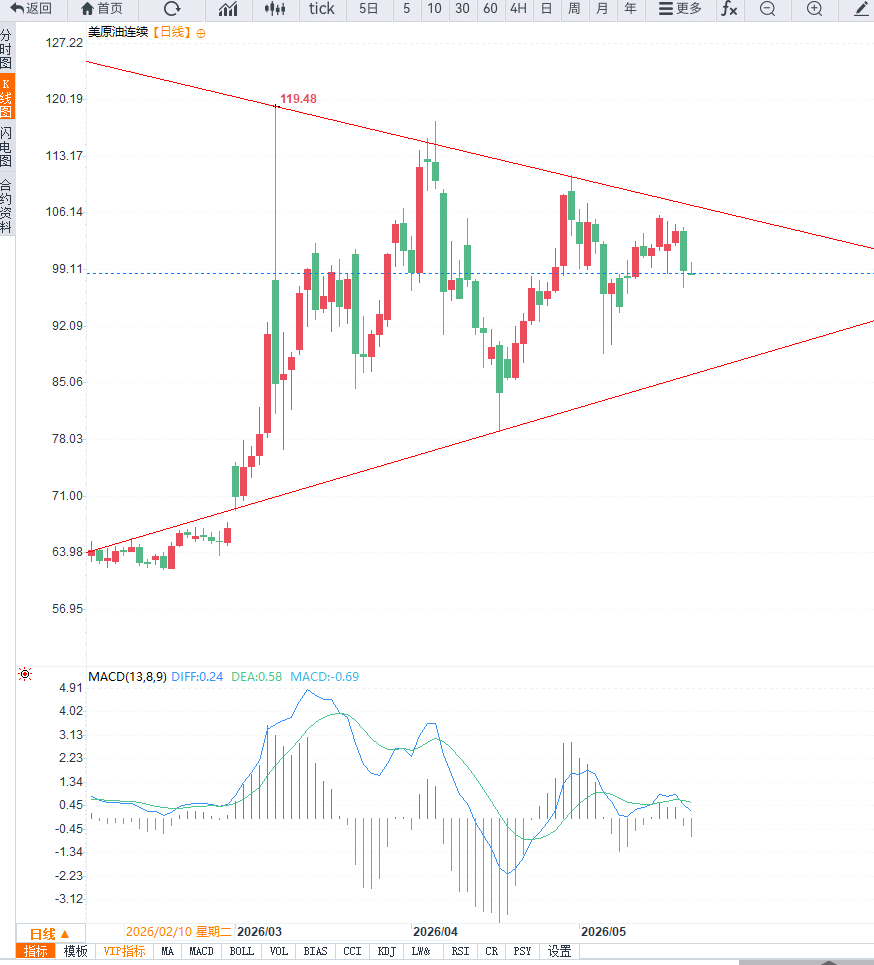
Furthermore, the Bollinger Bands have widened significantly, reflecting persistently high market volatility. If the situation in the Middle East escalates again, or if there is any risk of disruption to shipping through the Strait of Hormuz, oil prices could quickly resume their upward trend. Conversely, if the US-Iran negotiations achieve a substantial breakthrough, oil prices may further erode the previous geopolitical risk premium.
Overall, the core driver of the current crude oil market remains geopolitical risks in the Middle East. Although the market experienced a significant short-term correction due to news of peace negotiations, international oil prices are likely to maintain a high level of wide-range fluctuations in the short term, as supply risks have not been truly resolved and US demand remains stable.
Editor's Summary : The current international crude oil market is experiencing a typical dual game of "geopolitical risk and peace expectations." Positive signals from the US-Iran negotiations initially led to a rapid reduction in risk premiums, but the unresolved disputes over control of the Strait of Hormuz and the Iranian nuclear issue have kept the market cautious about a full easing of tensions. Meanwhile, the continued decline in US inventories reflects the resilience of global energy demand, meaning that even with a short-term easing of geopolitical risks, the supply and demand structure of the crude oil market remains tight. Going forward, the market will need to focus on the progress of US-Iran negotiations, changes in the situation in the Strait of Hormuz, and the performance of global energy demand. If the risk of conflict escalates again, WTI oil prices may once again challenge above $100; however, if a breakthrough is achieved in diplomatic negotiations, oil prices may enter a period of correction.
US President Trump stated on Wednesday that negotiations between the US and Iran had entered the "final stage," which the market interpreted as a possible sign of easing tensions in the Middle East. Risk premiums quickly declined, pushing international oil prices down sharply. Meanwhile, US Vice President Vance also indicated that Iran was willing to reach an agreement, further strengthening market expectations for a de-escalation of tensions.
As a result, WTI crude oil prices briefly fell below the $100 mark, with short-term profit-taking sentiment clearly intensifying in the market. However, the decline in oil prices subsequently slowed, because Trump also warned that the United States might resume military operations in the coming days if Iran refused its conditions. This means that the current so-called "peace window" remains highly uncertain.
Iran responded strongly to Trump's threats. Iranian officials warned that the situation could escalate further if the US and Israel launch renewed attacks. Furthermore, Iran announced the establishment of a new "Persian Gulf Straits Authority," attempting to strengthen its control over shipping in the Strait of Hormuz. This move quickly sparked market concerns about the security of global energy transport.
The Strait of Hormuz is one of the world's most important energy transport routes, handling approximately 20% of global seaborne crude oil shipments . Any military action, blockade, or transport restrictions targeting this waterway could rapidly drive up international oil prices and severely disrupt the global energy supply chain. Therefore, even if the market experiences short-term optimism due to peace negotiations, the uncertainty surrounding the Strait of Hormuz means that a significant risk premium remains priced into oil prices.
The market remains cautious about the prospects of a US-Iran agreement. Investors generally believe that significant differences remain between the two sides on Iran's nuclear program, with the issue of control of the Strait of Hormuz being one of the core disputes. Therefore, although short-term market sentiment has eased somewhat, reaching a comprehensive agreement remains highly difficult.
Meanwhile, inventory data released by the U.S. Energy Information Administration (EIA) on Wednesday continued to support oil prices. The data showed that both U.S. crude oil and gasoline inventories declined last week, reflecting that U.S. energy demand remains at a high level. With the summer driving season approaching, resilient U.S. fuel demand has kept the market relatively optimistic about the crude oil supply and demand outlook.
Declining inventories indicate that US refinery utilization rates remain high, while end-user demand has not yet shown a significant slowdown. Market analysts believe this will limit further downside potential for crude oil prices. Especially given the persistently high global geopolitical risks, as long as potential supply disruptions exist, oil prices are likely to remain highly volatile.
From a global market perspective, the recent sharp fluctuations in international oil prices have begun to impact global inflation expectations. Since energy prices are directly related to transportation, manufacturing, and consumption costs, rising oil prices could further increase inflationary pressures in major global economies. This is also a key reason why major central banks, including the Federal Reserve, are paying close attention to the situation in the Middle East.
From a technical perspective, although WTI crude oil experienced a significant pullback in the previous trading day, it remains within a strong high-level range. Previously, oil prices approached a high near $103 before quickly retreating due to changes in market sentiment. Currently, the key support level is around $96 ; a break below this area could lead to a further test of the $93 level. Resistance levels are back at $100 and $102.
The 4-hour chart shows that WTI crude oil has entered a short-term high-level consolidation phase. The MACD indicator has formed a death cross, and bearish momentum has eased somewhat. The RSI indicator has also clearly retreated from the overbought zone, indicating a short-term technical adjustment is needed. However, the price is currently still trading above the major moving averages, suggesting that the medium- to long-term upward trend has not been completely broken.
Furthermore, the Bollinger Bands have widened significantly, reflecting persistently high market volatility. If the situation in the Middle East escalates again, or if there is any risk of disruption to shipping through the Strait of Hormuz, oil prices could quickly resume their upward trend. Conversely, if the US-Iran negotiations achieve a substantial breakthrough, oil prices may further erode the previous geopolitical risk premium.
Overall, the core driver of the current crude oil market remains geopolitical risks in the Middle East. Although the market experienced a significant short-term correction due to news of peace negotiations, international oil prices are likely to maintain a high level of wide-range fluctuations in the short term, as supply risks have not been truly resolved and US demand remains stable.
Editor's Summary : The current international crude oil market is experiencing a typical dual game of "geopolitical risk and peace expectations." Positive signals from the US-Iran negotiations initially led to a rapid reduction in risk premiums, but the unresolved disputes over control of the Strait of Hormuz and the Iranian nuclear issue have kept the market cautious about a full easing of tensions. Meanwhile, the continued decline in US inventories reflects the resilience of global energy demand, meaning that even with a short-term easing of geopolitical risks, the supply and demand structure of the crude oil market remains tight. Going forward, the market will need to focus on the progress of US-Iran negotiations, changes in the situation in the Strait of Hormuz, and the performance of global energy demand. If the risk of conflict escalates again, WTI oil prices may once again challenge above $100; however, if a breakthrough is achieved in diplomatic negotiations, oil prices may enter a period of correction.
- Risk Warning and Disclaimer
- The market involves risk, and trading may not be suitable for all investors. This article is for reference only and does not constitute personal investment advice, nor does it take into account certain users’ specific investment objectives, financial situation, or other needs. Any investment decisions made based on this information are at your own risk.