Australian employment "flop" vs. Japanese trade "comeback", Australian dollar falls below 113 against Japanese yen
2026-05-21 10:43:22
On Thursday (May 21) during Asian trading hours, the Australian dollar fell by about 0.6% against the Japanese yen after rising more than 0.5% overnight, hitting a low of 112.91 and currently trading around 112.97, due to weak Australian labor market data. Meanwhile, unexpectedly better-than-expected Japanese trade data provided support for the yen. The Australian dollar continued its weakness against the US dollar, trading around 0.71, down about 0.6% from the previous day.

Australia's unemployment rate climbed to 4.5% in April from 4.3% in March, higher than the market expectation of 4.3%. Employment decreased by 18,600, while the previous figure was revised upward to an increase of 23,300, compared to market expectations of an increase of 17,500 – a significant discrepancy between the actual figure and expectations.
Furthermore, preliminary data released by S&P Global showed that Australia's manufacturing purchasing managers' index (PMI) fell to 50.3 in May from 51.3 in April, nearing the 50-point threshold separating expansion from contraction; the services PMI plummeted from 50.7 to 47.7, entering contraction territory. Dragged down by this, the composite PMI fell from 50.4 to 47.8, indicating an overall contraction in private sector activity.
Japan unexpectedly recorded a trade surplus of 301.9 billion yen in April, reversing the deficit of 149.5 billion yen in the same period last year and far exceeding market expectations of a deficit of 29.7 billion yen. This marks the second consecutive month of trade surplus for Japan, demonstrating the strong resilience of its export sector despite a complex external environment.
On the export front, April exports surged 14.8% year-on-year to ¥10.5073 trillion, nearing a record high, further accelerating from March's 11.5% growth and marking the strongest growth in three months. This growth was primarily driven by continued strong demand related to artificial intelligence and data centers—semiconductor equipment exports, which had already recorded a 29.3% year-on-year surge in March, continued this trend in April. Yuki Akimoto, an economist at the Daiwa Institute of Economics, pointed out that current trade growth is "mainly driven by demand for AI from data centers," and this trend is expected to continue in the short term. Regionally, exports to the United States increased by 3.4%, while exports to China increased by 17.7%, partially offsetting the impact of a sharp decline in exports from the Middle East due to war.
On the import side, imports in April increased by 9.7% year-on-year to 10.2054 trillion yen, a slight slowdown from March's 10.9%, but still higher than the market expectation of 8.3%. The slowdown in import growth reflects, to some extent, the restraining effect of high oil prices on import volume. It is worth noting that, affected by the deteriorating situation in the Middle East, Japan's gross domestic product (CGPI) surged 4.9% year-on-year in April, reaching its highest level since May 2023, with prices of oil, coal, and chemical products rising far more than expected.
Bank of Japan policy board member Junko Onoda said on Thursday that Japan's core inflation rate is approaching 2%, emphasizing progress made in achieving the central bank's inflation target—a core issue for policymakers in recent years. This statement is consistent with the tone of recent remarks from several other central bank officials.
Previously, Bank of Japan board member Yoichi Masaki stated on May 14 that although the underlying inflation rate was still below 2%, it was "very close" to the 2% target, and clearly indicated that the central bank would continue to raise policy interest rates based on economic, price, and financial developments.
The minutes of the Bank of Japan's April meeting show that one member explicitly stated during the discussion that "core CPI inflation is approaching 2%, while real interest rates remain at a fairly low level," therefore "it is appropriate to continue raising the policy rate."
In summary, the Australian dollar/Japanese yen exchange rate is currently facing a divergence in fundamentals: Australia's labor market unexpectedly deteriorated, with rising unemployment and declining employment, coupled with PMI data falling across the board into contraction territory, reinforcing market expectations that the Reserve Bank of Australia will maintain an accommodative stance; while in Japan, trade data improved significantly, with export growth hitting a three-month high, and comments from central bank officials that inflation is nearing its target provided support for the yen. Against this backdrop, the Australian dollar/Japanese yen exchange rate is expected to remain under pressure in the short term, with the market focusing on the evolution of subsequent economic data from both countries and central bank policy signals.
From the daily chart, the Australian dollar is currently trading around 113 against the Japanese yen, at a critical juncture where bulls and bears are locked in a battle, with multiple technical indicators showing a neutral to weak signal.
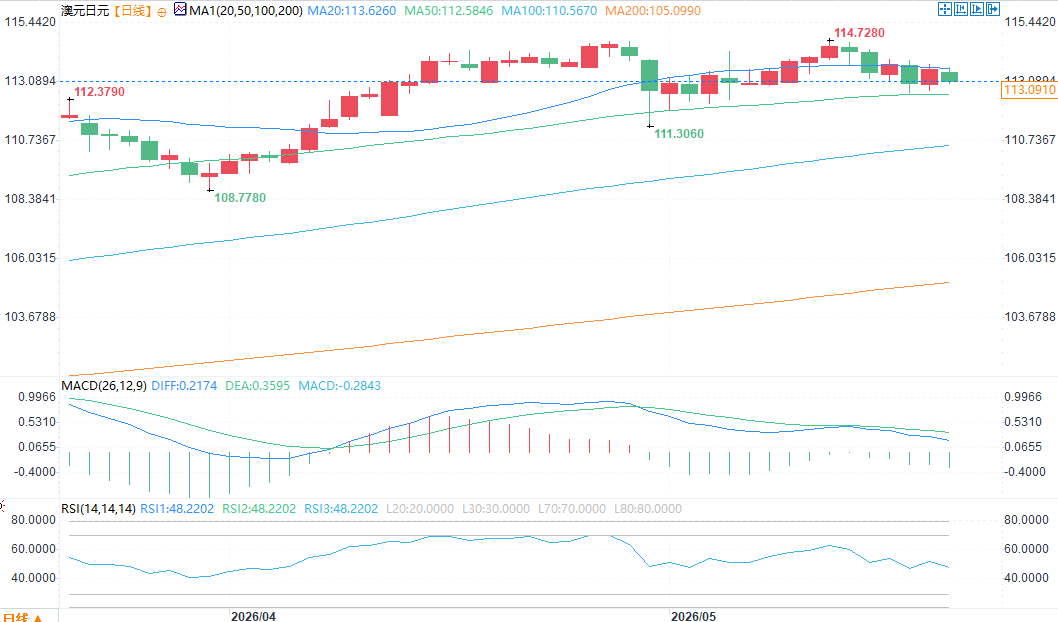
(AUD/JPY daily chart, source: FX678)
Regarding the moving average system, the short-term moving average MA20 is at 112.97, and the current price has fallen below this moving average; MA50 is at 112.585, below the current price; the long-term moving averages MA100 (110.57) and MA200 (105.10) are far below the current price. This arrangement of "price below MA20 but still above MA50" indicates that the AUD/JPY is in a short-term correction phase, but the medium-term upward trend has not been broken. It is worth noting that the price has tested the 114.00-114.25 area multiple times since the end of April without a successful breakout, indicating strong resistance in this area; while the MA50 (112.585) below is a key support level in the near term.
Regarding the MACD indicator, the DIFF line is at 0.2174, and the DEA line is at 0.3595. The DIFF has crossed below the DEA, forming a death cross signal. The MACD histogram value is -0.2843, which is negative and expanding, indicating that bearish momentum is continuing to be released. Looking at the histogram pattern, this round of bearish momentum began accumulating in mid-May, and there are still no obvious signs of convergence, meaning that short-term pullback pressure has not yet been fully digested. To see a trend reversal, we need to wait for a narrowing signal in the MACD histogram.
At 10:42 Beijing time on May 21, the Australian dollar was trading at 112.97/98 against the Japanese yen.
Australian employment data softens across the board
Australia's unemployment rate climbed to 4.5% in April from 4.3% in March, higher than the market expectation of 4.3%. Employment decreased by 18,600, while the previous figure was revised upward to an increase of 23,300, compared to market expectations of an increase of 17,500 – a significant discrepancy between the actual figure and expectations.
Furthermore, preliminary data released by S&P Global showed that Australia's manufacturing purchasing managers' index (PMI) fell to 50.3 in May from 51.3 in April, nearing the 50-point threshold separating expansion from contraction; the services PMI plummeted from 50.7 to 47.7, entering contraction territory. Dragged down by this, the composite PMI fell from 50.4 to 47.8, indicating an overall contraction in private sector activity.
Unexpectedly improved Japanese trade data provided support for the yen.
Japan unexpectedly recorded a trade surplus of 301.9 billion yen in April, reversing the deficit of 149.5 billion yen in the same period last year and far exceeding market expectations of a deficit of 29.7 billion yen. This marks the second consecutive month of trade surplus for Japan, demonstrating the strong resilience of its export sector despite a complex external environment.
On the export front, April exports surged 14.8% year-on-year to ¥10.5073 trillion, nearing a record high, further accelerating from March's 11.5% growth and marking the strongest growth in three months. This growth was primarily driven by continued strong demand related to artificial intelligence and data centers—semiconductor equipment exports, which had already recorded a 29.3% year-on-year surge in March, continued this trend in April. Yuki Akimoto, an economist at the Daiwa Institute of Economics, pointed out that current trade growth is "mainly driven by demand for AI from data centers," and this trend is expected to continue in the short term. Regionally, exports to the United States increased by 3.4%, while exports to China increased by 17.7%, partially offsetting the impact of a sharp decline in exports from the Middle East due to war.
On the import side, imports in April increased by 9.7% year-on-year to 10.2054 trillion yen, a slight slowdown from March's 10.9%, but still higher than the market expectation of 8.3%. The slowdown in import growth reflects, to some extent, the restraining effect of high oil prices on import volume. It is worth noting that, affected by the deteriorating situation in the Middle East, Japan's gross domestic product (CGPI) surged 4.9% year-on-year in April, reaching its highest level since May 2023, with prices of oil, coal, and chemical products rising far more than expected.
Bank of Japan officials say core inflation is approaching 2%.
Bank of Japan policy board member Junko Onoda said on Thursday that Japan's core inflation rate is approaching 2%, emphasizing progress made in achieving the central bank's inflation target—a core issue for policymakers in recent years. This statement is consistent with the tone of recent remarks from several other central bank officials.
Previously, Bank of Japan board member Yoichi Masaki stated on May 14 that although the underlying inflation rate was still below 2%, it was "very close" to the 2% target, and clearly indicated that the central bank would continue to raise policy interest rates based on economic, price, and financial developments.
The minutes of the Bank of Japan's April meeting show that one member explicitly stated during the discussion that "core CPI inflation is approaching 2%, while real interest rates remain at a fairly low level," therefore "it is appropriate to continue raising the policy rate."
Fundamental divergence puts short-term pressure on the Australian dollar against the Japanese yen.
In summary, the Australian dollar/Japanese yen exchange rate is currently facing a divergence in fundamentals: Australia's labor market unexpectedly deteriorated, with rising unemployment and declining employment, coupled with PMI data falling across the board into contraction territory, reinforcing market expectations that the Reserve Bank of Australia will maintain an accommodative stance; while in Japan, trade data improved significantly, with export growth hitting a three-month high, and comments from central bank officials that inflation is nearing its target provided support for the yen. Against this backdrop, the Australian dollar/Japanese yen exchange rate is expected to remain under pressure in the short term, with the market focusing on the evolution of subsequent economic data from both countries and central bank policy signals.
MA20 breach vs. MA50 support: A tug-of-war between bulls and bears continues.
From the daily chart, the Australian dollar is currently trading around 113 against the Japanese yen, at a critical juncture where bulls and bears are locked in a battle, with multiple technical indicators showing a neutral to weak signal.
(AUD/JPY daily chart, source: FX678)
Regarding the moving average system, the short-term moving average MA20 is at 112.97, and the current price has fallen below this moving average; MA50 is at 112.585, below the current price; the long-term moving averages MA100 (110.57) and MA200 (105.10) are far below the current price. This arrangement of "price below MA20 but still above MA50" indicates that the AUD/JPY is in a short-term correction phase, but the medium-term upward trend has not been broken. It is worth noting that the price has tested the 114.00-114.25 area multiple times since the end of April without a successful breakout, indicating strong resistance in this area; while the MA50 (112.585) below is a key support level in the near term.
Regarding the MACD indicator, the DIFF line is at 0.2174, and the DEA line is at 0.3595. The DIFF has crossed below the DEA, forming a death cross signal. The MACD histogram value is -0.2843, which is negative and expanding, indicating that bearish momentum is continuing to be released. Looking at the histogram pattern, this round of bearish momentum began accumulating in mid-May, and there are still no obvious signs of convergence, meaning that short-term pullback pressure has not yet been fully digested. To see a trend reversal, we need to wait for a narrowing signal in the MACD histogram.
At 10:42 Beijing time on May 21, the Australian dollar was trading at 112.97/98 against the Japanese yen.
- Risk Warning and Disclaimer
- The market involves risk, and trading may not be suitable for all investors. This article is for reference only and does not constitute personal investment advice, nor does it take into account certain users’ specific investment objectives, financial situation, or other needs. Any investment decisions made based on this information are at your own risk.