Oil prices were under pressure, and rising expectations of a hawkish stance from the Federal Reserve sent the US dollar higher against the Canadian dollar for the third consecutive day.
2026-05-21 11:29:53
The US dollar continued its upward trend against the Canadian dollar in Asian trading on Thursday, trading around 1.3750, marking its third consecutive day of gains. The market is currently closely watching the progress of negotiations between the US and Iran, as well as the impact of changes in the Strait of Hormuz on global energy markets and risk aversion. As a typical commodity currency, the Canadian dollar is highly correlated with international oil prices. Following the sharp drop in WTI crude oil prices in the previous trading day, the Canadian dollar came under significant pressure. The nearly 5% single-day decline in international oil prices was a major catalyst driving the US dollar higher against the Canadian dollar.
US President Trump stated that negotiations between the US and Iran had entered the "final stage." This statement initially eased market concerns about disruptions to Middle Eastern oil supplies, causing international oil prices to fall rapidly. However, market risk aversion has not completely subsided. Trump also warned that if Iran rejects the conditions proposed by the US, the US may resume military operations within days. As a result, market concerns about geopolitical risks in the Middle East remain high.
Iranian President Masoud Pezechzian subsequently responded on the social media platform X, stating that Tehran would not yield to external pressure and emphasizing that attempts to force concessions through hardline measures were merely "unrealistic fantasies." Currently, Iran is assessing the latest draft response from the United States to its 14 proposals, a document delivered through Pakistan. The market widely believes that a diplomatic breakthrough between the two sides could potentially ease the current "both-sided blockade" situation in the Strait of Hormuz.
The Strait of Hormuz handles approximately 20% of global seaborne crude oil transport . Since March of this year, commercial tanker shipping in the region has been severely disrupted, escalating risks to the global energy supply chain. Therefore, any news regarding the easing or escalation of tensions in the Middle East is quickly reflected in international oil prices and foreign exchange markets. Meanwhile, the overall strength of the US dollar has further supported the USD/CAD exchange rate. Market focus has shifted to the latest release of the minutes from the Federal Reserve's April FOMC meeting.
The meeting minutes showed that most Federal Reserve officials remained highly vigilant about inflation risks and believed that if inflation persisted above the 2% target level, the Fed might need to consider further tightening of monetary policy. Market expectations for the Fed to maintain high interest rates for a longer period are resurfacing . High U.S. Treasury yields have kept the dollar index strong, further suppressing the Canadian dollar.
Some Federal Reserve officials have pointed out that energy price volatility caused by the Middle East wars could reignite inflationary pressures in the United States, thus limiting the scope for future interest rate cuts.
From a market sentiment perspective, investors are currently reassessing global economic and energy market risks. As the situation in the Middle East continues to evolve, funds are flowing into safe-haven assets such as the US dollar, while commodity currencies have generally performed relatively weakly. Furthermore, the Canadian economy is highly dependent on energy exports, and a decline in international oil prices often directly impacts Canadian export revenue and economic growth expectations, which is also a significant reason for the recent weakness of the Canadian dollar.
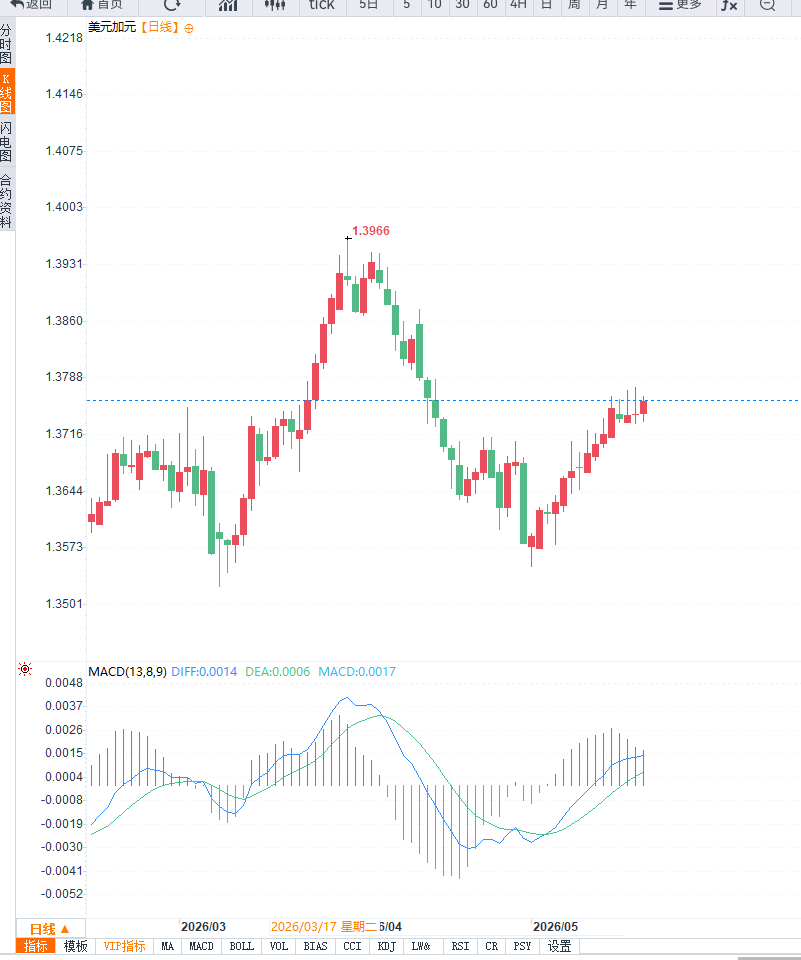
From a technical perspective, the USD/CAD daily chart shows clear signs of stabilization. After finding support around 1.3600, the exchange rate rebounded and has now regained position above several short-term moving averages. The 5-day and 10-day moving averages are diverging upwards, indicating gradually strengthening short-term buying power. The MACD indicator has formed a golden cross at a low level, and the RSI indicator has risen back above 50, suggesting improving market momentum. Initial resistance is currently around 1.3780; a break above this level could lead to a further test of the 1.3850 area. Key support levels are at 1.3680 and the psychological level of 1.3600.
From the 4-hour chart, the USD/CAD pair maintains a slightly bullish short-term structure. The exchange rate continues to trade above the Bollinger Band's middle line, and short-term moving averages are in a bullish alignment. The MACD indicator is running above the zero line, indicating that the short-term trend remains bullish. The RSI indicator remains in the 55-60 range, suggesting that short-term buying sentiment remains relatively stable. If the pair breaks through the 1.3760-1.3780 area, it may further test the 1.3820 level. However, if international oil prices rebound, or if the situation in the Middle East deteriorates again, driving up energy prices, this could boost the Canadian dollar, thus limiting further gains for the USD/CAD pair.
Editor's Summary : The core drivers of the current USD/CAD rise are primarily two factors: a sharp correction in international oil prices and rising expectations of a hawkish stance from the Federal Reserve. On the one hand, the plunge in oil prices weakened the Canadian dollar's support as a commodity currency; on the other hand, the Fed meeting minutes reinforced market expectations of a prolonged period of high interest rates in the US, thus pushing the US dollar to remain strong. The market will continue to be highly dependent on developments in the Middle East. If there is substantial diplomatic progress between the US and Iran, international oil prices may continue to be under pressure, and the USD/CAD pair is expected to maintain a relatively strong trend. However, if shipping risks in the Strait of Hormuz escalate further and energy supply concerns resurface, oil prices may rebound rapidly, providing renewed support for the Canadian dollar. Overall, given that global risk aversion has not yet subsided significantly and the Fed maintains a hawkish stance, the US dollar still possesses a certain advantage in the short term, and the USD/CAD pair is likely to maintain a volatile but generally strong trend.
US President Trump stated that negotiations between the US and Iran had entered the "final stage." This statement initially eased market concerns about disruptions to Middle Eastern oil supplies, causing international oil prices to fall rapidly. However, market risk aversion has not completely subsided. Trump also warned that if Iran rejects the conditions proposed by the US, the US may resume military operations within days. As a result, market concerns about geopolitical risks in the Middle East remain high.
Iranian President Masoud Pezechzian subsequently responded on the social media platform X, stating that Tehran would not yield to external pressure and emphasizing that attempts to force concessions through hardline measures were merely "unrealistic fantasies." Currently, Iran is assessing the latest draft response from the United States to its 14 proposals, a document delivered through Pakistan. The market widely believes that a diplomatic breakthrough between the two sides could potentially ease the current "both-sided blockade" situation in the Strait of Hormuz.
The Strait of Hormuz handles approximately 20% of global seaborne crude oil transport . Since March of this year, commercial tanker shipping in the region has been severely disrupted, escalating risks to the global energy supply chain. Therefore, any news regarding the easing or escalation of tensions in the Middle East is quickly reflected in international oil prices and foreign exchange markets. Meanwhile, the overall strength of the US dollar has further supported the USD/CAD exchange rate. Market focus has shifted to the latest release of the minutes from the Federal Reserve's April FOMC meeting.
The meeting minutes showed that most Federal Reserve officials remained highly vigilant about inflation risks and believed that if inflation persisted above the 2% target level, the Fed might need to consider further tightening of monetary policy. Market expectations for the Fed to maintain high interest rates for a longer period are resurfacing . High U.S. Treasury yields have kept the dollar index strong, further suppressing the Canadian dollar.
Some Federal Reserve officials have pointed out that energy price volatility caused by the Middle East wars could reignite inflationary pressures in the United States, thus limiting the scope for future interest rate cuts.
From a market sentiment perspective, investors are currently reassessing global economic and energy market risks. As the situation in the Middle East continues to evolve, funds are flowing into safe-haven assets such as the US dollar, while commodity currencies have generally performed relatively weakly. Furthermore, the Canadian economy is highly dependent on energy exports, and a decline in international oil prices often directly impacts Canadian export revenue and economic growth expectations, which is also a significant reason for the recent weakness of the Canadian dollar.
From a technical perspective, the USD/CAD daily chart shows clear signs of stabilization. After finding support around 1.3600, the exchange rate rebounded and has now regained position above several short-term moving averages. The 5-day and 10-day moving averages are diverging upwards, indicating gradually strengthening short-term buying power. The MACD indicator has formed a golden cross at a low level, and the RSI indicator has risen back above 50, suggesting improving market momentum. Initial resistance is currently around 1.3780; a break above this level could lead to a further test of the 1.3850 area. Key support levels are at 1.3680 and the psychological level of 1.3600.
From the 4-hour chart, the USD/CAD pair maintains a slightly bullish short-term structure. The exchange rate continues to trade above the Bollinger Band's middle line, and short-term moving averages are in a bullish alignment. The MACD indicator is running above the zero line, indicating that the short-term trend remains bullish. The RSI indicator remains in the 55-60 range, suggesting that short-term buying sentiment remains relatively stable. If the pair breaks through the 1.3760-1.3780 area, it may further test the 1.3820 level. However, if international oil prices rebound, or if the situation in the Middle East deteriorates again, driving up energy prices, this could boost the Canadian dollar, thus limiting further gains for the USD/CAD pair.
Editor's Summary : The core drivers of the current USD/CAD rise are primarily two factors: a sharp correction in international oil prices and rising expectations of a hawkish stance from the Federal Reserve. On the one hand, the plunge in oil prices weakened the Canadian dollar's support as a commodity currency; on the other hand, the Fed meeting minutes reinforced market expectations of a prolonged period of high interest rates in the US, thus pushing the US dollar to remain strong. The market will continue to be highly dependent on developments in the Middle East. If there is substantial diplomatic progress between the US and Iran, international oil prices may continue to be under pressure, and the USD/CAD pair is expected to maintain a relatively strong trend. However, if shipping risks in the Strait of Hormuz escalate further and energy supply concerns resurface, oil prices may rebound rapidly, providing renewed support for the Canadian dollar. Overall, given that global risk aversion has not yet subsided significantly and the Fed maintains a hawkish stance, the US dollar still possesses a certain advantage in the short term, and the USD/CAD pair is likely to maintain a volatile but generally strong trend.
- Risk Warning and Disclaimer
- The market involves risk, and trading may not be suitable for all investors. This article is for reference only and does not constitute personal investment advice, nor does it take into account certain users’ specific investment objectives, financial situation, or other needs. Any investment decisions made based on this information are at your own risk.