British inflation unexpectedly slowed, while uncertainty surrounding the US-Iran situation escalated, causing the pound to trade within a narrow range against the dollar.
2026-05-21 13:28:28
The British pound (GBP/USD) traded in a narrow range during Asian trading on Thursday, hovering around 1.3430. Market sentiment was generally cautious, with investors choosing to remain on the sidelines amid a backdrop of significantly weaker UK economic data and global geopolitical uncertainties.
The latest inflation data released by the UK shows that price pressures are easing rapidly. The UK Office for National Statistics (ONS) reported that the UK Consumer Price Index (CPI) rose 2.8% year-on-year in April, a significant drop from the previous month's 3.3%, and also lower than the market expectation of 3.0%. The core CPI, excluding energy and food, rose 2.5% year-on-year, also lower than the previous month's 3.1% and the market expectation of 2.6%.
The unexpected cooling of inflation has directly altered market expectations regarding UK monetary policy. Meanwhile, the UK unemployment rate unexpectedly rose to 5.0% , further reinforcing signals of an economic slowdown.
Following the data release, the interest rate futures market quickly adjusted its expectations for the Bank of England's (BoE) path. The market now anticipates a cumulative rate hike of approximately 52 basis points by December, a significant decrease from around 60 basis points on Tuesday, indicating that the market is reassessing the room for further tightening in UK monetary policy.
From a macroeconomic perspective, the convergence of cooling inflation and a weakening labor market suggests that the UK economy is gradually shifting from "high inflationary pressures" to "risks of slowing growth," which puts medium-term pressure on the pound. Meanwhile, global external factors are also influencing exchange rate movements. Market surveys indicate that US President Trump stated that US-Iran negotiations have entered the "final stage," but also warned that the US might take further military action if Iran rejects the agreement. This statement has exacerbated market concerns about the situation in the Middle East.
Iran responded that it would not back down under pressure and warned that it would retaliate strongly against any attack. Escalating geopolitical risks led to a return of risk aversion in the market, supporting the US dollar as a safe-haven asset and thus putting downward pressure on the pound against the dollar.
Furthermore, the market is closely watching the upcoming preliminary May PMI data for the UK and the US, which will be a crucial indicator of the differences in economic momentum between the two countries. If the UK's service and manufacturing sectors weaken in tandem, while the US economy remains resilient, the pound may face further downward pressure.
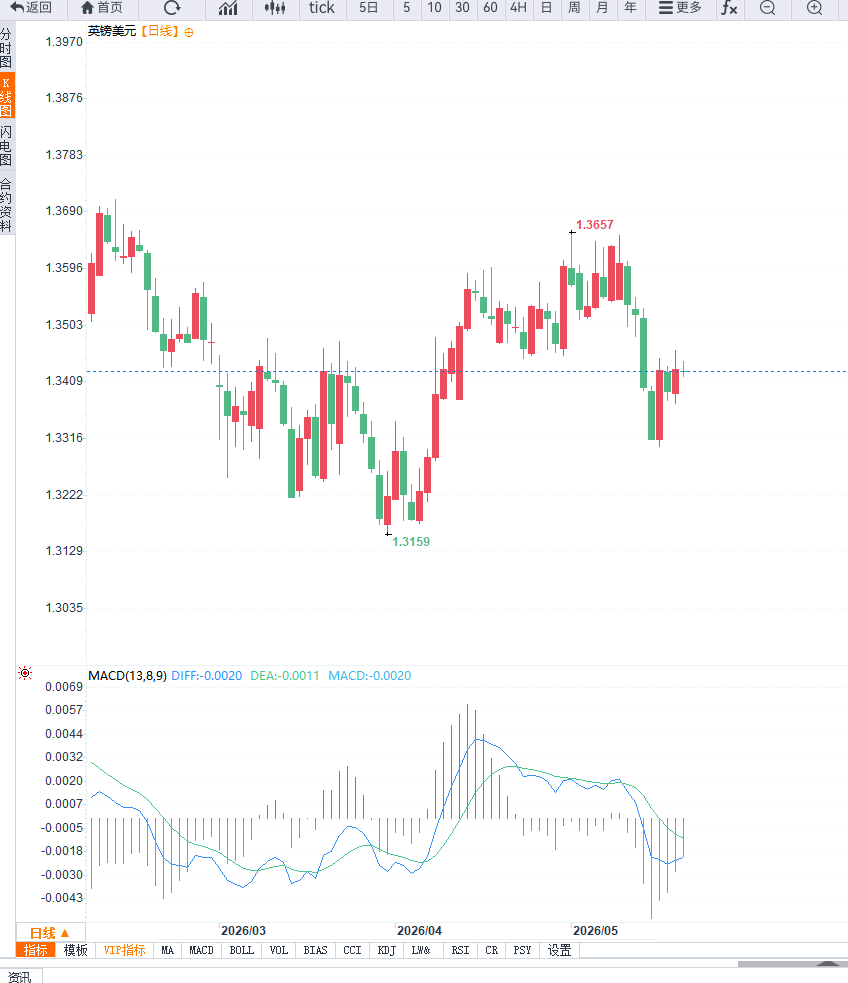
From a daily chart perspective, the GBP/USD pair remains in a wide-range trading pattern, but short-term rebound momentum has clearly weakened. After encountering resistance near 1.3600, the exchange rate has continued to fall, currently seeking support around 1.3400. The moving average system shows that the short-term 5-day moving average has begun to turn downwards, and the price is trading below the 10-day moving average, indicating that short-term bearish momentum slightly dominates. The MACD indicator, after a bearish crossover at a high level, continues to diverge downwards, indicating that upward momentum is waning. The RSI indicator has fallen back to around 50, suggesting a near balance between bullish and bearish forces, but with a slightly bearish bias. In terms of support and resistance levels, key support is concentrated in the 1.3380-1.3350 area; a decisive break below this level could lead to a further decline to the 1.3280 level. Resistance is located in the 1.3480-1.3520 range; failure to regain this area will limit the upside potential.
From the 4-hour chart, the short-term trend shows a downward oscillation. The exchange rate continues to trade below the middle Bollinger Band, indicating a weak short-term trend. The MACD indicator is running below the zero line, and the momentum bars remain negative, indicating that the bears still dominate. The RSI indicator is hovering around 45, showing a lack of significant rebound momentum. If it breaks below the 1.3400 level, it may accelerate its test of the 1.3350 support area in the short term; however, if the US dollar falls due to easing safe-haven demand, the exchange rate may also have a technical rebound potential.
Editor's Summary : The core contradiction in the current GBP/USD exchange rate lies in the hedging relationship between weakening UK economic data and the increased safe-haven appeal of the US dollar. On the one hand, UK inflation has cooled significantly, accompanied by a weakening job market, reducing market expectations for further tightening by the Bank of England. On the other hand, rising geopolitical uncertainty between the US and Iran has kept the US dollar relatively strong. In the short term, the pound lacks clear upward drivers, while the US dollar is relatively advantageous due to safe-haven demand, and the GBP/USD pair is generally biased towards a downward trend. However, the medium-term trend still depends on whether the UK economy slows further and whether the Federal Reserve's policy path changes.
The latest inflation data released by the UK shows that price pressures are easing rapidly. The UK Office for National Statistics (ONS) reported that the UK Consumer Price Index (CPI) rose 2.8% year-on-year in April, a significant drop from the previous month's 3.3%, and also lower than the market expectation of 3.0%. The core CPI, excluding energy and food, rose 2.5% year-on-year, also lower than the previous month's 3.1% and the market expectation of 2.6%.
The unexpected cooling of inflation has directly altered market expectations regarding UK monetary policy. Meanwhile, the UK unemployment rate unexpectedly rose to 5.0% , further reinforcing signals of an economic slowdown.
Following the data release, the interest rate futures market quickly adjusted its expectations for the Bank of England's (BoE) path. The market now anticipates a cumulative rate hike of approximately 52 basis points by December, a significant decrease from around 60 basis points on Tuesday, indicating that the market is reassessing the room for further tightening in UK monetary policy.
From a macroeconomic perspective, the convergence of cooling inflation and a weakening labor market suggests that the UK economy is gradually shifting from "high inflationary pressures" to "risks of slowing growth," which puts medium-term pressure on the pound. Meanwhile, global external factors are also influencing exchange rate movements. Market surveys indicate that US President Trump stated that US-Iran negotiations have entered the "final stage," but also warned that the US might take further military action if Iran rejects the agreement. This statement has exacerbated market concerns about the situation in the Middle East.
Iran responded that it would not back down under pressure and warned that it would retaliate strongly against any attack. Escalating geopolitical risks led to a return of risk aversion in the market, supporting the US dollar as a safe-haven asset and thus putting downward pressure on the pound against the dollar.
Furthermore, the market is closely watching the upcoming preliminary May PMI data for the UK and the US, which will be a crucial indicator of the differences in economic momentum between the two countries. If the UK's service and manufacturing sectors weaken in tandem, while the US economy remains resilient, the pound may face further downward pressure.
From a daily chart perspective, the GBP/USD pair remains in a wide-range trading pattern, but short-term rebound momentum has clearly weakened. After encountering resistance near 1.3600, the exchange rate has continued to fall, currently seeking support around 1.3400. The moving average system shows that the short-term 5-day moving average has begun to turn downwards, and the price is trading below the 10-day moving average, indicating that short-term bearish momentum slightly dominates. The MACD indicator, after a bearish crossover at a high level, continues to diverge downwards, indicating that upward momentum is waning. The RSI indicator has fallen back to around 50, suggesting a near balance between bullish and bearish forces, but with a slightly bearish bias. In terms of support and resistance levels, key support is concentrated in the 1.3380-1.3350 area; a decisive break below this level could lead to a further decline to the 1.3280 level. Resistance is located in the 1.3480-1.3520 range; failure to regain this area will limit the upside potential.
From the 4-hour chart, the short-term trend shows a downward oscillation. The exchange rate continues to trade below the middle Bollinger Band, indicating a weak short-term trend. The MACD indicator is running below the zero line, and the momentum bars remain negative, indicating that the bears still dominate. The RSI indicator is hovering around 45, showing a lack of significant rebound momentum. If it breaks below the 1.3400 level, it may accelerate its test of the 1.3350 support area in the short term; however, if the US dollar falls due to easing safe-haven demand, the exchange rate may also have a technical rebound potential.
Editor's Summary : The core contradiction in the current GBP/USD exchange rate lies in the hedging relationship between weakening UK economic data and the increased safe-haven appeal of the US dollar. On the one hand, UK inflation has cooled significantly, accompanied by a weakening job market, reducing market expectations for further tightening by the Bank of England. On the other hand, rising geopolitical uncertainty between the US and Iran has kept the US dollar relatively strong. In the short term, the pound lacks clear upward drivers, while the US dollar is relatively advantageous due to safe-haven demand, and the GBP/USD pair is generally biased towards a downward trend. However, the medium-term trend still depends on whether the UK economy slows further and whether the Federal Reserve's policy path changes.
- Risk Warning and Disclaimer
- The market involves risk, and trading may not be suitable for all investors. This article is for reference only and does not constitute personal investment advice, nor does it take into account certain users’ specific investment objectives, financial situation, or other needs. Any investment decisions made based on this information are at your own risk.