The US dollar index is fluctuating at high levels, while the euro is approaching its support zone and may see a rebound.
2026-05-21 14:52:59
The euro traded in a narrow range above 1.1600 against the US dollar during Asian trading on Thursday, as the market entered a wait-and-see phase after a strong rebound. The pair had earlier fallen to a low of 1.1582 but then rebounded quickly to around 1.1644 during the New York session, indicating that short-term bearish momentum is clearly weakening.

Strategists at United Overseas Bank (UOB) in Singapore pointed out that although the overall trend for the euro remains cautious, recent downward momentum has shown signs of slowing, potentially limiting further significant declines in the short term. Previously, the market generally bet on the dollar continuing its strength, mainly due to rising expectations of a hawkish stance from the Federal Reserve and increased safe-haven demand stemming from the Middle East situation. However, after the euro broke below 1.1600, the market did not experience sustained selling; instead, it triggered a significant technical rebound. UOB analysts believe that the euro's rapid rebound to 1.1644 after falling to 1.1582 against the dollar indicates that buying support remains in place.
While the bearish momentum in the market has not completely disappeared, it has clearly weakened . Technical indicators are beginning to show initial positive divergence signals, meaning that as prices make new lows, some momentum indicators have not weakened in tandem, which is usually considered an important sign of a short-term bottoming out.
From a macroeconomic perspective, the US dollar was previously supported by the minutes of the Federal Reserve meeting. The minutes of the Fed's April FOMC meeting showed that most officials remained vigilant about inflation risks and believed that if inflation remained above 2% for an extended period, further policy tightening might be necessary.
Meanwhile, continued tensions in the Middle East have also fueled demand for the US dollar as a safe haven. Market concerns that shipping risks in the Strait of Hormuz could impact global energy supplies and further exacerbate global inflationary pressures have contributed to this situation. However, as the dollar index's short-term gains have slowed, the euro has also gained some breathing room.
Furthermore, the market remains somewhat optimistic about the future policy path of the European Central Bank (ECB). Given the ongoing pressures from energy prices and imported inflation in the Eurozone, the market expects the ECB to maintain a relatively hawkish stance in the short term.
Market expectations for another ECB rate hike in June remain high, which to some extent limits the euro's further downside. Looking at fund flows, some institutions have begun to reduce their short euro positions. Due to the euro's rapid short-term decline and the market entering a technically oversold zone, the demand for profit-taking by short sellers has increased.
The 1.1570 area is currently considered a key medium-term support level for the euro against the US dollar . If the exchange rate fails to break below this area, it suggests that the euro may enter a longer period of consolidation rather than continue its downward trend.
From a technical perspective, the EUR/USD daily chart is currently showing a clear consolidation and recovery structure. The exchange rate rebounded quickly after breaking below 1.1600, indicating that buying pressure remains. The MACD indicator's bearish momentum bars are gradually narrowing, suggesting that downward momentum is weakening; the RSI indicator has rebounded from its lows to near the neutral zone, indicating that market sentiment has improved somewhat.
The initial resistance level is currently located in the 1.1650 to 1.1665 area. A break above 1.1665 would suggest a possible end to the previous downtrend and could open up further upside potential.
On the downside, 1.1600 forms the first short-term support level, while 1.1570 is currently the most critical technical support area. A decisive break below this level could reopen downside potential and lead to a further test of the 1.1500 level.
From the 4-hour chart, the EUR/USD pair has gradually broken free from its previous one-sided downward trend. The price has climbed back above the short-term moving average system, and the MACD indicator has returned to near the zero line, indicating a recovery in short-term bullish momentum. The RSI indicator remains above 50, suggesting that market sentiment is gradually becoming more balanced.
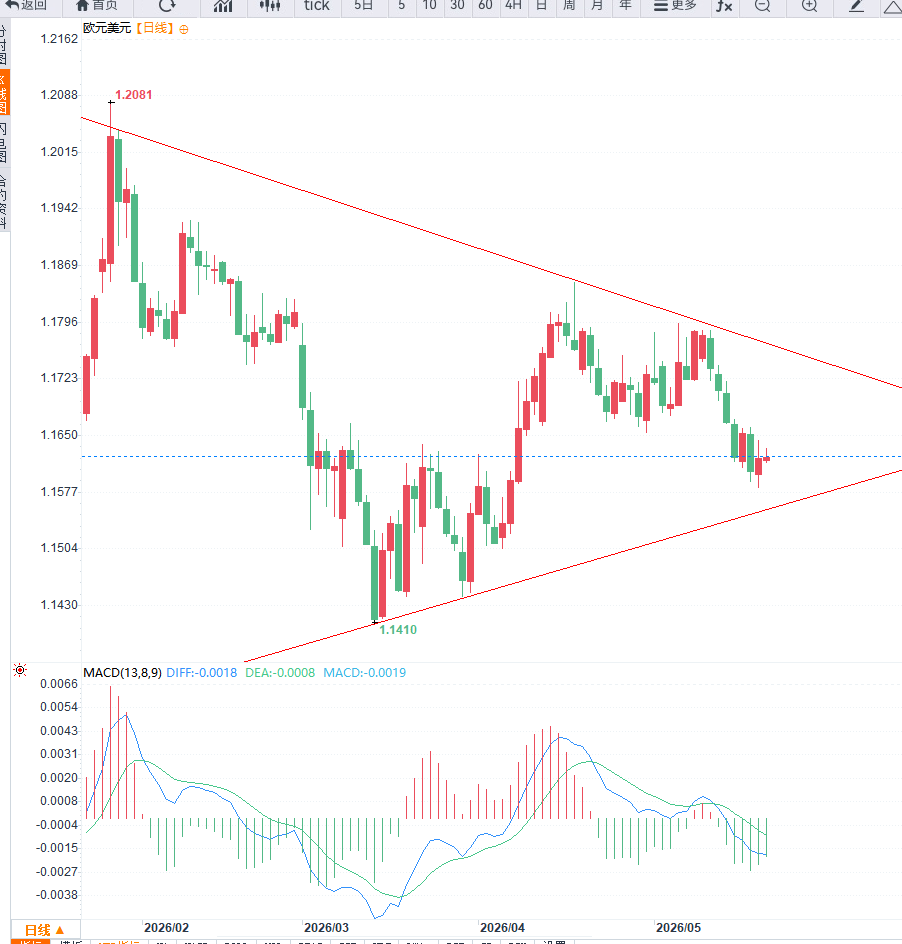
However, given that the US dollar remains supported by high interest rate expectations, the euro's short-term rebound may still be limited. The market currently leans towards the view that EUR/USD will consolidate within the 1.1600 to 1.1650 range.
Editor's Summary : The current euro/dollar exchange rate is gradually shifting from a previous one-sided decline to a consolidation phase. Although the dollar is still supported by safe-haven demand and hawkish expectations from the Federal Reserve, the euro's bearish momentum has clearly weakened, cooling market expectations for further sharp declines. In the short term, the 1.1570 support level and the 1.1665 resistance level will be crucial technical areas determining the subsequent direction. If the euro holds above 1.1570, the exchange rate may enter a period of bottoming out and consolidation; however, if the dollar strengthens again and pushes the exchange rate below this area, the euro may face greater downward pressure again. Overall, the market has gradually shifted from a "one-sided bearish view on the euro" to a "high-level consolidation" logic, and future trends will still be highly dependent on the Federal Reserve's policies, US Treasury yields, and subsequent changes in the European Central Bank's stance.
Strategists at United Overseas Bank (UOB) in Singapore pointed out that although the overall trend for the euro remains cautious, recent downward momentum has shown signs of slowing, potentially limiting further significant declines in the short term. Previously, the market generally bet on the dollar continuing its strength, mainly due to rising expectations of a hawkish stance from the Federal Reserve and increased safe-haven demand stemming from the Middle East situation. However, after the euro broke below 1.1600, the market did not experience sustained selling; instead, it triggered a significant technical rebound. UOB analysts believe that the euro's rapid rebound to 1.1644 after falling to 1.1582 against the dollar indicates that buying support remains in place.
While the bearish momentum in the market has not completely disappeared, it has clearly weakened . Technical indicators are beginning to show initial positive divergence signals, meaning that as prices make new lows, some momentum indicators have not weakened in tandem, which is usually considered an important sign of a short-term bottoming out.
From a macroeconomic perspective, the US dollar was previously supported by the minutes of the Federal Reserve meeting. The minutes of the Fed's April FOMC meeting showed that most officials remained vigilant about inflation risks and believed that if inflation remained above 2% for an extended period, further policy tightening might be necessary.
Meanwhile, continued tensions in the Middle East have also fueled demand for the US dollar as a safe haven. Market concerns that shipping risks in the Strait of Hormuz could impact global energy supplies and further exacerbate global inflationary pressures have contributed to this situation. However, as the dollar index's short-term gains have slowed, the euro has also gained some breathing room.
Furthermore, the market remains somewhat optimistic about the future policy path of the European Central Bank (ECB). Given the ongoing pressures from energy prices and imported inflation in the Eurozone, the market expects the ECB to maintain a relatively hawkish stance in the short term.
Market expectations for another ECB rate hike in June remain high, which to some extent limits the euro's further downside. Looking at fund flows, some institutions have begun to reduce their short euro positions. Due to the euro's rapid short-term decline and the market entering a technically oversold zone, the demand for profit-taking by short sellers has increased.
The 1.1570 area is currently considered a key medium-term support level for the euro against the US dollar . If the exchange rate fails to break below this area, it suggests that the euro may enter a longer period of consolidation rather than continue its downward trend.
From a technical perspective, the EUR/USD daily chart is currently showing a clear consolidation and recovery structure. The exchange rate rebounded quickly after breaking below 1.1600, indicating that buying pressure remains. The MACD indicator's bearish momentum bars are gradually narrowing, suggesting that downward momentum is weakening; the RSI indicator has rebounded from its lows to near the neutral zone, indicating that market sentiment has improved somewhat.
The initial resistance level is currently located in the 1.1650 to 1.1665 area. A break above 1.1665 would suggest a possible end to the previous downtrend and could open up further upside potential.
On the downside, 1.1600 forms the first short-term support level, while 1.1570 is currently the most critical technical support area. A decisive break below this level could reopen downside potential and lead to a further test of the 1.1500 level.
From the 4-hour chart, the EUR/USD pair has gradually broken free from its previous one-sided downward trend. The price has climbed back above the short-term moving average system, and the MACD indicator has returned to near the zero line, indicating a recovery in short-term bullish momentum. The RSI indicator remains above 50, suggesting that market sentiment is gradually becoming more balanced.
However, given that the US dollar remains supported by high interest rate expectations, the euro's short-term rebound may still be limited. The market currently leans towards the view that EUR/USD will consolidate within the 1.1600 to 1.1650 range.
Editor's Summary : The current euro/dollar exchange rate is gradually shifting from a previous one-sided decline to a consolidation phase. Although the dollar is still supported by safe-haven demand and hawkish expectations from the Federal Reserve, the euro's bearish momentum has clearly weakened, cooling market expectations for further sharp declines. In the short term, the 1.1570 support level and the 1.1665 resistance level will be crucial technical areas determining the subsequent direction. If the euro holds above 1.1570, the exchange rate may enter a period of bottoming out and consolidation; however, if the dollar strengthens again and pushes the exchange rate below this area, the euro may face greater downward pressure again. Overall, the market has gradually shifted from a "one-sided bearish view on the euro" to a "high-level consolidation" logic, and future trends will still be highly dependent on the Federal Reserve's policies, US Treasury yields, and subsequent changes in the European Central Bank's stance.
- Risk Warning and Disclaimer
- The market involves risk, and trading may not be suitable for all investors. This article is for reference only and does not constitute personal investment advice, nor does it take into account certain users’ specific investment objectives, financial situation, or other needs. Any investment decisions made based on this information are at your own risk.