Institutions: US strategic petroleum reserves are running low, oil prices face the risk of surging.
2026-05-21 14:36:06
Following the severance of the Strait of Hormuz, which triggered dramatic fluctuations in global oil prices, many countries jointly released strategic petroleum reserves to alleviate supply and demand pressures, with the United States taking on the largest share of reserve releases. However, the latest data shows that the pace of releases from the US strategic petroleum reserves has accelerated significantly, and inventories are nearing operational pressure levels.
Industry insiders warn that current measures to ease oil prices are only temporary and the short-term decline in oil prices is unlikely to be sustained. If geopolitical conflicts are not resolved, spot oil prices are likely to surge again, driving the futures market to strengthen in tandem.
In March of this year, Iran's blockade of the Strait of Hormuz triggered a surge in oil prices. The 32 member countries of the International Energy Agency (IEA) quickly reached a consensus, announcing the release of 400 million barrels of crude oil from their strategic petroleum reserves—a record-breaking amount, more than double the amount released during the 2022 Russia-Ukraine conflict. In this joint release, the United States again committed the largest share, pledging to release 172 million barrels of crude oil to stabilize prices.
On March 20, the U.S. Department of Energy (DOE) officially launched its first batch of reserve releases, signing contracts with eight companies to sell 45.2 million barrels of crude oil from storage facilities in Texas and Louisiana, thus kicking off a global emergency release of reserves. At the time, the market generally believed that the large-scale reserve release would effectively alleviate short-term energy supply shortages and curb the continued surge in oil prices.
A recent report from Standard Chartered's commodities analysts indicates that the rate of outflow from the U.S. Strategic Petroleum Reserve has accelerated dramatically, with the latest data recording the largest weekly decline on record. As of the week ending May 15, U.S. Strategic Petroleum Reserve inventories decreased by 9.9 million barrels , following a drop of 8.6 million barrels the previous week. After these consecutive sharp declines, total inventories have fallen to 374 million barrels, rapidly approaching operational limits.
It is understood that the U.S. Strategic Petroleum Reserve has limited physical storage capacity, with a maximum daily outflow of only 4.4 million barrels, while the statutory minimum operating inventory is 150 million barrels. The current rapid decline in inventories not only signifies a shrinking capacity for emergency releases but also suggests a weakening of the global energy supply's emergency buffering capacity.
Standard Chartered analysts point out that current global measures to alleviate short-term energy supply and demand imbalances, including the release of strategic reserves, are only temporarily feasible and cannot fundamentally resolve the supply and demand contradiction. This also means that the current short-term decline in spot oil prices is only a temporary phenomenon and does not represent a fundamental change in the supply and demand pattern. Once these temporary measures fail and the supply and demand imbalance reappears, it will inevitably drive crude oil futures prices up significantly.
In the short term, oil price movements are mainly driven by news, fluctuating primarily in line with the escalation and easing of the US-Iran conflict. At 22:00 Beijing time on May 20, US President Trump announced that negotiations between the US and Iran had entered the "final stage." This news triggered a sharp drop in oil prices. Brent crude for July delivery fell 4.95% to settle at $105.46 per barrel, while WTI crude futures fell 4.76% to settle at $99.08 per barrel.
Despite the recent short-term correction in oil prices and a structural adjustment in the crude oil futures curve, with the price of five-year Brent crude oil declining month-on-month, Trump's contradictory statements have created considerable uncertainty in the market. Trump said, "We'll see," before adding, "We'll take some tough measures, but hopefully it won't come to that." This ambiguous statement makes it difficult for outsiders to predict the next move by the United States, and has exacerbated the risk of oil price volatility.
It is worth noting that spot and futures crude oil prices have recently diverged unusually. Previously, during the escalation of the conflict, buyers rushed to purchase near-term spot crude oil from outside the Middle East, driving up spot premiums. Fortis crude oil in the North Sea surged to nearly $150 per barrel, surpassing its 2008 high. However, recently spot prices have fallen back towards futures prices, with some spot premiums dropping by as much as 90%. This is mainly due to factors such as buyers delaying purchases, reliance on inventory, and increased supply from unaffected regions.
Standard Chartered Bank stated that the short-term decline in spot oil prices is essentially due to buyers' optimistic expectations for a swift resolution to the conflict, as well as the combined effect of various temporary buffer measures. Currently, daily oil price fluctuations often exceed $10 per barrel, exacerbating market risks. Buyers are delaying purchases to mitigate these risks, while simultaneously using strategic reserve releases and refinery operating rate reductions to buffer oil price pressures.
However, this buffer effect is unlikely to last. Analysts predict that unless the US and Iran reach a formal settlement agreement, spot oil prices will rise again once buyers can no longer postpone purchases, refinery operating rates rebound, and strategic reserves are fully released. This will eventually drive futures prices toward the high spot benchmark, and global oil prices will still face a new round of upward pressure.
Overall, the joint release of strategic petroleum reserves by multiple countries has only temporarily alleviated the global energy supply shortage and has not fundamentally resolved the supply-demand imbalance caused by geopolitical conflicts. The US strategic petroleum reserves are running low, and the capacity for emergency releases is shrinking. Coupled with the uncertainty surrounding US-Iran negotiations, the short-term decline in oil prices is unlikely to be sustained.
As temporary buffer measures gradually fail, if the conflict cannot be resolved, oil prices are likely to surge again, and the global energy market will remain highly volatile.
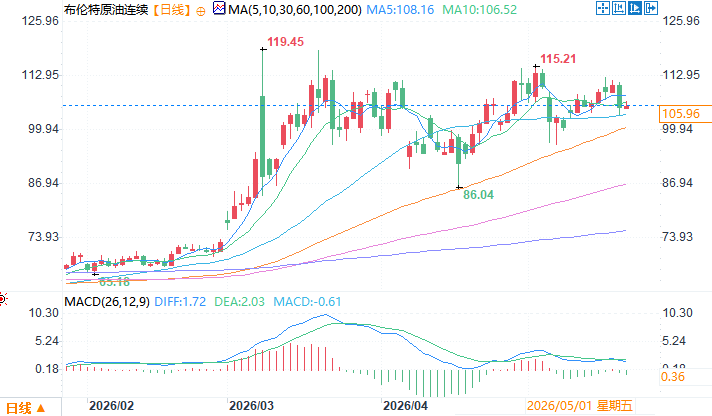
Brent crude oil daily chart source: EasyForex
At 14:35 Beijing time on May 21, Brent crude oil futures were trading at $106.19 per barrel.
Industry insiders warn that current measures to ease oil prices are only temporary and the short-term decline in oil prices is unlikely to be sustained. If geopolitical conflicts are not resolved, spot oil prices are likely to surge again, driving the futures market to strengthen in tandem.
Multiple countries joined forces to release reserves to rescue the market, with the United States taking the core responsibility.
In March of this year, Iran's blockade of the Strait of Hormuz triggered a surge in oil prices. The 32 member countries of the International Energy Agency (IEA) quickly reached a consensus, announcing the release of 400 million barrels of crude oil from their strategic petroleum reserves—a record-breaking amount, more than double the amount released during the 2022 Russia-Ukraine conflict. In this joint release, the United States again committed the largest share, pledging to release 172 million barrels of crude oil to stabilize prices.
On March 20, the U.S. Department of Energy (DOE) officially launched its first batch of reserve releases, signing contracts with eight companies to sell 45.2 million barrels of crude oil from storage facilities in Texas and Louisiana, thus kicking off a global emergency release of reserves. At the time, the market generally believed that the large-scale reserve release would effectively alleviate short-term energy supply shortages and curb the continued surge in oil prices.
US oil reserves are running low and nearing operational limits.
A recent report from Standard Chartered's commodities analysts indicates that the rate of outflow from the U.S. Strategic Petroleum Reserve has accelerated dramatically, with the latest data recording the largest weekly decline on record. As of the week ending May 15, U.S. Strategic Petroleum Reserve inventories decreased by 9.9 million barrels , following a drop of 8.6 million barrels the previous week. After these consecutive sharp declines, total inventories have fallen to 374 million barrels, rapidly approaching operational limits.
It is understood that the U.S. Strategic Petroleum Reserve has limited physical storage capacity, with a maximum daily outflow of only 4.4 million barrels, while the statutory minimum operating inventory is 150 million barrels. The current rapid decline in inventories not only signifies a shrinking capacity for emergency releases but also suggests a weakening of the global energy supply's emergency buffering capacity.
The short-term price suppression effect is limited; the risk of supply-demand imbalance remains.
Standard Chartered analysts point out that current global measures to alleviate short-term energy supply and demand imbalances, including the release of strategic reserves, are only temporarily feasible and cannot fundamentally resolve the supply and demand contradiction. This also means that the current short-term decline in spot oil prices is only a temporary phenomenon and does not represent a fundamental change in the supply and demand pattern. Once these temporary measures fail and the supply and demand imbalance reappears, it will inevitably drive crude oil futures prices up significantly.
In the short term, oil price movements are mainly driven by news, fluctuating primarily in line with the escalation and easing of the US-Iran conflict. At 22:00 Beijing time on May 20, US President Trump announced that negotiations between the US and Iran had entered the "final stage." This news triggered a sharp drop in oil prices. Brent crude for July delivery fell 4.95% to settle at $105.46 per barrel, while WTI crude futures fell 4.76% to settle at $99.08 per barrel.
Oil price volatility intensifies, causing a divergence between spot and futures price movements.
Despite the recent short-term correction in oil prices and a structural adjustment in the crude oil futures curve, with the price of five-year Brent crude oil declining month-on-month, Trump's contradictory statements have created considerable uncertainty in the market. Trump said, "We'll see," before adding, "We'll take some tough measures, but hopefully it won't come to that." This ambiguous statement makes it difficult for outsiders to predict the next move by the United States, and has exacerbated the risk of oil price volatility.
It is worth noting that spot and futures crude oil prices have recently diverged unusually. Previously, during the escalation of the conflict, buyers rushed to purchase near-term spot crude oil from outside the Middle East, driving up spot premiums. Fortis crude oil in the North Sea surged to nearly $150 per barrel, surpassing its 2008 high. However, recently spot prices have fallen back towards futures prices, with some spot premiums dropping by as much as 90%. This is mainly due to factors such as buyers delaying purchases, reliance on inventory, and increased supply from unaffected regions.
Short-term buffer unlikely to last, oil prices may surge again
Standard Chartered Bank stated that the short-term decline in spot oil prices is essentially due to buyers' optimistic expectations for a swift resolution to the conflict, as well as the combined effect of various temporary buffer measures. Currently, daily oil price fluctuations often exceed $10 per barrel, exacerbating market risks. Buyers are delaying purchases to mitigate these risks, while simultaneously using strategic reserve releases and refinery operating rate reductions to buffer oil price pressures.
However, this buffer effect is unlikely to last. Analysts predict that unless the US and Iran reach a formal settlement agreement, spot oil prices will rise again once buyers can no longer postpone purchases, refinery operating rates rebound, and strategic reserves are fully released. This will eventually drive futures prices toward the high spot benchmark, and global oil prices will still face a new round of upward pressure.
Summarize
Overall, the joint release of strategic petroleum reserves by multiple countries has only temporarily alleviated the global energy supply shortage and has not fundamentally resolved the supply-demand imbalance caused by geopolitical conflicts. The US strategic petroleum reserves are running low, and the capacity for emergency releases is shrinking. Coupled with the uncertainty surrounding US-Iran negotiations, the short-term decline in oil prices is unlikely to be sustained.
As temporary buffer measures gradually fail, if the conflict cannot be resolved, oil prices are likely to surge again, and the global energy market will remain highly volatile.
Brent crude oil daily chart source: EasyForex
At 14:35 Beijing time on May 21, Brent crude oil futures were trading at $106.19 per barrel.
- Risk Warning and Disclaimer
- The market involves risk, and trading may not be suitable for all investors. This article is for reference only and does not constitute personal investment advice, nor does it take into account certain users’ specific investment objectives, financial situation, or other needs. Any investment decisions made based on this information are at your own risk.