With the US-Iran negotiations entering their "final stage" and the Bank of Japan issuing hawkish signals, the USD/JPY pair awaits a directional breakout.
2026-05-21 13:35:17
The US dollar rose against the Japanese yen during Asian trading hours on Thursday (May 21), currently hovering around 159.00. Investors are awaiting new developments in US-Iran negotiations—US President Trump said on Wednesday that talks had entered the "final stage." The US dollar index is currently slightly higher, around 99.20. The dollar index's gains paused after hitting a six-week high of 99.47 on Wednesday, as Trump expressed confidence that a deal was imminent.
US President Donald Trump said on Wednesday that US-Iran negotiations have entered the "final stage," and Washington is willing to wait a few more days for the "right response" from Tehran. Trump told reporters, "We're in the final stage of negotiations with Iran. We'll see. Either we make a deal, or we'll take some pretty tough measures, but hopefully that won't happen." He also emphasized that the US will only give Iran "one chance," implying that the administration will not accept temporary or partial agreements limited to issues such as the reopening of the Strait of Hormuz, but will instead seek a broader and more lasting solution with Tehran.
At the same time, Trump indicated that he was "not in a hurry" to reach an agreement, not because he was deliberately rushing things due to the upcoming midterm elections. But while making a tough statement, he also released a relatively conciliatory signal: "If I can avoid war and save lives by waiting a few days, I think that's a great thing."
Optimism surrounding US-Iran negotiations has led to a sharp drop in oil prices and has also slightly dampened market expectations for a Federal Reserve rate hike this year.
The CME FedWatch tool shows that the market's expectation of at least one Fed rate hike this year has cooled to 51% from 61.3% on Tuesday. Nevertheless, this is still a clear directional reversal compared to the two rate cuts expected by the market before the Middle East conflict.
From a broader perspective, the temporary cooling of interest rate hike expectations does not mean the market has completely abandoned this direction. As one analyst pointed out, the minutes of the Fed's April meeting showed that "most participants indicated that if inflation persists above 2%, further policy tightening may be necessary." This means that as long as the "last mile" of the Middle East situation remains unresolved and oil prices remain above $100 per barrel, the market's pricing in an interest rate hike this year will be difficult to completely disappear. Furthermore, if the agreement ultimately collapses or navigation in the Strait of Hormuz fails to substantially resume, the probability of an interest rate hike could easily rise back to over 60%.
Bank of Japan policy board member Junko Onoda said on Thursday (May 21) that the central bank should raise interest rates at an "appropriate pace" as price pressures from the US-Iran conflict could push core inflation above the 2% target. This statement reinforces expectations of a rate hike as early as June. Onoda also pointed out that the central bank must pay closer attention to the side effects of negative real interest rates, given that oil prices are likely to remain high for an extended period.
Onoda's hawkish stance has introduced potential uncertainty into the recent bullish trend of USD/JPY. From early to mid-May, USD/JPY experienced a continuous rise, achieving seven consecutive days of gains and approaching the 160 level. This surge was primarily supported by two factors: firstly, the ongoing geopolitical tensions in the Middle East strengthened the safe-haven demand for the US dollar; and secondly, market expectations for a Federal Reserve rate hike this year continued to rise, while the Bank of Japan maintained an accommodative stance, keeping the USD/JPY interest rate differential at a high level.
From the daily chart, the USD/JPY pair is currently trading around 159.00, in a consolidation phase at high levels after a continuous rise, with multiple technical indicators showing bullish signals.
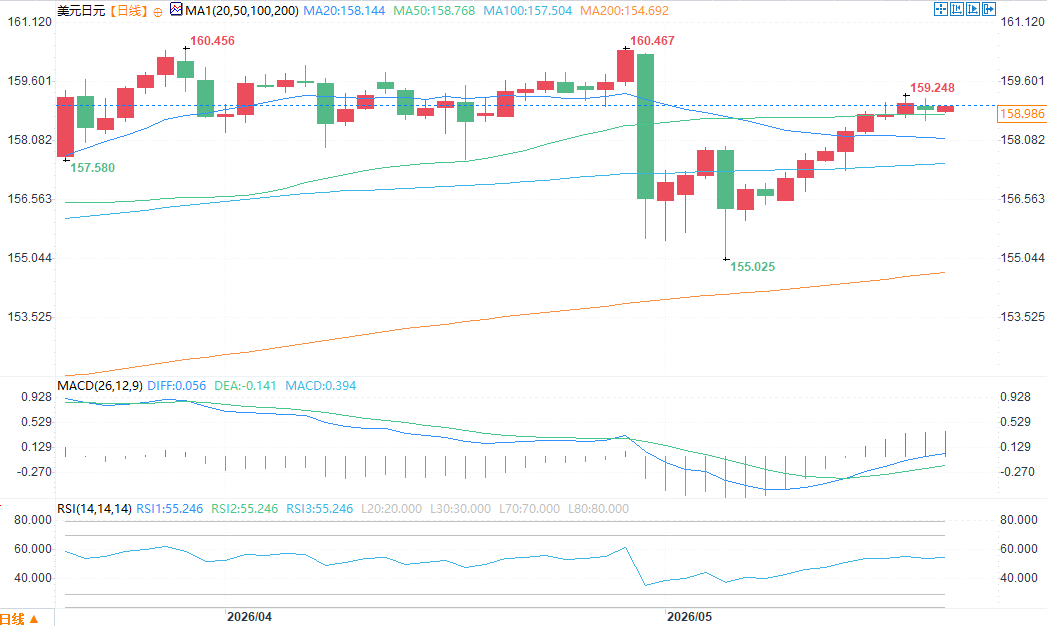
Regarding the moving average system, the short-term moving averages MA20 (158.14) and MA50 (158.77) are both below the current price, forming short-term support; while MA100 (157.50) and MA200 (154.69) are significantly lower than the current price. This bullish alignment of "short-term moving averages above and price above the moving averages" indicates that USD/JPY is in a clear upward trend. It is worth noting that the price has repeatedly tested the 160 level since the end of April without a successful breakout, indicating strong resistance in that area; while the MA20 (158.14) and MA50 (158.77) below act as important support levels in the near term.
Regarding the MACD indicator, the DIFF line is at 0.056, and the DEA line is at -0.141. The DIFF line has crossed above the DEA line, forming a golden cross signal, and the angle of the golden cross is relatively stable. The MACD histogram value is 0.394, which is positive and in an expanding state, indicating that the bullish momentum is continuing to be released.
In conclusion, the USD/JPY pair is currently in a "wait-and-see" mode regarding geopolitical news. News of the US-Iran negotiations entering their final stage is the core variable affecting recent market sentiment.
Meanwhile, Bank of Japan board member Junko Onoda delivered a hawkish speech, stating that the Middle East conflict could push core inflation above 2%, and that the central bank should raise interest rates at an "appropriate pace," while also being wary of the side effects of negative interest rates. Market expectations for a June rate hike by the Bank of Japan have intensified, introducing potential uncertainty into the appreciation of the US dollar against the yen.
At 13:34 Beijing time on May 21, the USD/JPY exchange rate was 159.02/03.
Trump stated that negotiations have entered the "final stage," and that either an agreement will be reached or "tough measures" will be taken.
US President Donald Trump said on Wednesday that US-Iran negotiations have entered the "final stage," and Washington is willing to wait a few more days for the "right response" from Tehran. Trump told reporters, "We're in the final stage of negotiations with Iran. We'll see. Either we make a deal, or we'll take some pretty tough measures, but hopefully that won't happen." He also emphasized that the US will only give Iran "one chance," implying that the administration will not accept temporary or partial agreements limited to issues such as the reopening of the Strait of Hormuz, but will instead seek a broader and more lasting solution with Tehran.
At the same time, Trump indicated that he was "not in a hurry" to reach an agreement, not because he was deliberately rushing things due to the upcoming midterm elections. But while making a tough statement, he also released a relatively conciliatory signal: "If I can avoid war and save lives by waiting a few days, I think that's a great thing."
Falling oil prices weaken expectations of a Fed rate hike
Optimism surrounding US-Iran negotiations has led to a sharp drop in oil prices and has also slightly dampened market expectations for a Federal Reserve rate hike this year.
The CME FedWatch tool shows that the market's expectation of at least one Fed rate hike this year has cooled to 51% from 61.3% on Tuesday. Nevertheless, this is still a clear directional reversal compared to the two rate cuts expected by the market before the Middle East conflict.
From a broader perspective, the temporary cooling of interest rate hike expectations does not mean the market has completely abandoned this direction. As one analyst pointed out, the minutes of the Fed's April meeting showed that "most participants indicated that if inflation persists above 2%, further policy tightening may be necessary." This means that as long as the "last mile" of the Middle East situation remains unresolved and oil prices remain above $100 per barrel, the market's pricing in an interest rate hike this year will be difficult to completely disappear. Furthermore, if the agreement ultimately collapses or navigation in the Strait of Hormuz fails to substantially resume, the probability of an interest rate hike could easily rise back to over 60%.
After seven consecutive days of increases, Tokyo is sounding the alarm about further interest rate hikes.
Bank of Japan policy board member Junko Onoda said on Thursday (May 21) that the central bank should raise interest rates at an "appropriate pace" as price pressures from the US-Iran conflict could push core inflation above the 2% target. This statement reinforces expectations of a rate hike as early as June. Onoda also pointed out that the central bank must pay closer attention to the side effects of negative real interest rates, given that oil prices are likely to remain high for an extended period.
Onoda's hawkish stance has introduced potential uncertainty into the recent bullish trend of USD/JPY. From early to mid-May, USD/JPY experienced a continuous rise, achieving seven consecutive days of gains and approaching the 160 level. This surge was primarily supported by two factors: firstly, the ongoing geopolitical tensions in the Middle East strengthened the safe-haven demand for the US dollar; and secondly, market expectations for a Federal Reserve rate hike this year continued to rise, while the Bank of Japan maintained an accommodative stance, keeping the USD/JPY interest rate differential at a high level.
The moving averages are in a bullish alignment, and the upward trend remains unchanged.
From the daily chart, the USD/JPY pair is currently trading around 159.00, in a consolidation phase at high levels after a continuous rise, with multiple technical indicators showing bullish signals.
Regarding the moving average system, the short-term moving averages MA20 (158.14) and MA50 (158.77) are both below the current price, forming short-term support; while MA100 (157.50) and MA200 (154.69) are significantly lower than the current price. This bullish alignment of "short-term moving averages above and price above the moving averages" indicates that USD/JPY is in a clear upward trend. It is worth noting that the price has repeatedly tested the 160 level since the end of April without a successful breakout, indicating strong resistance in that area; while the MA20 (158.14) and MA50 (158.77) below act as important support levels in the near term.
Regarding the MACD indicator, the DIFF line is at 0.056, and the DEA line is at -0.141. The DIFF line has crossed above the DEA line, forming a golden cross signal, and the angle of the golden cross is relatively stable. The MACD histogram value is 0.394, which is positive and in an expanding state, indicating that the bullish momentum is continuing to be released.
Geopolitical waiting vs. interest rate hike expectations: Two major variables for USD/JPY
In conclusion, the USD/JPY pair is currently in a "wait-and-see" mode regarding geopolitical news. News of the US-Iran negotiations entering their final stage is the core variable affecting recent market sentiment.
Meanwhile, Bank of Japan board member Junko Onoda delivered a hawkish speech, stating that the Middle East conflict could push core inflation above 2%, and that the central bank should raise interest rates at an "appropriate pace," while also being wary of the side effects of negative interest rates. Market expectations for a June rate hike by the Bank of Japan have intensified, introducing potential uncertainty into the appreciation of the US dollar against the yen.
At 13:34 Beijing time on May 21, the USD/JPY exchange rate was 159.02/03.
- Risk Warning and Disclaimer
- The market involves risk, and trading may not be suitable for all investors. This article is for reference only and does not constitute personal investment advice, nor does it take into account certain users’ specific investment objectives, financial situation, or other needs. Any investment decisions made based on this information are at your own risk.