A surprising twist! Iran suddenly closes its nuclear red line; investment banks urgently raise their oil price forecasts.
2026-05-21 19:45:07
Two sources said that Iran's Supreme Leader has ordered that near-weapon-grade uranium must remain within Iran. The Supreme Leader's directive reflects a consensus within the Iranian regime.
The current geopolitical landscape in the Middle East is undergoing profound changes, with the US-Iran ceasefire negotiations stalled and remaining in a stalemate.
With major personnel changes in Iranian politics, the power structure at the top has been restructured, and hardline military generals who hold real power in the military and government have risen to prominence, becoming key figures who influence the direction of the US-Iran rivalry .
Earlier, Iran's former Supreme Leader was assassinated, and the new leader, who was injured in the conflict, has kept a low profile and rarely makes public appearances.
After a brief power vacuum at the top, the power struggle within Iranian religious factions intensified, and the political discourse continued to be reshaped.
Against this backdrop, Ahmed Vahidi, the long-dormant brigadier general of the Iranian Revolutionary Guard, has returned to the forefront. With his close connections to the new Supreme Leader, he has officially entered the highest decision-making level of the country, and is fully responsible for finalizing Iran's bottom line in negotiations with the United States and its overall strategy for foreign relations. He has become a key player in the current geopolitical confrontation between the United States and Iran.
Wahidi had faded from public view and kept a low profile before the outbreak of this round of Middle East conflict. He recently made a formal appearance in Tehran to meet with the Pakistani Minister of the Interior.
The Pakistani officials' visit not only conveyed the US-Iran peace talks mediation efforts, but also included meetings with several high-ranking Iranian military and political officials. Vahidi has become the primary liaison between external forces and Iran for communication and negotiations.
Prior to this, high-level talks between the US and Iran, led by Iranian political officials, ended without any results or substantive consensus. Members of the negotiating delegation were also criticized by hardline factions in Iran for their weak negotiating stance.
This incident has led to suspicions that the initiative in Iran's diplomatic negotiations has completely shifted to the powerful ranks of the Revolutionary Guard , and the Iranian president has gradually been marginalized. Even if he takes the initiative to make public appearances and statements, it will be difficult to change the current political landscape.
The 67-year-old Vahidi has a strong military and political background. He joined the Iranian Islamic Revolution in 1979 and personally participated in the Iran-Iraq War, where he was tempered by real combat.
He subsequently took charge of the Revolutionary Guard's intelligence system for a long period, cultivating the Quds Force for many years, and single-handedly built a network of proxy armed forces spanning various Middle Eastern countries, deeply managing various overseas geopolitical operations.
He successively served as Iran's Minister of Defense and Minister of the Interior, among other key positions. During his tenure, he vigorously promoted the development of Iran's nuclear technology and defense industry. In the face of domestic protests and demands, he adopted high-pressure tactics to maintain stability and control the situation.
In his foreign relations, Vahidi has always adhered to the ideology of extreme anti-American resistance, advocating for a comprehensive counterbalance of Western forces, resolutely refusing to compromise or back down, and believing that Iran's powerful missiles and coastal armed forces are sufficient to withstand external military strikes.
Under the leadership of hardliners headed by Vahidi, Iran has become increasingly resolute in its foreign negotiations, resolutely rejecting the harsh conditions put forward by the United States, such as the elimination of highly enriched uranium.
Iran's leadership is well aware that the Trump administration has no intention of launching a large-scale war in the Middle East. A hasty war would only cause huge economic losses to the United States' Middle Eastern allies. Therefore, Iran has always adhered to its core interests.
On the military front, the Iranian Revolutionary Guard has ample ballistic missiles and offshore mobile vessels, firmly controlling the Strait of Hormuz, a vital choke point for global energy transport.
On the one hand, Iran controls the Strait of Hormuz oil and gas export routes, stirring up the global energy market; on the other hand, it precisely targets the energy facilities and core infrastructure of Gulf countries, constantly amplifying its geopolitical deterrence and further increasing the difficulty for the US and Iran to reach a ceasefire and reconciliation agreement.
The stalled process of de-escalation between the US and Iran, coupled with the complete control of foreign policy decisions by Iranian hardliners, means that geopolitical tensions in the Middle East are unlikely to ease in the short term, and the risk of regional conflict remains high.
UBS stated that if supply disruptions persist for an extended period, oil prices could surge in the short term, triggering significant demand damage. They raised their September Brent crude price forecast by $10 to $105 per barrel and their West Texas Intermediate crude price forecast to $97 per barrel.
From the perspective of the energy market, the Strait of Hormuz carries a large amount of global crude oil transportation. If the US-Iran rivalry escalates again, Iran tightens its control over passage through the strait and intensifies regional armed friction, market concerns about crude oil supply will rise rapidly, directly driving international oil prices to a high level.
If there are signs of a temporary easing of tensions between the two sides, and geopolitical risk aversion subsides, oil prices will likely see a short-term correction.
Given the current situation, Iran's hardline stance has become the mainstream, and the situation in the Middle East is unlikely to see a substantial de-escalation. International oil prices will continue to closely monitor the developments in the US-Iran rivalry, and will generally maintain a high level of fluctuation.
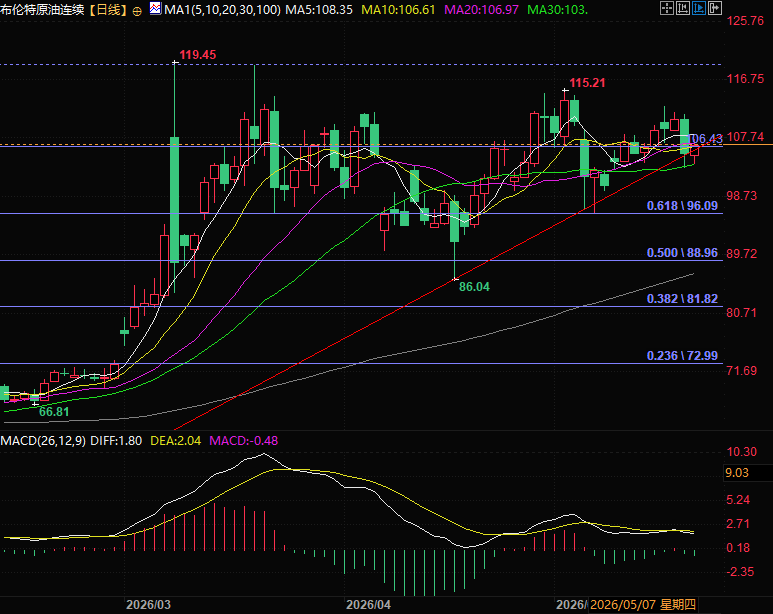
Technical Analysis: With an agreement about to be finalized on one hand and Iran's sudden hardline stance on enriched uranium on the other, Brent crude oil is fluctuating around the key 0.786 Fibonacci retracement level of 106.43. This level is a recent watershed between bullish and bearish sentiment in oil prices.
The current geopolitical landscape in the Middle East is undergoing profound changes, with the US-Iran ceasefire negotiations stalled and remaining in a stalemate.
With major personnel changes in Iranian politics, the power structure at the top has been restructured, and hardline military generals who hold real power in the military and government have risen to prominence, becoming key figures who influence the direction of the US-Iran rivalry .
Earlier, Iran's former Supreme Leader was assassinated, and the new leader, who was injured in the conflict, has kept a low profile and rarely makes public appearances.
After a brief power vacuum at the top, the power struggle within Iranian religious factions intensified, and the political discourse continued to be reshaped.
Against this backdrop, Ahmed Vahidi, the long-dormant brigadier general of the Iranian Revolutionary Guard, has returned to the forefront. With his close connections to the new Supreme Leader, he has officially entered the highest decision-making level of the country, and is fully responsible for finalizing Iran's bottom line in negotiations with the United States and its overall strategy for foreign relations. He has become a key player in the current geopolitical confrontation between the United States and Iran.
Rise to Real Power: A Subdued Figure Returns to Power, Taking Control of Foreign Affairs and Negotiations
Wahidi had faded from public view and kept a low profile before the outbreak of this round of Middle East conflict. He recently made a formal appearance in Tehran to meet with the Pakistani Minister of the Interior.
The Pakistani officials' visit not only conveyed the US-Iran peace talks mediation efforts, but also included meetings with several high-ranking Iranian military and political officials. Vahidi has become the primary liaison between external forces and Iran for communication and negotiations.
Prior to this, high-level talks between the US and Iran, led by Iranian political officials, ended without any results or substantive consensus. Members of the negotiating delegation were also criticized by hardline factions in Iran for their weak negotiating stance.
This incident has led to suspicions that the initiative in Iran's diplomatic negotiations has completely shifted to the powerful ranks of the Revolutionary Guard , and the Iranian president has gradually been marginalized. Even if he takes the initiative to make public appearances and statements, it will be difficult to change the current political landscape.
Strong resume: Years of combat experience, adhering to a confrontational diplomatic stance
The 67-year-old Vahidi has a strong military and political background. He joined the Iranian Islamic Revolution in 1979 and personally participated in the Iran-Iraq War, where he was tempered by real combat.
He subsequently took charge of the Revolutionary Guard's intelligence system for a long period, cultivating the Quds Force for many years, and single-handedly built a network of proxy armed forces spanning various Middle Eastern countries, deeply managing various overseas geopolitical operations.
He successively served as Iran's Minister of Defense and Minister of the Interior, among other key positions. During his tenure, he vigorously promoted the development of Iran's nuclear technology and defense industry. In the face of domestic protests and demands, he adopted high-pressure tactics to maintain stability and control the situation.
In his foreign relations, Vahidi has always adhered to the ideology of extreme anti-American resistance, advocating for a comprehensive counterbalance of Western forces, resolutely refusing to compromise or back down, and believing that Iran's powerful missiles and coastal armed forces are sufficient to withstand external military strikes.
Escalating the Game: Safeguarding Core Red Lines and Seizing Geostrategic Advantages
Under the leadership of hardliners headed by Vahidi, Iran has become increasingly resolute in its foreign negotiations, resolutely rejecting the harsh conditions put forward by the United States, such as the elimination of highly enriched uranium.
Iran's leadership is well aware that the Trump administration has no intention of launching a large-scale war in the Middle East. A hasty war would only cause huge economic losses to the United States' Middle Eastern allies. Therefore, Iran has always adhered to its core interests.
On the military front, the Iranian Revolutionary Guard has ample ballistic missiles and offshore mobile vessels, firmly controlling the Strait of Hormuz, a vital choke point for global energy transport.
On the one hand, Iran controls the Strait of Hormuz oil and gas export routes, stirring up the global energy market; on the other hand, it precisely targets the energy facilities and core infrastructure of Gulf countries, constantly amplifying its geopolitical deterrence and further increasing the difficulty for the US and Iran to reach a ceasefire and reconciliation agreement.
Market Interaction: Persistent Geopolitical Stalemate Deeply Impacts International Oil Prices
The stalled process of de-escalation between the US and Iran, coupled with the complete control of foreign policy decisions by Iranian hardliners, means that geopolitical tensions in the Middle East are unlikely to ease in the short term, and the risk of regional conflict remains high.
UBS stated that if supply disruptions persist for an extended period, oil prices could surge in the short term, triggering significant demand damage. They raised their September Brent crude price forecast by $10 to $105 per barrel and their West Texas Intermediate crude price forecast to $97 per barrel.
From the perspective of the energy market, the Strait of Hormuz carries a large amount of global crude oil transportation. If the US-Iran rivalry escalates again, Iran tightens its control over passage through the strait and intensifies regional armed friction, market concerns about crude oil supply will rise rapidly, directly driving international oil prices to a high level.
If there are signs of a temporary easing of tensions between the two sides, and geopolitical risk aversion subsides, oil prices will likely see a short-term correction.
Given the current situation, Iran's hardline stance has become the mainstream, and the situation in the Middle East is unlikely to see a substantial de-escalation. International oil prices will continue to closely monitor the developments in the US-Iran rivalry, and will generally maintain a high level of fluctuation.
Technical Analysis: With an agreement about to be finalized on one hand and Iran's sudden hardline stance on enriched uranium on the other, Brent crude oil is fluctuating around the key 0.786 Fibonacci retracement level of 106.43. This level is a recent watershed between bullish and bearish sentiment in oil prices.
- Risk Warning and Disclaimer
- The market involves risk, and trading may not be suitable for all investors. This article is for reference only and does not constitute personal investment advice, nor does it take into account certain users’ specific investment objectives, financial situation, or other needs. Any investment decisions made based on this information are at your own risk.