The triple whammy of the US dollar, US Treasury bonds, and crude oil: Can gold escape the "suffocation zone" of $4,500?
2026-05-21 20:28:42
On Thursday, May 21, spot gold remained above $4,500, but faced intraday pressure. June gold futures were around $4,537.90. The daily chart shows the current price around $4,515, with the Bollinger Band middle line at approximately $4,652.94, the upper line at approximately $4,848.95, and the lower line at approximately $4,456.93. The price is approaching the lower line area.
Gold is not currently trading on a simple safe-haven premium, but rather is being repriced amid high oil prices, high bond yields, a strong dollar, and hawkish expectations from the Federal Reserve. Data shows that Brent crude remains above $105, energy prices are influencing inflation expectations, and the rising 10-year US Treasury yield is diminishing the attractiveness of non-interest-bearing assets. Gold has fallen more than 14% since the escalation of the US-Iran conflict in late February.
The key to this round of gold price correction lies not in the complete disappearance of safe-haven demand, but in the inability of safe-haven buying to offset the pressure from interest rates. Traditionally, escalating geopolitical risks are generally beneficial to gold, but when risk events simultaneously push up energy prices and increase inflation stickiness, the market reassesses the probability of the Federal Reserve maintaining high interest rates or even raising them further. As a result, gold transforms from a "risk-hedging asset" into a "non-interest-bearing asset in a high real interest rate environment," passively shifting its valuation downwards.
The minutes of the April Federal Reserve meeting were released on May 20. The April meeting statement reiterated the long-term inflation target of 2%, and pointed out that the situation in the Middle East increased uncertainty in the economic outlook, requiring policymakers to pay attention to risks on both the employment and inflation ends. Public reports also show that most officials believe that if inflation persists above 2%, further interest rate hikes may be an appropriate option. This means that gold is not facing a single hawkish statement, but rather a phased shift in the policy response function.
For traders, the core variable for current price elasticity is the 10-year real interest rate, not a single day's safe-haven news. Rising nominal yields directly increase the opportunity cost of holding gold; if oil prices continue to drive up inflation expectations, and short-term policy interest rate expectations are revised upwards simultaneously, gold is more likely to move inversely to oil prices. This characteristic has already emerged in the market recently: rising oil prices have not led to sustained strength in gold, but rather reinforced the trading chain that "inflation is more difficult to fall, and interest rates are more difficult to decline."
The earlier short-term pullback in the US dollar helped stabilize gold, but this support was more tactical than trend-driven. This is because the dollar's decline was not accompanied by a trend of declining yields, nor by a significant dovish shift in expectations regarding Federal Reserve policy. In other words, gold only gained a temporary respite in terms of exchange rates, rather than a renewed expansion in valuation.
From an inter-asset perspective, the US dollar, yields, and oil prices are currently exerting complex pressure on gold. A stronger dollar increases the cost of purchase for non-dollar buyers, higher yields weaken the value of holding gold, and high oil prices suppress the scope for interest rate cuts through inflation expectations. Unless these three factors weaken simultaneously, gold will find it difficult to escape the selling pressure from above.
Some market analysts believe that gold remains trapped in the $4,500 range because the dollar has retained most of its gains since the conflict, inflation concerns continue to loom over global markets, and the hawkish tone of the latest Fed minutes limits upside potential for gold prices. The key point of this assessment is not a short-term bearish view on gold, but rather that the current trading focus for gold has shifted from "whether there is risk" to "whether the risk is sufficient to outweigh high interest rates."
Gold is typically viewed as an inflation hedge, but in the current environment, inflation is primarily driven by energy supply shocks, which will force the bond market to repric its interest rate path. Brent crude oil remains above $105, with supply disruptions, declining inventories, and negotiation uncertainties continuing to impact the market. Public data also shows a significant drop in global visible inventories in May, with some institutions estimating a decrease of 8.7 million barrels per day, rapidly depleting the inventory buffer.
This type of inflation differs from overheated demand and is more likely to create a combination of "growth under pressure but inflation remaining high." This is not the most favorable environment for gold. If rising oil prices stem from geopolitical risks, gold will see safe-haven buying; however, if rising oil prices further boost inflation expectations and drive up bond yields, gold's non-interest-bearing nature will be repriced.
Iran-related negotiations remain a common source of volatility for both oil and gold prices. When negotiations show signs of easing, oil prices may fall, reducing inflationary pressures, but also weakening safe-haven demand. Conversely, when negotiations stall, oil prices may surge again, increasing safe-haven demand, which could simultaneously push up yields and the US dollar. Therefore, simply explaining the current market trend as "geopolitical tensions are bullish for gold" is insufficient. What gold truly needs is easing yield pressures, not an escalation of a single risk event.
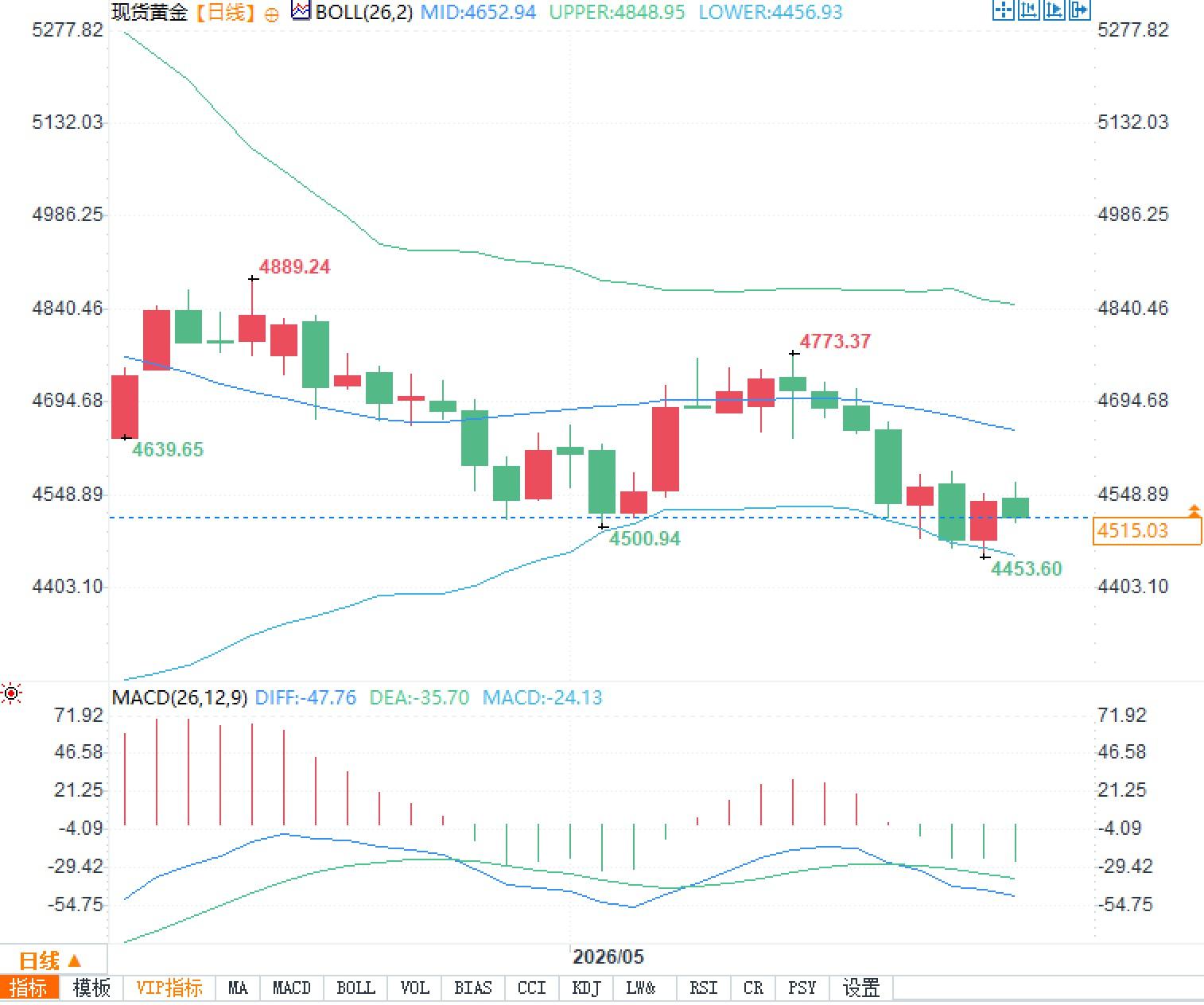
From a technical perspective, the daily chart shows the price below the Bollinger Band's middle line. The short-term rebound has yet to regain control of the middle line, and the MACD remains in weak territory, indicating that the current market is more likely to be consolidating at lower levels after a decline, rather than a trend reversal. The lower Bollinger Band around $4456 and the psychological level of $4500 form a short-term observation zone, while the $4650-$4695 area represents resistance near the moving averages and the Bollinger Band's middle line. These technical signals align with the macroeconomic logic; gold needs to see a decline in yields or a cooling of the dollar before it can potentially recover its upside potential.
Gold is not currently trading on a simple safe-haven premium, but rather is being repriced amid high oil prices, high bond yields, a strong dollar, and hawkish expectations from the Federal Reserve. Data shows that Brent crude remains above $105, energy prices are influencing inflation expectations, and the rising 10-year US Treasury yield is diminishing the attractiveness of non-interest-bearing assets. Gold has fallen more than 14% since the escalation of the US-Iran conflict in late February.
The core issue for gold has shifted from safe-haven appeal to suppression of real interest rates.
The key to this round of gold price correction lies not in the complete disappearance of safe-haven demand, but in the inability of safe-haven buying to offset the pressure from interest rates. Traditionally, escalating geopolitical risks are generally beneficial to gold, but when risk events simultaneously push up energy prices and increase inflation stickiness, the market reassesses the probability of the Federal Reserve maintaining high interest rates or even raising them further. As a result, gold transforms from a "risk-hedging asset" into a "non-interest-bearing asset in a high real interest rate environment," passively shifting its valuation downwards.
The minutes of the April Federal Reserve meeting were released on May 20. The April meeting statement reiterated the long-term inflation target of 2%, and pointed out that the situation in the Middle East increased uncertainty in the economic outlook, requiring policymakers to pay attention to risks on both the employment and inflation ends. Public reports also show that most officials believe that if inflation persists above 2%, further interest rate hikes may be an appropriate option. This means that gold is not facing a single hawkish statement, but rather a phased shift in the policy response function.
For traders, the core variable for current price elasticity is the 10-year real interest rate, not a single day's safe-haven news. Rising nominal yields directly increase the opportunity cost of holding gold; if oil prices continue to drive up inflation expectations, and short-term policy interest rate expectations are revised upwards simultaneously, gold is more likely to move inversely to oil prices. This characteristic has already emerged in the market recently: rising oil prices have not led to sustained strength in gold, but rather reinforced the trading chain that "inflation is more difficult to fall, and interest rates are more difficult to decline."
The dollar's pullback failed to change the weak structure of gold.
The earlier short-term pullback in the US dollar helped stabilize gold, but this support was more tactical than trend-driven. This is because the dollar's decline was not accompanied by a trend of declining yields, nor by a significant dovish shift in expectations regarding Federal Reserve policy. In other words, gold only gained a temporary respite in terms of exchange rates, rather than a renewed expansion in valuation.
From an inter-asset perspective, the US dollar, yields, and oil prices are currently exerting complex pressure on gold. A stronger dollar increases the cost of purchase for non-dollar buyers, higher yields weaken the value of holding gold, and high oil prices suppress the scope for interest rate cuts through inflation expectations. Unless these three factors weaken simultaneously, gold will find it difficult to escape the selling pressure from above.
Some market analysts believe that gold remains trapped in the $4,500 range because the dollar has retained most of its gains since the conflict, inflation concerns continue to loom over global markets, and the hawkish tone of the latest Fed minutes limits upside potential for gold prices. The key point of this assessment is not a short-term bearish view on gold, but rather that the current trading focus for gold has shifted from "whether there is risk" to "whether the risk is sufficient to outweigh high interest rates."
High oil prices are weakening gold's inflation hedge properties.
Gold is typically viewed as an inflation hedge, but in the current environment, inflation is primarily driven by energy supply shocks, which will force the bond market to repric its interest rate path. Brent crude oil remains above $105, with supply disruptions, declining inventories, and negotiation uncertainties continuing to impact the market. Public data also shows a significant drop in global visible inventories in May, with some institutions estimating a decrease of 8.7 million barrels per day, rapidly depleting the inventory buffer.
This type of inflation differs from overheated demand and is more likely to create a combination of "growth under pressure but inflation remaining high." This is not the most favorable environment for gold. If rising oil prices stem from geopolitical risks, gold will see safe-haven buying; however, if rising oil prices further boost inflation expectations and drive up bond yields, gold's non-interest-bearing nature will be repriced.
Iran-related negotiations remain a common source of volatility for both oil and gold prices. When negotiations show signs of easing, oil prices may fall, reducing inflationary pressures, but also weakening safe-haven demand. Conversely, when negotiations stall, oil prices may surge again, increasing safe-haven demand, which could simultaneously push up yields and the US dollar. Therefore, simply explaining the current market trend as "geopolitical tensions are bullish for gold" is insufficient. What gold truly needs is easing yield pressures, not an escalation of a single risk event.
From a technical perspective, the daily chart shows the price below the Bollinger Band's middle line. The short-term rebound has yet to regain control of the middle line, and the MACD remains in weak territory, indicating that the current market is more likely to be consolidating at lower levels after a decline, rather than a trend reversal. The lower Bollinger Band around $4456 and the psychological level of $4500 form a short-term observation zone, while the $4650-$4695 area represents resistance near the moving averages and the Bollinger Band's middle line. These technical signals align with the macroeconomic logic; gold needs to see a decline in yields or a cooling of the dollar before it can potentially recover its upside potential.
- Risk Warning and Disclaimer
- The market involves risk, and trading may not be suitable for all investors. This article is for reference only and does not constitute personal investment advice, nor does it take into account certain users’ specific investment objectives, financial situation, or other needs. Any investment decisions made based on this information are at your own risk.