The final stage of US-Iran negotiations took an unexpected turn when Iran refused to hand over enriched uranium, but UBS remains bullish on the market outlook.
2026-05-22 11:23:30
On Friday (May 22), oil prices rebounded after two consecutive days of decline. During early Asian trading, Brent crude futures for July delivery rose nearly 2% from Thursday's settlement price to $105.13 per barrel, before retreating slightly to $104.18, with the gain narrowing to 1.53%. WTI crude futures for July delivery rose more than 2% from Thursday's settlement price to $98.35 per barrel, and are currently trading around $97.37 per barrel, with the gain narrowing to 1%.
Investors are weighing conflicting signals emerging from the US-Iran peace talks. While US statements suggest a peace agreement is imminent, reports that the Iranian leadership wants to keep enriched uranium within its borders have raised concerns that the conflict could be prolonged, meaning oil supply disruptions could last longer.
According to Iranian sources on May 21, Iran's Supreme Leader Ayatollah Mojtaba Khamenei has issued a clear directive that Iran's stockpile of highly enriched uranium near weapons-grade levels must not be shipped abroad.
Sources say that senior Iranian officials believe that shipping nuclear materials out of the country will make Iran more vulnerable to future military strikes by the United States and Israel. It is estimated that before the US-Israeli attacks on Iranian nuclear facilities last June, Iran possessed approximately 440.9 kilograms of uranium enriched to 60%, a level far exceeding civilian nuclear energy needs and just one step away from weapons-grade enrichment at 90%.
Iranian Foreign Ministry spokesman Bagaei responded to the reports on the 21st, saying that the focus of the negotiations at this stage is to end the war on all fronts, and that the claims about uranium enrichment are "just speculation and lack credibility."
On the same day Iran sent its strong signal, US President Trump responded sharply at the White House. He stated unequivocally that Iran must hand over highly enriched uranium, which the US would "likely destroy" once acquired. "We don't need it, and we don't want it," Trump said. "We're not going to let them have it." He also revealed that US-Iran negotiations had entered the "final stage," but that if Iran did not accept an agreement that met US demands, it would face a large-scale military strike.
International Energy Agency Executive Director Fatih Birol issued a stern warning in a speech at the Chatham House in London on May 21: With global crude oil inventories continuing to decline rapidly, coupled with a rebound in demand due to the summer travel season in the Northern Hemisphere, the global oil market may enter a "red alert zone" in July or August.
Birol pointed out that the market was initially able to buffer some of the shock because there was a certain surplus of global crude oil supply before the crisis broke out, "which was a relatively fortunate situation." But now these buffer inventories are being depleted at an alarming rate.
He warned that restoring crude oil production and refining capacity in the Middle East to pre-war levels "will likely take a long time," and even if the Strait of Hormuz were to reopen immediately tomorrow, it would still take a considerable amount of time for the market to return to normal.
The head of European equity strategy at Barclays described the current situation as "an extremely difficult one" at the same event. She stated, "This is the largest supply disruption we have ever experienced. The cumulative loss of crude oil production has already exceeded 1 billion barrels, and even if the Strait of Hormuz reopens tomorrow, it will take a long time for the market to return to normal."
UBS released a report stating that global oil inventories are declining at a record pace and may approach historic lows by the end of May. The firm predicts that production shutdowns in May could reach 15 million barrels per day. If traffic in the Strait of Hormuz does not improve significantly, oil prices remain at risk of rising in the short term, and could even break through the $150 per barrel mark. UBS expects Brent crude to remain around $100 in the short term. If the conflict eases and traffic in the Strait resumes, oil prices may fall back to the mid-$80 range. As inventories need to gradually recover, oil prices will continue to be supported in 2027.
In conclusion, the differences in positions between the US and Iran on the issue of uranium enrichment have cast a shadow over the prospects for a peace agreement, thus providing renewed support for oil prices. Although the US has released optimistic signals that negotiations have entered the "final stage," Iran's insistence on maintaining its uranium enrichment policy means that the geopolitical risk premium is unlikely to subside. The International Energy Agency's "red zone" warning and Mitsubishi UFJ's forecast that supply normalization may be delayed until 2027 have further strengthened market expectations of supply tightness. In the short term, oil prices are expected to remain volatile at high levels, with the direction depending on the actual progress of US-Iran negotiations and the navigation status of the Strait of Hormuz.
From the daily chart, US crude oil is currently trading around $97.50, in a consolidation phase after a recent pullback from its highs, with multiple technical indicators showing a neutral to weak signal.
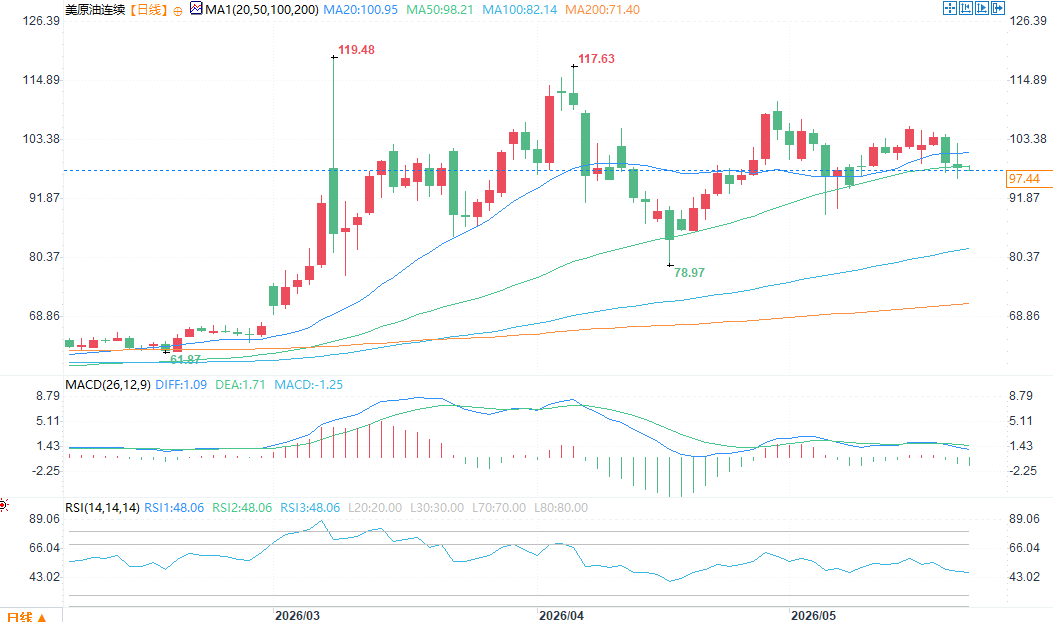
(US crude oil daily chart, source: FX678)
Regarding the moving average system, the short-term moving averages MA20 (100.95) and MA50 (98.21) are both above the current price, forming short-term resistance. The current price has fallen below MA20 and MA50, indicating a weak short-term trend. MA100 (82.14) and MA200 (71.40) are significantly lower than the current price, indicating that the long-term upward trend has not been completely broken, but short-term downward pressure is increasing.
At 11:19 AM Beijing time on May 22, US crude oil futures were trading at $97.50 per barrel.
Investors are weighing conflicting signals emerging from the US-Iran peace talks. While US statements suggest a peace agreement is imminent, reports that the Iranian leadership wants to keep enriched uranium within its borders have raised concerns that the conflict could be prolonged, meaning oil supply disruptions could last longer.
Geopolitical developments: The US says negotiations have entered the "final stage," while Iran insists on retaining enriched uranium.
According to Iranian sources on May 21, Iran's Supreme Leader Ayatollah Mojtaba Khamenei has issued a clear directive that Iran's stockpile of highly enriched uranium near weapons-grade levels must not be shipped abroad.
Sources say that senior Iranian officials believe that shipping nuclear materials out of the country will make Iran more vulnerable to future military strikes by the United States and Israel. It is estimated that before the US-Israeli attacks on Iranian nuclear facilities last June, Iran possessed approximately 440.9 kilograms of uranium enriched to 60%, a level far exceeding civilian nuclear energy needs and just one step away from weapons-grade enrichment at 90%.
Iranian Foreign Ministry spokesman Bagaei responded to the reports on the 21st, saying that the focus of the negotiations at this stage is to end the war on all fronts, and that the claims about uranium enrichment are "just speculation and lack credibility."
On the same day Iran sent its strong signal, US President Trump responded sharply at the White House. He stated unequivocally that Iran must hand over highly enriched uranium, which the US would "likely destroy" once acquired. "We don't need it, and we don't want it," Trump said. "We're not going to let them have it." He also revealed that US-Iran negotiations had entered the "final stage," but that if Iran did not accept an agreement that met US demands, it would face a large-scale military strike.
Supply Concerns: IEA Warns Oil Market May Enter "Red Zone" This Summer
International Energy Agency Executive Director Fatih Birol issued a stern warning in a speech at the Chatham House in London on May 21: With global crude oil inventories continuing to decline rapidly, coupled with a rebound in demand due to the summer travel season in the Northern Hemisphere, the global oil market may enter a "red alert zone" in July or August.
Birol pointed out that the market was initially able to buffer some of the shock because there was a certain surplus of global crude oil supply before the crisis broke out, "which was a relatively fortunate situation." But now these buffer inventories are being depleted at an alarming rate.
He warned that restoring crude oil production and refining capacity in the Middle East to pre-war levels "will likely take a long time," and even if the Strait of Hormuz were to reopen immediately tomorrow, it would still take a considerable amount of time for the market to return to normal.
Institutional Outlook: UBS says oil prices will remain supported in 2027
The head of European equity strategy at Barclays described the current situation as "an extremely difficult one" at the same event. She stated, "This is the largest supply disruption we have ever experienced. The cumulative loss of crude oil production has already exceeded 1 billion barrels, and even if the Strait of Hormuz reopens tomorrow, it will take a long time for the market to return to normal."
UBS released a report stating that global oil inventories are declining at a record pace and may approach historic lows by the end of May. The firm predicts that production shutdowns in May could reach 15 million barrels per day. If traffic in the Strait of Hormuz does not improve significantly, oil prices remain at risk of rising in the short term, and could even break through the $150 per barrel mark. UBS expects Brent crude to remain around $100 in the short term. If the conflict eases and traffic in the Strait resumes, oil prices may fall back to the mid-$80 range. As inventories need to gradually recover, oil prices will continue to be supported in 2027.
Geopolitical stalemate continues, oil prices to remain high in the short term.
In conclusion, the differences in positions between the US and Iran on the issue of uranium enrichment have cast a shadow over the prospects for a peace agreement, thus providing renewed support for oil prices. Although the US has released optimistic signals that negotiations have entered the "final stage," Iran's insistence on maintaining its uranium enrichment policy means that the geopolitical risk premium is unlikely to subside. The International Energy Agency's "red zone" warning and Mitsubishi UFJ's forecast that supply normalization may be delayed until 2027 have further strengthened market expectations of supply tightness. In the short term, oil prices are expected to remain volatile at high levels, with the direction depending on the actual progress of US-Iran negotiations and the navigation status of the Strait of Hormuz.
The moving average is providing resistance, indicating short-term weakness.
From the daily chart, US crude oil is currently trading around $97.50, in a consolidation phase after a recent pullback from its highs, with multiple technical indicators showing a neutral to weak signal.
(US crude oil daily chart, source: FX678)
Regarding the moving average system, the short-term moving averages MA20 (100.95) and MA50 (98.21) are both above the current price, forming short-term resistance. The current price has fallen below MA20 and MA50, indicating a weak short-term trend. MA100 (82.14) and MA200 (71.40) are significantly lower than the current price, indicating that the long-term upward trend has not been completely broken, but short-term downward pressure is increasing.
At 11:19 AM Beijing time on May 22, US crude oil futures were trading at $97.50 per barrel.
- Risk Warning and Disclaimer
- The market involves risk, and trading may not be suitable for all investors. This article is for reference only and does not constitute personal investment advice, nor does it take into account certain users’ specific investment objectives, financial situation, or other needs. Any investment decisions made based on this information are at your own risk.