Despite a series of positive developments between the US and Iran, oil prices have seen limited declines.
2026-05-22 21:39:04
On Friday (May 22), during the Asian and European sessions, international oil prices continued to decline, with Brent crude trading around 102.96.
Recent developments seem to be progressing rapidly, with frequent good news from the US and Iran, and marginal improvements in cross-strait traffic. However, no substantial results from the negotiations have been seen yet. Although navigation has improved marginally, the total number is still a drop in the bucket. The most certain thing is the gradually rising cost of living.
With the peak travel season approaching, US fuel retail prices have remained at a four-year high, significantly increasing travel costs for the public.
Industry analysts point out that if the deadlock over cross-strait navigation cannot be resolved, U.S. gasoline prices may exceed $5 per gallon this summer.
Eurasian economies are vying for US refined oil export supplies, and the bidding frenzy is further pushing up domestic gasoline and diesel prices, making a short-term upward trend in oil prices clear.
The current average price of gasoline in the United States is $4.55 per gallon, an increase of more than 50% since the US-Israel war against Iran began at the end of February, marking the highest price for the same period since the Russia-Ukraine conflict in 2022.
Iran's blockade of this core global energy shipping route has triggered a severe oil supply crisis, with US crude oil prices surging by more than 40% compared to pre-war levels, and cost pressures being directly passed on to end consumers.
Experts predict that if the Strait of Hormuz remains closed for an extended period, gasoline prices in the United States will likely reach $5 per gallon in June.
Geopolitical dynamics have become the core factor in short-term oil price fluctuations. The US announced a temporary halt to military strikes against Iran, creating room for negotiation, and international oil prices fell by nearly 7% in the short term.
However, the US has repeatedly failed to deliver on its promises to end the war quickly, and the situation between the US and Iran has repeatedly escalated, causing oil prices to fluctuate wildly.
Market confidence in official statements has declined, and even positive developments are currently unable to support a significant drop in oil prices.
Industry experts believe that only when cross-strait navigation resumes substantially will the risk of high oil prices gradually decrease; even if the waterway reopens, oil prices are not expected to return to normal levels until 2027.
The core demand of the US in the negotiations was to prevent Iran from developing nuclear weapons. The policy-making did not take into account US inflation and the cost of fuel for the people. The geopolitical game-first approach further amplified the uncertainty in the energy market.
Global oil inventories are being depleted at an accelerated pace, with current reserves only enough to last four to six weeks. If there is no substantial progress between the US and Iran by then, gasoline, diesel, and jet fuel prices may see another surge once inventories are exhausted.
Due to its domestic production capacity and strategic petroleum reserves, the United States currently faces no risk of fuel supply disruptions.
However, the supply gap in Middle Eastern crude oil is difficult to fill, and Asian and European countries are rushing to buy US exported oil and gas products. The restructuring of the supply and demand pattern continues to drive up US oil prices.
Currently, diesel prices in the United States are approaching $6 per gallon, and in extreme market conditions, they may even reach $7. The global competition for refined oil resources is a key factor driving the continued rise in oil prices.
Sources familiar with the matter revealed that Qatar has sent a negotiating team to Tehran to coordinate with the United States in an effort to reach an agreement to end the war with Iran. While oil prices fluctuate with geopolitical tensions, a slight positive development has emerged from the US-Iran negotiations, but the risk of a renewed conflict remains, and uncertainty in the crude oil trading market remains high.
U.S. Secretary of State Marco Rubio stated that there had been marginal improvements in the negotiations between the two sides, but a substantive peace agreement had yet to be reached.
The U.S. military's wavering stance, with its history of repeatedly suspending strikes only to launch sudden airstrikes, has kept traders and investors constantly cautious.
The decision to temporarily halt military action was made in response to the security concerns of Middle Eastern allies such as Qatar and Saudi Arabia. This decision has also caused a split in the positions of the United States and Israel, with Israel firmly opposing reconciliation between the two countries. This marks the first time since the start of the US-Iran conflict that the two countries have publicly displayed significant policy differences.
Multiple countries have intervened to mediate the situation, and Pakistani officials have visited Iran multiple times to help de-escalate the conflict. They will also use diplomatic activities to communicate the results of their mediation efforts.
However, the core stalemate in the game between the two sides has not been broken. Although some ships have sailed out of the strait, Iran still effectively blocks the Strait of Hormuz, and the shipping of crude oil and natural gas has basically come to a standstill.
The US simultaneously blocked Iranian ports, forcing a large number of merchant ships to change routes, severely disrupting the global crude oil transportation chain.
The US and Iran each adhere to their bottom lines on the nuclear issue. The US demands that Iran destroy highly enriched uranium and completely cease its nuclear research and development, while Iran insists that its nuclear program will only be used for peaceful purposes.
Multiple contradictions are intertwined, making the negotiation process extremely difficult. Going forward, oil prices will continue to fluctuate significantly, depending on the progress of negotiations and changes in the status of navigation across the Taiwan Strait.
When oil prices will start to fall depends on when the Strait of Hormuz will officially open to navigation and how long the navigation can be guaranteed. Currently, Iran's oil storage capacity is subject to physical constraints, and some institutions estimate that it will take less than two weeks.
Meanwhile, the US midterm election primaries have begun, and summer is also the peak season for oil consumption. Both sides are taking a hard line, but under the constraints of reality, neither wants to continue fighting. Ultimately, they still need to reach a settlement on core differences, such as uranium enrichment.
From a technical perspective, Brent crude oil has broken through several key support levels, with current support around 96, which is also the 0.618 Fibonacci retracement level.
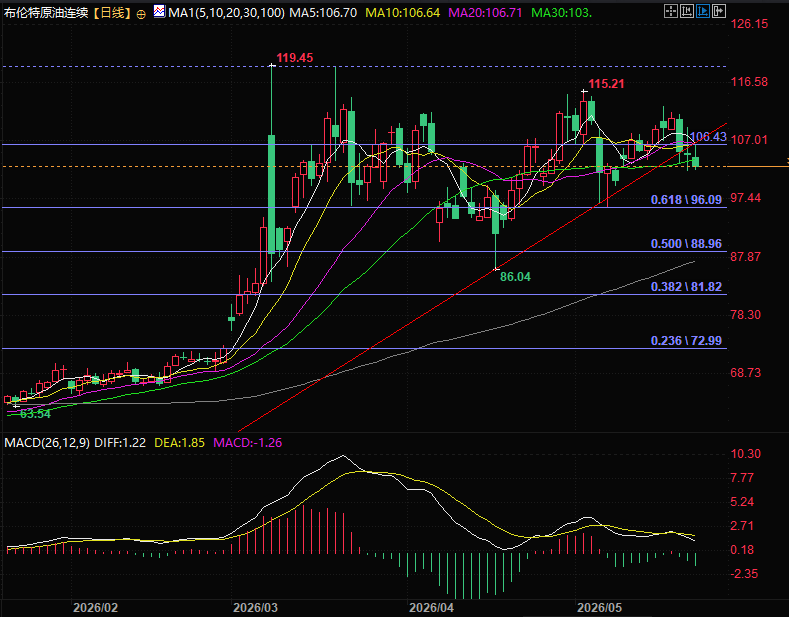
(Brent crude oil futures daily chart, source: EasyForex)
At 21:37 Beijing time, Brent crude oil futures were trading at $103.4 per barrel.
Recent developments seem to be progressing rapidly, with frequent good news from the US and Iran, and marginal improvements in cross-strait traffic. However, no substantial results from the negotiations have been seen yet. Although navigation has improved marginally, the total number is still a drop in the bucket. The most certain thing is the gradually rising cost of living.
With the peak travel season approaching, US fuel retail prices have remained at a four-year high, significantly increasing travel costs for the public.
Industry analysts point out that if the deadlock over cross-strait navigation cannot be resolved, U.S. gasoline prices may exceed $5 per gallon this summer.
Eurasian economies are vying for US refined oil export supplies, and the bidding frenzy is further pushing up domestic gasoline and diesel prices, making a short-term upward trend in oil prices clear.
The current average price of gasoline in the United States is $4.55 per gallon, an increase of more than 50% since the US-Israel war against Iran began at the end of February, marking the highest price for the same period since the Russia-Ukraine conflict in 2022.
Iran's blockade of this core global energy shipping route has triggered a severe oil supply crisis, with US crude oil prices surging by more than 40% compared to pre-war levels, and cost pressures being directly passed on to end consumers.
Oil prices are unlikely to fall significantly due to fluctuations.
Experts predict that if the Strait of Hormuz remains closed for an extended period, gasoline prices in the United States will likely reach $5 per gallon in June.
Geopolitical dynamics have become the core factor in short-term oil price fluctuations. The US announced a temporary halt to military strikes against Iran, creating room for negotiation, and international oil prices fell by nearly 7% in the short term.
However, the US has repeatedly failed to deliver on its promises to end the war quickly, and the situation between the US and Iran has repeatedly escalated, causing oil prices to fluctuate wildly.
Market confidence in official statements has declined, and even positive developments are currently unable to support a significant drop in oil prices.
Industry experts believe that only when cross-strait navigation resumes substantially will the risk of high oil prices gradually decrease; even if the waterway reopens, oil prices are not expected to return to normal levels until 2027.
The core demand of the US in the negotiations was to prevent Iran from developing nuclear weapons. The policy-making did not take into account US inflation and the cost of fuel for the people. The geopolitical game-first approach further amplified the uncertainty in the energy market.
Continued depletion of inventories drives up global competition for refined oil products.
Global oil inventories are being depleted at an accelerated pace, with current reserves only enough to last four to six weeks. If there is no substantial progress between the US and Iran by then, gasoline, diesel, and jet fuel prices may see another surge once inventories are exhausted.
Due to its domestic production capacity and strategic petroleum reserves, the United States currently faces no risk of fuel supply disruptions.
However, the supply gap in Middle Eastern crude oil is difficult to fill, and Asian and European countries are rushing to buy US exported oil and gas products. The restructuring of the supply and demand pattern continues to drive up US oil prices.
Currently, diesel prices in the United States are approaching $6 per gallon, and in extreme market conditions, they may even reach $7. The global competition for refined oil resources is a key factor driving the continued rise in oil prices.
Negotiations show marginal progress, but the risk of war restarting remains.
Sources familiar with the matter revealed that Qatar has sent a negotiating team to Tehran to coordinate with the United States in an effort to reach an agreement to end the war with Iran. While oil prices fluctuate with geopolitical tensions, a slight positive development has emerged from the US-Iran negotiations, but the risk of a renewed conflict remains, and uncertainty in the crude oil trading market remains high.
U.S. Secretary of State Marco Rubio stated that there had been marginal improvements in the negotiations between the two sides, but a substantive peace agreement had yet to be reached.
The U.S. military's wavering stance, with its history of repeatedly suspending strikes only to launch sudden airstrikes, has kept traders and investors constantly cautious.
The decision to temporarily halt military action was made in response to the security concerns of Middle Eastern allies such as Qatar and Saudi Arabia. This decision has also caused a split in the positions of the United States and Israel, with Israel firmly opposing reconciliation between the two countries. This marks the first time since the start of the US-Iran conflict that the two countries have publicly displayed significant policy differences.
Multi-party mediation has yielded limited results, and the core contradictions remain unresolved.
Multiple countries have intervened to mediate the situation, and Pakistani officials have visited Iran multiple times to help de-escalate the conflict. They will also use diplomatic activities to communicate the results of their mediation efforts.
However, the core stalemate in the game between the two sides has not been broken. Although some ships have sailed out of the strait, Iran still effectively blocks the Strait of Hormuz, and the shipping of crude oil and natural gas has basically come to a standstill.
The US simultaneously blocked Iranian ports, forcing a large number of merchant ships to change routes, severely disrupting the global crude oil transportation chain.
The US and Iran each adhere to their bottom lines on the nuclear issue. The US demands that Iran destroy highly enriched uranium and completely cease its nuclear research and development, while Iran insists that its nuclear program will only be used for peaceful purposes.
Multiple contradictions are intertwined, making the negotiation process extremely difficult. Going forward, oil prices will continue to fluctuate significantly, depending on the progress of negotiations and changes in the status of navigation across the Taiwan Strait.
Summary and Technical Analysis:
When oil prices will start to fall depends on when the Strait of Hormuz will officially open to navigation and how long the navigation can be guaranteed. Currently, Iran's oil storage capacity is subject to physical constraints, and some institutions estimate that it will take less than two weeks.
Meanwhile, the US midterm election primaries have begun, and summer is also the peak season for oil consumption. Both sides are taking a hard line, but under the constraints of reality, neither wants to continue fighting. Ultimately, they still need to reach a settlement on core differences, such as uranium enrichment.
From a technical perspective, Brent crude oil has broken through several key support levels, with current support around 96, which is also the 0.618 Fibonacci retracement level.
(Brent crude oil futures daily chart, source: EasyForex)
At 21:37 Beijing time, Brent crude oil futures were trading at $103.4 per barrel.
- Risk Warning and Disclaimer
- The market involves risk, and trading may not be suitable for all investors. This article is for reference only and does not constitute personal investment advice, nor does it take into account certain users’ specific investment objectives, financial situation, or other needs. Any investment decisions made based on this information are at your own risk.