Can the Canadian dollar escape the pressure of the US dollar? Oil price rebound provides support, but the US-Iran conflict and expectations of interest rate hikes exert dual pressure.
2026-06-10 11:05:58
On Wednesday (June 9) during Asian trading hours, the US dollar rose above 1.3950 against the Canadian dollar before falling back, and is currently trading around 1.3945.
Rising oil prices supported the Canadian dollar, as Canada is the largest supplier of crude oil to the United States, and the commodity linkage effect benefited the Canadian dollar. However, renewed escalation of geopolitical tensions in the Middle East, with the US launching a third round of retaliatory strikes against Iran, fueled safe-haven demand and kept the US dollar strong, limiting the Canadian dollar's upside potential. Furthermore, better-than-expected US employment data for May strengthened market expectations of a Federal Reserve rate hike this year.

As geopolitical tensions in the Middle East escalated between June 9th and 10th, renewed concerns about oil supply disruptions pushed international oil prices higher during Wednesday's Asian trading session. Previously, a brief pause in hostilities between Israel and Iran on Tuesday had initially fueled expectations of de-escalation, causing oil prices to fall rapidly, with WTI crude oil dropping nearly 3% at one point. However, this brief respite was short-lived. With the US launching a second and even third round of retaliatory strikes against Iran, and Iran firing ballistic missiles from Isfahan at US targets in the region, the conflict quickly escalated again, completely shattering ceasefire expectations, and oil prices rebounded accordingly.
The stabilization of crude oil prices has directly benefited the Canadian dollar. As the largest exporter of crude oil to the United States, Canada's economy is highly correlated with oil price trends. Crude oil exports account for a significant portion of Canada's GDP, and rising oil prices typically mean increased revenue for energy companies, improved terms of trade, and consequently, increased demand for the Canadian dollar. Furthermore, higher oil prices also provide longer-term fundamental support for the Canadian dollar by improving Canada's current account balance.
WTI crude oil has rebounded to around $88.50 per barrel. Although it has not fully recovered Tuesday's losses, the continued existence of geopolitical risks provides upward momentum for oil prices in the short term. As long as the US-Iran standoff does not see substantial easing, oil prices are likely to remain high. For the Canadian dollar, this means that support from commodity channels will not fade in the short term, potentially offsetting the downward pressure from a strong US dollar to some extent. However, it is worth noting that if geopolitical tensions suddenly ease or global economic growth expectations deteriorate, oil prices may quickly correct, and the support for the Canadian dollar will weaken accordingly.
According to the latest reports, the United States launched a third round of retaliatory strikes against targets off the coast of Iran on Wednesday, after Iran launched at least three ballistic missiles from Isfahan. This round of strikes followed Tuesday's initial U.S. strikes, which Washington described as a "reciprocal response" to Iran's downing of a U.S. armed helicopter near the Strait of Hormuz.
US President Trump emphasized earlier on Tuesday that a deal between Iran and the US was close, but progress has been minimal since the fragile ceasefire took effect in early April. Continued uncertainty surrounding a Middle East peace agreement has exacerbated market concerns about inflation and increased expectations that interest rates will remain high.
Escalating geopolitical risks have supported the US dollar amid risk aversion, keeping the dollar index strong, which in turn has provided upward support for the US dollar against the Canadian dollar.
The U.S. non-farm payrolls report released last week was strong, with 172,000 new jobs added, significantly exceeding market expectations. This data indicates that despite the Federal Reserve maintaining high interest rates for some time, the U.S. labor market remains surprisingly resilient. The breadth of job growth is also noteworthy; not only did the service sector continue to absorb labor, but hiring activity in interest rate-sensitive sectors such as manufacturing and construction also did not show a significant slowdown. This suggests that the economy's endogenous growth momentum remains, further postponing recession expectations.
Strong employment data has had a direct and profound impact on the market. The core transmission mechanism is that a tight labor market will continue to exert pressure on inflation through wages. When companies struggle to recruit suitable employees, they are forced to raise wages to attract and retain talent. These wage increases translate into disposable income, supporting consumer demand and ultimately making it difficult for overall inflation to quickly fall back to the Federal Reserve's 2% target. This chain of logic—"strong employment—rising wages—stable consumption—sticky inflation"—is precisely why Federal Reserve officials have repeatedly emphasized the need for vigilance recently.
Against this backdrop, market expectations for a Federal Reserve rate hike this year have significantly strengthened. Following the release of the non-farm payroll data, the interest rate futures market quickly adjusted its pricing, with the probability of a 25 basis point rate hike before the end of the year climbing from a previous low to around 22 basis points. Some members of the Federal Open Market Committee have also publicly stated that if inflation data continues to show stubborn characteristics in the coming months, they do not rule out another rate hike later this year.
For the US dollar, strong employment data provides crucial fundamental support. Expectations that the Federal Reserve will maintain high interest rates or even raise them further will attract global capital flows to dollar assets, pushing up US Treasury yields and thus supporting the dollar index at a relatively high level. As long as the labor market does not experience a sharp deterioration, the dollar's strong position is unlikely to be fundamentally shaken. This also means that non-US dollar currencies, including the Canadian dollar, will continue to face pressure from the dollar in the short term.
The USD/CAD pair is showing a clear upward trend on the daily chart, with the price rising steadily from the recent low of 1.3549 and currently trading around 1.3945, approaching the previous high of 1.3968. Short-term bullish momentum is strong. The moving average system is in a bullish alignment, with the price trading above the 20-day, 50-day, 100-day, and 200-day moving averages, forming a support zone and maintaining the upward trend.
The MACD indicator shows that the DIFF line is above the DEA line, and the red bars continue to expand, indicating that the bullish momentum is still continuing. The RSI indicator has risen to around 72, approaching the overbought zone, so we need to be wary of the risk of a short-term pullback.
Overall, the USD/CAD pair is in a strong upward channel, with key resistance at 1.3968. A break above this level could lead to a further challenge of the previous high of 1.4130. Support lies near the 20-day moving average (MA20) (around 1.3830), where a pullback should likely find support. The recommended strategy is to primarily buy on dips, monitoring for a break above the previous high while remaining cautious of potential technical pullbacks triggered by overbought conditions.
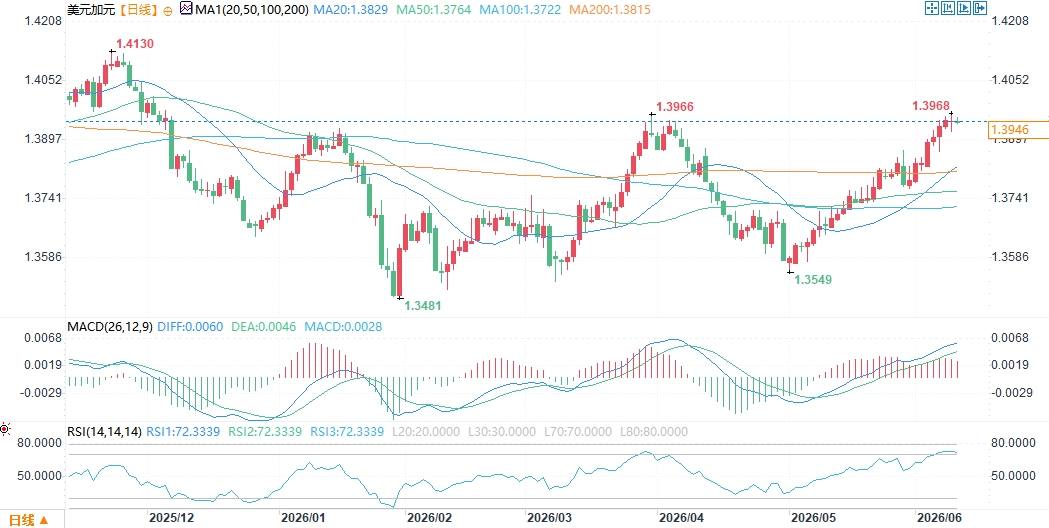
(USD/CAD daily chart, source: EasyForex)
At 11:05 Beijing time on June 10, the USD/CAD exchange rate was 1.3947/48.
Rising oil prices supported the Canadian dollar, as Canada is the largest supplier of crude oil to the United States, and the commodity linkage effect benefited the Canadian dollar. However, renewed escalation of geopolitical tensions in the Middle East, with the US launching a third round of retaliatory strikes against Iran, fueled safe-haven demand and kept the US dollar strong, limiting the Canadian dollar's upside potential. Furthermore, better-than-expected US employment data for May strengthened market expectations of a Federal Reserve rate hike this year.
Rising oil prices provide support for the Canadian dollar.
As geopolitical tensions in the Middle East escalated between June 9th and 10th, renewed concerns about oil supply disruptions pushed international oil prices higher during Wednesday's Asian trading session. Previously, a brief pause in hostilities between Israel and Iran on Tuesday had initially fueled expectations of de-escalation, causing oil prices to fall rapidly, with WTI crude oil dropping nearly 3% at one point. However, this brief respite was short-lived. With the US launching a second and even third round of retaliatory strikes against Iran, and Iran firing ballistic missiles from Isfahan at US targets in the region, the conflict quickly escalated again, completely shattering ceasefire expectations, and oil prices rebounded accordingly.
The stabilization of crude oil prices has directly benefited the Canadian dollar. As the largest exporter of crude oil to the United States, Canada's economy is highly correlated with oil price trends. Crude oil exports account for a significant portion of Canada's GDP, and rising oil prices typically mean increased revenue for energy companies, improved terms of trade, and consequently, increased demand for the Canadian dollar. Furthermore, higher oil prices also provide longer-term fundamental support for the Canadian dollar by improving Canada's current account balance.
WTI crude oil has rebounded to around $88.50 per barrel. Although it has not fully recovered Tuesday's losses, the continued existence of geopolitical risks provides upward momentum for oil prices in the short term. As long as the US-Iran standoff does not see substantial easing, oil prices are likely to remain high. For the Canadian dollar, this means that support from commodity channels will not fade in the short term, potentially offsetting the downward pressure from a strong US dollar to some extent. However, it is worth noting that if geopolitical tensions suddenly ease or global economic growth expectations deteriorate, oil prices may quickly correct, and the support for the Canadian dollar will weaken accordingly.
Geopolitics: Escalating US-Iran conflict supports the US dollar due to risk aversion.
According to the latest reports, the United States launched a third round of retaliatory strikes against targets off the coast of Iran on Wednesday, after Iran launched at least three ballistic missiles from Isfahan. This round of strikes followed Tuesday's initial U.S. strikes, which Washington described as a "reciprocal response" to Iran's downing of a U.S. armed helicopter near the Strait of Hormuz.
US President Trump emphasized earlier on Tuesday that a deal between Iran and the US was close, but progress has been minimal since the fragile ceasefire took effect in early April. Continued uncertainty surrounding a Middle East peace agreement has exacerbated market concerns about inflation and increased expectations that interest rates will remain high.
Escalating geopolitical risks have supported the US dollar amid risk aversion, keeping the dollar index strong, which in turn has provided upward support for the US dollar against the Canadian dollar.
US Data: Strong Jobs Data Strengthens Expectations of Interest Rate Hikes
The U.S. non-farm payrolls report released last week was strong, with 172,000 new jobs added, significantly exceeding market expectations. This data indicates that despite the Federal Reserve maintaining high interest rates for some time, the U.S. labor market remains surprisingly resilient. The breadth of job growth is also noteworthy; not only did the service sector continue to absorb labor, but hiring activity in interest rate-sensitive sectors such as manufacturing and construction also did not show a significant slowdown. This suggests that the economy's endogenous growth momentum remains, further postponing recession expectations.
Strong employment data has had a direct and profound impact on the market. The core transmission mechanism is that a tight labor market will continue to exert pressure on inflation through wages. When companies struggle to recruit suitable employees, they are forced to raise wages to attract and retain talent. These wage increases translate into disposable income, supporting consumer demand and ultimately making it difficult for overall inflation to quickly fall back to the Federal Reserve's 2% target. This chain of logic—"strong employment—rising wages—stable consumption—sticky inflation"—is precisely why Federal Reserve officials have repeatedly emphasized the need for vigilance recently.
Against this backdrop, market expectations for a Federal Reserve rate hike this year have significantly strengthened. Following the release of the non-farm payroll data, the interest rate futures market quickly adjusted its pricing, with the probability of a 25 basis point rate hike before the end of the year climbing from a previous low to around 22 basis points. Some members of the Federal Open Market Committee have also publicly stated that if inflation data continues to show stubborn characteristics in the coming months, they do not rule out another rate hike later this year.
For the US dollar, strong employment data provides crucial fundamental support. Expectations that the Federal Reserve will maintain high interest rates or even raise them further will attract global capital flows to dollar assets, pushing up US Treasury yields and thus supporting the dollar index at a relatively high level. As long as the labor market does not experience a sharp deterioration, the dollar's strong position is unlikely to be fundamentally shaken. This also means that non-US dollar currencies, including the Canadian dollar, will continue to face pressure from the dollar in the short term.
Technical Analysis
The USD/CAD pair is showing a clear upward trend on the daily chart, with the price rising steadily from the recent low of 1.3549 and currently trading around 1.3945, approaching the previous high of 1.3968. Short-term bullish momentum is strong. The moving average system is in a bullish alignment, with the price trading above the 20-day, 50-day, 100-day, and 200-day moving averages, forming a support zone and maintaining the upward trend.
The MACD indicator shows that the DIFF line is above the DEA line, and the red bars continue to expand, indicating that the bullish momentum is still continuing. The RSI indicator has risen to around 72, approaching the overbought zone, so we need to be wary of the risk of a short-term pullback.
Overall, the USD/CAD pair is in a strong upward channel, with key resistance at 1.3968. A break above this level could lead to a further challenge of the previous high of 1.4130. Support lies near the 20-day moving average (MA20) (around 1.3830), where a pullback should likely find support. The recommended strategy is to primarily buy on dips, monitoring for a break above the previous high while remaining cautious of potential technical pullbacks triggered by overbought conditions.
(USD/CAD daily chart, source: EasyForex)
At 11:05 Beijing time on June 10, the USD/CAD exchange rate was 1.3947/48.
- Risk Warning and Disclaimer
- The market involves risk, and trading may not be suitable for all investors. This article is for reference only and does not constitute personal investment advice, nor does it take into account certain users’ specific investment objectives, financial situation, or other needs. Any investment decisions made based on this information are at your own risk.