Geopolitical "time bomb" enters its final countdown: Strait blockade coincides with OPEC+ production increase countdown, who is swimming naked on the eve of oil price breakdown?
2026-05-23 12:34:46
International oil prices fluctuated at high levels this week before closing higher. Market sentiment was dominated by concerns about the prospects for the resumption of shipping in the Strait of Hormuz, influenced by the slow progress of US-Iran peace talks. Although the weekly chart still showed a significant decline, oil prices surged by more than 3% intraday on Friday, ultimately closing stronger. The core event this week revolved around the US-Iran peace talks. Reports from major overseas institutions indicate that although some progress has been made in the negotiations, significant differences remain between the two sides on issues such as Tehran's uranium stockpile and the control of the Strait of Hormuz.

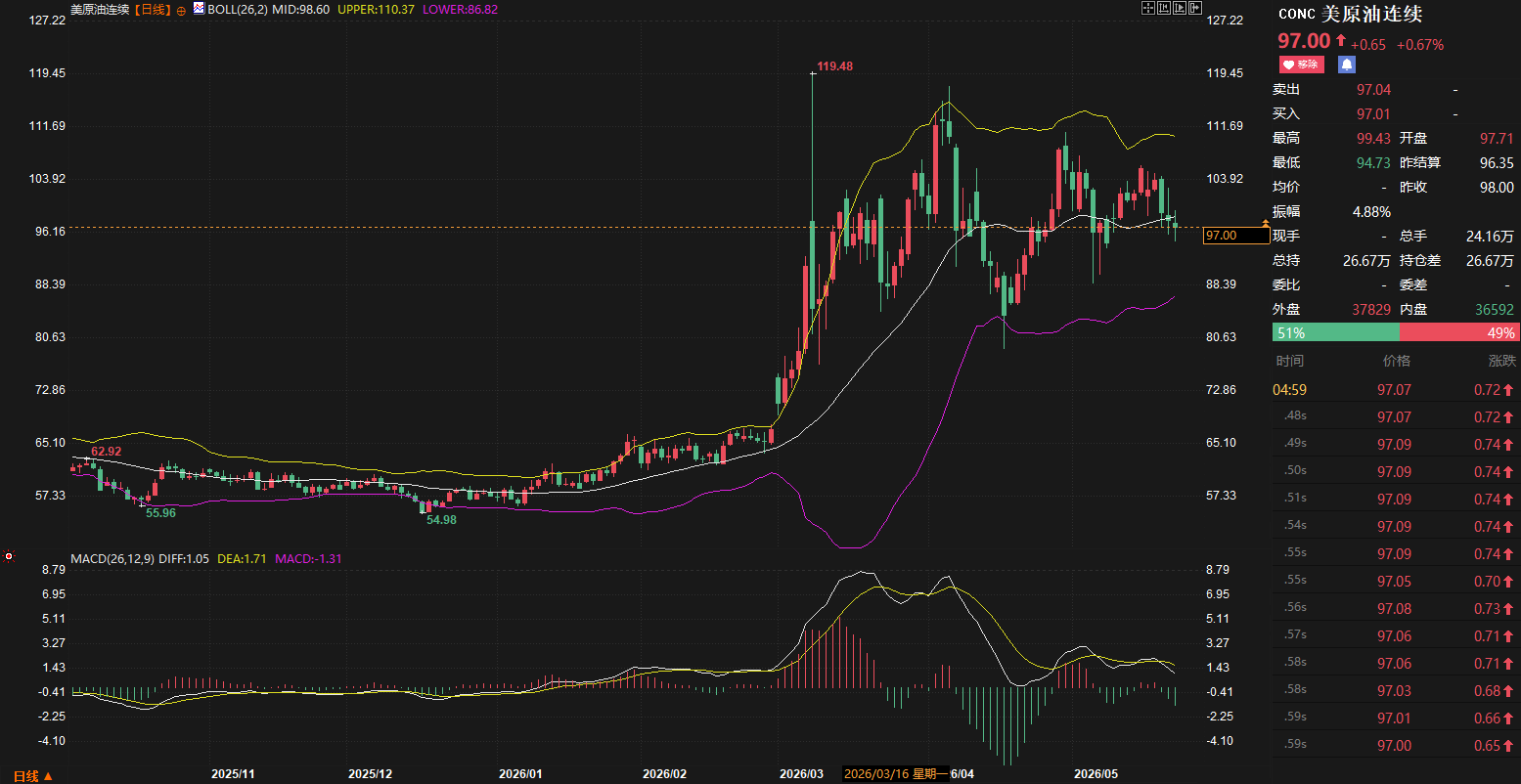
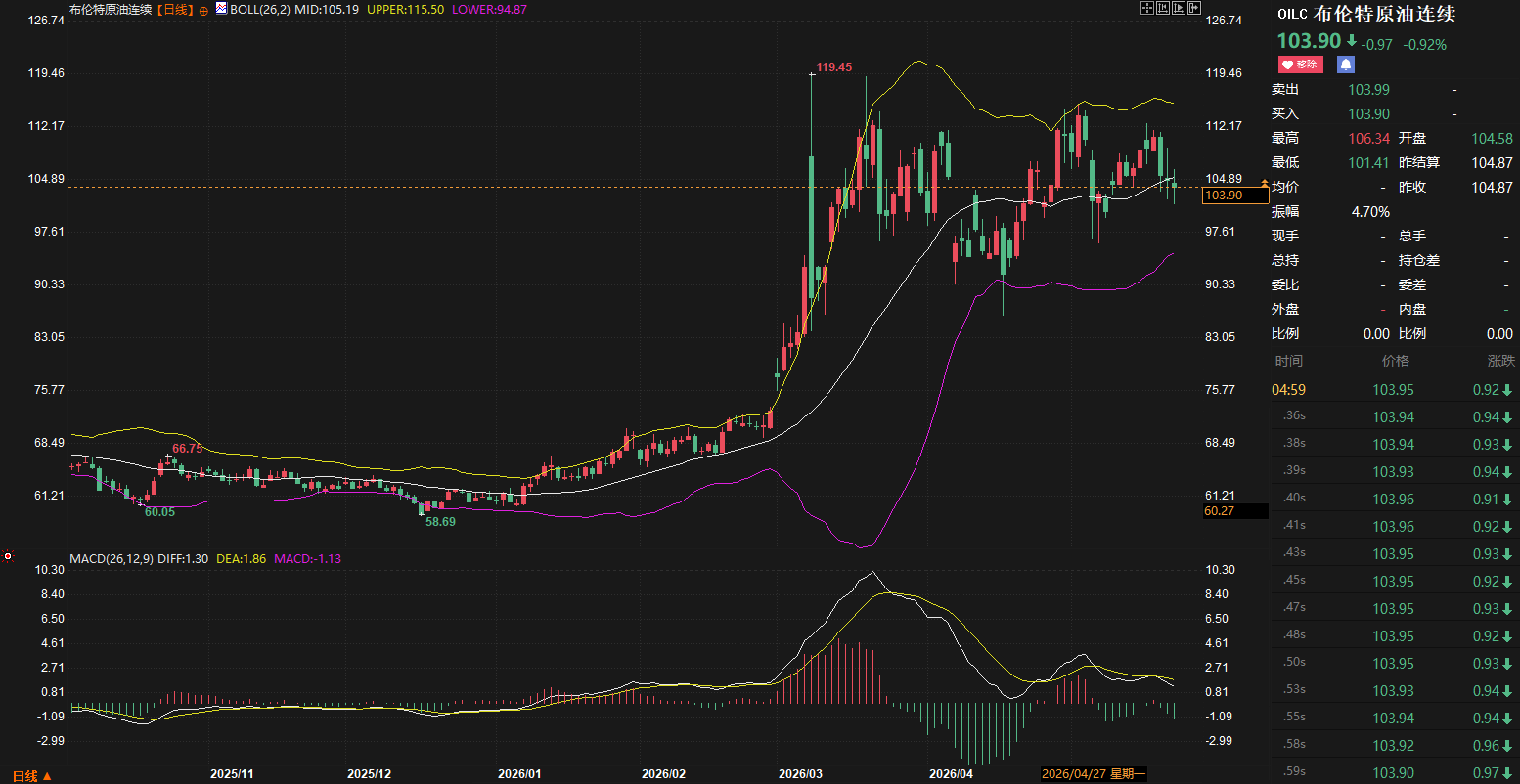
1. Weekly Price Review <br/>Crude oil prices initially declined before rebounding this week. At the beginning of the week, influenced by the overall commodity market sentiment, prices tested the Bollinger Band middle line resistance, subsequently closing lower for several consecutive weeks. On Friday, as news related to the US-Iran negotiations unfolded, oil prices surged briefly before retreating slightly, ultimately closing lower for the week. Brent crude fell approximately 4.82%-5.48% for the week, while WTI crude fell approximately 8.20%-8.37%. The short-term trend exhibited a pattern of rising and then falling, with the MACD histogram continuing to expand, indicating that bearish forces were in control. Prices were significantly suppressed by a stronger US dollar and overall commodity market sentiment, resulting in a significant increase in volatility.
The overall trend of crude oil was suppressed by geopolitical factors, commodity sentiment, and the US dollar's performance. This week, WTI crude oil fell by 8.20% cumulatively, while Brent crude fell by 4.82%. On Friday, WTI crude closed at $96.60 per barrel, up 0.26%; Brent crude closed at $103.54 per barrel, up 0.94%. Both closed lower for the week, with the market experiencing significant volatility amid fluctuating news regarding negotiations.
2. Economic Data and Event Summary <br/>This week's core events revolved around the US-Iran peace talks. Major overseas institutions reported that although some progress had been made, significant differences remained between the two sides on issues such as Tehran's uranium stockpile and control of the Strait of Hormuz. US Secretary of State Rubio stated that there were "some positive signs" in the negotiations, but emphasized that much work still needed to be done. Pakistan participated in the coordination, with its diplomats traveling to and from Iran. A Qatari negotiating delegation also arrived in Tehran to assist in advancing the agreement.
Furthermore, sources revealed that OPEC+ is expected to discuss a slight increase in crude oil production in July at its June 7 meeting, despite ongoing disruptions to transportation in some member countries due to the conflict. The head of the UAE's national oil company pointed out that even with a current easing of the conflict, oil shipments through the Straits of Vale are unlikely to fully recover before the first or second quarter of 2027. The fragile ceasefire agreement has been in place for six weeks, and the potential impact of high oil prices on global inflation and the economic outlook continues to be a major concern.
3. Summary of Analyst and Institutional Views
Phil Flynn, senior analyst at Price Futures Group, pointed out that market news is constantly shifting, making it difficult to grasp the rhythm. Currently, there are rumors that Iran will hand over uranium in exchange for the lifting of sanctions, but these claims are highly uncertain. Tamas Varga, an analyst at PVM Oil Associates, stated that due to a significant reduction in oil shipments through the Strait of Hormuz, global oil inventories are declining at an alarming rate, which is a key factor supporting oil prices. Several major overseas institutions believe that the pace of negotiations will be a key variable in oil price movements in the second half of the year, with short-term supply contraction and expectations of increased production creating a counterbalancing effect.
Overall, oil prices sought a balance amidst uncertainty surrounding negotiations this week. Geopolitical risk premiums remained high, but potential OPEC+ production increases put some pressure on the market outlook. Short-term price movements will continue to heavily depend on substantial progress in US-Iran negotiations.
This week, the international oil market was dominated by geopolitical negotiations. Although oil prices fell on the weekly chart, they rebounded significantly on Friday. The accelerated inventory reduction caused by shipping disruptions in the Strait of Hormuz became a significant supporting force for oil prices. Going forward, the market will continue to focus on the outcome of the June OPEC+ meeting and the progress of the US-Iran peace agreement. Under the dual influence of supply-side contraction and potential production increases, oil prices are expected to maintain a high-level fluctuation pattern. Investors need to closely monitor the negotiation dynamics and avoid excessive volatility caused by a single piece of news. Overall, the current oil market is in a complex environment of information asymmetry and fluctuating expectations; long-term balance still requires consensus among all parties on key issues.
Q1: What was the core driver behind the weekly decline in oil prices but the rebound on Friday?
Oil prices were under downward pressure this week, mainly due to the gradual digestion of previously accumulated optimistic expectations regarding negotiations and the release of signals regarding potential production increases from OPEC+. However, a rebound occurred on Friday, primarily driven by investor concerns about the difficulty in reaching a quick agreement on US-Iran peace talks and the slow recovery of shipping in the Strait of Hormuz. News indicated that disagreements remained between the two sides regarding uranium stockpiles and strait control, leading to increased market expectations of continued supply contraction. While short-term bearish forces were strong, the repricing of geopolitical risk premiums drove a price rebound. This rebound is not a trend reversal but rather a sentiment correction amid uncertainty surrounding the pace of negotiations. If negotiations continue to drag on, the tight supply situation may continue to support oil prices; conversely, if a substantial breakthrough occurs, prices may face downward pressure. Traders should pay close attention to the volatility of news and avoid chasing highs and lows.
Q2: What is the impact of shipping issues in the Strait of Hormuz on global oil inventories?
Market analysis indicates that the sharp decline in cross-strait shipping volume has directly led to a rapid decrease in global oil inventories, a key fundamental factor supporting current oil prices. The head of the UAE National Oil Company explicitly stated that even if the conflict eases, full resumption of transportation will not occur until the first half of 2027. This implies a substantial supply gap in the short term, with inventory reduction occurring faster than seasonal levels. Coupled with the reality of transportation disruptions in some OPEC+ member countries, global available supply faces a temporary tightness. Analysts believe that this inventory dynamic will continue to influence the central oil price in the coming months, but the potential hedging effect of a collective production increase by OPEC+ should also be considered. Overall, the cross-strait issue has become a significant variable in this round of oil price fluctuations, and its duration will determine the degree of supply imbalance in the second half of the year.
Q3: How do OPEC+ production increase plans and geopolitical risks offset each other?
OPEC+ is expected to discuss a slight increase in July production at its June meeting, a signal that is putting downward pressure on oil prices. However, current geopolitical factors causing actual transportation disruptions create uncertainty regarding the effectiveness of the production increase plan. Many institutions believe that the gap between nominal production increases and actual deliverables limits the downward pressure on prices. The slow progress of US-Iran negotiations further amplifies this hedging effect: delays in negotiations push up risk premiums, while the production increase plan provides a potential supply buffer. In the short term, the market will seek a balance between these two factors. If negotiations progress, the production increase signal may dominate; if the stalemate continues, geopolitical premiums will continue to support prices. Investors need to monitor the specific decisions of the June meeting to assess the actual tightness of the supply side.
Q4: What is the logic behind the suppression of crude oil by the strengthening US dollar and commodity sentiment?
This week, crude oil prices were significantly suppressed by a stronger US dollar and the overall commodity market sentiment. A stronger dollar typically increases the cost of holding dollar-denominated commodities, thus putting downward pressure on oil prices. Simultaneously, market concerns about the global economic outlook also dampened demand expectations. The MACD indicator shows that bearish forces continue to dominate, with technical and fundamental factors converging. Analysts point out that this suppression is temporary; once geopolitical risk premiums regain dominance, oil prices may break free from their short-term weakness. Current prices have broken below some technical mid-range levels, and the effectiveness of support in the $90-$100 range needs to be monitored. If this range holds, a period of low-level consolidation may follow; if it breaks, the downward trend may continue. The overall logic lies in the shifting weight of macroeconomic and geopolitical factors.
Q5: What is the potential impact of the US-Iran negotiations outlook on the central oil price in the second half of the year?
While there are positive signs in the current negotiations, core differences remain unresolved, leading to fluctuating market expectations. This has directly resulted in oil prices remaining volatile at high levels. Institutional views generally suggest that the pace of negotiations will be a key variable in oil price movements in the second half of the year. If an agreement is reached and cross-strait shipping gradually resumes, supply-side tensions will ease, potentially lowering the central oil price level. Conversely, if the stalemate persists, continued inventory reduction will support higher oil prices. Coupled with OPEC+ production policies, the market faces double uncertainty. From a trading perspective, attention should be paid to the verification of news at key junctures, rather than judging a single point in time. Overall, the current environment requires participants to maintain flexibility, focus on risk management, and seek structural opportunities within information gaps.
Detailed Review of Crude Oil Varieties
1. Weekly Price Review <br/>Crude oil prices initially declined before rebounding this week. At the beginning of the week, influenced by the overall commodity market sentiment, prices tested the Bollinger Band middle line resistance, subsequently closing lower for several consecutive weeks. On Friday, as news related to the US-Iran negotiations unfolded, oil prices surged briefly before retreating slightly, ultimately closing lower for the week. Brent crude fell approximately 4.82%-5.48% for the week, while WTI crude fell approximately 8.20%-8.37%. The short-term trend exhibited a pattern of rising and then falling, with the MACD histogram continuing to expand, indicating that bearish forces were in control. Prices were significantly suppressed by a stronger US dollar and overall commodity market sentiment, resulting in a significant increase in volatility.
The overall trend of crude oil was suppressed by geopolitical factors, commodity sentiment, and the US dollar's performance. This week, WTI crude oil fell by 8.20% cumulatively, while Brent crude fell by 4.82%. On Friday, WTI crude closed at $96.60 per barrel, up 0.26%; Brent crude closed at $103.54 per barrel, up 0.94%. Both closed lower for the week, with the market experiencing significant volatility amid fluctuating news regarding negotiations.
2. Economic Data and Event Summary <br/>This week's core events revolved around the US-Iran peace talks. Major overseas institutions reported that although some progress had been made, significant differences remained between the two sides on issues such as Tehran's uranium stockpile and control of the Strait of Hormuz. US Secretary of State Rubio stated that there were "some positive signs" in the negotiations, but emphasized that much work still needed to be done. Pakistan participated in the coordination, with its diplomats traveling to and from Iran. A Qatari negotiating delegation also arrived in Tehran to assist in advancing the agreement.
Furthermore, sources revealed that OPEC+ is expected to discuss a slight increase in crude oil production in July at its June 7 meeting, despite ongoing disruptions to transportation in some member countries due to the conflict. The head of the UAE's national oil company pointed out that even with a current easing of the conflict, oil shipments through the Straits of Vale are unlikely to fully recover before the first or second quarter of 2027. The fragile ceasefire agreement has been in place for six weeks, and the potential impact of high oil prices on global inflation and the economic outlook continues to be a major concern.
3. Summary of Analyst and Institutional Views
Phil Flynn, senior analyst at Price Futures Group, pointed out that market news is constantly shifting, making it difficult to grasp the rhythm. Currently, there are rumors that Iran will hand over uranium in exchange for the lifting of sanctions, but these claims are highly uncertain. Tamas Varga, an analyst at PVM Oil Associates, stated that due to a significant reduction in oil shipments through the Strait of Hormuz, global oil inventories are declining at an alarming rate, which is a key factor supporting oil prices. Several major overseas institutions believe that the pace of negotiations will be a key variable in oil price movements in the second half of the year, with short-term supply contraction and expectations of increased production creating a counterbalancing effect.
Overall, oil prices sought a balance amidst uncertainty surrounding negotiations this week. Geopolitical risk premiums remained high, but potential OPEC+ production increases put some pressure on the market outlook. Short-term price movements will continue to heavily depend on substantial progress in US-Iran negotiations.
This week, the international oil market was dominated by geopolitical negotiations. Although oil prices fell on the weekly chart, they rebounded significantly on Friday. The accelerated inventory reduction caused by shipping disruptions in the Strait of Hormuz became a significant supporting force for oil prices. Going forward, the market will continue to focus on the outcome of the June OPEC+ meeting and the progress of the US-Iran peace agreement. Under the dual influence of supply-side contraction and potential production increases, oil prices are expected to maintain a high-level fluctuation pattern. Investors need to closely monitor the negotiation dynamics and avoid excessive volatility caused by a single piece of news. Overall, the current oil market is in a complex environment of information asymmetry and fluctuating expectations; long-term balance still requires consensus among all parties on key issues.
QA module
Q1: What was the core driver behind the weekly decline in oil prices but the rebound on Friday?
Oil prices were under downward pressure this week, mainly due to the gradual digestion of previously accumulated optimistic expectations regarding negotiations and the release of signals regarding potential production increases from OPEC+. However, a rebound occurred on Friday, primarily driven by investor concerns about the difficulty in reaching a quick agreement on US-Iran peace talks and the slow recovery of shipping in the Strait of Hormuz. News indicated that disagreements remained between the two sides regarding uranium stockpiles and strait control, leading to increased market expectations of continued supply contraction. While short-term bearish forces were strong, the repricing of geopolitical risk premiums drove a price rebound. This rebound is not a trend reversal but rather a sentiment correction amid uncertainty surrounding the pace of negotiations. If negotiations continue to drag on, the tight supply situation may continue to support oil prices; conversely, if a substantial breakthrough occurs, prices may face downward pressure. Traders should pay close attention to the volatility of news and avoid chasing highs and lows.
Q2: What is the impact of shipping issues in the Strait of Hormuz on global oil inventories?
Market analysis indicates that the sharp decline in cross-strait shipping volume has directly led to a rapid decrease in global oil inventories, a key fundamental factor supporting current oil prices. The head of the UAE National Oil Company explicitly stated that even if the conflict eases, full resumption of transportation will not occur until the first half of 2027. This implies a substantial supply gap in the short term, with inventory reduction occurring faster than seasonal levels. Coupled with the reality of transportation disruptions in some OPEC+ member countries, global available supply faces a temporary tightness. Analysts believe that this inventory dynamic will continue to influence the central oil price in the coming months, but the potential hedging effect of a collective production increase by OPEC+ should also be considered. Overall, the cross-strait issue has become a significant variable in this round of oil price fluctuations, and its duration will determine the degree of supply imbalance in the second half of the year.
Q3: How do OPEC+ production increase plans and geopolitical risks offset each other?
OPEC+ is expected to discuss a slight increase in July production at its June meeting, a signal that is putting downward pressure on oil prices. However, current geopolitical factors causing actual transportation disruptions create uncertainty regarding the effectiveness of the production increase plan. Many institutions believe that the gap between nominal production increases and actual deliverables limits the downward pressure on prices. The slow progress of US-Iran negotiations further amplifies this hedging effect: delays in negotiations push up risk premiums, while the production increase plan provides a potential supply buffer. In the short term, the market will seek a balance between these two factors. If negotiations progress, the production increase signal may dominate; if the stalemate continues, geopolitical premiums will continue to support prices. Investors need to monitor the specific decisions of the June meeting to assess the actual tightness of the supply side.
Q4: What is the logic behind the suppression of crude oil by the strengthening US dollar and commodity sentiment?
This week, crude oil prices were significantly suppressed by a stronger US dollar and the overall commodity market sentiment. A stronger dollar typically increases the cost of holding dollar-denominated commodities, thus putting downward pressure on oil prices. Simultaneously, market concerns about the global economic outlook also dampened demand expectations. The MACD indicator shows that bearish forces continue to dominate, with technical and fundamental factors converging. Analysts point out that this suppression is temporary; once geopolitical risk premiums regain dominance, oil prices may break free from their short-term weakness. Current prices have broken below some technical mid-range levels, and the effectiveness of support in the $90-$100 range needs to be monitored. If this range holds, a period of low-level consolidation may follow; if it breaks, the downward trend may continue. The overall logic lies in the shifting weight of macroeconomic and geopolitical factors.
Q5: What is the potential impact of the US-Iran negotiations outlook on the central oil price in the second half of the year?
While there are positive signs in the current negotiations, core differences remain unresolved, leading to fluctuating market expectations. This has directly resulted in oil prices remaining volatile at high levels. Institutional views generally suggest that the pace of negotiations will be a key variable in oil price movements in the second half of the year. If an agreement is reached and cross-strait shipping gradually resumes, supply-side tensions will ease, potentially lowering the central oil price level. Conversely, if the stalemate persists, continued inventory reduction will support higher oil prices. Coupled with OPEC+ production policies, the market faces double uncertainty. From a trading perspective, attention should be paid to the verification of news at key junctures, rather than judging a single point in time. Overall, the current environment requires participants to maintain flexibility, focus on risk management, and seek structural opportunities within information gaps.
- Risk Warning and Disclaimer
- The market involves risk, and trading may not be suitable for all investors. This article is for reference only and does not constitute personal investment advice, nor does it take into account certain users’ specific investment objectives, financial situation, or other needs. Any investment decisions made based on this information are at your own risk.