The US dollar is nearing a six-week high; is 99.46 a critical level for bulls? The pound's counter-trend rally hints at something fishy, and the 159 level for the yen remains a warning sign.
2026-05-23 12:30:58
This week, global currency markets exhibited a clear divergence. The US dollar index remained strong, near a six-week high, primarily driven by geopolitical factors related to Iran, with rising concerns about potential energy disruptions pushing up inflation. Non-US currencies were generally under pressure, with the Japanese yen and Canadian dollar showing relative weakness, while the British pound demonstrated some resilience. Traders focused on the possibility of a shift in Federal Reserve policy and the potential transmission effects of the Middle East situation on global economic growth. Overall, the US dollar found support amid fluctuations in risk appetite, but its upside potential remains constrained by multiple factors.
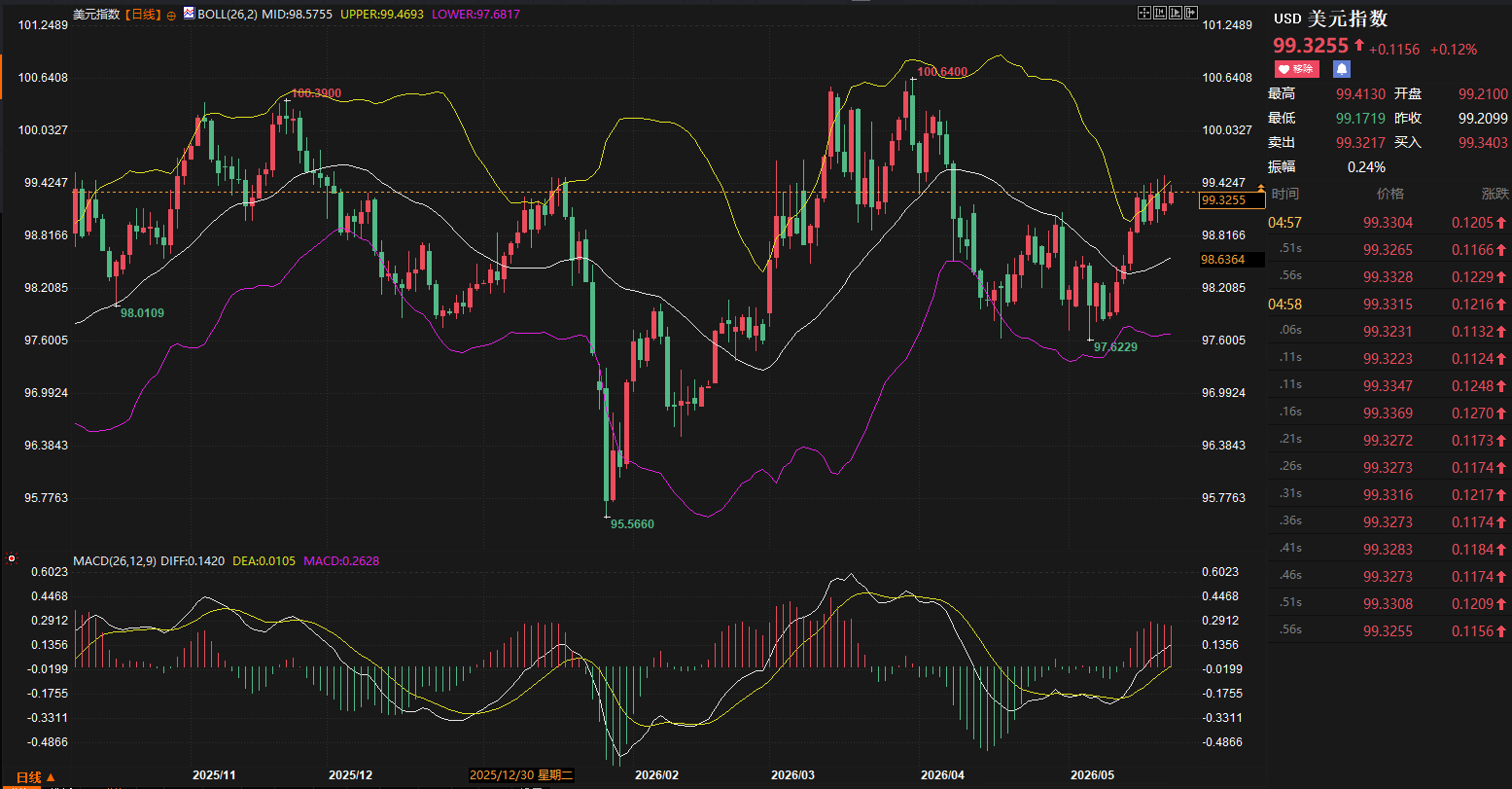
The US dollar index rebounded strongly this week, closing positive for five consecutive days. After breaking through the Bollinger Middle Band, it approached the upper band resistance level of 99.46, with a weekly gain of over 1%. The index's steady rise from its lows indicates that bullish momentum is gradually accumulating.
In terms of economic data and events, US consumer confidence fell to a record low in May, mainly due to soaring gasoline prices exacerbating concerns about purchasing power, while inflation expectations rose. A well-known foreign media report indicated that traders assessed that if inflation continues to accelerate, the likelihood of the Federal Reserve raising interest rates has increased. The US Secretary of State mentioned some progress in reaching an agreement with Iran, but significant differences remain. Federal Reserve Governor Waller stated on Friday that the "dovish bias" should be removed from the policy statement, opening the door to possible rate hikes. Furthermore, new Federal Reserve Chairman Warsh was sworn in on Friday.
A compilation of analyst and institutional opinions shows that State Street Bank's global macro strategist, Noel Dixon, points out that current pressures affecting the Fed's preferred inflation indicator remain relatively manageable, but the risk of Trump resuming a hardline stance against Iran warrants attention, potentially leading to increased interest rate volatility. Federal funds futures traders currently expect a 50% probability of a rate hike before the end of October. Lee Hardman, currency strategist at Mitsubishi UFJ Bank, believes that an agreement to end the Iran conflict is the fundamental solution, and institutions such as the Bank of Japan need to wait for improvements in fundamentals.
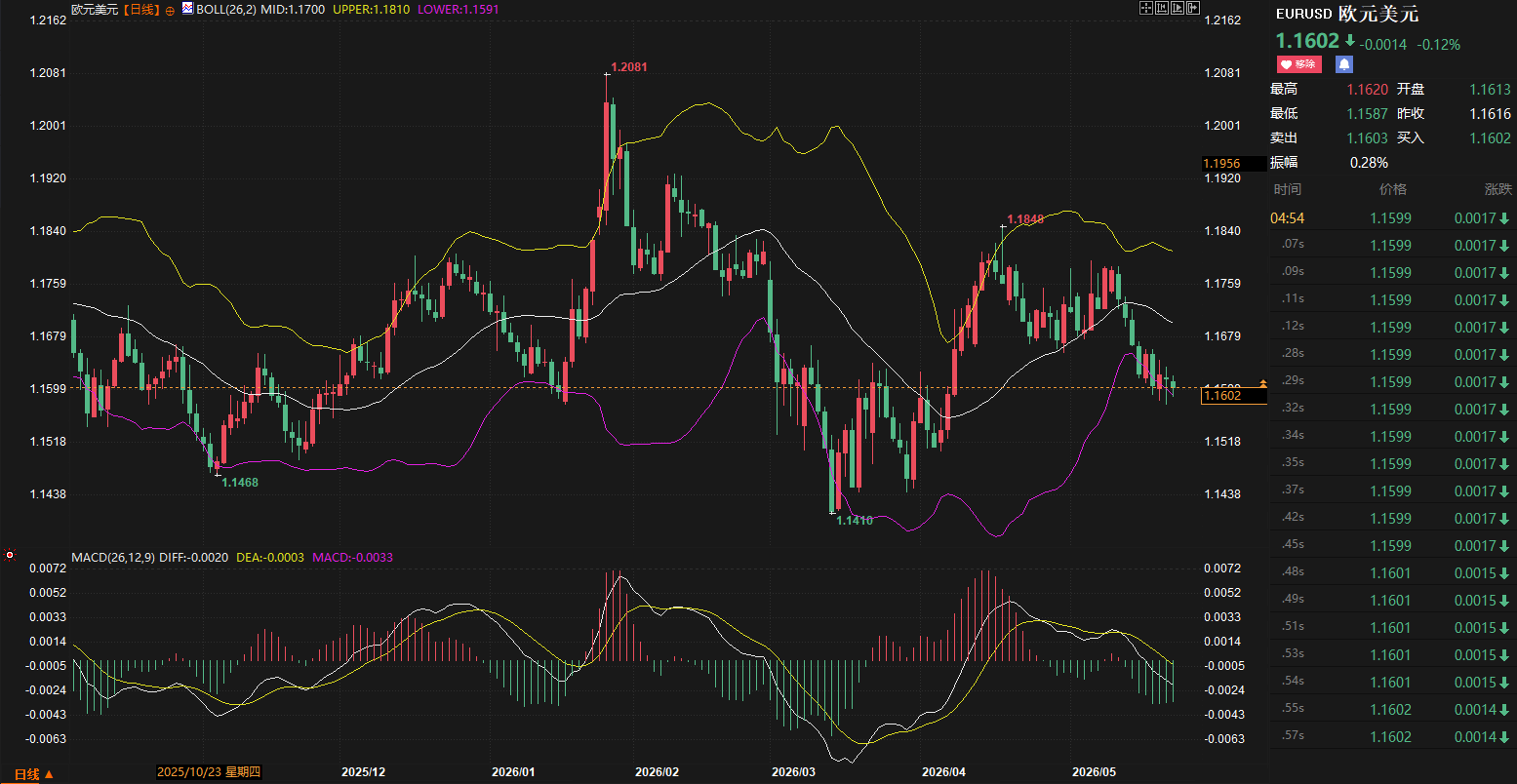
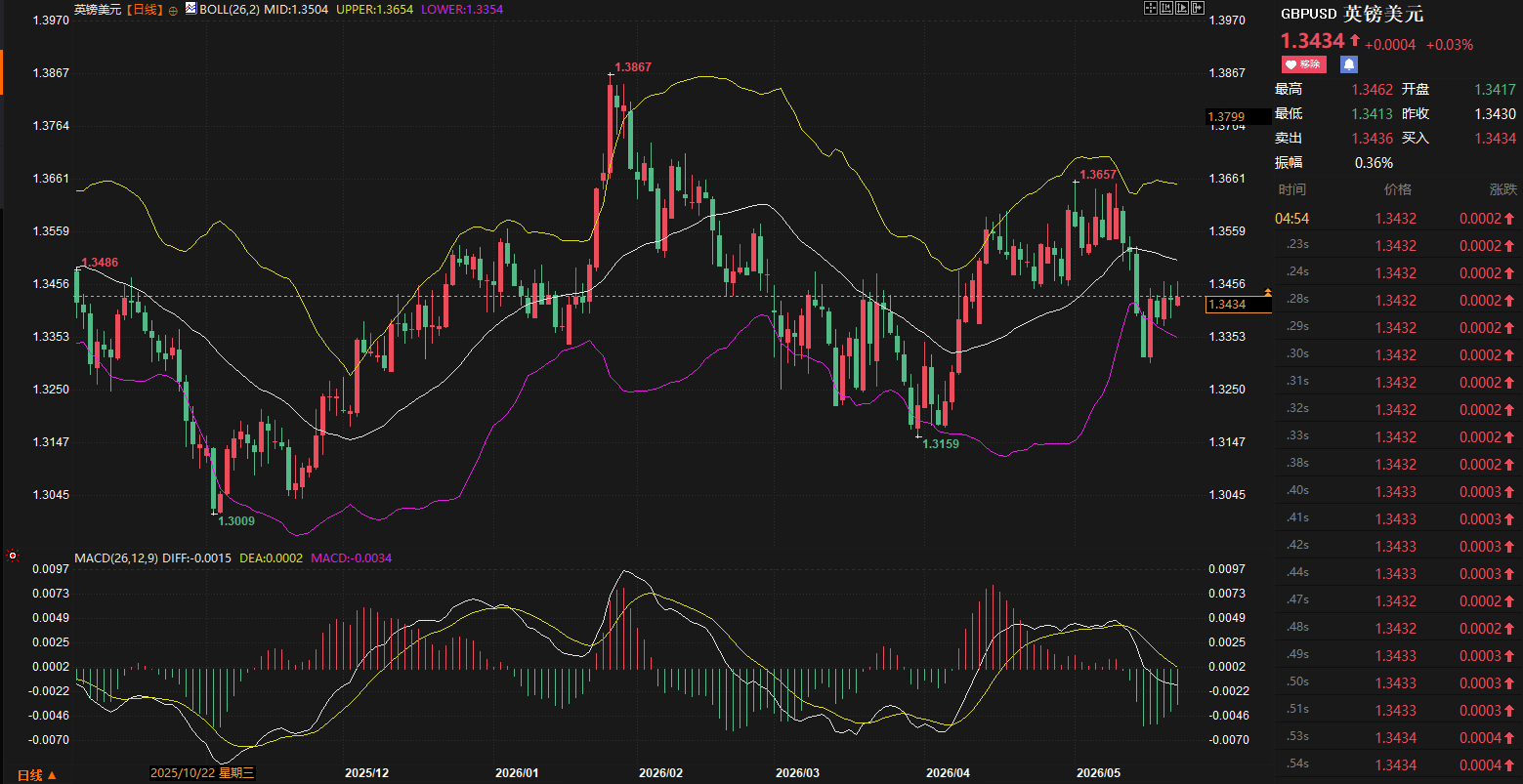
The euro fell 0.18% this week, while the pound rose 0.89%. European currencies as a whole were under downward pressure, both breaking below the Bollinger Middle Band support, with weekly declines ranging from 0.5% to 0.8%. The pound's performance was relatively more independent.
Economic data and events revealed that UK retail sales in April saw their biggest drop in nearly a year, with consumers clearly pressured by inflationary pressures stemming from the Iran war. Australia, meanwhile, faces shortages of aviation fuel and diesel, potentially dragging down key industries. Australian employment unexpectedly declined in April, with the unemployment rate rising to its highest level since the end of 2021, indicating signs of a loosening labor market.
In terms of institutional perspectives, mainstream overseas institutions believe that the US economy is expected to outperform most other economies, which will put some pressure on European currencies. Dixon warned that the potential risk of layoffs in Australia may be difficult to reconcile with expectations of interest rate hikes. Although the pound is affected by data, it still exhibits some defensive characteristics in the short term.
The USD/JPY pair rebounded sharply this week, rising rapidly from around 156 to above 159, recovering most of its previous losses and approaching the upper Bollinger Band resistance. The weekly gain was 0.24%. The USD/CAD pair also rose, breaking through the upper Bollinger Band and reaching a near one-month high, with a weekly gain of 0.50%.
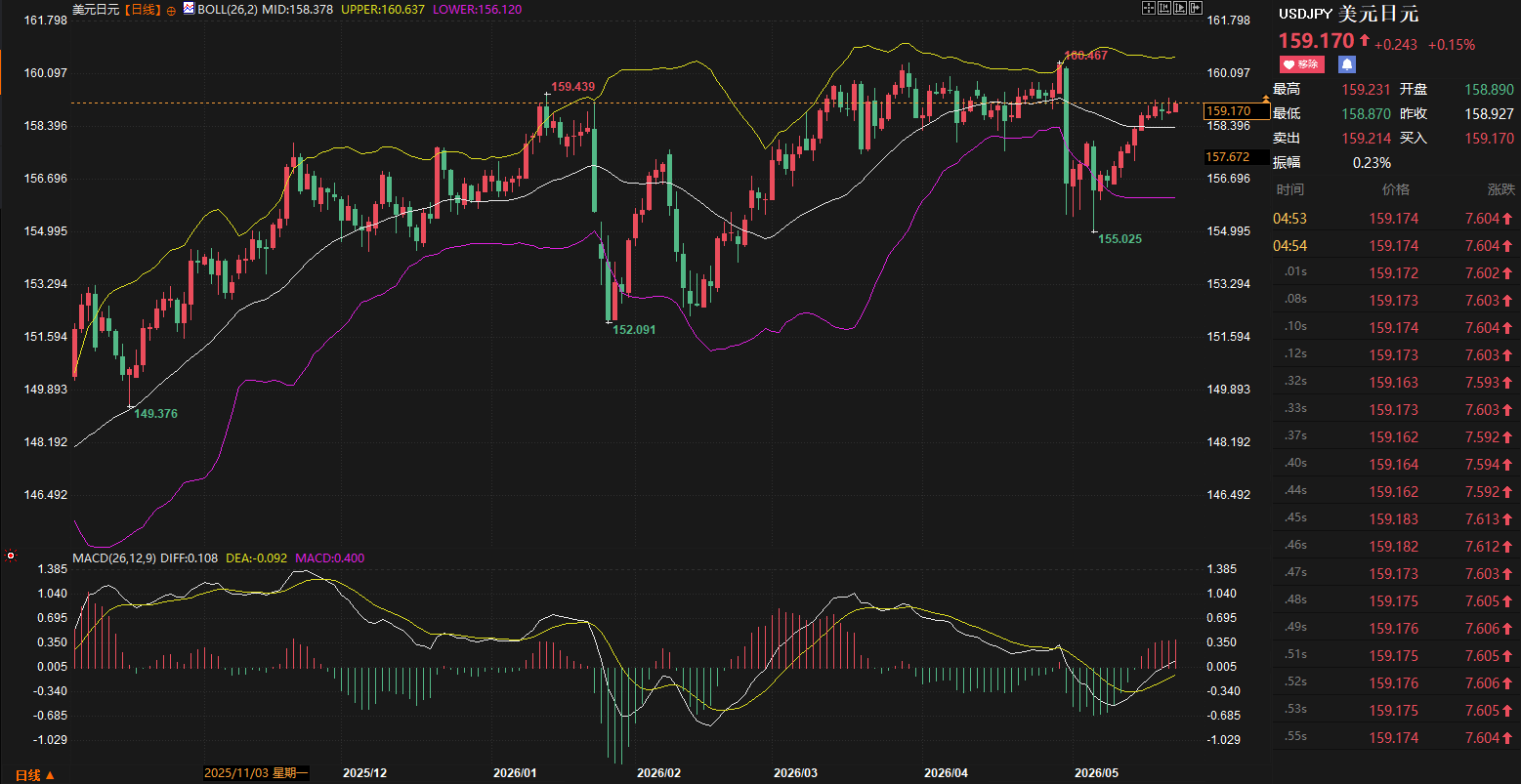
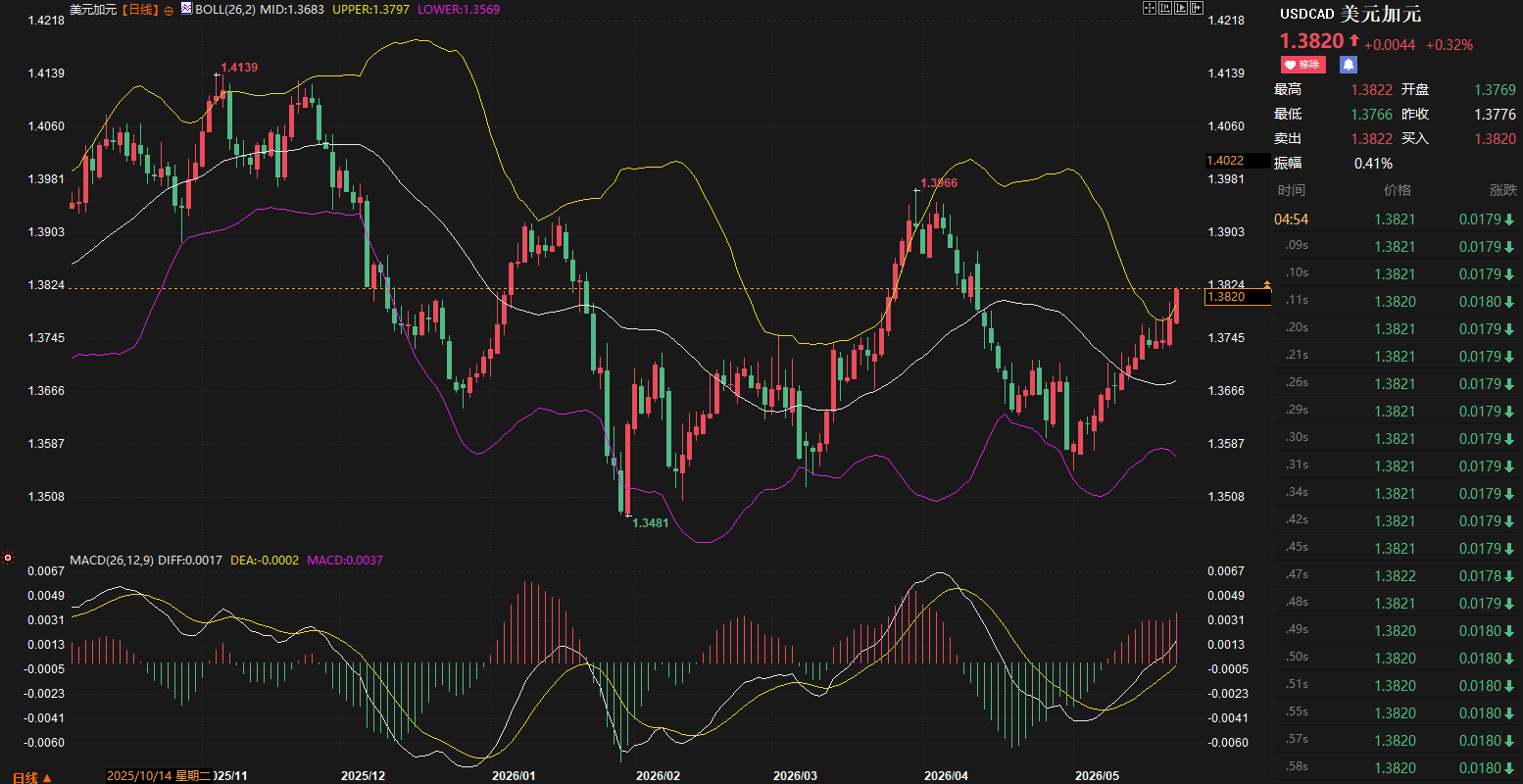
On the economic data and event front, Japan's core inflation rate slowed to its lowest level in four years in April, further complicating the Bank of Japan's policy outlook. Despite potential intervention support a few weeks ago, the yen remains fragile and has given back most of its gains. The Canadian dollar's performance has a negative feedback correlation with oil prices.
A summary of analyst opinions indicates that the Bank of Japan is expected to raise borrowing costs slowly, while other major central banks may act more quickly, putting the yen at a disadvantage for yield-seeking investors. Lee Hardman emphasizes that fundamental changes are key, and further action by Japanese authorities should be approached with caution. The Canadian dollar, meanwhile, is significantly volatile in the short term due to the combined effects of a stronger US dollar and high oil prices.
The Australian dollar fell 0.15% this week to around US$0.7136, weighed down by energy shortages and employment data. Non-US currencies generally came under pressure this week amid a rebound in the US dollar, with markets focusing on the continued impact of differing growth prospects on exchange rates.
Overall, the core drivers of the currency market this week were the combined effects of geopolitical risks and inflation expectations. The US dollar index remained near a six-week high, reflecting the market's repricing of the Federal Reserve's policy flexibility. Non-US currencies diverged significantly, with the Japanese yen and Canadian dollar being more affected by weak fundamentals, while the British pound was relatively resilient. Future trends will still depend on the progress of the Middle East agreement, the evolution of inflation data, and policy signals from major central banks. Traders need to continuously monitor the actual impact of energy market turmoil on global price transmission, as well as the degree of strengthening of hawkish voices within the Federal Reserve. The overall environment remains cautious and wait-and-see, with volatility expected to remain high.
Question 1: What are the core driving factors behind the strong rebound of the US dollar index this week? How do you view its sustainability?
The US dollar index rose for the second consecutive week, approaching the 99.46 resistance level, mainly due to escalating market concerns about the situation in Iran. The risk of energy disruptions could push up inflation, thus increasing expectations of a Fed rate hike. Record low consumer confidence further reinforced this logic. According to reports from well-known foreign media citing institutional views, traders are assessing the possibility of inflation transmitting to core indicators, providing support for the dollar. However, sustainability remains questionable. If substantial progress is made on the Middle East agreement, risk premiums could fall rapidly, and the dollar's upward momentum may face downward pressure. Current technical indicators show the MACD histogram expanding, but its proximity to the upper Bollinger Band suggests a short-term risk of profit-taking. Investors need to pay attention to whether Fed Governor Waller's hawkish shift will translate into actual policy adjustments, rather than just remaining a statement. Overall, the dollar's strength is more event-driven than a trend reversal, and it is expected to remain range-bound between 99 and 99.5, unless it breaks through the 99.5 level to open up further upside.
Question 2: Why does the yen still face downward pressure after its sharp rebound this week? What are the risks of intervention by the Bank of Japan?
The USD/JPY pair rallied this week from around 156 to above 159, recovering previous losses, but the yen's fundamentals remain fragile. Japan's core inflation slowed to a four-year low in April, coupled with the Bank of Japan's expected slow pace of interest rate hikes, placing it relatively weak among major central banks globally. Analysts believe the yen's reversal of most of its gains following previous intervention indicates market caution regarding further action from the authorities. Strategists such as Lee Hardman point out that an agreement to end the conflict is the fundamental solution, and the yen remains vulnerable to pressure from a stronger dollar and volatile oil prices in the short term. The risk of intervention persists, but its effectiveness may diminish. Traders should be wary of resistance above 160; a break above this level would open up further upside potential, otherwise, the pair is expected to trade within the 158-160 range. Weak Japanese economic data and diverging global growth are jointly suppressing the yen's performance, and it is expected to remain under pressure in the short term.
Question 3: What are the reasons behind the divergence between the British pound and the euro this week? What implications does this have for the future market?
The euro fell 0.18% this week, while the pound rose 0.89%, showing some divergence. The euro was more affected by overall pressure on non-US currencies. Although UK retail sales recorded a significant decline, the pound showed short-term resilience, possibly stemming from market expectations of relative resilience in the UK economy. Inflationary pressures stemming from the Iranian situation pose a challenge to both currencies, but the consensus that the US economy is stronger than other countries further suppressed the euro. Institutional views suggest that European currencies are approaching the lower Bollinger Band support; if they hold, a rebound is possible, with 1.159 for the euro and 1.335 for the pound being key levels. This divergence suggests that the impact of a single data point is limited; more crucial factors are the evolution of geopolitical risks and the Fed's policy signals. If energy prices stabilize in the future, the probability of a rebound in European currencies will increase; conversely, they may further test the lower Bollinger Band support.
Question 4: The Canadian dollar and the Australian dollar are significantly affected by energy factors. How will their future fluctuations evolve?
The USD/CAD pair broke through the upper Bollinger Band this week, reaching a near one-month high, negatively impacting crude oil prices. The AUD fell 0.15% due to shortages of jet fuel and diesel. Deteriorating Australian employment data suggests a loosening labor market, potentially contradicting expectations of interest rate hikes. Institutions warn that potential layoffs will increase the difficulty of policy coordination. Future volatility will primarily revolve around the correlation between oil prices and the US dollar index. If the Iran deal progresses, a decline in energy prices could alleviate pressure on the Canadian and Australian dollars; conversely, continued pressure is expected. The Canadian dollar faces resistance at 1.39 and support at 1.37, while the Australian dollar needs to watch the 0.71 level. Overall, commodity currencies demonstrated sensitivity to geopolitical and inflationary factors this week, and investors need to monitor actual disruptions in the energy market.
Question 5: What are the medium- to long-term impacts of changes in the Federal Reserve's internal policy signals on the global foreign exchange market?
Federal Reserve Governor Waller's shift to removing the "dovish bias," the appointment of a new chairman, and declining consumer confidence have all contributed to pushing up market pricing in a rate hike. Federal funds futures indicate a 50% probability of a rate hike before the end of October. This has had a significant impact on global currency markets, supporting the US dollar and putting downward pressure on non-US currencies. State Street strategist Dixon points out that current inflationary pressures remain manageable, but geopolitical risks are the main variable. In the medium to long term, if the Fed maintains a flexible stance, the dollar's strength may continue; if the situation in the Middle East eases and global risk appetite recovers, it could benefit non-US currencies. The divergent pattern in the currency market is expected to continue, with the relative advantage of the US economy becoming a key pricing factor. Traders need to comprehensively assess inflation data, employment indicators, and geopolitical developments to avoid excessive volatility from a single event.
A Review of the US Dollar Index
The US dollar index rebounded strongly this week, closing positive for five consecutive days. After breaking through the Bollinger Middle Band, it approached the upper band resistance level of 99.46, with a weekly gain of over 1%. The index's steady rise from its lows indicates that bullish momentum is gradually accumulating.
In terms of economic data and events, US consumer confidence fell to a record low in May, mainly due to soaring gasoline prices exacerbating concerns about purchasing power, while inflation expectations rose. A well-known foreign media report indicated that traders assessed that if inflation continues to accelerate, the likelihood of the Federal Reserve raising interest rates has increased. The US Secretary of State mentioned some progress in reaching an agreement with Iran, but significant differences remain. Federal Reserve Governor Waller stated on Friday that the "dovish bias" should be removed from the policy statement, opening the door to possible rate hikes. Furthermore, new Federal Reserve Chairman Warsh was sworn in on Friday.
A compilation of analyst and institutional opinions shows that State Street Bank's global macro strategist, Noel Dixon, points out that current pressures affecting the Fed's preferred inflation indicator remain relatively manageable, but the risk of Trump resuming a hardline stance against Iran warrants attention, potentially leading to increased interest rate volatility. Federal funds futures traders currently expect a 50% probability of a rate hike before the end of October. Lee Hardman, currency strategist at Mitsubishi UFJ Bank, believes that an agreement to end the Iran conflict is the fundamental solution, and institutions such as the Bank of Japan need to wait for improvements in fundamentals.
Euro and Pound Sterling Performance Review
The euro fell 0.18% this week, while the pound rose 0.89%. European currencies as a whole were under downward pressure, both breaking below the Bollinger Middle Band support, with weekly declines ranging from 0.5% to 0.8%. The pound's performance was relatively more independent.
Economic data and events revealed that UK retail sales in April saw their biggest drop in nearly a year, with consumers clearly pressured by inflationary pressures stemming from the Iran war. Australia, meanwhile, faces shortages of aviation fuel and diesel, potentially dragging down key industries. Australian employment unexpectedly declined in April, with the unemployment rate rising to its highest level since the end of 2021, indicating signs of a loosening labor market.
In terms of institutional perspectives, mainstream overseas institutions believe that the US economy is expected to outperform most other economies, which will put some pressure on European currencies. Dixon warned that the potential risk of layoffs in Australia may be difficult to reconcile with expectations of interest rate hikes. Although the pound is affected by data, it still exhibits some defensive characteristics in the short term.
A Review of the Japanese Yen and Canadian Dollar Exchange Rates
The USD/JPY pair rebounded sharply this week, rising rapidly from around 156 to above 159, recovering most of its previous losses and approaching the upper Bollinger Band resistance. The weekly gain was 0.24%. The USD/CAD pair also rose, breaking through the upper Bollinger Band and reaching a near one-month high, with a weekly gain of 0.50%.
On the economic data and event front, Japan's core inflation rate slowed to its lowest level in four years in April, further complicating the Bank of Japan's policy outlook. Despite potential intervention support a few weeks ago, the yen remains fragile and has given back most of its gains. The Canadian dollar's performance has a negative feedback correlation with oil prices.
A summary of analyst opinions indicates that the Bank of Japan is expected to raise borrowing costs slowly, while other major central banks may act more quickly, putting the yen at a disadvantage for yield-seeking investors. Lee Hardman emphasizes that fundamental changes are key, and further action by Japanese authorities should be approached with caution. The Canadian dollar, meanwhile, is significantly volatile in the short term due to the combined effects of a stronger US dollar and high oil prices.
Other non-US dollar currencies and overall summary
The Australian dollar fell 0.15% this week to around US$0.7136, weighed down by energy shortages and employment data. Non-US currencies generally came under pressure this week amid a rebound in the US dollar, with markets focusing on the continued impact of differing growth prospects on exchange rates.
Overall, the core drivers of the currency market this week were the combined effects of geopolitical risks and inflation expectations. The US dollar index remained near a six-week high, reflecting the market's repricing of the Federal Reserve's policy flexibility. Non-US currencies diverged significantly, with the Japanese yen and Canadian dollar being more affected by weak fundamentals, while the British pound was relatively resilient. Future trends will still depend on the progress of the Middle East agreement, the evolution of inflation data, and policy signals from major central banks. Traders need to continuously monitor the actual impact of energy market turmoil on global price transmission, as well as the degree of strengthening of hawkish voices within the Federal Reserve. The overall environment remains cautious and wait-and-see, with volatility expected to remain high.
QA module
Question 1: What are the core driving factors behind the strong rebound of the US dollar index this week? How do you view its sustainability?
The US dollar index rose for the second consecutive week, approaching the 99.46 resistance level, mainly due to escalating market concerns about the situation in Iran. The risk of energy disruptions could push up inflation, thus increasing expectations of a Fed rate hike. Record low consumer confidence further reinforced this logic. According to reports from well-known foreign media citing institutional views, traders are assessing the possibility of inflation transmitting to core indicators, providing support for the dollar. However, sustainability remains questionable. If substantial progress is made on the Middle East agreement, risk premiums could fall rapidly, and the dollar's upward momentum may face downward pressure. Current technical indicators show the MACD histogram expanding, but its proximity to the upper Bollinger Band suggests a short-term risk of profit-taking. Investors need to pay attention to whether Fed Governor Waller's hawkish shift will translate into actual policy adjustments, rather than just remaining a statement. Overall, the dollar's strength is more event-driven than a trend reversal, and it is expected to remain range-bound between 99 and 99.5, unless it breaks through the 99.5 level to open up further upside.
Question 2: Why does the yen still face downward pressure after its sharp rebound this week? What are the risks of intervention by the Bank of Japan?
The USD/JPY pair rallied this week from around 156 to above 159, recovering previous losses, but the yen's fundamentals remain fragile. Japan's core inflation slowed to a four-year low in April, coupled with the Bank of Japan's expected slow pace of interest rate hikes, placing it relatively weak among major central banks globally. Analysts believe the yen's reversal of most of its gains following previous intervention indicates market caution regarding further action from the authorities. Strategists such as Lee Hardman point out that an agreement to end the conflict is the fundamental solution, and the yen remains vulnerable to pressure from a stronger dollar and volatile oil prices in the short term. The risk of intervention persists, but its effectiveness may diminish. Traders should be wary of resistance above 160; a break above this level would open up further upside potential, otherwise, the pair is expected to trade within the 158-160 range. Weak Japanese economic data and diverging global growth are jointly suppressing the yen's performance, and it is expected to remain under pressure in the short term.
Question 3: What are the reasons behind the divergence between the British pound and the euro this week? What implications does this have for the future market?
The euro fell 0.18% this week, while the pound rose 0.89%, showing some divergence. The euro was more affected by overall pressure on non-US currencies. Although UK retail sales recorded a significant decline, the pound showed short-term resilience, possibly stemming from market expectations of relative resilience in the UK economy. Inflationary pressures stemming from the Iranian situation pose a challenge to both currencies, but the consensus that the US economy is stronger than other countries further suppressed the euro. Institutional views suggest that European currencies are approaching the lower Bollinger Band support; if they hold, a rebound is possible, with 1.159 for the euro and 1.335 for the pound being key levels. This divergence suggests that the impact of a single data point is limited; more crucial factors are the evolution of geopolitical risks and the Fed's policy signals. If energy prices stabilize in the future, the probability of a rebound in European currencies will increase; conversely, they may further test the lower Bollinger Band support.
Question 4: The Canadian dollar and the Australian dollar are significantly affected by energy factors. How will their future fluctuations evolve?
The USD/CAD pair broke through the upper Bollinger Band this week, reaching a near one-month high, negatively impacting crude oil prices. The AUD fell 0.15% due to shortages of jet fuel and diesel. Deteriorating Australian employment data suggests a loosening labor market, potentially contradicting expectations of interest rate hikes. Institutions warn that potential layoffs will increase the difficulty of policy coordination. Future volatility will primarily revolve around the correlation between oil prices and the US dollar index. If the Iran deal progresses, a decline in energy prices could alleviate pressure on the Canadian and Australian dollars; conversely, continued pressure is expected. The Canadian dollar faces resistance at 1.39 and support at 1.37, while the Australian dollar needs to watch the 0.71 level. Overall, commodity currencies demonstrated sensitivity to geopolitical and inflationary factors this week, and investors need to monitor actual disruptions in the energy market.
Question 5: What are the medium- to long-term impacts of changes in the Federal Reserve's internal policy signals on the global foreign exchange market?
Federal Reserve Governor Waller's shift to removing the "dovish bias," the appointment of a new chairman, and declining consumer confidence have all contributed to pushing up market pricing in a rate hike. Federal funds futures indicate a 50% probability of a rate hike before the end of October. This has had a significant impact on global currency markets, supporting the US dollar and putting downward pressure on non-US currencies. State Street strategist Dixon points out that current inflationary pressures remain manageable, but geopolitical risks are the main variable. In the medium to long term, if the Fed maintains a flexible stance, the dollar's strength may continue; if the situation in the Middle East eases and global risk appetite recovers, it could benefit non-US currencies. The divergent pattern in the currency market is expected to continue, with the relative advantage of the US economy becoming a key pricing factor. Traders need to comprehensively assess inflation data, employment indicators, and geopolitical developments to avoid excessive volatility from a single event.
- Risk Warning and Disclaimer
- The market involves risk, and trading may not be suitable for all investors. This article is for reference only and does not constitute personal investment advice, nor does it take into account certain users’ specific investment objectives, financial situation, or other needs. Any investment decisions made based on this information are at your own risk.