Market risk appetite rebounded, and a decline in the US dollar led to a rebound in the British pound against the US dollar.
2026-05-25 10:46:00
The British pound extended its rebound against the US dollar in Asian trading on Monday, rising to around 1.3480. With progress in peace talks between the US and Iran, market risk sentiment improved significantly, reducing demand for the safe-haven dollar and thus supporting risk currencies like the pound. However, recent weak UK economic data has dampened market expectations for further interest rate hikes by the Bank of England, limiting the pound's overall gains.
The US and Iran are nearing an agreement that could potentially reopen the Strait of Hormuz. Markets believe that a de-escalation in the Middle East could reduce global energy supply risks and alleviate recent risk aversion. Some of the safe-haven funds that flowed into the US dollar due to Middle East tensions are now flowing back into risk assets, causing a temporary pullback in the dollar index.
Meanwhile, UK assets also benefited from improved market risk appetite. Typically, when global risk aversion declines, higher-risk currencies like the pound tend to attract inflows. The market is currently readjusting its previously overly dollar-hedging positioning, which is providing some support for the pound against the dollar.
However, significant uncertainties remain in the Middle East. US President Trump stated that the US is not in a "rush" to reach an agreement with Iran and emphasized that the US blockade of the Strait of Hormuz will continue until an agreement is formally signed. This means that while the market remains optimistic about the prospects of negotiations, geopolitical risks have not truly been completely eliminated.
Furthermore, the US still retains the possibility of military action, keeping the market highly vigilant about the future situation in the Middle East. If the situation deteriorates again, the US dollar, as a traditional safe-haven currency, could regain buying support.
From the UK perspective, recent economic data has been generally weak. UK retail sales figures fell short of market expectations, while the unemployment rate unexpectedly rose to 5.0%, indicating that the UK's economic growth momentum is slowing. The cooling UK job market and weak consumer data have diminished market bets on further interest rate hikes by the Bank of England.
As UK economic data weakens, the market has begun to lower its expectations for further tightening by the Bank of England this year. Previously, the market anticipated that the Bank of England might raise interest rates again before the end of the year, but now it believes the Bank of England is more likely to maintain stable interest rates for an extended period.
Bank of England official Alan Taylor stated that maintaining interest rates unchanged for an extended period may be sufficient, while also noting that the current secondary effects of inflation are significantly lower than those seen during the 2022 Russia-Ukraine conflict. This statement further reinforced market perceptions of a wait-and-see approach from the Bank of England.
Meanwhile, the high-interest-rate environment in the US continues to support the dollar. Recent US inflation data remains stubbornly strong, and Federal Reserve officials continue to send hawkish signals, with the market still expecting at least another 25 basis point rate hike by the Fed this year. The divergence in monetary policy expectations between the US and the UK may limit further significant gains for the pound against the dollar.
With US markets closed on Monday for Memorial Day, overall market liquidity was relatively limited, which could lead to increased short-term volatility in the foreign exchange market. In a low-liquidity environment, markets are more susceptible to sudden news and changes in the Middle East situation.
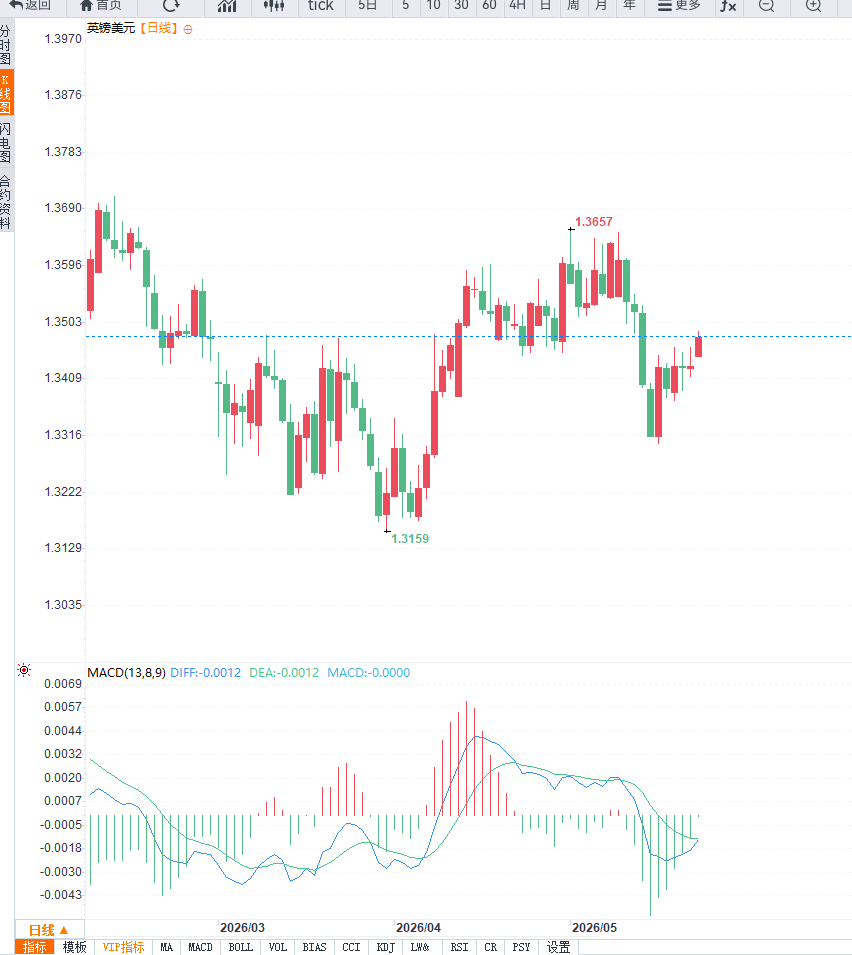
From a technical perspective, the GBP/USD daily chart remains in a high-level consolidation pattern. The pair rebounded after finding support near 1.3400, and short-term bullish sentiment has recovered somewhat. Initial resistance on the daily chart is located in the 1.3500-1.3530 area; a successful break above this level could lead to a further test of the 1.3580 level.
On the downside, 1.3450 has become a key short-term support level, with further support around 1.3400. If the US dollar index continues to decline while market risk appetite improves further, the pound/dollar pair still has room to rebound. Looking at daily indicators, the MACD bearish momentum is weakening, with the green histogram bars narrowing, indicating that downward pressure is easing. The RSI indicator is gradually rising to near the neutral zone, suggesting some short-term market sentiment has recovered, but the overall market has not yet fully entered a strong bullish structure.
However, if subsequent US economic data remains strong and hawkish expectations from the Federal Reserve intensify, the dollar may regain support, thus limiting the pound's upside potential. Furthermore, the risk of a UK economic slowdown could continue to weaken market bullish sentiment towards the pound. Overall, the current pound/dollar exchange rate is primarily influenced by three factors: changes in the Middle East situation, fluctuations in the dollar index, and expectations regarding the Bank of England's policy. While improved market risk appetite has provided some short-term support for the pound, weak UK economic data may still limit its medium- to long-term upside potential.
Editor's Summary : The British pound is currently in a tug-of-war between improved risk sentiment and a slowing UK economy. The US-Iran peace talks have reduced demand for the safe-haven dollar, providing temporary support for the pound. However, weak UK economic data and waning expectations of a Bank of England rate hike have limited further upside potential. In the short term, if the situation in the Middle East continues to ease and the US dollar index remains weak, the pound/dollar exchange rate may maintain its rebound. However, in the medium to long term, the high-interest-rate environment of the Federal Reserve and the pressure on UK economic growth may still put pressure on the pound. Going forward, the market will need to focus on the progress of US-Iran negotiations, Federal Reserve policy expectations, UK economic data, and speeches by Bank of England officials, as these factors will be crucial variables influencing the direction of the pound/dollar exchange rate.
The US and Iran are nearing an agreement that could potentially reopen the Strait of Hormuz. Markets believe that a de-escalation in the Middle East could reduce global energy supply risks and alleviate recent risk aversion. Some of the safe-haven funds that flowed into the US dollar due to Middle East tensions are now flowing back into risk assets, causing a temporary pullback in the dollar index.
Meanwhile, UK assets also benefited from improved market risk appetite. Typically, when global risk aversion declines, higher-risk currencies like the pound tend to attract inflows. The market is currently readjusting its previously overly dollar-hedging positioning, which is providing some support for the pound against the dollar.
However, significant uncertainties remain in the Middle East. US President Trump stated that the US is not in a "rush" to reach an agreement with Iran and emphasized that the US blockade of the Strait of Hormuz will continue until an agreement is formally signed. This means that while the market remains optimistic about the prospects of negotiations, geopolitical risks have not truly been completely eliminated.
Furthermore, the US still retains the possibility of military action, keeping the market highly vigilant about the future situation in the Middle East. If the situation deteriorates again, the US dollar, as a traditional safe-haven currency, could regain buying support.
From the UK perspective, recent economic data has been generally weak. UK retail sales figures fell short of market expectations, while the unemployment rate unexpectedly rose to 5.0%, indicating that the UK's economic growth momentum is slowing. The cooling UK job market and weak consumer data have diminished market bets on further interest rate hikes by the Bank of England.
As UK economic data weakens, the market has begun to lower its expectations for further tightening by the Bank of England this year. Previously, the market anticipated that the Bank of England might raise interest rates again before the end of the year, but now it believes the Bank of England is more likely to maintain stable interest rates for an extended period.
Bank of England official Alan Taylor stated that maintaining interest rates unchanged for an extended period may be sufficient, while also noting that the current secondary effects of inflation are significantly lower than those seen during the 2022 Russia-Ukraine conflict. This statement further reinforced market perceptions of a wait-and-see approach from the Bank of England.
Meanwhile, the high-interest-rate environment in the US continues to support the dollar. Recent US inflation data remains stubbornly strong, and Federal Reserve officials continue to send hawkish signals, with the market still expecting at least another 25 basis point rate hike by the Fed this year. The divergence in monetary policy expectations between the US and the UK may limit further significant gains for the pound against the dollar.
With US markets closed on Monday for Memorial Day, overall market liquidity was relatively limited, which could lead to increased short-term volatility in the foreign exchange market. In a low-liquidity environment, markets are more susceptible to sudden news and changes in the Middle East situation.
From a technical perspective, the GBP/USD daily chart remains in a high-level consolidation pattern. The pair rebounded after finding support near 1.3400, and short-term bullish sentiment has recovered somewhat. Initial resistance on the daily chart is located in the 1.3500-1.3530 area; a successful break above this level could lead to a further test of the 1.3580 level.
On the downside, 1.3450 has become a key short-term support level, with further support around 1.3400. If the US dollar index continues to decline while market risk appetite improves further, the pound/dollar pair still has room to rebound. Looking at daily indicators, the MACD bearish momentum is weakening, with the green histogram bars narrowing, indicating that downward pressure is easing. The RSI indicator is gradually rising to near the neutral zone, suggesting some short-term market sentiment has recovered, but the overall market has not yet fully entered a strong bullish structure.
However, if subsequent US economic data remains strong and hawkish expectations from the Federal Reserve intensify, the dollar may regain support, thus limiting the pound's upside potential. Furthermore, the risk of a UK economic slowdown could continue to weaken market bullish sentiment towards the pound. Overall, the current pound/dollar exchange rate is primarily influenced by three factors: changes in the Middle East situation, fluctuations in the dollar index, and expectations regarding the Bank of England's policy. While improved market risk appetite has provided some short-term support for the pound, weak UK economic data may still limit its medium- to long-term upside potential.
Editor's Summary : The British pound is currently in a tug-of-war between improved risk sentiment and a slowing UK economy. The US-Iran peace talks have reduced demand for the safe-haven dollar, providing temporary support for the pound. However, weak UK economic data and waning expectations of a Bank of England rate hike have limited further upside potential. In the short term, if the situation in the Middle East continues to ease and the US dollar index remains weak, the pound/dollar exchange rate may maintain its rebound. However, in the medium to long term, the high-interest-rate environment of the Federal Reserve and the pressure on UK economic growth may still put pressure on the pound. Going forward, the market will need to focus on the progress of US-Iran negotiations, Federal Reserve policy expectations, UK economic data, and speeches by Bank of England officials, as these factors will be crucial variables influencing the direction of the pound/dollar exchange rate.
- Risk Warning and Disclaimer
- The market involves risk, and trading may not be suitable for all investors. This article is for reference only and does not constitute personal investment advice, nor does it take into account certain users’ specific investment objectives, financial situation, or other needs. Any investment decisions made based on this information are at your own risk.