The Australian dollar rebounded above 0.71, but weak employment and a strong US dollar remain major obstacles.
2026-05-25 11:14:29
The Australian dollar edged higher against the US dollar on Monday (May 25), currently up 0.53% at 0.7163. US President Trump announced over the weekend that a peace agreement between the US and Iran had been "fundamentally agreed upon," and the Strait of Hormuz could reopen. This news significantly improved global risk sentiment. As a typical risk currency, the Australian dollar directly benefited from the recovery in investor risk appetite. However, weak Australian employment data released last week shattered market expectations for a June rate hike by the Reserve Bank of Australia, while market focus shifted to US inflation and government bond yields. Although the Australian dollar is temporarily holding above 0.71 against the US dollar, bullish momentum is waning, and a weakening labor market and widening yield spreads suggest that risks still lean towards further downside.
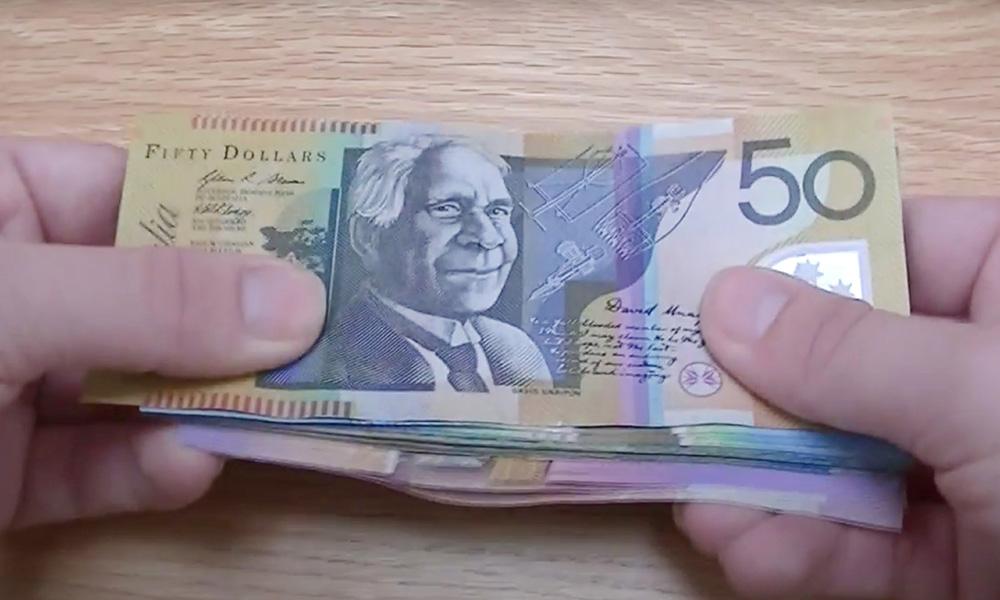
Following the release of the latest employment report, the probability of a June rate hike has fallen to just 4%. The unemployment rate rose to 4.5%, a four-and-a-half-year high; overall employment decreased by 10,000, including a loss of 18,000 full-time jobs. Although the unemployment rate remains below its long-term average, it has been on an upward trend since October 2022, and is currently rising faster than the Reserve Bank of Australia (RBA) expects. Nevertheless, interest rate futures have fully priced in a 25 basis point rate hike before December.
This casts doubt on the importance of Wednesday's monthly CPI data. While the market knows prices may remain high in the short term due to inflationary pressures in the Middle East, a weaker labor market gives the Reserve Bank of Australia more room to remain cautious. Although rising oil prices may bring forward the timing of interest rate hikes, cracks have appeared in the labor market, and it remains questionable whether the market will repric multiple rate hikes. Therefore, if inflation rises less than expected, the Australian dollar could face greater downward pressure against the US dollar.
US inflation is the most important data point this week. With Kevin Warsh at the helm of the Federal Reserve, traders are likely to be highly sensitive to any upward surprises in inflation data. The market expects the April PCE price index to reach its highest level since May 2023, with overall PCE rising to 3.8% year-on-year and core PCE reaching 3.3%. If the core PCE rises more than 0.3% month-on-month, it will reinforce expectations of "higher and longer" interest rates and could trigger a further reassessment of market expectations for Fed rate hikes. Given Warsh's role as Fed Chair, his emphasis on data dependence and independence means the market will react more dramatically to changes in inflation data.
This assessment supports analysts' view that the US dollar index is still attempting to break through 100. Currently, the US dollar index is holding steady in the 99.60-99.00 range, while the 10-year US Treasury yield remains around 4.56% to 4.58%. The high inflation environment means the Federal Reserve is unlikely to quickly shift to interest rate cuts, and further rate hikes cannot be ruled out, providing sustained interest rate differential support for the dollar. Although the US dollar index may not break through the 100 mark in one go, any inflation data exceeding expectations could push US Treasury yields further up, thus supporting the US dollar index's attempt to test the 100 level.
Analysts maintain a "sell on rallies" strategy for the Australian dollar against the US dollar. If inflation data is higher than expected, further strengthening of the US dollar will accelerate the Australian dollar's decline towards 70 US cents.
The Reserve Bank of Australia (RBA) has more reason to remain cautious due to a weak labor market. While rising oil prices may bring forward the timing of interest rate hikes, cracks have appeared in the job market, and the market is skeptical about the repricing of multiple rate hikes.
Regarding the Reserve Bank of New Zealand, the market widely expects it to keep the cash rate unchanged at 2.25%. However, given its warning that Middle East-driven inflationary pressures may still require further tightening, policymakers may again adopt a hawkish stance and remain on hold. The 1-year overnight index swap rate is 2.9%, and the market is currently pricing in approximately 65 basis points of tightening room.
The Australian dollar traded mixed last week, falling the most against the Swiss franc and British pound, also weakening against the US dollar and euro, holding steady against the Japanese yen, and rising slightly against the Canadian dollar. Notably, the classic correlation between the Australian dollar and the US dollar has approached zero, consistent with the mixed price movements of Australian dollar crosses last week. The pattern of strong correlation between the Australian dollar and the US dollar driven by geopolitical risk sentiment and equities, commodities, and the US dollar has temporarily subsided.
In summary, the Australian dollar is currently facing multiple pressures against the US dollar: weak Australian employment data has dashed expectations of a June rate hike, yield spreads have widened, and market focus has shifted to US inflation and Treasury yields. Although the Australian dollar is temporarily holding above 0.71, bullish momentum is waning.
Analysts maintain their "sell on rallies" strategy, believing the index may fall back to 0.70 in the coming weeks. Key variables include Wednesday's Australian CPI data, Thursday's US PCE inflation report, and the Federal Reserve's policy signals.
From the daily chart, the Australian dollar is currently trading around 0.7160 against the US dollar, in a consolidation phase after the recent rebound, with multiple technical indicators showing neutral to weak signals.
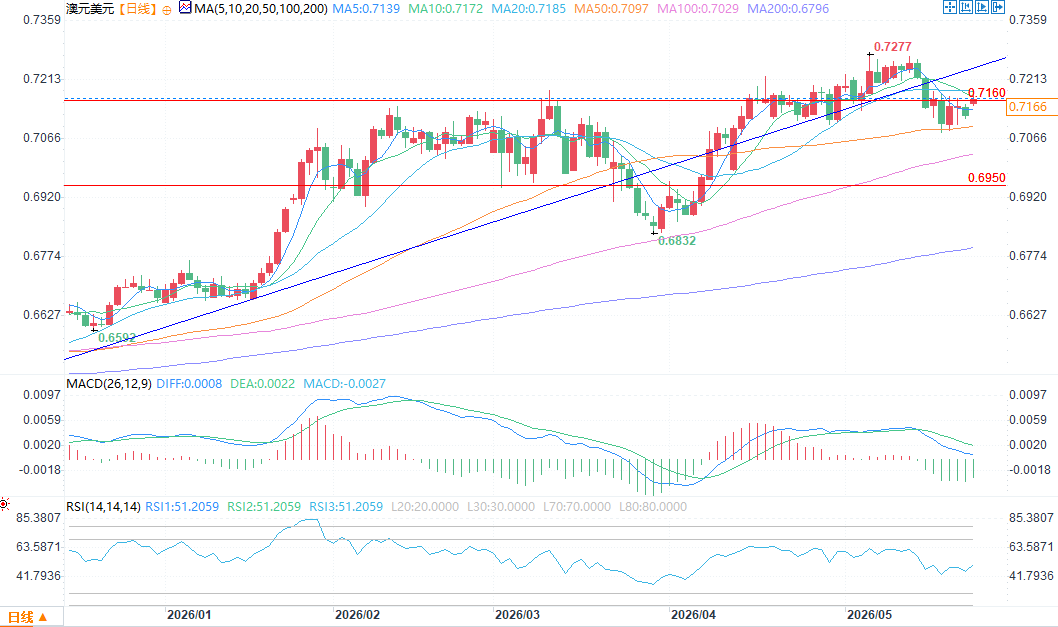
(AUD/USD daily chart, source: FX678)
Regarding the moving average system, the short-term moving averages MA5 (0.7139) and MA10 (0.7172) are roughly in line with the current price, while MA20 (0.7185) is above the current price, forming short-term resistance. MA50 (0.7097), MA100 (0.7029), and MA200 (0.6796) are below the current price, forming medium-term support. This arrangement of "price sandwiched between MA20 and MA50" indicates that the Australian dollar against the US dollar is at a critical juncture, facing short-term pressure but still possessing medium-term support.
At 11:13 Beijing time on May 25, the Australian dollar was trading at 0.7162/63 against the US dollar.
Australian employment data: The probability of a June rate hike has plummeted to 4%, with a weak labor market mitigating the impact of inflation.
Following the release of the latest employment report, the probability of a June rate hike has fallen to just 4%. The unemployment rate rose to 4.5%, a four-and-a-half-year high; overall employment decreased by 10,000, including a loss of 18,000 full-time jobs. Although the unemployment rate remains below its long-term average, it has been on an upward trend since October 2022, and is currently rising faster than the Reserve Bank of Australia (RBA) expects. Nevertheless, interest rate futures have fully priced in a 25 basis point rate hike before December.
This casts doubt on the importance of Wednesday's monthly CPI data. While the market knows prices may remain high in the short term due to inflationary pressures in the Middle East, a weaker labor market gives the Reserve Bank of Australia more room to remain cautious. Although rising oil prices may bring forward the timing of interest rate hikes, cracks have appeared in the labor market, and it remains questionable whether the market will repric multiple rate hikes. Therefore, if inflation rises less than expected, the Australian dollar could face greater downward pressure against the US dollar.
US inflation data: Could drive the next move in the Australian dollar against the US dollar.
US inflation is the most important data point this week. With Kevin Warsh at the helm of the Federal Reserve, traders are likely to be highly sensitive to any upward surprises in inflation data. The market expects the April PCE price index to reach its highest level since May 2023, with overall PCE rising to 3.8% year-on-year and core PCE reaching 3.3%. If the core PCE rises more than 0.3% month-on-month, it will reinforce expectations of "higher and longer" interest rates and could trigger a further reassessment of market expectations for Fed rate hikes. Given Warsh's role as Fed Chair, his emphasis on data dependence and independence means the market will react more dramatically to changes in inflation data.
This assessment supports analysts' view that the US dollar index is still attempting to break through 100. Currently, the US dollar index is holding steady in the 99.60-99.00 range, while the 10-year US Treasury yield remains around 4.56% to 4.58%. The high inflation environment means the Federal Reserve is unlikely to quickly shift to interest rate cuts, and further rate hikes cannot be ruled out, providing sustained interest rate differential support for the dollar. Although the US dollar index may not break through the 100 mark in one go, any inflation data exceeding expectations could push US Treasury yields further up, thus supporting the US dollar index's attempt to test the 100 level.
Analysts maintain a "sell on rallies" strategy for the Australian dollar against the US dollar. If inflation data is higher than expected, further strengthening of the US dollar will accelerate the Australian dollar's decline towards 70 US cents.
Policy Outlook for the Reserve Bank of Australia and the Reserve Bank of New Zealand
The Reserve Bank of Australia (RBA) has more reason to remain cautious due to a weak labor market. While rising oil prices may bring forward the timing of interest rate hikes, cracks have appeared in the job market, and the market is skeptical about the repricing of multiple rate hikes.
Regarding the Reserve Bank of New Zealand, the market widely expects it to keep the cash rate unchanged at 2.25%. However, given its warning that Middle East-driven inflationary pressures may still require further tightening, policymakers may again adopt a hawkish stance and remain on hold. The 1-year overnight index swap rate is 2.9%, and the market is currently pricing in approximately 65 basis points of tightening room.
A review of the Australian dollar's performance and its correlation with the market.
The Australian dollar traded mixed last week, falling the most against the Swiss franc and British pound, also weakening against the US dollar and euro, holding steady against the Japanese yen, and rising slightly against the Canadian dollar. Notably, the classic correlation between the Australian dollar and the US dollar has approached zero, consistent with the mixed price movements of Australian dollar crosses last week. The pattern of strong correlation between the Australian dollar and the US dollar driven by geopolitical risk sentiment and equities, commodities, and the US dollar has temporarily subsided.
The Australian dollar is under short-term pressure; selling on rallies remains the primary strategy.
In summary, the Australian dollar is currently facing multiple pressures against the US dollar: weak Australian employment data has dashed expectations of a June rate hike, yield spreads have widened, and market focus has shifted to US inflation and Treasury yields. Although the Australian dollar is temporarily holding above 0.71, bullish momentum is waning.
Analysts maintain their "sell on rallies" strategy, believing the index may fall back to 0.70 in the coming weeks. Key variables include Wednesday's Australian CPI data, Thursday's US PCE inflation report, and the Federal Reserve's policy signals.
Australian Dollar to US Dollar Daily Technical Analysis
From the daily chart, the Australian dollar is currently trading around 0.7160 against the US dollar, in a consolidation phase after the recent rebound, with multiple technical indicators showing neutral to weak signals.
(AUD/USD daily chart, source: FX678)
Regarding the moving average system, the short-term moving averages MA5 (0.7139) and MA10 (0.7172) are roughly in line with the current price, while MA20 (0.7185) is above the current price, forming short-term resistance. MA50 (0.7097), MA100 (0.7029), and MA200 (0.6796) are below the current price, forming medium-term support. This arrangement of "price sandwiched between MA20 and MA50" indicates that the Australian dollar against the US dollar is at a critical juncture, facing short-term pressure but still possessing medium-term support.
At 11:13 Beijing time on May 25, the Australian dollar was trading at 0.7162/63 against the US dollar.
- Risk Warning and Disclaimer
- The market involves risk, and trading may not be suitable for all investors. This article is for reference only and does not constitute personal investment advice, nor does it take into account certain users’ specific investment objectives, financial situation, or other needs. Any investment decisions made based on this information are at your own risk.