Cooling UK inflation weakened expectations of interest rate hikes, coupled with hawkish comments from the Bank of Japan, causing the pound to retreat from its highs against the yen.
2026-05-26 14:33:33
The British pound (GBP/JPY) retreated slightly from its monthly high in Asian trading on Tuesday, currently hovering around 214.35 , giving back some of its earlier gains. Although some short-term profit-taking has occurred, the overall trend remains high, indicating that bullish sentiment has not yet weakened significantly.

The core factors influencing the recent exchange rate of the British pound against the Japanese yen have primarily stemmed from changes in expectations regarding the Bank of England's policy, the hawkish stance of the Bank of Japan, and escalating global energy risks. Previously, the latest UK Consumer Price Index (CPI) data showed that the annual inflation rate unexpectedly fell to 2.8% in April, lower than the previous reading of 3.3% . This result significantly weakened market bets on further interest rate hikes by the Bank of England.
The market had initially expected the Bank of England to maintain a hawkish stance for an extended period, given persistently high energy prices and service sector inflation. However, with inflation showing a significant decline, investors began to postpone their expectations regarding the timing of the Bank of England's next interest rate hike. This shift in interest rate expectations directly weakened the pound's appeal and led to a temporary pullback in the pound against major currencies.
Furthermore, domestic political uncertainty in the UK has also weighed on the pound. Recent escalating controversy surrounding Prime Minister Keir Starmer has raised market concerns about the potential impact on the stability of future UK fiscal and economic policies. Simultaneously, renewed demand for the US dollar as a safe haven has indirectly pressured the pound. Recent renewed tensions in the Middle East, following the US military strike on southern Iran, have significantly impacted global market risk sentiment, leading to a renewed flow of funds into safe-haven assets such as the US dollar.
However, the yen is also affected by multiple factors. Bank of Japan Deputy Governor Ryozo Himino recently stated that the Bank of Japan will continue to raise interest rates based on changes in the economic, price, and financial environments. This statement further strengthens market expectations that the Bank of Japan will gradually exit its ultra-loose monetary policy. For a considerable period, Japan maintained an ultra-low interest rate policy, leading to sustained pressure on the yen. However, with rising inflation and improved wage growth in Japan, the Bank of Japan has begun to gradually normalize its monetary policy.
The market believes that if the Bank of Japan continues to raise interest rates, the yen may gradually break free from its long-term weakness. However, the market remains cautious about a sustained rise in the yen. The main reason is that the situation in the Middle East has increased global energy supply risks, and Japan is highly dependent on energy imports.
If international oil prices continue to rise, Japan's import costs could increase further, putting pressure on Japan's economic growth. This concern has limited further expansion of yen bullish bets. Therefore, although the Bank of Japan has released hawkish signals, energy risks have weakened the yen's rebound to some extent, keeping the pound/yen exchange rate generally at a high level.
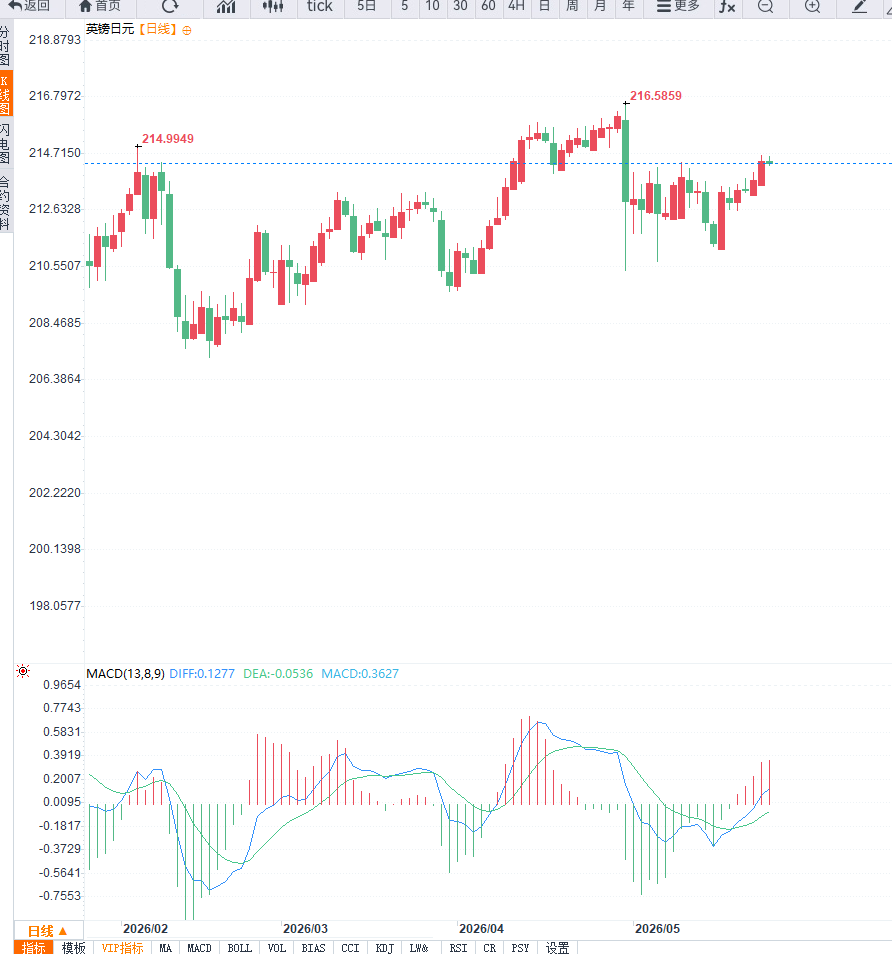
From a technical perspective, the overall trend for GBP/JPY remains bullish. After finding significant support near the 100-day exponential moving average (EMA) around 211.00 , the pair rebounded and is now approaching the 215 level again. The daily chart shows the 20-day moving average continuing its upward trend, and the MACD indicator remaining above the zero line, indicating that the overall upward structure of the market has not been broken. The first major resistance level is currently around 214.70 , which is the area of this week's high. A successful break above this level could lead to further testing of 216.00 or even higher. On the downside, the first key support level is around 213.80 , with further support at 212.50 and the 211.00 area where the 100-day EMA is located.
Given the current lack of significant economic data, the market will continue to focus on developments in the Middle East, policy signals from the Bank of Japan, and UK economic data. Overall, the GBP/JPY exchange rate is currently influenced by three main factors: changes in expectations regarding the Bank of England's policy, the Bank of Japan's hawkish stance, and global energy risks. Short-term market volatility is likely to remain high.
Editor's Summary : The recent high-level fluctuations in the GBP/JPY exchange rate reflect the market's rebalancing between the Bank of England's policy shift and the Bank of Japan's gradual normalization. Cooling UK inflation has weakened market expectations for interest rate hikes, putting temporary pressure on the pound, while the Bank of Japan's continued hawkish signals have increased market expectations for a medium- to long-term yen rebound. However, Middle East energy risks and Japan's high dependence on energy imports limit further yen appreciation. Therefore, the GBP/JPY exchange rate is likely to remain highly volatile in the future. Investors should pay close attention to UK economic data, changes in Bank of Japan policy, and international oil price trends.
The core factors influencing the recent exchange rate of the British pound against the Japanese yen have primarily stemmed from changes in expectations regarding the Bank of England's policy, the hawkish stance of the Bank of Japan, and escalating global energy risks. Previously, the latest UK Consumer Price Index (CPI) data showed that the annual inflation rate unexpectedly fell to 2.8% in April, lower than the previous reading of 3.3% . This result significantly weakened market bets on further interest rate hikes by the Bank of England.
The market had initially expected the Bank of England to maintain a hawkish stance for an extended period, given persistently high energy prices and service sector inflation. However, with inflation showing a significant decline, investors began to postpone their expectations regarding the timing of the Bank of England's next interest rate hike. This shift in interest rate expectations directly weakened the pound's appeal and led to a temporary pullback in the pound against major currencies.
Furthermore, domestic political uncertainty in the UK has also weighed on the pound. Recent escalating controversy surrounding Prime Minister Keir Starmer has raised market concerns about the potential impact on the stability of future UK fiscal and economic policies. Simultaneously, renewed demand for the US dollar as a safe haven has indirectly pressured the pound. Recent renewed tensions in the Middle East, following the US military strike on southern Iran, have significantly impacted global market risk sentiment, leading to a renewed flow of funds into safe-haven assets such as the US dollar.
However, the yen is also affected by multiple factors. Bank of Japan Deputy Governor Ryozo Himino recently stated that the Bank of Japan will continue to raise interest rates based on changes in the economic, price, and financial environments. This statement further strengthens market expectations that the Bank of Japan will gradually exit its ultra-loose monetary policy. For a considerable period, Japan maintained an ultra-low interest rate policy, leading to sustained pressure on the yen. However, with rising inflation and improved wage growth in Japan, the Bank of Japan has begun to gradually normalize its monetary policy.
The market believes that if the Bank of Japan continues to raise interest rates, the yen may gradually break free from its long-term weakness. However, the market remains cautious about a sustained rise in the yen. The main reason is that the situation in the Middle East has increased global energy supply risks, and Japan is highly dependent on energy imports.
If international oil prices continue to rise, Japan's import costs could increase further, putting pressure on Japan's economic growth. This concern has limited further expansion of yen bullish bets. Therefore, although the Bank of Japan has released hawkish signals, energy risks have weakened the yen's rebound to some extent, keeping the pound/yen exchange rate generally at a high level.
From a technical perspective, the overall trend for GBP/JPY remains bullish. After finding significant support near the 100-day exponential moving average (EMA) around 211.00 , the pair rebounded and is now approaching the 215 level again. The daily chart shows the 20-day moving average continuing its upward trend, and the MACD indicator remaining above the zero line, indicating that the overall upward structure of the market has not been broken. The first major resistance level is currently around 214.70 , which is the area of this week's high. A successful break above this level could lead to further testing of 216.00 or even higher. On the downside, the first key support level is around 213.80 , with further support at 212.50 and the 211.00 area where the 100-day EMA is located.
Given the current lack of significant economic data, the market will continue to focus on developments in the Middle East, policy signals from the Bank of Japan, and UK economic data. Overall, the GBP/JPY exchange rate is currently influenced by three main factors: changes in expectations regarding the Bank of England's policy, the Bank of Japan's hawkish stance, and global energy risks. Short-term market volatility is likely to remain high.
Editor's Summary : The recent high-level fluctuations in the GBP/JPY exchange rate reflect the market's rebalancing between the Bank of England's policy shift and the Bank of Japan's gradual normalization. Cooling UK inflation has weakened market expectations for interest rate hikes, putting temporary pressure on the pound, while the Bank of Japan's continued hawkish signals have increased market expectations for a medium- to long-term yen rebound. However, Middle East energy risks and Japan's high dependence on energy imports limit further yen appreciation. Therefore, the GBP/JPY exchange rate is likely to remain highly volatile in the future. Investors should pay close attention to UK economic data, changes in Bank of Japan policy, and international oil price trends.
- Risk Warning and Disclaimer
- The market involves risk, and trading may not be suitable for all investors. This article is for reference only and does not constitute personal investment advice, nor does it take into account certain users’ specific investment objectives, financial situation, or other needs. Any investment decisions made based on this information are at your own risk.