US and Iran risk another clash! A test of negotiating resilience amid oil price volatility.
2026-05-26 15:59:30
On Tuesday (May 26), international oil prices rebounded during the Asian and European sessions, with Brent crude rising 2.5% to trade around 98.75. It can be seen that oil prices have rebounded again after the US launched its strikes and Iran responded with strong statements.
Recently, the diplomatic game between the United States and Iran has taken a key turn. Negotiations between the two sides on core issues such as the nuclear issue, the situation in the Strait of Hormuz, and the freezing of assets have made phased progress. Coupled with optimistic signals released from Iran, market expectations for a US-Iran agreement have risen significantly .
However, a spokesperson for the U.S. Central Command reported this morning that the U.S. military conducted a self-defense strike mission in southern Iran, striking multiple targets, including missile launch sites, and taking action against Iranian vessels attempting to lay mines.
Meanwhile, Iran's Supreme Leader Mojtaba Khamenei stated that Israel is entering the final stage of its existence, reiterating his previous prediction that the country would not last more than 25 years.
The market is currently shrouded in a paradox between the positive news surrounding the US-Iran negotiations and the lack of concrete results. The US's intervention and Iran's tough stance can be used to observe the resilience of these negotiations and the market's flexibility.
US President Trump made a new statement on the issue of Iran's enriched uranium on his social media platform "Truth Social," proposing two solutions: one is to demand that Iran immediately hand over the enriched uranium to the United States for shipment and destruction.
Second, it is recommended that the US and Iran cooperate to complete the destruction within Iran or at other locations agreed upon by both parties, with the entire process requiring on-site witnessing by the Atomic Energy Organization of Iran or an equivalent body.
An analysis by a reporter from the US media outlet Axios suggests that this statement indicates a softening of the US stance on the issue of enriched uranium stockpiles, gradually moving closer to Iran's position.
However, the US remains firm in its stance, with Trump reiterating his demand for the transfer and destruction of the agreement, suggesting that the deal still risks collapsing.
In an effort to push for a breakthrough in the peace talks, Iran’s chief negotiator and foreign minister led a delegation to Doha, Qatar, for key talks with the Qatari prime minister. The talks focused on two key areas: the situation in the Strait of Hormuz and Iran’s highly enriched uranium stockpile.
It is noteworthy that the Governor of the Central Bank of Iran attended the meeting, and the three parties focused on discussing matters related to unfreezing Iranian assets under the framework of the final agreement. Qatar is the custodian of Iran's $6 billion in frozen funds , which are Iranian oil export revenues and were previously subject to strict US regulation, allowing them to be used only for the purchase of humanitarian supplies.
At the same time, optimistic signals are emerging within Iran, with controls gradually being relaxed in areas such as schools and communications. This reflects the Iranian leadership's positive assessment of the prospects for peace talks and is creating an internal atmosphere conducive to advancing the negotiations.
In the US-Iran rivalry, Pakistan has consistently played the role of a neutral mediator. On May 26, local time, Pakistani Defense Minister Asif clearly stated that Pakistan would not join any "Abraham Accords" aimed at normalizing relations with Israel, nor would it accept any agreement that conflicted with its fundamental principles.
Previously, Trump had called on mediators such as Saudi Arabia, Qatar, and Pakistan to join the agreement, otherwise they would not be allowed to participate in the US-Iran negotiations. He also demanded that Iran join if an agreement was reached. However, Pakistan's neutral stance preserved a key communication channel for the US-Iran dialogue.
As a vital passage for global energy transportation, the Strait of Hormuz carries approximately 20% of the world's oil and gas shipments.
Since the outbreak of the conflict, Iran has cut off almost all navigation routes for non-Iranian vessels, causing disruptions to the global energy supply chain and high prices.
As peace talks progress, navigation conditions continue to improve: the Iranian Revolutionary Guard Navy announced that 32 oil tankers, container ships and merchant ships were permitted to pass through the strait in the past 24 hours;
The Iraqi supertanker that had been stranded for nearly three months has sailed to China, while three other liquefied natural gas (LNG) carriers are heading to Pakistan, China, and India respectively.
According to the memorandum of understanding to be reached by both sides, Iran has pledged to clear mines from the Strait of Hormuz and cease collecting transit fees within 30 days, and the agreement will give negotiators 60 days to finalize the terms.
Charu Chanana, chief strategist at Saxo Bank, pointed out that the reopening of the Strait of Hormuz could significantly alleviate extreme risks such as oil supply and inflationary pressures, but the real test lies in the actual implementation, such as the free passage of oil tankers and the decline in shipping insurance rates. In the short term, the market may maintain intermittent risk characteristics.
Financial markets reacted positively to progress in the US-Iran peace talks. US financial markets resumed trading after the holiday, and driven by optimistic expectations of an agreement, US Treasury yields fell across the board: the two-year yield fell 7 basis points to 4.05%, the ten-year yield fell 7 basis points to 4.49%, and the thirty-year yield fell 5 basis points to 5.02%.
Royal Bank analyst Abbas Keshwani noted that given the repeated failures to reach an agreement, market sentiment remains cautious, but progress in negotiations is expected to further reduce energy prices and inflation expectations, continuing to depress yields.
Currently, based on market details, including the US expressing a softening stance on the nuclear issue, the presence of a central bank governor in the Iranian negotiating team (the negotiations involve the unfreezing of frozen funds), and the opening of civilian facilities, all suggest a smooth progress in the peace talks. However, the US military attack and Khamenei's tough statements are testing the stability of the overall negotiation process.
The current rebound in oil prices is driven by two factors: firstly, the risk premium resulting from geopolitical uncertainties, and secondly, the global inventory cycle leading to future restocking. The key point to watch going forward is whether the oil price rebound will fall short of expectations and begin to weaken today. If it does weaken, it would indicate that the market has accepted the stress test of the US-Iran negotiations.
Fundamentally, it is necessary to continue monitoring the passage through the Strait of Hormuz and the manner and frequency of US and Iranian statements regarding the nuclear issue.
From a technical perspective, Brent crude oil has rebounded from the 0.618 level, and is currently facing resistance near the gap and the 5-day moving average.
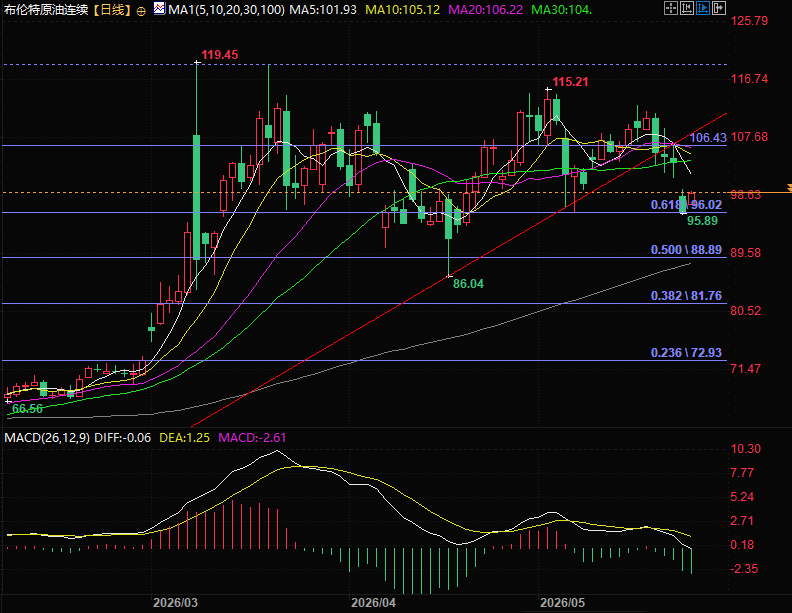
(Brent crude oil futures contract daily chart, source: EasyForex)
At 15:56 Beijing time, Brent crude oil futures contracts were trading at $99.22 per barrel.
Recently, the diplomatic game between the United States and Iran has taken a key turn. Negotiations between the two sides on core issues such as the nuclear issue, the situation in the Strait of Hormuz, and the freezing of assets have made phased progress. Coupled with optimistic signals released from Iran, market expectations for a US-Iran agreement have risen significantly .
However, a spokesperson for the U.S. Central Command reported this morning that the U.S. military conducted a self-defense strike mission in southern Iran, striking multiple targets, including missile launch sites, and taking action against Iranian vessels attempting to lay mines.
Meanwhile, Iran's Supreme Leader Mojtaba Khamenei stated that Israel is entering the final stage of its existence, reiterating his previous prediction that the country would not last more than 25 years.
The market is currently shrouded in a paradox between the positive news surrounding the US-Iran negotiations and the lack of concrete results. The US's intervention and Iran's tough stance can be used to observe the resilience of these negotiations and the market's flexibility.
The US stance on the nuclear issue has softened, with the US proposing a nuclear destruction plan.
US President Trump made a new statement on the issue of Iran's enriched uranium on his social media platform "Truth Social," proposing two solutions: one is to demand that Iran immediately hand over the enriched uranium to the United States for shipment and destruction.
Second, it is recommended that the US and Iran cooperate to complete the destruction within Iran or at other locations agreed upon by both parties, with the entire process requiring on-site witnessing by the Atomic Energy Organization of Iran or an equivalent body.
An analysis by a reporter from the US media outlet Axios suggests that this statement indicates a softening of the US stance on the issue of enriched uranium stockpiles, gradually moving closer to Iran's position.
However, the US remains firm in its stance, with Trump reiterating his demand for the transfer and destruction of the agreement, suggesting that the deal still risks collapsing.
Iranian central bank governor attends talks in Qatar, focusing on asset unfreezing.
In an effort to push for a breakthrough in the peace talks, Iran’s chief negotiator and foreign minister led a delegation to Doha, Qatar, for key talks with the Qatari prime minister. The talks focused on two key areas: the situation in the Strait of Hormuz and Iran’s highly enriched uranium stockpile.
It is noteworthy that the Governor of the Central Bank of Iran attended the meeting, and the three parties focused on discussing matters related to unfreezing Iranian assets under the framework of the final agreement. Qatar is the custodian of Iran's $6 billion in frozen funds , which are Iranian oil export revenues and were previously subject to strict US regulation, allowing them to be used only for the purchase of humanitarian supplies.
At the same time, optimistic signals are emerging within Iran, with controls gradually being relaxed in areas such as schools and communications. This reflects the Iranian leadership's positive assessment of the prospects for peace talks and is creating an internal atmosphere conducive to advancing the negotiations.
Pakistan maintains neutrality and plays a crucial mediating role.
In the US-Iran rivalry, Pakistan has consistently played the role of a neutral mediator. On May 26, local time, Pakistani Defense Minister Asif clearly stated that Pakistan would not join any "Abraham Accords" aimed at normalizing relations with Israel, nor would it accept any agreement that conflicted with its fundamental principles.
Previously, Trump had called on mediators such as Saudi Arabia, Qatar, and Pakistan to join the agreement, otherwise they would not be allowed to participate in the US-Iran negotiations. He also demanded that Iran join if an agreement was reached. However, Pakistan's neutral stance preserved a key communication channel for the US-Iran dialogue.
Navigation in the Strait of Hormuz is picking up, and shipping restrictions are being gradually lifted.
As a vital passage for global energy transportation, the Strait of Hormuz carries approximately 20% of the world's oil and gas shipments.
Since the outbreak of the conflict, Iran has cut off almost all navigation routes for non-Iranian vessels, causing disruptions to the global energy supply chain and high prices.
As peace talks progress, navigation conditions continue to improve: the Iranian Revolutionary Guard Navy announced that 32 oil tankers, container ships and merchant ships were permitted to pass through the strait in the past 24 hours;
The Iraqi supertanker that had been stranded for nearly three months has sailed to China, while three other liquefied natural gas (LNG) carriers are heading to Pakistan, China, and India respectively.
According to the memorandum of understanding to be reached by both sides, Iran has pledged to clear mines from the Strait of Hormuz and cease collecting transit fees within 30 days, and the agreement will give negotiators 60 days to finalize the terms.
Charu Chanana, chief strategist at Saxo Bank, pointed out that the reopening of the Strait of Hormuz could significantly alleviate extreme risks such as oil supply and inflationary pressures, but the real test lies in the actual implementation, such as the free passage of oil tankers and the decline in shipping insurance rates. In the short term, the market may maintain intermittent risk characteristics.
Market optimism spread, and US Treasury yields fell across the board.
Financial markets reacted positively to progress in the US-Iran peace talks. US financial markets resumed trading after the holiday, and driven by optimistic expectations of an agreement, US Treasury yields fell across the board: the two-year yield fell 7 basis points to 4.05%, the ten-year yield fell 7 basis points to 4.49%, and the thirty-year yield fell 5 basis points to 5.02%.
Royal Bank analyst Abbas Keshwani noted that given the repeated failures to reach an agreement, market sentiment remains cautious, but progress in negotiations is expected to further reduce energy prices and inflation expectations, continuing to depress yields.
Summary and Technical Analysis:
Currently, based on market details, including the US expressing a softening stance on the nuclear issue, the presence of a central bank governor in the Iranian negotiating team (the negotiations involve the unfreezing of frozen funds), and the opening of civilian facilities, all suggest a smooth progress in the peace talks. However, the US military attack and Khamenei's tough statements are testing the stability of the overall negotiation process.
The current rebound in oil prices is driven by two factors: firstly, the risk premium resulting from geopolitical uncertainties, and secondly, the global inventory cycle leading to future restocking. The key point to watch going forward is whether the oil price rebound will fall short of expectations and begin to weaken today. If it does weaken, it would indicate that the market has accepted the stress test of the US-Iran negotiations.
Fundamentally, it is necessary to continue monitoring the passage through the Strait of Hormuz and the manner and frequency of US and Iranian statements regarding the nuclear issue.
From a technical perspective, Brent crude oil has rebounded from the 0.618 level, and is currently facing resistance near the gap and the 5-day moving average.
(Brent crude oil futures contract daily chart, source: EasyForex)
At 15:56 Beijing time, Brent crude oil futures contracts were trading at $99.22 per barrel.
- Risk Warning and Disclaimer
- The market involves risk, and trading may not be suitable for all investors. This article is for reference only and does not constitute personal investment advice, nor does it take into account certain users’ specific investment objectives, financial situation, or other needs. Any investment decisions made based on this information are at your own risk.