With Middle East peace talks and a decline in US Treasury yields, why hasn't the euro taken off yet?
2026-05-26 16:35:25
At the start of the new trading week, the euro showed short-term strength against the dollar, recording a gain of nearly 0.4% on the first day. Although it corrected slightly on Tuesday (May 26), this movement is beginning to suggest a short-term bullish bias is forming, mainly driven by progress in Middle East negotiations and a decline in US Treasury yields. These factors weakened the dollar, providing support for the euro's rise. If this dynamic continues, the euro/dollar pair may continue to face considerable buying pressure in the coming trading days.

Significant progress was made in Middle East peace talks over the weekend. President Trump stated on Saturday that progress had been made on a memorandum of understanding regarding a potential agreement. While Iran still has conditions to be met (such as unfreezing billions of dollars in frozen funds in foreign banks), it is believed that Iran is at least initially willing to support a large-scale reopening of the Strait of Hormuz—which carries over 20% of global oil trade.
This event triggered a sharp correction in oil prices, with Brent crude falling below $100, hitting a two-week low, thus reducing some global inflation uncertainty and geopolitical premiums. Consequently, market demand for the US dollar as a safe-haven currency also began to weaken.
In fact, the dollar index fell more than 0.3% on Monday, returning below the 99 level. Although it returned to the 99 level on Tuesday, demand for the dollar had cooled somewhat. This scenario is favorable for the euro, as renewed hopes for a peace agreement have weakened its main rival currency, the dollar, giving the euro more room to rise in the short term.
If this confidence environment is maintained and the dollar continues to weaken, the euro may continue to face significant buying pressure against the dollar in the coming trading days.
Another important factor is that the potential reduction in global uncertainty is also beginning to change market expectations of the Federal Reserve—which has been one of the main drivers supporting the dollar in recent weeks.
Currently, the CME Group probability table shows that the market expects the Federal Reserve to keep interest rates unchanged until December this year. A potential rate hike is now priced in for March 2027, with a probability exceeding 40%. This change is significant—just weeks ago, the same probability was assigned to December this year, indicating that the market no longer expects a rate hike as soon as before. This dynamic has begun to weaken the yield on the 10-year US Treasury bond, which has now fallen below the 4.6% area. The weakening yield has reduced the global appeal of these instruments and may have also affected demand for the US dollar in recent trading days.
In summary, the weakening demand for the US dollar is not only related to increased confidence in the Middle East situation, but also to a shift in market expectations regarding the Federal Reserve. If the Fed maintains interest rates unchanged in the coming months, the US dollar may continue to exhibit a neutral stance, which could potentially reduce buying pressure on the euro against the dollar in the short to medium term.
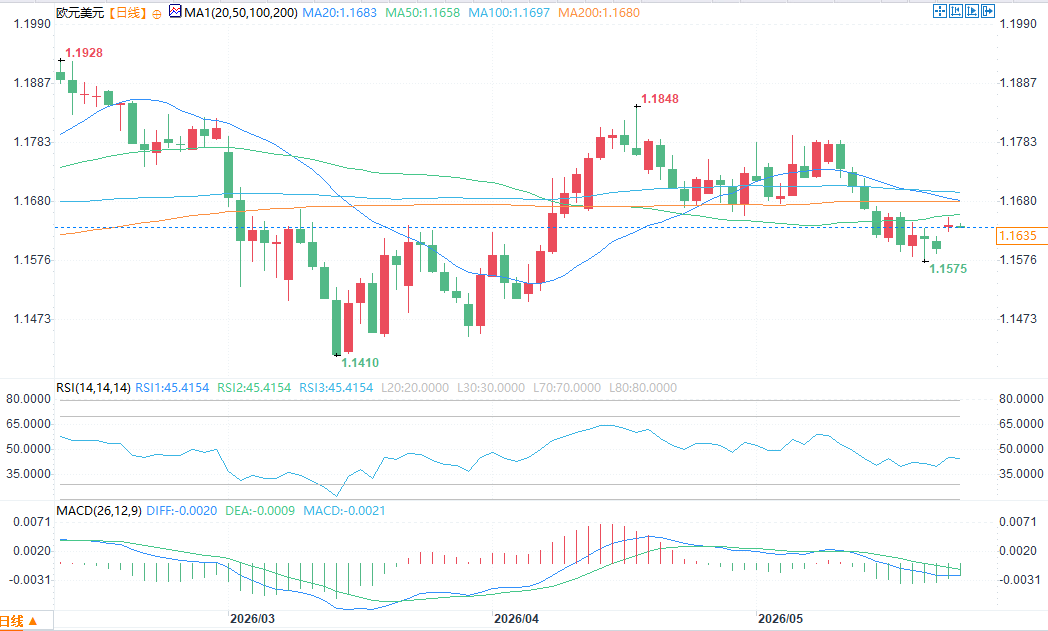
From the daily chart, the euro is currently trading around 1.1635 against the US dollar, in a consolidation phase after rebounding from recent lows, with multiple technical indicators showing neutral to weak signals.
(Euro/USD daily chart, source: FX678)
Regarding the moving average system, the short-term moving averages MA20 (1.1683) and MA50 (1.1658) are above the current price, forming short-term resistance; MA100 (1.1697) and MA200 (1.1680) are also above the current price. This arrangement of "price below all major moving averages" indicates that the Euro/USD pair is under significant short-term pressure and is in a weak consolidation pattern. It is worth noting that since the price fell from above 1.1900 in early May, it has failed to effectively recover any major moving average, indicating insufficient upward momentum. The 1.1680-1.1700 area above is a resistance zone where multiple moving averages converge, making a breakthrough difficult.
The MACD histogram value is -0.0020, a negative value but with a very small amplitude, indicating that the bearish momentum is extremely weak and the bulls and bears are in a stalemate. Looking at the shape of the histogram, since mid-May, the histogram has been hovering around the zero axis, neither expanding significantly nor converging markedly, reflecting a lack of clear directional momentum in the market.
Regarding the RSI indicator, the RSI line is attempting to return to the 50 neutral zone, indicating that bearish forces have a slight but not significant advantage. The reading being in the neutral zone suggests that the market still has room for further two-way fluctuations and has not yet entered oversold territory.
At 16:01 Beijing time on May 26, the euro was trading at 1.1635/36 against the US dollar.
Potential peace agreement? Falling oil prices weaken demand for the safe-haven dollar.
Significant progress was made in Middle East peace talks over the weekend. President Trump stated on Saturday that progress had been made on a memorandum of understanding regarding a potential agreement. While Iran still has conditions to be met (such as unfreezing billions of dollars in frozen funds in foreign banks), it is believed that Iran is at least initially willing to support a large-scale reopening of the Strait of Hormuz—which carries over 20% of global oil trade.
This event triggered a sharp correction in oil prices, with Brent crude falling below $100, hitting a two-week low, thus reducing some global inflation uncertainty and geopolitical premiums. Consequently, market demand for the US dollar as a safe-haven currency also began to weaken.
In fact, the dollar index fell more than 0.3% on Monday, returning below the 99 level. Although it returned to the 99 level on Tuesday, demand for the dollar had cooled somewhat. This scenario is favorable for the euro, as renewed hopes for a peace agreement have weakened its main rival currency, the dollar, giving the euro more room to rise in the short term.
If this confidence environment is maintained and the dollar continues to weaken, the euro may continue to face significant buying pressure against the dollar in the coming trading days.
Is the central bank's approach changing? The Fed's rate hike expectations have been delayed, and US Treasury yields have fallen.
Another important factor is that the potential reduction in global uncertainty is also beginning to change market expectations of the Federal Reserve—which has been one of the main drivers supporting the dollar in recent weeks.
Currently, the CME Group probability table shows that the market expects the Federal Reserve to keep interest rates unchanged until December this year. A potential rate hike is now priced in for March 2027, with a probability exceeding 40%. This change is significant—just weeks ago, the same probability was assigned to December this year, indicating that the market no longer expects a rate hike as soon as before. This dynamic has begun to weaken the yield on the 10-year US Treasury bond, which has now fallen below the 4.6% area. The weakening yield has reduced the global appeal of these instruments and may have also affected demand for the US dollar in recent trading days.
In summary, the weakening demand for the US dollar is not only related to increased confidence in the Middle East situation, but also to a shift in market expectations regarding the Federal Reserve. If the Fed maintains interest rates unchanged in the coming months, the US dollar may continue to exhibit a neutral stance, which could potentially reduce buying pressure on the euro against the dollar in the short to medium term.
EUR/USD Daily Technical Analysis
From the daily chart, the euro is currently trading around 1.1635 against the US dollar, in a consolidation phase after rebounding from recent lows, with multiple technical indicators showing neutral to weak signals.
(Euro/USD daily chart, source: FX678)
Regarding the moving average system, the short-term moving averages MA20 (1.1683) and MA50 (1.1658) are above the current price, forming short-term resistance; MA100 (1.1697) and MA200 (1.1680) are also above the current price. This arrangement of "price below all major moving averages" indicates that the Euro/USD pair is under significant short-term pressure and is in a weak consolidation pattern. It is worth noting that since the price fell from above 1.1900 in early May, it has failed to effectively recover any major moving average, indicating insufficient upward momentum. The 1.1680-1.1700 area above is a resistance zone where multiple moving averages converge, making a breakthrough difficult.
The MACD histogram value is -0.0020, a negative value but with a very small amplitude, indicating that the bearish momentum is extremely weak and the bulls and bears are in a stalemate. Looking at the shape of the histogram, since mid-May, the histogram has been hovering around the zero axis, neither expanding significantly nor converging markedly, reflecting a lack of clear directional momentum in the market.
Regarding the RSI indicator, the RSI line is attempting to return to the 50 neutral zone, indicating that bearish forces have a slight but not significant advantage. The reading being in the neutral zone suggests that the market still has room for further two-way fluctuations and has not yet entered oversold territory.
At 16:01 Beijing time on May 26, the euro was trading at 1.1635/36 against the US dollar.
- Risk Warning and Disclaimer
- The market involves risk, and trading may not be suitable for all investors. This article is for reference only and does not constitute personal investment advice, nor does it take into account certain users’ specific investment objectives, financial situation, or other needs. Any investment decisions made based on this information are at your own risk.