Despite the threat of a "double blockade" from the Hormuz and Mandheh Belt and Road Initiative, the medium-term bullish trend of the US dollar index remains unchanged.
2026-06-02 12:01:41
On Tuesday (June 2nd) during Asian trading hours, the US dollar index fluctuated narrowly after opening, currently trading around 99.20. Geopolitical risks in the Middle East have escalated again – Iran has suspended negotiations and plans to block the Strait of Hormuz.
Iran's Tasnim News Agency reported that Tehran has suspended indirect negotiations with the United States, and that Iran and its allies in the "resistance front" across the Middle East plan to completely blockade the Straits of Hormuz and Bab el-Mandeb. The so-called "resistance front" includes the Houthi rebels in Yemen, Hezbollah in Lebanon, and pro-Iranian militias in Iraq.
The Bab el-Mandeb Strait is a crucial waterway connecting the Red Sea and the Gulf of Aden, through which approximately 10% of global maritime trade passes. If both the Strait of Hormuz and the Bab el-Mandeb Strait were blocked simultaneously, global energy transport would face a "double blockade," potentially causing oil prices to surge to over $150 and triggering a global supply chain crisis.
Furthermore, media reports indicate that Iran laid more mines in the Strait of Hormuz last week, and these developments pose a serious obstacle to a swift resolution to the crisis. Mine clearance operations can take weeks or even months and involve extremely high security risks.
The dollar index received support from renewed tensions in the Middle East, which exacerbated global inflation concerns and reinforced expectations that the Federal Reserve's policy rates will remain high.
The continued closure of the Strait of Hormuz is keeping Brent crude oil prices around $95, and energy costs are penetrating into a wider economic sector through a "second-round effect."
U.S. PCE inflation rose to a three-year high of 3.8% in April, and Governor Cook has said he is "ready to raise interest rates," while Waller, previously the most dovish, has also supported removing the "accommodative bias."
Reflecting these persistent inflationary pressures, financial markets are currently pricing in a possible Fed rate hike before the end of the year, with the CME FedWatch tool showing a 39% probability of a 25 basis point rate hike in December.
However, US President Trump offered an optimistic outlook that contrasted sharply with Iran's official narrative.
Amid Iran's announcement of a suspension of negotiations and threat to close the Strait of Hormuz, Trump said talks were continuing and hinted that a memorandum of understanding to reopen the Strait of Hormuz could be reached within the next week.
He also revealed that he had communicated with Israel and Hezbollah, and all parties agreed not to attack each other. The market remains cautious – previous reports of "an impending agreement" have ultimately fallen through due to fundamental disagreements over nuclear programs and control of the Strait of Hormuz.
Meanwhile, the regional diplomatic landscape is also changing. Lebanese authorities have called for the ceasefire agreement between Hezbollah and Tel Aviv to be extended to cover all of Lebanese territory.
However, Netanyahu has previously stated clearly that he will continue to crack down on Hezbollah, creating a direct conflict between the two sides' demands. The trajectory of the situation in Lebanon is, in effect, an extension of the US-Iran rivalry—if US-Iran negotiations break down, the fighting on the Lebanese border could escalate further.
Amid the chaotic signals of "fighting while negotiating" in the Middle East, several institutions have offered their own assessments of the future of the US dollar.
Commonwealth Bank of Australia strategists point out that the US dollar still has room for further appreciation, driven by multiple factors including the AI capital expenditure boom, tax cuts, energy independence, and the safe-haven status of the US dollar.
The Commonwealth Bank of Australia has raised its forecast for the US dollar index to 100.1 by the end of June from 99.6, and significantly increased its forecast for the end of December to 104.5 (previously estimated at 101.8).
Strategists at MUFG Financial Group noted that the dollar was "basically stable" in early June, with the market watching the US-Iran negotiations and the US data schedule. If an agreement is reached, Federal Reserve officials may be more willing to "see through" the energy price impact; however, stronger inflation data would complicate the situation. It's worth noting that new Fed Chairman Warsh cited cut-off mean inflation as a benchmark during his nomination hearing, which could mean he will push for a "dovish interpretation," thus putting pressure on the dollar.
ING analysts point out that the increasing prospect of a Fed rate hike should support the dollar, and the dollar index is expected to find support in the 99.00-99.50 range.
The US dollar index is currently quoted around 99.20, with the price stabilizing above the four moving averages of MA20, MA50, MA100, and MA200. The short, medium, and long-term moving averages are arranged in a bullish pattern, and the moving average system forms bottom support, indicating a strong medium-term trend.
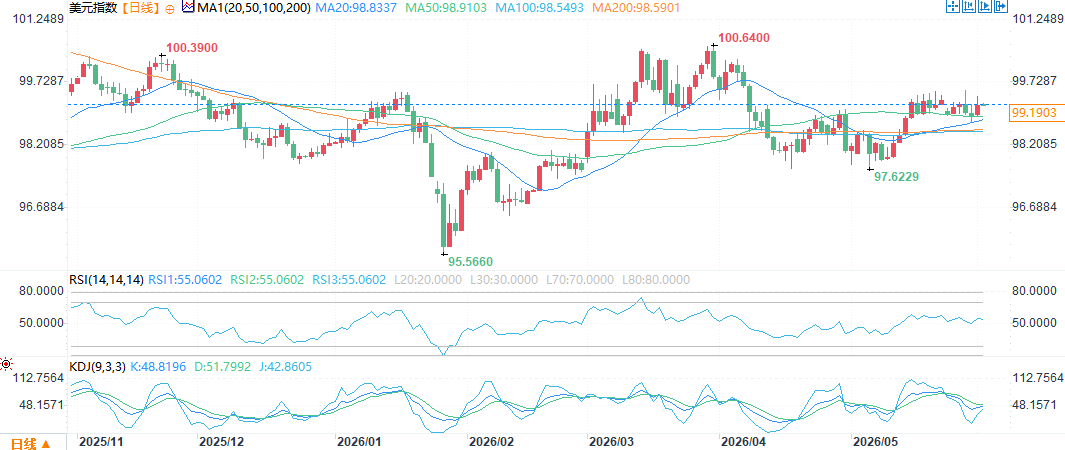
(US Dollar Index Daily Chart, Source: FX678)
The previous highs of 100.64 and 100.39 form key resistance levels above, while the April low of 97.62 and the year's low of 95.57 are important support levels. Since bottoming out and rebounding in April, the market has been steadily rising along the moving averages, and is generally in an upward trend.
In terms of indicators, the RSI value is 55.06, which is firmly above the 50 dividing line between bullish and bearish sentiment. The bulls have the upper hand, but it has not yet reached the 70 overbought zone, so there is still room for upward movement.
Given the rising expectations of a Fed rate hike, the US dollar is expected to fluctuate with a slight upward bias in the short term. The first resistance level to watch is the 99.7-100 level, while the support level is around 98.8-99. As long as it does not break below the short-term moving average, the medium-term upward trend remains unchanged.
At 12:00 Beijing time on June 2, the US dollar index was at 99.18.
Iran escalates actions: Suspends negotiations, plans to blockade the Strait of Hormuz
Iran's Tasnim News Agency reported that Tehran has suspended indirect negotiations with the United States, and that Iran and its allies in the "resistance front" across the Middle East plan to completely blockade the Straits of Hormuz and Bab el-Mandeb. The so-called "resistance front" includes the Houthi rebels in Yemen, Hezbollah in Lebanon, and pro-Iranian militias in Iraq.
The Bab el-Mandeb Strait is a crucial waterway connecting the Red Sea and the Gulf of Aden, through which approximately 10% of global maritime trade passes. If both the Strait of Hormuz and the Bab el-Mandeb Strait were blocked simultaneously, global energy transport would face a "double blockade," potentially causing oil prices to surge to over $150 and triggering a global supply chain crisis.
Furthermore, media reports indicate that Iran laid more mines in the Strait of Hormuz last week, and these developments pose a serious obstacle to a swift resolution to the crisis. Mine clearance operations can take weeks or even months and involve extremely high security risks.
Inflation concerns rekindle: Interest rate hike expectations rise slightly.
The dollar index received support from renewed tensions in the Middle East, which exacerbated global inflation concerns and reinforced expectations that the Federal Reserve's policy rates will remain high.
The continued closure of the Strait of Hormuz is keeping Brent crude oil prices around $95, and energy costs are penetrating into a wider economic sector through a "second-round effect."
U.S. PCE inflation rose to a three-year high of 3.8% in April, and Governor Cook has said he is "ready to raise interest rates," while Waller, previously the most dovish, has also supported removing the "accommodative bias."
Reflecting these persistent inflationary pressures, financial markets are currently pricing in a possible Fed rate hike before the end of the year, with the CME FedWatch tool showing a 39% probability of a 25 basis point rate hike in December.
Trump expressed optimism: Negotiations are still ongoing, and an agreement may be reached within a week.
However, US President Trump offered an optimistic outlook that contrasted sharply with Iran's official narrative.
Amid Iran's announcement of a suspension of negotiations and threat to close the Strait of Hormuz, Trump said talks were continuing and hinted that a memorandum of understanding to reopen the Strait of Hormuz could be reached within the next week.
He also revealed that he had communicated with Israel and Hezbollah, and all parties agreed not to attack each other. The market remains cautious – previous reports of "an impending agreement" have ultimately fallen through due to fundamental disagreements over nuclear programs and control of the Strait of Hormuz.
Meanwhile, the regional diplomatic landscape is also changing. Lebanese authorities have called for the ceasefire agreement between Hezbollah and Tel Aviv to be extended to cover all of Lebanese territory.
However, Netanyahu has previously stated clearly that he will continue to crack down on Hezbollah, creating a direct conflict between the two sides' demands. The trajectory of the situation in Lebanon is, in effect, an extension of the US-Iran rivalry—if US-Iran negotiations break down, the fighting on the Lebanese border could escalate further.
Institutional Views
Amid the chaotic signals of "fighting while negotiating" in the Middle East, several institutions have offered their own assessments of the future of the US dollar.
Commonwealth Bank of Australia strategists point out that the US dollar still has room for further appreciation, driven by multiple factors including the AI capital expenditure boom, tax cuts, energy independence, and the safe-haven status of the US dollar.
The Commonwealth Bank of Australia has raised its forecast for the US dollar index to 100.1 by the end of June from 99.6, and significantly increased its forecast for the end of December to 104.5 (previously estimated at 101.8).
Strategists at MUFG Financial Group noted that the dollar was "basically stable" in early June, with the market watching the US-Iran negotiations and the US data schedule. If an agreement is reached, Federal Reserve officials may be more willing to "see through" the energy price impact; however, stronger inflation data would complicate the situation. It's worth noting that new Fed Chairman Warsh cited cut-off mean inflation as a benchmark during his nomination hearing, which could mean he will push for a "dovish interpretation," thus putting pressure on the dollar.
ING analysts point out that the increasing prospect of a Fed rate hike should support the dollar, and the dollar index is expected to find support in the 99.00-99.50 range.
US Dollar Index Daily Technical Analysis
The US dollar index is currently quoted around 99.20, with the price stabilizing above the four moving averages of MA20, MA50, MA100, and MA200. The short, medium, and long-term moving averages are arranged in a bullish pattern, and the moving average system forms bottom support, indicating a strong medium-term trend.
(US Dollar Index Daily Chart, Source: FX678)
The previous highs of 100.64 and 100.39 form key resistance levels above, while the April low of 97.62 and the year's low of 95.57 are important support levels. Since bottoming out and rebounding in April, the market has been steadily rising along the moving averages, and is generally in an upward trend.
In terms of indicators, the RSI value is 55.06, which is firmly above the 50 dividing line between bullish and bearish sentiment. The bulls have the upper hand, but it has not yet reached the 70 overbought zone, so there is still room for upward movement.
Given the rising expectations of a Fed rate hike, the US dollar is expected to fluctuate with a slight upward bias in the short term. The first resistance level to watch is the 99.7-100 level, while the support level is around 98.8-99. As long as it does not break below the short-term moving average, the medium-term upward trend remains unchanged.
At 12:00 Beijing time on June 2, the US dollar index was at 99.18.
- Risk Warning and Disclaimer
- The market involves risk, and trading may not be suitable for all investors. This article is for reference only and does not constitute personal investment advice, nor does it take into account certain users’ specific investment objectives, financial situation, or other needs. Any investment decisions made based on this information are at your own risk.