June 3rd Financial Breakfast: Trump says negotiations continue VS Iran says "no communication for days," gold prices encounter resistance at the $4500 mark, oil prices accelerate bullish trend.
2026-06-03 06:24:06
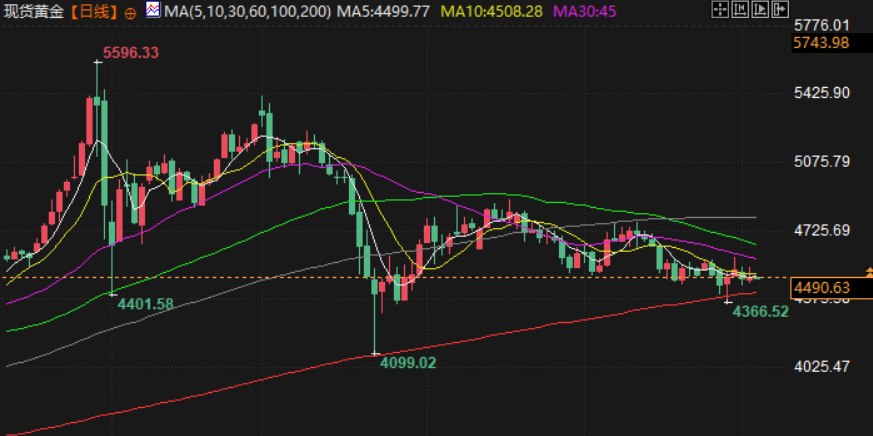
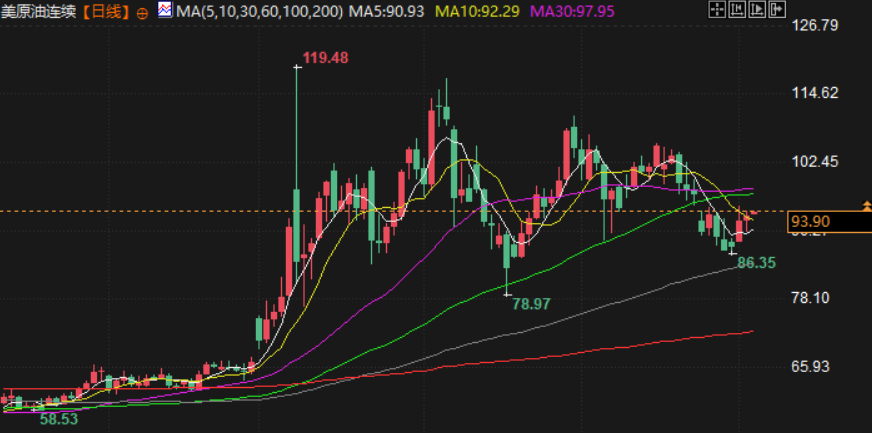
On Wednesday (June 3rd, Beijing time) in early Asian trading, spot gold was trading around $4490 per ounce. The market is closely watching the situation in the Middle East and US economic data. It is reported that Iran is reviewing the ceasefire agreement proposed by the United States, but has not communicated with Washington for several days. US President Trump said that negotiations are still ongoing. Meanwhile, the market is waiting for Friday's non-farm payroll report. Oil prices fluctuated upward on Tuesday, with US crude oil currently trading around $94 per barrel. It may test the $95 per barrel mark during the day.

U.S. stocks closed higher on Tuesday, with the Dow Jones Industrial Average up 0.45%, the S&P 500 up 0.13%, and the Nasdaq Composite up 0.03%. Both the Dow and the S&P 500 hit record highs.
Hewlett Packard Enterprise (HPE) shares surged about 26% after achieving its long-term financial goals two years ahead of schedule, Supermicro rose 6%, and the chipmakers index climbed 5%. Meanwhile, Alphabet’s stock fell nearly 2.5% as it planned to raise $80 billion through equity financing (including Berkshire Hathaway investment) to expand its artificial intelligence infrastructure. Overall market optimism regarding AI spending was boosted.
Nvidia CEO Jensen Huang stated that Marvell Technology will become the next trillion-dollar company, driving its stock price up by more than 26%, pushing its market capitalization above $240 billion; however, the software index fell back by 3.7% after surging 14% for three consecutive days, with ServiceNow, Salesforce, Intuit, and Microsoft all falling between 3.7% and 10%.
In addition, expectations of easing tensions between the US and Iran and the potential reopening of the Strait of Hormuz provided support for the market, but Cleveland Fed President Hammark warned that if inflationary pressures persist, interest rate hikes may be needed soon, and traders have largely ruled out the possibility of a rate cut in 2026.
Gold prices held steady on Tuesday, with spot gold closing at $4,487.74 per ounce, essentially unchanged. The market is closely watching the situation in the Middle East and US economic data. Analysts point out that the direction of gold prices depends on oil prices, Treasury yields, and the performance of the US dollar, all of which are related to the situation in the Middle East.
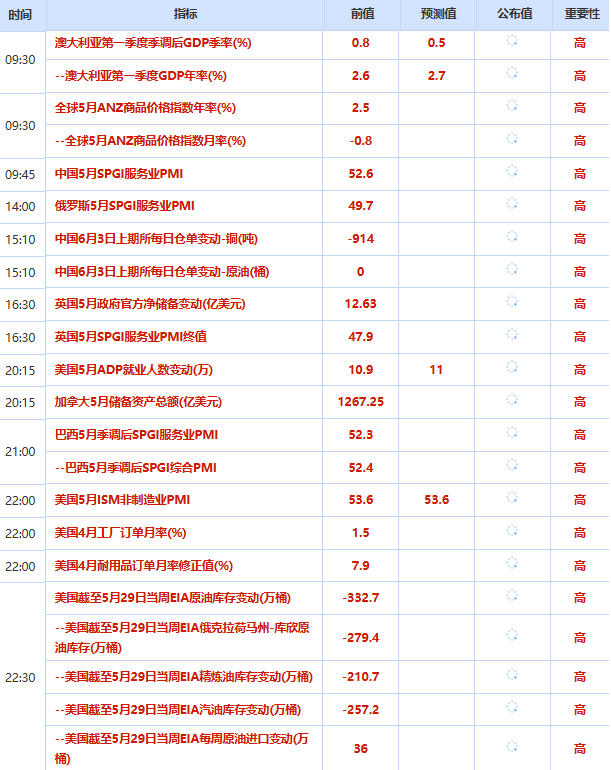
Iranian media reports indicate that Iran is reviewing a ceasefire agreement proposed by the United States, but has not communicated with Washington for several days, while US President Trump stated that negotiations are ongoing. This week will see the release of the ADP employment report and Friday's non-farm payrolls report; US job openings increased more than expected in April, but hiring declined.
Commerzbank lowered its year-end gold price forecast to $4,800 per ounce (from $5,000), while maintaining its year-end forecast of $5,200 per ounce. Spot silver rose 0.5% to $75.09, platinum rose 0.5% to $1,933.07, and palladium rose 0.6% to $1,370.16.
Oil prices fluctuated and rose on Tuesday, with Brent crude closing at $95.76 per barrel and WTI crude closing at $93.39 per barrel. The market is closely watching the situation in Iran, with Iranian media reporting that Tehran is reviewing a ceasefire agreement proposed by the United States, but has not communicated with Washington for several days, while US President Trump said that negotiations are still ongoing.
More than three months after the US and Israel launched attacks on Iran, the Strait of Hormuz remains largely blocked from maritime traffic, continuing to disrupt global oil and gas supplies. The International Energy Agency (IEA) warns that if the current rate of inventory decline continues, global oil inventories could fall to critically low levels before the summer demand peak.
U.S. Secretary of State Marco Rubio revealed that Iran has agreed to negotiate parts of its nuclear program, but did not guarantee an agreement; Iran, on the other hand, stated that information exchange regarding the agreement had been interrupted several days ago. The market is also awaiting the weekly inventory reports from the American Petroleum Institute (API) and the Energy Information Administration (EIA). API data showed that U.S. crude oil inventories decreased by 6.757 million barrels last week.
The dollar index fluctuated within a narrow range on Tuesday, rising slightly by 0.046% to 99.216. Traders were closely watching progress in Middle East peace talks, as an agreement between the US and Iran to reopen the Strait of Hormuz would ease currency pressures on oil-importing countries and reduce demand for the dollar as a safe haven.
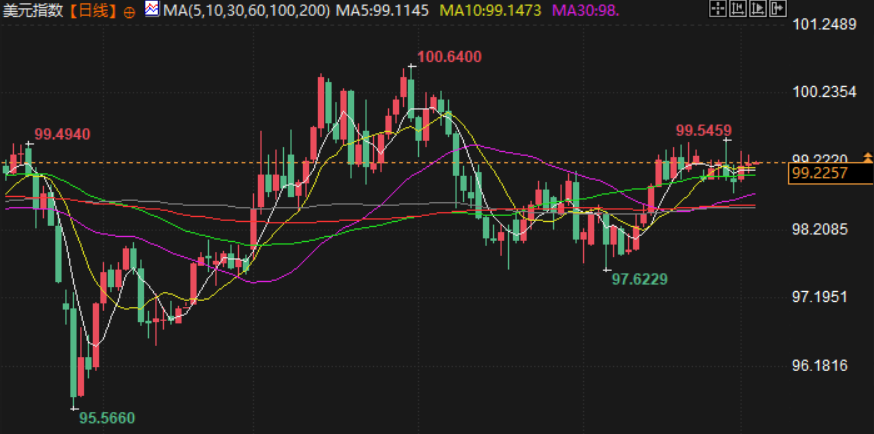
US data showed that job openings rose to 7.618 million in April, and the market is focused on Friday's non-farm payroll report; HSBC analysts pointed out that the loose financial environment and the reversal of risk aversion have curbed the dollar's rise.
US President Trump said negotiations with Iran are still ongoing, but markets remain cautious about the fragile ceasefire agreement.
The yen fell to 159.92 yen against the dollar, nearing the 160 mark. Japanese Finance Minister Satsuki Katayama said the country is prepared to intervene in the foreign exchange market if necessary. The market awaits a speech from Bank of Japan Governor Kazuo Ueda to determine whether interest rates will be raised next week.
The euro was largely unchanged at $1.1629, as eurozone inflation data reinforced expectations that the European Central Bank would raise interest rates by 25 basis points this month.
Trump on Iran: Negotiations between the two sides have been ongoing
Trump stated on social media that fake news reports claiming Iran and the United States had severed communication several days prior were untrue. He said dialogue between the two sides had been ongoing, with exchanges taking place four, three, two days ago, yesterday, and today. While the future of the negotiations remains uncertain, he stated that he had informed Iran that, regardless, it was time to reach an agreement. He added that the stalemate, which had lasted 47 years, could not continue.
Report: Trump urges Iran to make a firmer nuclear commitment
According to an ABC News report, US Secretary of State Marco Rubio stated at a Senate Foreign Relations Committee hearing that a US-Iran agreement could be finalized today, tomorrow, or next week. Multiple US officials and sources familiar with the matter revealed that President Trump demanded concrete written concessions from Iran on its nuclear program as part of a preliminary agreement to break the long-standing deadlock in negotiations between the two countries. Sources indicated that Iranian negotiators had previously only made verbal assurances, promising that the country would eventually reach an agreement on the terms of its nuclear program; however, Trump determined at a White House Situation Room meeting on Friday that such verbal promises were insufficiently binding.
The US military claims it attacked an Iranian-related oil tanker, rendering it unable to navigate.
On June 2, local time, the U.S. Central Command stated that the U.S. military took action in the Arabian Gulf against an oil tanker bound for an Iranian port, rendering it incapable of navigation. The U.S. Central Command stated that the Botswana-flagged oil tanker "Lexie" was en route to Kharg Island, Iran. The U.S. stated that the ship repeatedly ignored U.S. warnings and instructions within 24 hours and failed to comply with relevant blockade measures. Subsequently, a U.S. military aircraft fired a Hellfire missile at the ship's engine room, causing the tanker to lose power and be unable to continue its journey to Iran. The U.S. Central Command stated that since the implementation of the blockade measures targeting maritime traffic to and from Iranian ports on April 13, the U.S. military has disabled six commercial vessels and diverted 122 ships. The U.S.-Iran ceasefire is currently ongoing. (CCTV News)
US lawmakers say war with Iran would be a serious policy mistake.
On May 31, local time, U.S. Democratic Senator Jon Osoff stated in a speech at an event that the U.S. war against Iran is the most serious foreign policy blunder since the Iraq War. Osoff pointed out, "This is a war built on lies." The U.S. federal government repeatedly stated that the war was "close to ending" or had "made great progress," but now, more than three months into the war, "Iran's ballistic missiles and drones have not been destroyed, the Strait of Hormuz, which was open before the war, remains closed, and the Iranian regime and its highly enriched uranium stockpile remain intact." Osoff also criticized the government for continuously cutting social security funding while pouring large sums of money into the Pentagon to sustain the war. (CCTV International News)
European Central Bank: Gold becomes the world's largest official reserve asset.
The European Central Bank released a report on February 2nd stating that by the end of 2025, gold's share of global official reserve assets will have risen to 27%, surpassing US Treasury bonds to become the world's largest official reserve asset. The report noted that US Treasury bonds will account for 22% of global official reserve assets, other dollar-denominated reserve assets will account for 20%, and euro-denominated reserve assets will account for 15%. The report attributes the significant increase in gold's share primarily to valuation effects. Benefiting from the surge in international gold prices in 2024 and 2025, the value of gold assets has risen accordingly, thus securing a larger share in global official reserves. (Xinhua)
Hezbollah refuses to accept a "partial ceasefire" with Israel; both sides continue to attack each other.
Mahmoud Kumaty, a senior Hezbollah official, stated in a media interview on August 2nd that Hezbollah does not agree to any "partial ceasefire" agreement with Israel. Kumaty said that Hezbollah and its allies will not accept a proposal that "exchanges the Israeli military ceasing attacks on Beirut's southern suburbs for Hezbollah ceasing attacks on northern Israeli settlements." He emphasized that Hezbollah only accepts a comprehensive, complete, and genuine ceasefire, not merely a return to the situation before the outbreak of this round of conflict. "We will not agree to any partial ceasefire agreement," he said. (CCTV)
Rubio: The US and Iran are still negotiating, and it's uncertain when an agreement will be reached.
U.S. Secretary of State Marco Rubio stated at a hearing before the Senate Foreign Relations Committee on February 2nd that the United States is still negotiating with Iran, but he is unsure when an agreement can be reached. This is Rubio's first testimony before Congress since the U.S. and Israel launched a large-scale military operation against Iran at the end of February. Answering questions from senators regarding the progress of U.S.-Iran negotiations, he said, "We are negotiating with Iran," and that Iran "has agreed to negotiate some aspects of its nuclear program, whereas just a month ago, even a year ago, they wouldn't even talk." Rubio said an agreement with Iran "could be reached today, it could be reached tomorrow, it could be reached next week," but this "does not guarantee that an agreement will ultimately be reached and approved by Congress." (Xinhua)
Canada formally proposes to renew the USMCA agreement.
According to Canadian media reports on the 2nd, the Canadian government has proposed to the US and Mexican governments to renew the United States-Mexico-Canada Agreement (USMCA). The report states that Dominic LeBlanc, Canada's Minister for Canada-US Trade, recommended in a letter to US Trade Representative Jamison Greer and Mexican Economy Minister Marcelo Ebrard that the free trade agreement be renewed for 16 years to avoid triggering the statutory annual review process. (Xinhua)
Trump signs executive order to boost cutting-edge artificial intelligence innovation
The White House disclosed on Tuesday that US President Trump has signed an executive order related to artificial intelligence, aiming to promote innovation in advanced AI technology and improve AI security management. The text of the executive order released by the White House shows that it requires various US federal departments to develop cybersecurity standards for advanced AI models and to focus on strengthening the cybersecurity capabilities of the entire government system. The order specifies that the US Treasury Secretary should lead the establishment of a cybersecurity information coordination center for the AI field, linking the AI industry and critical infrastructure operators on a voluntary collaboration basis; this center will coordinate and streamline the software vulnerability investigation work of all parties, complete vulnerability discovery and verification, and prioritize vulnerability remediation, uniformly pushing out vulnerability patches. (Xinhua)
Israel may become the biggest obstacle to the implementation of the US-Iran agreement.
US President Donald Trump and Israeli Prime Minister Benjamin Netanyahu spoke by phone again on June 1st. Trump described the call as "productive," contributing to a truce between Israel and Hezbollah. However, Netanyahu maintained a tough tone in his social media post following the call. US media even reported that the call was "highly inflammatory," with reports of "Trump angrily rebuking Netanyahu." What are the reasons behind this divergence in statements from the US and Israel? Can the US effectively restrain Israel? How will this disagreement affect the prospects of US-Iran negotiations? #NewsQ&A# Li Zixin, Assistant Researcher at the China Institute of International Studies, analyzed that the seemingly different statements from the US and Israel actually reflect their respective strategic priorities regarding the current regional situation and the practical needs of their own political agendas. While the US does have the ability to restrain Israel's actions, this ability is limited and conditional, and it is unlikely to change Israel's strategic goals. It cannot be ruled out that Israel will not recognize or accept any future US-Iran agreement and will act entirely according to its own political agenda. (CCTV International News)
my country achieves a major breakthrough in optical communication technology; the world's first three-band ultra-low loss multi-core optical cable line is officially opened.
The world's first S+C+L three-band (short-wavelength + conventional communication band + long-wavelength) ultra-low-loss multi-core optical cable line was officially completed and put into operation in Qingdao, Shandong Province recently. This new type of optical cable line breaks through the transmission capacity limit of traditional optical fibers, marking a new stage in the commercialization of my country's space-division multiplexing optical fiber and multi-band fusion technology, and providing a brand-new technical solution for computing power interconnection and ultra-high bandwidth transmission in the intelligent era. The three bands refer to the S-band (short-wavelength) + C-band (conventional communication band) + L-band (long-wavelength) of communication optical signals, representing a core upgrade direction for AI computing power, all-optical networks, and 5G-A/6G. (CCTV)
Key Focus Today
stock market
U.S. stocks closed higher on Tuesday, with the Dow Jones Industrial Average up 0.45%, the S&P 500 up 0.13%, and the Nasdaq Composite up 0.03%. Both the Dow and the S&P 500 hit record highs.
Hewlett Packard Enterprise (HPE) shares surged about 26% after achieving its long-term financial goals two years ahead of schedule, Supermicro rose 6%, and the chipmakers index climbed 5%. Meanwhile, Alphabet’s stock fell nearly 2.5% as it planned to raise $80 billion through equity financing (including Berkshire Hathaway investment) to expand its artificial intelligence infrastructure. Overall market optimism regarding AI spending was boosted.
Nvidia CEO Jensen Huang stated that Marvell Technology will become the next trillion-dollar company, driving its stock price up by more than 26%, pushing its market capitalization above $240 billion; however, the software index fell back by 3.7% after surging 14% for three consecutive days, with ServiceNow, Salesforce, Intuit, and Microsoft all falling between 3.7% and 10%.
In addition, expectations of easing tensions between the US and Iran and the potential reopening of the Strait of Hormuz provided support for the market, but Cleveland Fed President Hammark warned that if inflationary pressures persist, interest rate hikes may be needed soon, and traders have largely ruled out the possibility of a rate cut in 2026.
Gold Market
Gold prices held steady on Tuesday, with spot gold closing at $4,487.74 per ounce, essentially unchanged. The market is closely watching the situation in the Middle East and US economic data. Analysts point out that the direction of gold prices depends on oil prices, Treasury yields, and the performance of the US dollar, all of which are related to the situation in the Middle East.
Iranian media reports indicate that Iran is reviewing a ceasefire agreement proposed by the United States, but has not communicated with Washington for several days, while US President Trump stated that negotiations are ongoing. This week will see the release of the ADP employment report and Friday's non-farm payrolls report; US job openings increased more than expected in April, but hiring declined.
Commerzbank lowered its year-end gold price forecast to $4,800 per ounce (from $5,000), while maintaining its year-end forecast of $5,200 per ounce. Spot silver rose 0.5% to $75.09, platinum rose 0.5% to $1,933.07, and palladium rose 0.6% to $1,370.16.
oil market
Oil prices fluctuated and rose on Tuesday, with Brent crude closing at $95.76 per barrel and WTI crude closing at $93.39 per barrel. The market is closely watching the situation in Iran, with Iranian media reporting that Tehran is reviewing a ceasefire agreement proposed by the United States, but has not communicated with Washington for several days, while US President Trump said that negotiations are still ongoing.
More than three months after the US and Israel launched attacks on Iran, the Strait of Hormuz remains largely blocked from maritime traffic, continuing to disrupt global oil and gas supplies. The International Energy Agency (IEA) warns that if the current rate of inventory decline continues, global oil inventories could fall to critically low levels before the summer demand peak.
U.S. Secretary of State Marco Rubio revealed that Iran has agreed to negotiate parts of its nuclear program, but did not guarantee an agreement; Iran, on the other hand, stated that information exchange regarding the agreement had been interrupted several days ago. The market is also awaiting the weekly inventory reports from the American Petroleum Institute (API) and the Energy Information Administration (EIA). API data showed that U.S. crude oil inventories decreased by 6.757 million barrels last week.
Foreign exchange market
The dollar index fluctuated within a narrow range on Tuesday, rising slightly by 0.046% to 99.216. Traders were closely watching progress in Middle East peace talks, as an agreement between the US and Iran to reopen the Strait of Hormuz would ease currency pressures on oil-importing countries and reduce demand for the dollar as a safe haven.
US data showed that job openings rose to 7.618 million in April, and the market is focused on Friday's non-farm payroll report; HSBC analysts pointed out that the loose financial environment and the reversal of risk aversion have curbed the dollar's rise.
US President Trump said negotiations with Iran are still ongoing, but markets remain cautious about the fragile ceasefire agreement.
The yen fell to 159.92 yen against the dollar, nearing the 160 mark. Japanese Finance Minister Satsuki Katayama said the country is prepared to intervene in the foreign exchange market if necessary. The market awaits a speech from Bank of Japan Governor Kazuo Ueda to determine whether interest rates will be raised next week.
The euro was largely unchanged at $1.1629, as eurozone inflation data reinforced expectations that the European Central Bank would raise interest rates by 25 basis points this month.
International News
Trump on Iran: Negotiations between the two sides have been ongoing
Trump stated on social media that fake news reports claiming Iran and the United States had severed communication several days prior were untrue. He said dialogue between the two sides had been ongoing, with exchanges taking place four, three, two days ago, yesterday, and today. While the future of the negotiations remains uncertain, he stated that he had informed Iran that, regardless, it was time to reach an agreement. He added that the stalemate, which had lasted 47 years, could not continue.
Report: Trump urges Iran to make a firmer nuclear commitment
According to an ABC News report, US Secretary of State Marco Rubio stated at a Senate Foreign Relations Committee hearing that a US-Iran agreement could be finalized today, tomorrow, or next week. Multiple US officials and sources familiar with the matter revealed that President Trump demanded concrete written concessions from Iran on its nuclear program as part of a preliminary agreement to break the long-standing deadlock in negotiations between the two countries. Sources indicated that Iranian negotiators had previously only made verbal assurances, promising that the country would eventually reach an agreement on the terms of its nuclear program; however, Trump determined at a White House Situation Room meeting on Friday that such verbal promises were insufficiently binding.
The US military claims it attacked an Iranian-related oil tanker, rendering it unable to navigate.
On June 2, local time, the U.S. Central Command stated that the U.S. military took action in the Arabian Gulf against an oil tanker bound for an Iranian port, rendering it incapable of navigation. The U.S. Central Command stated that the Botswana-flagged oil tanker "Lexie" was en route to Kharg Island, Iran. The U.S. stated that the ship repeatedly ignored U.S. warnings and instructions within 24 hours and failed to comply with relevant blockade measures. Subsequently, a U.S. military aircraft fired a Hellfire missile at the ship's engine room, causing the tanker to lose power and be unable to continue its journey to Iran. The U.S. Central Command stated that since the implementation of the blockade measures targeting maritime traffic to and from Iranian ports on April 13, the U.S. military has disabled six commercial vessels and diverted 122 ships. The U.S.-Iran ceasefire is currently ongoing. (CCTV News)
US lawmakers say war with Iran would be a serious policy mistake.
On May 31, local time, U.S. Democratic Senator Jon Osoff stated in a speech at an event that the U.S. war against Iran is the most serious foreign policy blunder since the Iraq War. Osoff pointed out, "This is a war built on lies." The U.S. federal government repeatedly stated that the war was "close to ending" or had "made great progress," but now, more than three months into the war, "Iran's ballistic missiles and drones have not been destroyed, the Strait of Hormuz, which was open before the war, remains closed, and the Iranian regime and its highly enriched uranium stockpile remain intact." Osoff also criticized the government for continuously cutting social security funding while pouring large sums of money into the Pentagon to sustain the war. (CCTV International News)
European Central Bank: Gold becomes the world's largest official reserve asset.
The European Central Bank released a report on February 2nd stating that by the end of 2025, gold's share of global official reserve assets will have risen to 27%, surpassing US Treasury bonds to become the world's largest official reserve asset. The report noted that US Treasury bonds will account for 22% of global official reserve assets, other dollar-denominated reserve assets will account for 20%, and euro-denominated reserve assets will account for 15%. The report attributes the significant increase in gold's share primarily to valuation effects. Benefiting from the surge in international gold prices in 2024 and 2025, the value of gold assets has risen accordingly, thus securing a larger share in global official reserves. (Xinhua)
Hezbollah refuses to accept a "partial ceasefire" with Israel; both sides continue to attack each other.
Mahmoud Kumaty, a senior Hezbollah official, stated in a media interview on August 2nd that Hezbollah does not agree to any "partial ceasefire" agreement with Israel. Kumaty said that Hezbollah and its allies will not accept a proposal that "exchanges the Israeli military ceasing attacks on Beirut's southern suburbs for Hezbollah ceasing attacks on northern Israeli settlements." He emphasized that Hezbollah only accepts a comprehensive, complete, and genuine ceasefire, not merely a return to the situation before the outbreak of this round of conflict. "We will not agree to any partial ceasefire agreement," he said. (CCTV)
Rubio: The US and Iran are still negotiating, and it's uncertain when an agreement will be reached.
U.S. Secretary of State Marco Rubio stated at a hearing before the Senate Foreign Relations Committee on February 2nd that the United States is still negotiating with Iran, but he is unsure when an agreement can be reached. This is Rubio's first testimony before Congress since the U.S. and Israel launched a large-scale military operation against Iran at the end of February. Answering questions from senators regarding the progress of U.S.-Iran negotiations, he said, "We are negotiating with Iran," and that Iran "has agreed to negotiate some aspects of its nuclear program, whereas just a month ago, even a year ago, they wouldn't even talk." Rubio said an agreement with Iran "could be reached today, it could be reached tomorrow, it could be reached next week," but this "does not guarantee that an agreement will ultimately be reached and approved by Congress." (Xinhua)
Canada formally proposes to renew the USMCA agreement.
According to Canadian media reports on the 2nd, the Canadian government has proposed to the US and Mexican governments to renew the United States-Mexico-Canada Agreement (USMCA). The report states that Dominic LeBlanc, Canada's Minister for Canada-US Trade, recommended in a letter to US Trade Representative Jamison Greer and Mexican Economy Minister Marcelo Ebrard that the free trade agreement be renewed for 16 years to avoid triggering the statutory annual review process. (Xinhua)
Trump signs executive order to boost cutting-edge artificial intelligence innovation
The White House disclosed on Tuesday that US President Trump has signed an executive order related to artificial intelligence, aiming to promote innovation in advanced AI technology and improve AI security management. The text of the executive order released by the White House shows that it requires various US federal departments to develop cybersecurity standards for advanced AI models and to focus on strengthening the cybersecurity capabilities of the entire government system. The order specifies that the US Treasury Secretary should lead the establishment of a cybersecurity information coordination center for the AI field, linking the AI industry and critical infrastructure operators on a voluntary collaboration basis; this center will coordinate and streamline the software vulnerability investigation work of all parties, complete vulnerability discovery and verification, and prioritize vulnerability remediation, uniformly pushing out vulnerability patches. (Xinhua)
Israel may become the biggest obstacle to the implementation of the US-Iran agreement.
US President Donald Trump and Israeli Prime Minister Benjamin Netanyahu spoke by phone again on June 1st. Trump described the call as "productive," contributing to a truce between Israel and Hezbollah. However, Netanyahu maintained a tough tone in his social media post following the call. US media even reported that the call was "highly inflammatory," with reports of "Trump angrily rebuking Netanyahu." What are the reasons behind this divergence in statements from the US and Israel? Can the US effectively restrain Israel? How will this disagreement affect the prospects of US-Iran negotiations? #NewsQ&A# Li Zixin, Assistant Researcher at the China Institute of International Studies, analyzed that the seemingly different statements from the US and Israel actually reflect their respective strategic priorities regarding the current regional situation and the practical needs of their own political agendas. While the US does have the ability to restrain Israel's actions, this ability is limited and conditional, and it is unlikely to change Israel's strategic goals. It cannot be ruled out that Israel will not recognize or accept any future US-Iran agreement and will act entirely according to its own political agenda. (CCTV International News)
Domestic News
my country achieves a major breakthrough in optical communication technology; the world's first three-band ultra-low loss multi-core optical cable line is officially opened.
The world's first S+C+L three-band (short-wavelength + conventional communication band + long-wavelength) ultra-low-loss multi-core optical cable line was officially completed and put into operation in Qingdao, Shandong Province recently. This new type of optical cable line breaks through the transmission capacity limit of traditional optical fibers, marking a new stage in the commercialization of my country's space-division multiplexing optical fiber and multi-band fusion technology, and providing a brand-new technical solution for computing power interconnection and ultra-high bandwidth transmission in the intelligent era. The three bands refer to the S-band (short-wavelength) + C-band (conventional communication band) + L-band (long-wavelength) of communication optical signals, representing a core upgrade direction for AI computing power, all-optical networks, and 5G-A/6G. (CCTV)
- Risk Warning and Disclaimer
- The market involves risk, and trading may not be suitable for all investors. This article is for reference only and does not constitute personal investment advice, nor does it take into account certain users’ specific investment objectives, financial situation, or other needs. Any investment decisions made based on this information are at your own risk.