The US is using "cracks" to support oil prices, which are expected to rise for the third consecutive day.
2026-06-03 08:52:13
US crude oil futures prices rose as much as 2% to $96 a barrel in Asian trading on Wednesday (June 3) before retreating and are currently trading around $94.50. This followed two consecutive days of gains. The reassessment of geopolitical risks is the core driver of oil price volatility.
Despite the US denies that negotiations have completely broken down, Iran's suspension of communication with the US through intermediaries, Israel's continued military operations in southern Lebanon, and signals of discrepancies in the content of the phone call between the US and Israeli leaders have all led the market to reassess the risks of supply chain disruptions in the Middle East.
For months, US President Trump has confidently stated that an agreement to end the conflict with Iran is within reach.
However, Israel's determination to pursue its strategic goals reveals that Trump's control over the outcome of this crisis is actually quite fragile.
The United States and Israel have drastically different ideas about how the war should end, a difference that is jeopardizing the already fragile long-term negotiations between Washington and Tehran.
Following days of military escalation by Israel against Hezbollah in Lebanon, a new diplomatic breakdown has ensued. Israel maintains that the continued attacks on Hezbollah are essential for securing its northern border and are a key means of weakening Iran's influence in Lebanon.
However, this stance directly conflicts with the United States' strategic goal of de-escalating tensions as quickly as possible and focusing its efforts on reaching a broader agreement with Iran.
A phone call between Trump and Israeli Prime Minister Netanyahu brought this disagreement to the public eye. According to sources, the call was tense, with Trump even using harsh language, accusing Netanyahu of being "ungrateful."
More importantly, the two sides disagreed on the consensus reached—Trump publicly stated after the call that Israeli troops would not advance on Beirut and hinted that a broad ceasefire had been reached between Israel and Hezbollah; while Netanyahu only confirmed the temporary ceasefire arrangement in northern Lebanon, while emphasizing that Israel would continue its military operations in the south of the country.
This incident once again highlights a fact that Trump has largely refused to acknowledge: a significant difference exists between the US and Israel's visions of the war's outcome. The US hopes to stabilize the entire Middle East through a comprehensive agreement with Iran; while Israel is more focused on eliminating the Hezbollah threat in the short term and is unwilling to fully embed its own security agenda within the US-Iran diplomatic framework. This misalignment of strategic goals is becoming the latest obstacle to Trump's push for an Iran deal.
Iran said Monday it had suspended intermediary-based negotiations after Netanyahu threatened further strikes on the Lebanese capital, Beirut (Trump denied on Tuesday that the negotiations had stopped), a move seen as a strong response from Tehran to Israel's military escalation.
Iran has publicly condemned Israel's deep incursion into Lebanon and issued several threats, including potentially increasing restrictions on passage through the Strait of Hormuz, closing the Bab el-Mandeb Strait, and even directly attacking Israeli territory.
These statements mean that two key shipping routes in the Middle East are at risk of being disrupted simultaneously, further highlighting the fragility of the global energy supply chain.
Meanwhile, the direct intervention of the U.S. military further complicated the situation. U.S. Central Command stated on Tuesday that it fired a Hellfire missile at an empty oil tanker heading towards Iran's Harqa Island, causing its engines to fail—a rare direct strike by the U.S. against Iranian maritime trade routes.
Furthermore, Kuwait stated that it intercepted drone and missile attacks early Wednesday morning local time, indicating that the conflict has begun to spread to neighboring Gulf states. Overall, tensions are escalating simultaneously on multiple fronts, from Lebanon to the Persian Gulf.
The United States and Israel launched a joint attack on Iran in late February, initiating the war. However, the current rift between the two countries may complicate Trump's efforts to end the war.
According to media reports, during that heated phone call this week, Trump not only used profanity but also accused Netanyahu of being ungrateful.
Former National Security Council senior director Michael Singh said: "Iran is trying to create a divide between the United States and Israel, and frankly, they have had some success."
US and Iranian negotiators are still working to resolve several key issues: freedom of navigation in the Strait of Hormuz, the future of Iran’s frozen overseas funds, and the scope of broader regional security arrangements.
The report states that Trump is pushing Iran to make specific nuclear concessions in the preliminary agreement. Iran, however, insists that any peace agreement must include Lebanon.
On June 2, local time, U.S. Central Command stated that the USS Abraham Lincoln aircraft carrier was sailing in the Arabian Sea and continuing to support the U.S. maritime blockade against Iran. U.S. Central Command stated that to ensure the implementation of the blockade measures, the U.S. military had diverted 122 commercial vessels. Currently, the U.S. military maintains a large-scale military deployment in the Middle East to support military and maritime operations against Iran.
On the same day, US President Trump denied that Iran had stopped communicating with the mediators, saying that dialogue between the US and Iran had been ongoing. Trump also urged Iran to reach an agreement as soon as possible.
Iranian sources on February 2nd stated that an informed source close to the Iranian negotiating team indicated that information exchanges between Iran and the United States regarding the memorandum of understanding had been suspended for several days. Although some Western media outlets and officials have attempted to portray the information exchanges between Iran and the US as progressing normally, this is not the case.
In summary, the rift between Trump and Netanyahu has become the latest key obstacle to a US-Iran agreement. The differing visions of the war's outcome between the US and Israel, coupled with Iran's stance of linking the Lebanese issue to negotiations, have made the diplomatic solution increasingly complex.
Despite Trump's expressed strong desire to reach an agreement, Israel's insistence on its own security agenda, the ongoing regional conflict, and the unresolved key issues in the negotiations all suggest that the prospect of a comprehensive peace agreement in the short term remains slim. The market is turning its attention to actual oil flows, and oil prices have received substantial support amid geopolitical risks.
US crude oil futures are currently trading around $94.50 per barrel, with prices below the 20-day and 50-day moving averages (MA20 and MA50), which are acting as resistance. However, prices are firmly above the 100-day and 200-day moving averages (MA100 and MA200), indicating that the major uptrend has not reversed. The price has gradually retreated from the year's high of $119.48 and the second-highest point of $117.63, showing signs of weakening at higher levels. The $96-$97 range represents resistance from moving averages, while the previous lows of $86.35 and $78.97 form key support levels.
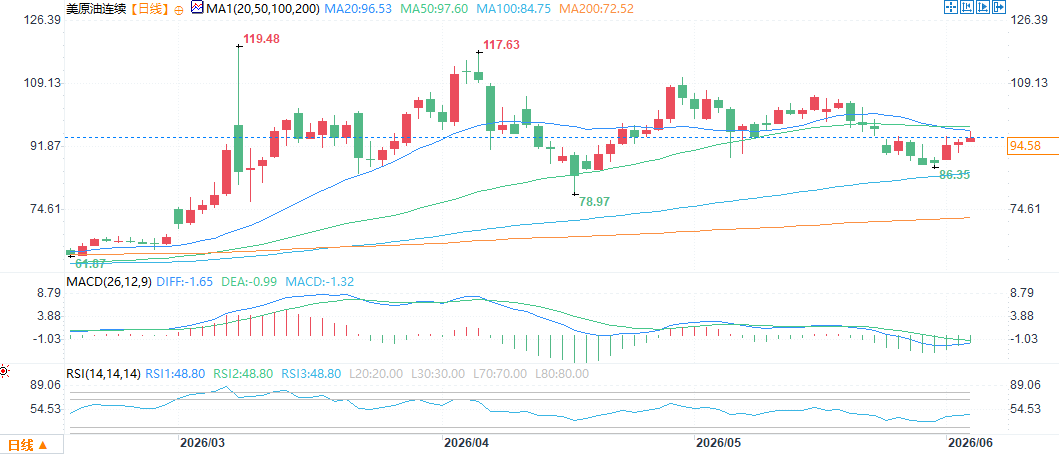
(US crude oil futures daily chart, source: FX678)
In terms of indicators, the RSI value is 48.80, which is below the 50 midline, indicating short-term weakness but not yet entering the oversold zone; the MACD indicator's DIFF and DEA are both running below the zero axis, with the green bars narrowing slightly, indicating that the bearish momentum is weakening and there is a short-term need for a bottoming out and recovery.
With supply and demand factors intertwined, crude oil has entered a period of consolidation at high levels. The short-term rebound is facing resistance near the moving average around 96.5. If the rebound falters, it is likely to retrace to the support level of 86.35. As long as the key support level of 86 holds, the medium-term upward structure remains intact, and the room for a deep correction is limited.
At 8:51 a.m. Beijing time on June 3, US crude oil futures were trading at $94.54 per barrel.
Despite the US denies that negotiations have completely broken down, Iran's suspension of communication with the US through intermediaries, Israel's continued military operations in southern Lebanon, and signals of discrepancies in the content of the phone call between the US and Israeli leaders have all led the market to reassess the risks of supply chain disruptions in the Middle East.
For months, US President Trump has confidently stated that an agreement to end the conflict with Iran is within reach.
However, Israel's determination to pursue its strategic goals reveals that Trump's control over the outcome of this crisis is actually quite fragile.
The United States and Israel have drastically different ideas about how the war should end, a difference that is jeopardizing the already fragile long-term negotiations between Washington and Tehran.
Diplomatic breakdown and public divisions between the US and Israel
Following days of military escalation by Israel against Hezbollah in Lebanon, a new diplomatic breakdown has ensued. Israel maintains that the continued attacks on Hezbollah are essential for securing its northern border and are a key means of weakening Iran's influence in Lebanon.
However, this stance directly conflicts with the United States' strategic goal of de-escalating tensions as quickly as possible and focusing its efforts on reaching a broader agreement with Iran.
A phone call between Trump and Israeli Prime Minister Netanyahu brought this disagreement to the public eye. According to sources, the call was tense, with Trump even using harsh language, accusing Netanyahu of being "ungrateful."
More importantly, the two sides disagreed on the consensus reached—Trump publicly stated after the call that Israeli troops would not advance on Beirut and hinted that a broad ceasefire had been reached between Israel and Hezbollah; while Netanyahu only confirmed the temporary ceasefire arrangement in northern Lebanon, while emphasizing that Israel would continue its military operations in the south of the country.
This incident once again highlights a fact that Trump has largely refused to acknowledge: a significant difference exists between the US and Israel's visions of the war's outcome. The US hopes to stabilize the entire Middle East through a comprehensive agreement with Iran; while Israel is more focused on eliminating the Hezbollah threat in the short term and is unwilling to fully embed its own security agenda within the US-Iran diplomatic framework. This misalignment of strategic goals is becoming the latest obstacle to Trump's push for an Iran deal.
Iran suspends negotiations as regional conflict continues.
Iran said Monday it had suspended intermediary-based negotiations after Netanyahu threatened further strikes on the Lebanese capital, Beirut (Trump denied on Tuesday that the negotiations had stopped), a move seen as a strong response from Tehran to Israel's military escalation.
Iran has publicly condemned Israel's deep incursion into Lebanon and issued several threats, including potentially increasing restrictions on passage through the Strait of Hormuz, closing the Bab el-Mandeb Strait, and even directly attacking Israeli territory.
These statements mean that two key shipping routes in the Middle East are at risk of being disrupted simultaneously, further highlighting the fragility of the global energy supply chain.
Meanwhile, the direct intervention of the U.S. military further complicated the situation. U.S. Central Command stated on Tuesday that it fired a Hellfire missile at an empty oil tanker heading towards Iran's Harqa Island, causing its engines to fail—a rare direct strike by the U.S. against Iranian maritime trade routes.
Furthermore, Kuwait stated that it intercepted drone and missile attacks early Wednesday morning local time, indicating that the conflict has begun to spread to neighboring Gulf states. Overall, tensions are escalating simultaneously on multiple fronts, from Lebanon to the Persian Gulf.
US-Israel relations: From fighting side by side to showing cracks
The United States and Israel launched a joint attack on Iran in late February, initiating the war. However, the current rift between the two countries may complicate Trump's efforts to end the war.
According to media reports, during that heated phone call this week, Trump not only used profanity but also accused Netanyahu of being ungrateful.
Former National Security Council senior director Michael Singh said: "Iran is trying to create a divide between the United States and Israel, and frankly, they have had some success."
Negotiation deadlock: Multiple key issues remain unresolved
US and Iranian negotiators are still working to resolve several key issues: freedom of navigation in the Strait of Hormuz, the future of Iran’s frozen overseas funds, and the scope of broader regional security arrangements.
The report states that Trump is pushing Iran to make specific nuclear concessions in the preliminary agreement. Iran, however, insists that any peace agreement must include Lebanon.
The conflict continues
On June 2, local time, U.S. Central Command stated that the USS Abraham Lincoln aircraft carrier was sailing in the Arabian Sea and continuing to support the U.S. maritime blockade against Iran. U.S. Central Command stated that to ensure the implementation of the blockade measures, the U.S. military had diverted 122 commercial vessels. Currently, the U.S. military maintains a large-scale military deployment in the Middle East to support military and maritime operations against Iran.
On the same day, US President Trump denied that Iran had stopped communicating with the mediators, saying that dialogue between the US and Iran had been ongoing. Trump also urged Iran to reach an agreement as soon as possible.
Iranian sources on February 2nd stated that an informed source close to the Iranian negotiating team indicated that information exchanges between Iran and the United States regarding the memorandum of understanding had been suspended for several days. Although some Western media outlets and officials have attempted to portray the information exchanges between Iran and the US as progressing normally, this is not the case.
In summary, the rift between Trump and Netanyahu has become the latest key obstacle to a US-Iran agreement. The differing visions of the war's outcome between the US and Israel, coupled with Iran's stance of linking the Lebanese issue to negotiations, have made the diplomatic solution increasingly complex.
Despite Trump's expressed strong desire to reach an agreement, Israel's insistence on its own security agenda, the ongoing regional conflict, and the unresolved key issues in the negotiations all suggest that the prospect of a comprehensive peace agreement in the short term remains slim. The market is turning its attention to actual oil flows, and oil prices have received substantial support amid geopolitical risks.
US crude oil daily technical analysis
US crude oil futures are currently trading around $94.50 per barrel, with prices below the 20-day and 50-day moving averages (MA20 and MA50), which are acting as resistance. However, prices are firmly above the 100-day and 200-day moving averages (MA100 and MA200), indicating that the major uptrend has not reversed. The price has gradually retreated from the year's high of $119.48 and the second-highest point of $117.63, showing signs of weakening at higher levels. The $96-$97 range represents resistance from moving averages, while the previous lows of $86.35 and $78.97 form key support levels.
(US crude oil futures daily chart, source: FX678)
In terms of indicators, the RSI value is 48.80, which is below the 50 midline, indicating short-term weakness but not yet entering the oversold zone; the MACD indicator's DIFF and DEA are both running below the zero axis, with the green bars narrowing slightly, indicating that the bearish momentum is weakening and there is a short-term need for a bottoming out and recovery.
With supply and demand factors intertwined, crude oil has entered a period of consolidation at high levels. The short-term rebound is facing resistance near the moving average around 96.5. If the rebound falters, it is likely to retrace to the support level of 86.35. As long as the key support level of 86 holds, the medium-term upward structure remains intact, and the room for a deep correction is limited.
At 8:51 a.m. Beijing time on June 3, US crude oil futures were trading at $94.54 per barrel.
- Risk Warning and Disclaimer
- The market involves risk, and trading may not be suitable for all investors. This article is for reference only and does not constitute personal investment advice, nor does it take into account certain users’ specific investment objectives, financial situation, or other needs. Any investment decisions made based on this information are at your own risk.