Gold Trading Alert: Iranian Missile Attack on US Military Base in Kuwait! Gold Prices Plunge Nearly $30, 200-Day Moving Average in Danger Again?
2026-06-03 07:51:44
Tensions in the Middle East have escalated again, with news of Iran's precision missile strikes on a US military base in Kuwait spreading rapidly across global markets. This retaliatory action not only dramatically increased geopolitical risks but also directly pressured international gold prices, causing them to fall. On Wednesday (June 3rd) in early Asian trading, spot gold fell nearly 0.5% (almost $30), reaching a low of around $4462.24 per ounce by 7:30 AM.
Meanwhile, the latest US Job Openings and Labor Force Mobility Survey (JOLTS) data showed mixed signals in the job market, with a strong increase in job openings providing support for the US dollar and further exacerbating the volatile price action for gold. Amidst the interplay of conflict uncertainty and macroeconomic data, market sentiment fluctuated wildly, while oil prices surged, with US crude oil prices hitting a one-and-a-half-week high of $96.05 per barrel. This fueled inflation expectations, significantly suppressing gold as a non-interest-bearing asset.

The latest Job Openings and Labor Turnover Survey (JOLTS) report released by the U.S. Department of Labor shows that the number of job openings rose significantly in April, reaching 7.618 million, an increase of 731,000 from the previous month, marking the largest increase in nearly five years and the highest level in nearly two years. This data exceeded market expectations and could have been positive for economic performance, but a deeper analysis reveals potential signs of weakness in the labor market.
The report shows that hiring decreased by 419,000 in April, falling to 5.116 million, with almost all major industries experiencing a decline in hiring. While the professional and business services sector saw a significant increase of 668,000 job vacancies, some economists believe this may be an anomaly resulting from data revisions and does not necessarily reflect strong genuine demand. The number of resignations fell to 2.977 million, the lowest level since August 2020, reflecting a lack of confidence in the job market and a reluctance among workers to easily change jobs.
Despite a decrease in layoffs, the overall sluggish hiring situation indicates that businesses' willingness to expand is significantly restrained amid the economic uncertainty stemming from the Iranian conflict. Matthew Martin, senior economist at Oxford Economics, points out that if there are no clear signs of a resolution to the Iranian conflict, higher oil prices will continue to squeeze household real income, weaken aggregate demand, and businesses' willingness to hire may decline further.
According to the Islamic Republic of Iran Broadcasting (IRIB), an explosion occurred off the southern coast of Qeshm Island in Iran early Wednesday morning. Following this, the Iranian Revolutionary Guard announced a "precision-intensive missile strike" against US military bases in Kuwait, targeting Ali Al Salim Air Base and Camp Arifjan. The Kuwaiti military confirmed that its air defense system activated interception operations, and sirens were also sounded over Bahrain.
This attack is seen as a direct response to the earlier U.S. attacks on Iranian oil tankers in the Persian Gulf. U.S. Central Command had previously confirmed that U.S. aircraft fired Hellfire missiles at an empty oil tanker attempting to reach an Iranian port, rendering it incapable of navigation. Since mid-April, the U.S. military has imposed a blockade on maritime traffic to and from Iranian ports, affecting numerous merchant ships.
Following news of the attack, international oil prices surged by over 2%, with US crude briefly touching $96.05 per barrel, while gold prices fell rapidly by nearly $30, hitting a low of $4462.24 per ounce. Support is seen at the 200-day moving average, currently around $4417 per ounce. Market concerns about potential disruptions to Middle Eastern energy supplies have intensified significantly, especially given the continued blockage of the Strait of Hormuz, which poses a persistent threat to global oil transportation.
Amidst heightened military tensions, significant disagreements have also emerged in diplomatic negotiations. Iranian media reports indicate that Iran is reviewing a ceasefire agreement proposed by the United States, but has not communicated with Washington for several days and has adopted a relatively hardline stance. However, US President Trump has explicitly denied this claim, emphasizing that dialogue between the two sides has been ongoing, including communication in recent days.
Trump stated that an agreement to extend the ceasefire and reopen the Strait of Hormuz is expected within the next week. US Secretary of State Rubio also noted that Iran has agreed to negotiations on parts of its nuclear program, but emphasized that this does not guarantee a final agreement. Iran, on the other hand, hopes to alleviate economic pressure through a limited interim agreement while maintaining its bottom line on the nuclear issue and demanding a complete cessation of hostilities on all fronts, including Lebanon.
Furthermore, Israel's continued airstrikes on southern Lebanon have further complicated the regional situation. Energy consulting firms believe that amid conflicting statements from various parties, the oil market will continue to experience significant volatility, and the prospect of a large-scale reopening of the Strait of Hormuz remains uncertain.
International oil prices rose about 1% on Tuesday, influenced by Iranian attacks and continued disruptions in the Strait of Hormuz. Both Brent and U.S. crude oil hit their highest closing levels since May 26. The International Energy Agency warned that if the rate of decline in inventories continues at its current level, global oil inventories could fall to critically low levels before the summer demand peak.
In summary, the gold market is currently embroiled in a fierce struggle between geopolitical risk aversion and expectations of macroeconomic tightening. While Commerzbank lowered its year-end gold price forecast to $4,800, it maintained its long-term target of $5,200 by the end of 2027, emphasizing that the structural factors supporting gold prices—including long-term uncertainty, geopolitical risk premiums, and global central bank gold purchases—remain intact.
Analyst Fawad Razaqzada points out that gold's price movements are highly dependent on the correlation between oil prices, government bond yields, and the US dollar, all of which are closely related to the situation in the Middle East. Currently, the market direction is unclear, and participants are generally awaiting clear signals from the Middle East, as well as further guidance from this week's ADP employment report and non-farm payroll data.
Overall, gold is expected to maintain a high-level consolidation pattern in the short term. Further escalation of the Middle East conflict or a substantial breakthrough in negotiations could trigger significant price fluctuations. Given the continued strength of US economic data and persistent inflationary pressures, gold's ability to regain its upward momentum will require a key catalyst that allows safe-haven demand to completely outweigh expectations of macroeconomic tightening. Investors should remain cautious at this juncture, closely monitoring the latest developments in the geopolitical situation and changes in the Federal Reserve's policy signals.
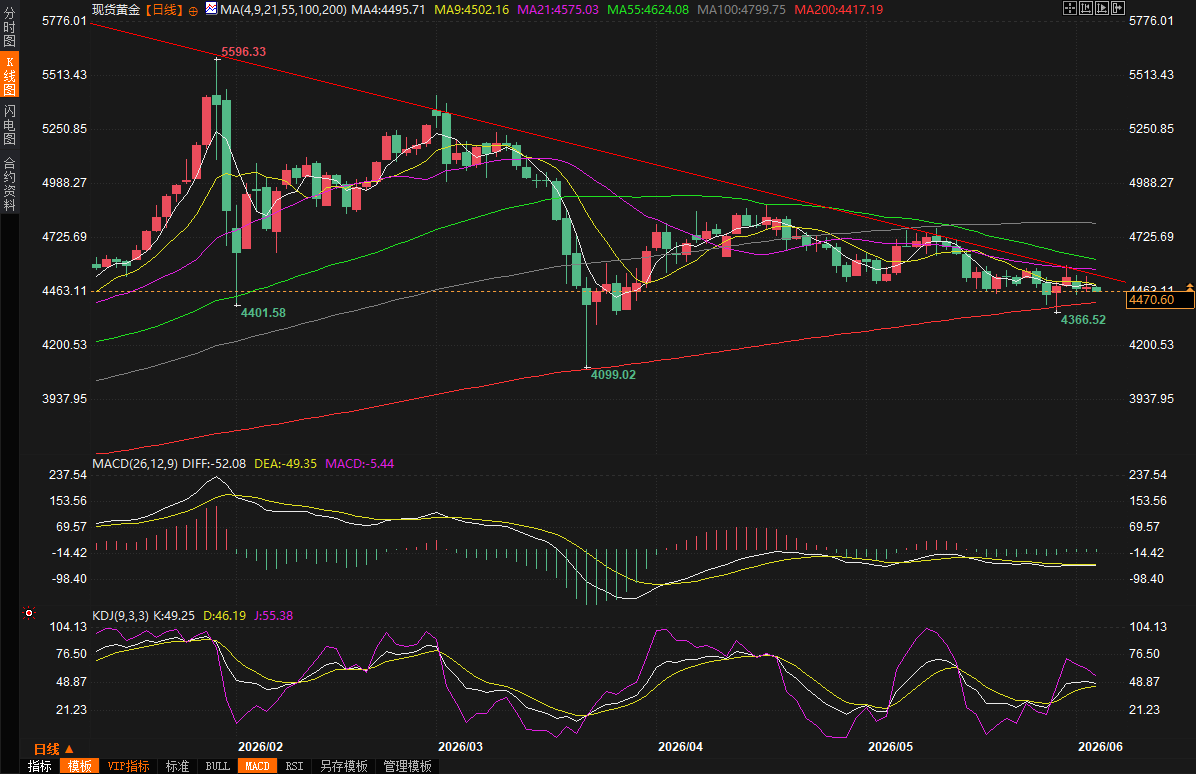
(Spot gold daily chart, source: FX678)
At 07:47 Beijing time, spot gold was trading at $4472.36 per ounce.
Meanwhile, the latest US Job Openings and Labor Force Mobility Survey (JOLTS) data showed mixed signals in the job market, with a strong increase in job openings providing support for the US dollar and further exacerbating the volatile price action for gold. Amidst the interplay of conflict uncertainty and macroeconomic data, market sentiment fluctuated wildly, while oil prices surged, with US crude oil prices hitting a one-and-a-half-week high of $96.05 per barrel. This fueled inflation expectations, significantly suppressing gold as a non-interest-bearing asset.
U.S. job openings increased sharply in April, revealing a complex situation in the job market.
The latest Job Openings and Labor Turnover Survey (JOLTS) report released by the U.S. Department of Labor shows that the number of job openings rose significantly in April, reaching 7.618 million, an increase of 731,000 from the previous month, marking the largest increase in nearly five years and the highest level in nearly two years. This data exceeded market expectations and could have been positive for economic performance, but a deeper analysis reveals potential signs of weakness in the labor market.
The report shows that hiring decreased by 419,000 in April, falling to 5.116 million, with almost all major industries experiencing a decline in hiring. While the professional and business services sector saw a significant increase of 668,000 job vacancies, some economists believe this may be an anomaly resulting from data revisions and does not necessarily reflect strong genuine demand. The number of resignations fell to 2.977 million, the lowest level since August 2020, reflecting a lack of confidence in the job market and a reluctance among workers to easily change jobs.
Despite a decrease in layoffs, the overall sluggish hiring situation indicates that businesses' willingness to expand is significantly restrained amid the economic uncertainty stemming from the Iranian conflict. Matthew Martin, senior economist at Oxford Economics, points out that if there are no clear signs of a resolution to the Iranian conflict, higher oil prices will continue to squeeze household real income, weaken aggregate demand, and businesses' willingness to hire may decline further.
Iran's retaliatory strikes against US military bases sharply escalate the risk of conflict in the Middle East.
According to the Islamic Republic of Iran Broadcasting (IRIB), an explosion occurred off the southern coast of Qeshm Island in Iran early Wednesday morning. Following this, the Iranian Revolutionary Guard announced a "precision-intensive missile strike" against US military bases in Kuwait, targeting Ali Al Salim Air Base and Camp Arifjan. The Kuwaiti military confirmed that its air defense system activated interception operations, and sirens were also sounded over Bahrain.
This attack is seen as a direct response to the earlier U.S. attacks on Iranian oil tankers in the Persian Gulf. U.S. Central Command had previously confirmed that U.S. aircraft fired Hellfire missiles at an empty oil tanker attempting to reach an Iranian port, rendering it incapable of navigation. Since mid-April, the U.S. military has imposed a blockade on maritime traffic to and from Iranian ports, affecting numerous merchant ships.
Following news of the attack, international oil prices surged by over 2%, with US crude briefly touching $96.05 per barrel, while gold prices fell rapidly by nearly $30, hitting a low of $4462.24 per ounce. Support is seen at the 200-day moving average, currently around $4417 per ounce. Market concerns about potential disruptions to Middle Eastern energy supplies have intensified significantly, especially given the continued blockage of the Strait of Hormuz, which poses a persistent threat to global oil transportation.
The US and Iran have differing stances in their negotiations, and the prospects for a ceasefire remain uncertain.
Amidst heightened military tensions, significant disagreements have also emerged in diplomatic negotiations. Iranian media reports indicate that Iran is reviewing a ceasefire agreement proposed by the United States, but has not communicated with Washington for several days and has adopted a relatively hardline stance. However, US President Trump has explicitly denied this claim, emphasizing that dialogue between the two sides has been ongoing, including communication in recent days.
Trump stated that an agreement to extend the ceasefire and reopen the Strait of Hormuz is expected within the next week. US Secretary of State Rubio also noted that Iran has agreed to negotiations on parts of its nuclear program, but emphasized that this does not guarantee a final agreement. Iran, on the other hand, hopes to alleviate economic pressure through a limited interim agreement while maintaining its bottom line on the nuclear issue and demanding a complete cessation of hostilities on all fronts, including Lebanon.
Furthermore, Israel's continued airstrikes on southern Lebanon have further complicated the regional situation. Energy consulting firms believe that amid conflicting statements from various parties, the oil market will continue to experience significant volatility, and the prospect of a large-scale reopening of the Strait of Hormuz remains uncertain.
With oil prices continuing to rise, global energy supplies are facing challenges.
International oil prices rose about 1% on Tuesday, influenced by Iranian attacks and continued disruptions in the Strait of Hormuz. Both Brent and U.S. crude oil hit their highest closing levels since May 26. The International Energy Agency warned that if the rate of decline in inventories continues at its current level, global oil inventories could fall to critically low levels before the summer demand peak.
Market Outlook: Structural support remains, but a clear signal is still needed in the short term.
In summary, the gold market is currently embroiled in a fierce struggle between geopolitical risk aversion and expectations of macroeconomic tightening. While Commerzbank lowered its year-end gold price forecast to $4,800, it maintained its long-term target of $5,200 by the end of 2027, emphasizing that the structural factors supporting gold prices—including long-term uncertainty, geopolitical risk premiums, and global central bank gold purchases—remain intact.
Analyst Fawad Razaqzada points out that gold's price movements are highly dependent on the correlation between oil prices, government bond yields, and the US dollar, all of which are closely related to the situation in the Middle East. Currently, the market direction is unclear, and participants are generally awaiting clear signals from the Middle East, as well as further guidance from this week's ADP employment report and non-farm payroll data.
Overall, gold is expected to maintain a high-level consolidation pattern in the short term. Further escalation of the Middle East conflict or a substantial breakthrough in negotiations could trigger significant price fluctuations. Given the continued strength of US economic data and persistent inflationary pressures, gold's ability to regain its upward momentum will require a key catalyst that allows safe-haven demand to completely outweigh expectations of macroeconomic tightening. Investors should remain cautious at this juncture, closely monitoring the latest developments in the geopolitical situation and changes in the Federal Reserve's policy signals.
(Spot gold daily chart, source: FX678)
At 07:47 Beijing time, spot gold was trading at $4472.36 per ounce.
- Risk Warning and Disclaimer
- The market involves risk, and trading may not be suitable for all investors. This article is for reference only and does not constitute personal investment advice, nor does it take into account certain users’ specific investment objectives, financial situation, or other needs. Any investment decisions made based on this information are at your own risk.