June 4th Financial Breakfast: Naval blockade against Iran may continue until September; gold prices remain below $4500; Lebanon and Israel agree to a ceasefire; US oil prices retest the $95 level.
2026-06-04 07:28:58
On Thursday (June 4th, Beijing time) in early Asian trading, spot gold was trading around $4448 per ounce. Although gold prices briefly approached the $4500 per ounce mark on Wednesday, concerns about inflation triggered by escalating tensions in the Middle East led the market to bet that interest rates would remain high, putting pressure on gold prices below the $4500 per ounce level. US crude oil was trading around $95.44 per barrel. The agreement between Lebanon and Israel to implement a ceasefire and establish a pilot zone limited the rise in oil prices. Oil prices rose for the third consecutive trading day on Wednesday as tensions in the Middle East escalated, with Trump stating that the naval blockade against Iran might continue until September.

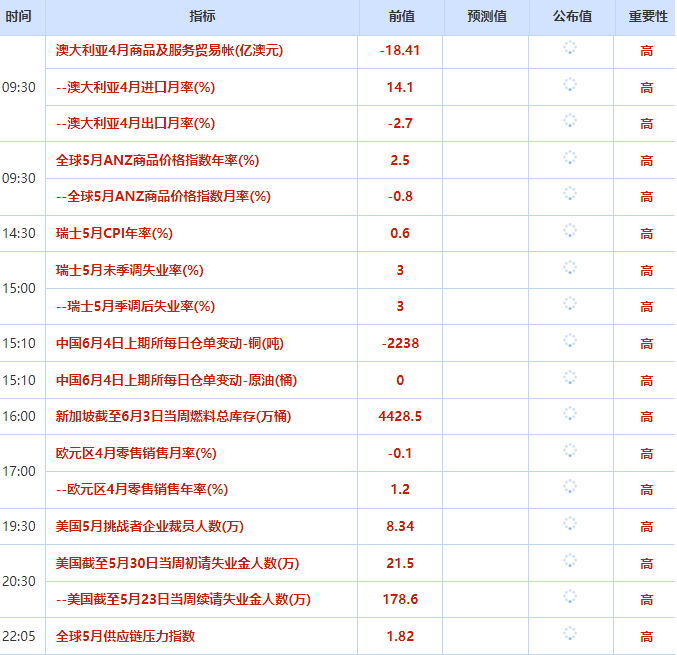
U.S. stocks retreated from record highs on Wednesday, with all three major indexes closing lower. The Dow Jones Industrial Average fell 1.21%, the S&P 500 dropped 0.74%, and the Nasdaq Composite declined 0.89%. Escalating tensions in the Middle East and rising oil prices fueled inflation concerns, prompting investors to take profits.
The financial and technology sectors dragged down the broader market, but chip stocks bucked the trend, rising 1.4%, indicating the continued hype surrounding artificial intelligence. Asset management stocks generally declined as Swiss firm Partners Group restricted redemptions from its private equity funds.
Economic data shows that U.S. service sector activity increased in May, the labor market remained stable, but input costs remained high.
New York Fed President Williams reiterated that monetary policy is in the right place and there is no need to adjust interest rates. The Fed's Beige Book noted stronger economic activity, but rising energy prices had a broad impact. Additionally, Broadcom's stock fell in after-hours trading following its earnings report, and SpaceX plans a record IPO at $135 per share.
Gold prices edged lower on Wednesday, with spot gold falling 1% to $4,434.25 an ounce, as escalating tensions in the Middle East fueled inflation concerns and led markets to bet that interest rates would remain high.
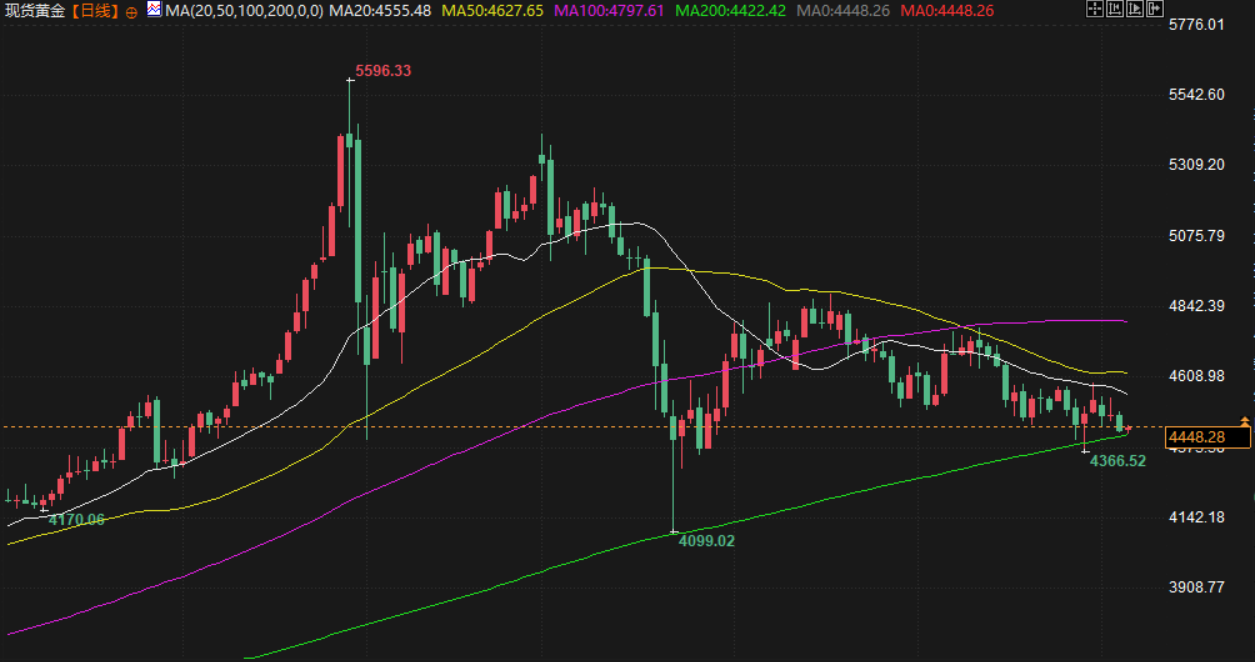
Escalating tensions between the US and Iran, including Iranian attacks on Kuwait and US airstrikes near the Strait of Hormuz, have pushed up energy prices and inflation expectations, potentially leading to higher interest rates and a stronger dollar, all of which put downward pressure on gold. Although gold is often considered a safe-haven asset, its appeal diminishes in a high-interest-rate environment.
New York Fed President Williams stated that he expects the upward risk to inflation triggered by the conflict to be short-lived and that there is no need to adjust monetary policy at present. The market is also focused on Friday's release of the US May non-farm payroll data, following a previous ADP report showing stronger-than-expected private sector job growth in May.
Oil prices rose more than 3% on Wednesday, with U.S. crude hitting a one-week high of $97 a barrel before settling at $96.20 a barrel, influenced by renewed tensions in the Middle East and little progress in U.S.-Iran negotiations.
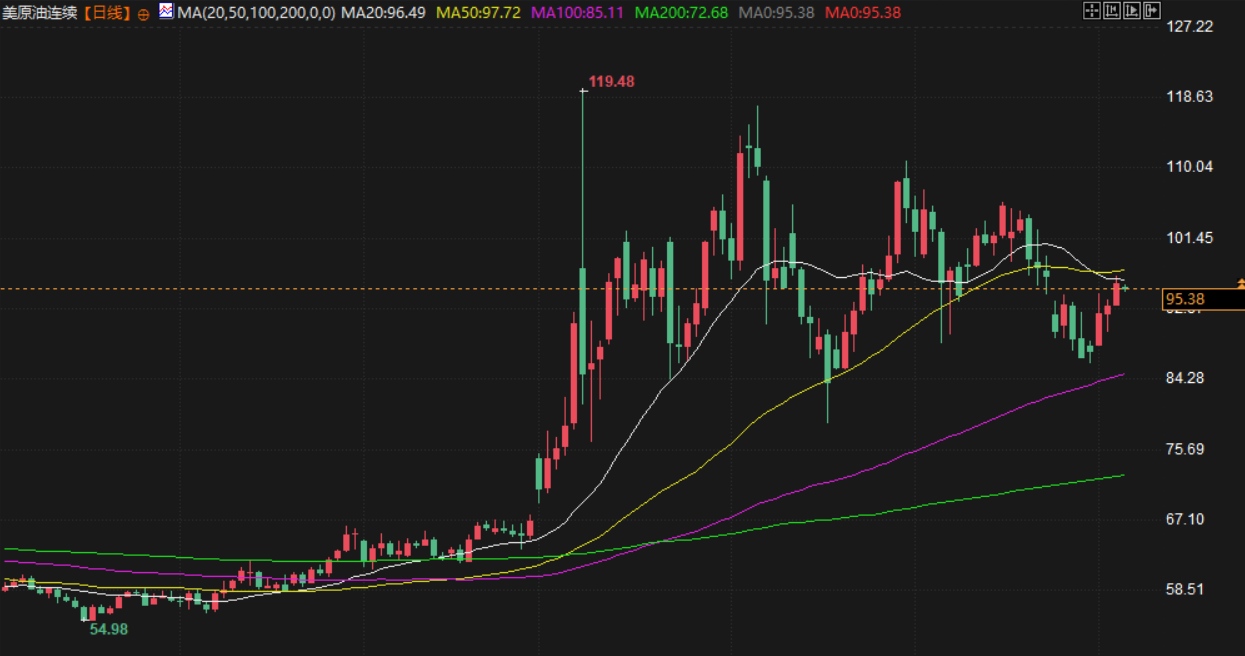
Iran launched ballistic missiles at neighboring Kuwait and Bahrain, and the US launched airstrikes on Iran's Qeshm Island, dimming the prospects for a ceasefire.
Iran's foreign minister stated that contact with Washington has not been interrupted, but negotiations have not made progress. The International Energy Agency warned that if inventory depletion continues at the current rate, global crude oil inventories could fall to a critical point before the summer demand peak.
In addition, data from the U.S. Energy Information Administration showed that U.S. crude oil inventories fell by 8 million barrels in the week ending May 29, far exceeding the expected drop of 4 million barrels.
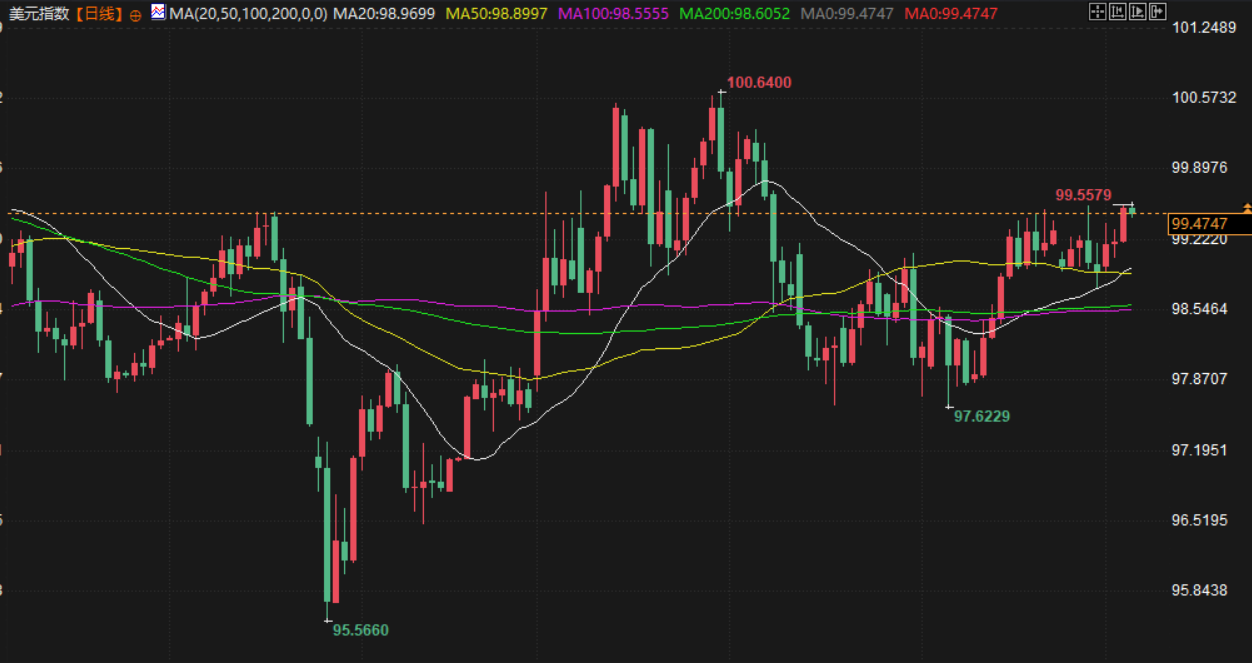
The dollar index rose 0.23% on Wednesday to close at 99.53, as renewed tensions in the Gulf region boosted demand for the dollar. The US stated that Iran launched ballistic missiles at neighboring countries but missed their targets, and the US military subsequently struck Qeshm Island. Diplomatic negotiations between the US and Iran remain deadlocked. Safe-haven demand and the US's relatively low sensitivity to energy price shocks jointly pushed up the dollar.
Driven by the inherent strength of the US dollar, the yen weakened to the key 160 level on Wednesday, prompting verbal warnings from Japanese authorities and alerting traders to possible intervention. Meanwhile, Japan's reliance on energy imports weakened the yen as oil prices rose. The yen fell to 160 yen to the dollar, erasing gains following last month's record intervention by Japan. The chief market strategist at Bannockburn Global Forex noted that increased intervention risk failed to prevent the exchange rate from falling. Japanese Prime Minister Sanae Takaichi stated that Japan was prepared to respond to exchange rate fluctuations as needed, while Bank of Japan Governor Kazuo Ueda made hawkish comments, suggesting that the pros and cons of raising interest rates should be discussed if inflation risks outweighed economic downside risks. The dollar closed at 160.06 yen on Wednesday.
The market is focused on the US labor market: April job openings saw the largest increase in five years, and May's ADP private sector employment rose by 122,000, exceeding expectations. Friday's non-farm payroll data will be released, and SEB macro strategists say this could prompt the Federal Reserve to deviate from its dovish stance and consider raising interest rates. The market has already priced in an expected rate hike of approximately 19 basis points by December and a 25 basis point hike by March next year.
US State Department: Lebanon and Israel agree to implement a ceasefire and establish a pilot zone.
The U.S. State Department stated that, following U.S.-led negotiations, Israel and Lebanon have agreed to a ceasefire. Both sides, following U.S. guidelines, have agreed to rapidly advance the establishment of pilot zones. Within these pilot zones, the Lebanese Armed Forces will exercise exclusive control over the relevant territories, excluding all non-state actors.
Trump says naval blockade against Iran could continue until September.
In an interview broadcast on September 3, US President Donald Trump stated that the US naval blockade against Iran might continue until Labor Day, September 7th. Trump said, "I don't know. I mean, I think it's possible (the blockade will continue until Labor Day), but I think it's unlikely. I think we'll reach a deal. I think this issue will be resolved quickly." Trump indicated that negotiations between the US and Iran are "progressing rapidly," adding, "We're not going to let them have nuclear weapons, and there are many other good things going to happen." (Xinhua)
Trump says he is willing to meet with Iran's Supreme Leader
In an interview broadcast on the 3rd, US President Trump said he looked forward to meeting with Iranian Supreme Leader Mojtaba Khamenei. Trump said, "He (Mojtaba) is deeply involved (in the negotiations), that's right. I think people have a lot of respect for him." When asked if he would like to meet with Mojtaba, Trump said, "Yes, I'd love to see him. I'd like to meet with everyone. I hope to see him, and we might meet when the time is right, it depends on how things develop." (Xinhua)
The US House of Representatives passed a resolution seeking to limit military action against Iran.
The U.S. House of Representatives passed a resolution on Wednesday by a vote of 215 to 208, aimed at limiting the president's power to wage war against Iran. Four Republican lawmakers joined Democrats in voting in favor. The resolution requires that military action against Iran not proceed without explicit authorization from Congress. The vote reflects growing concerns about war even within Trump's own Republican Party. The vote was largely symbolic. For the resolution to become law, it must pass the Senate and receive a two-thirds majority in both houses to override the president's almost certain veto power.
Canada extends import restrictions on steel and aluminum for another year
Canada said Wednesday it would extend import restrictions on steel and aluminum from countries other than the United States and Mexico for another year. This move indicates that the struggles of Canada's domestic manufacturing sector continue amid trade turmoil sparked by US President Trump. The Canadian Finance Minister stated that the import measures, pending cabinet approval and extending until the end of June 2027, represent Canada's commitment to "defending steelworkers and industry against steel trade diversion and non-market policies and practices that contribute to global overcapacity."
Trump says US-Iran talks may make progress over the weekend
U.S. President Donald Trump said on Wednesday that talks with Iran could make progress as early as this weekend. “It might not happen,” Trump told reporters at the White House, adding, “It could happen over the weekend.”
The Houthi rebels issued a statement reiterating their support for Iran in upholding its rights.
On the evening of August 3rd local time, the Houthi rebels in Yemen issued a statement praising Iran's response to the US-led attacks and stating that Iran's actions played a role in preventing an Israeli attack on Beirut, the capital of Lebanon. The statement reiterated support for Iran's right to respond to any violation of its territory and national security, while criticizing some Gulf states for continuing to allow the presence of US military bases, claiming these bases are being used for operations against regional countries. The statement also accused these countries of portraying themselves as victims of Iranian military operations while providing support to foreign forces. (CCTV News)
Financial compensation has become the core point of contention in the negotiations with Iran.
US media reports indicate that the payment of reparations to Iran is one of the main sticking points in the US-Iran negotiations. Iran has indicated to the mediators that it hopes the reparations will be disbursed immediately after the memorandum of understanding is finalized, and is unwilling to delay the payment.
Iranian media: Iran outlines four-phase plan for agreement with the United States
According to Iranian media Fars News, Iran has outlined a four-phase plan for the agreement reached with the United States. The first phase focuses on a complete cessation of military operations on all fronts, including those involving Iran, the United States, and the resistance axis. The second phase centers on implementation measures for four key issues: the Strait of Hormuz and related mechanisms, lifting the blockade, lifting oil restrictions and sanctions, and unfreezing some Iranian assets. The third phase will begin broader negotiations on sanctions and the nuclear issue after objective and verifiable measures are implemented. The fourth phase involves establishing a monitoring committee to oversee the implementation of the agreement and track the parties' compliance.
Trump administration adjusts import copper tariff rules
The Trump administration has adjusted tariff rules on imported copper, making it easier for importers to obtain preferential treatment related to domestically produced metals. According to a notice published Wednesday in the Federal Register, the U.S. government has adjusted tariff rules on aluminum, steel, and copper imports. The notice maintains the 50% tariff rate on some copper products but lowers the standard for products deemed 100% made from U.S. copper. Previously, for a product to be considered U.S.-made, at least 95% of its copper content had to be smelted and cast within the United States. This threshold has now been lowered to 85%. The notice also expands the product coverage, including some electrical conductors and cables on the list of goods subject to Section 232 tariffs.
Rubio reiterated that the US military operation in Iraq has ended.
On March 3, local time, U.S. Secretary of State Marco Rubio stated at a hearing held by the House Appropriations Committee that the U.S. military operation "Operation Epic Fury" against Iran had ended, and claimed that the U.S. had "achieved a victory." Rubio stated, "We are no longer conducting sustained strikes against targets inside Iran because Operation Epic Fury has ended." Rubio also stated that although the U.S. and Israel have severely damaged Iran's military capabilities, Iran "still retains some drone and naval combat capabilities." (CCTV News)
Iranian parliamentary leader: Ceasefire on all fronts is the top priority in Iran-US negotiations.
On March 3, local time, Ibrahim Aziz, chairman of the National Security and Foreign Policy Committee of the Iranian Islamic Parliament, stated that a cessation of hostilities on all fronts is the top priority in Iran's negotiations with the United States, and Iran will never allow the United States and Israel to undermine the unity of the regional "resistance front." Aziz expressed Iran's firm belief that the "resistance front" can achieve victory and that with joint efforts, "the ultimate goal of destroying Israel can be achieved." (CCTV News)
Iranian media reports that the draft law on the management of the Strait of Hormuz has entered the review stage.
According to Iran's Mehr News Agency on the 3rd, a draft law concerning the management of the Strait of Hormuz has entered the review stage of Iran's Supreme National Security Council and will be submitted to the plenary session of parliament for deliberation and voting after the final opinion is formed. The report stated that the drafting process has been ongoing for some time. Several specialized committees of the Iranian parliament have participated in the research and argumentation work related to the draft law, including the National Security and Foreign Policy Committee, the Construction Committee, and the Internal Affairs Committee. The report said that these committees and some members of parliament had previously submitted different versions of suggestions and proposals on the draft law; after coordination and integration, a unified text has been formed. (Xinhua)
Russia releases its first gold production data in recent years
Russia has released its first gold production figures in years, far exceeding independent industry assessments. Russian Natural Resources Minister Kozlov revealed that ore production this year is expected to be 480 to 500 tons, compared to approximately 480 tons last year. If accurate, this would make Russia the world's largest gold producer. Executives from two major Russian gold mining companies expressed skepticism, finding the figures difficult to interpret. Moscow has not released official gold production data since the 2022 Russia-Ukraine conflict, making this announcement surprising. The figure is about 50% higher than the World Gold Council's forecast for Russian mine production in 2024 (approximately 330 tons). Russia has not seen any major new mines come online in recent years, making it unable to rapidly increase production. World Gold Council data shows that Russia mined approximately 330 tons of gold in 2024.
Optical fiber and cable orders are booked until 2027.
Driven by the development of AI computing power, fiber optic cable companies are experiencing a surge in orders. In a fiber optic communication technology park in Suzhou, Jiangsu Province, 120-micron optical fibers are being drawn, cooled, coated, and then wound up on production lines at speeds of tens of meters per second. Xu Yong, the production line manager, stated that the company has been operating at full capacity since the fourth quarter of 2025, with current orders booked until 2027. Liu Zhenhua, General Manager of Jiangsu Hengtong Fiber Optic Technology Co., Ltd., said, “Orders are very full, and both production and sales are booming. Overall output in the first quarter increased by 35% year-on-year, with overseas shipments increasing by 55%. The company's fiber optic products are mainly exported to North America and Southeast Asia.” However, the biggest bottleneck for the current capacity expansion of fiber optic cable companies is the optical fiber preform, also known as the “optical fiber rod.” Faced with strong demand, leading domestic companies are accelerating their efforts in self-developed and expanded production of optical fiber preforms. (CCTV Finance)
The price of high-end optical fiber preforms has surged by 550%.
Optical fiber preforms, also known as "optical rods," are the raw rod material that controls the performance of optical fibers. Optical rods can be divided into three main categories: A, B, and C. Among them, A2-type optical fiber preforms, as a high-end product category, are experiencing explosive demand. Industry insiders say that optical fiber preforms, as upstream materials for optical cable products, account for 70% of the industry's profit distribution. Currently, the most sought-after optical rod product is the "A2-type optical fiber preform." Optical fibers drawn from this type of preform have strong bending resistance and are widely used in AI computing infrastructure and home communication scenarios. Data shows that the price of A2-type preforms rose from 22-30 yuan/equivalent core-kilometer in early 2025 to 160 yuan/equivalent core-kilometer in mid-2026, an increase of nearly 550%.
Key Focus Today
stock market
U.S. stocks retreated from record highs on Wednesday, with all three major indexes closing lower. The Dow Jones Industrial Average fell 1.21%, the S&P 500 dropped 0.74%, and the Nasdaq Composite declined 0.89%. Escalating tensions in the Middle East and rising oil prices fueled inflation concerns, prompting investors to take profits.
The financial and technology sectors dragged down the broader market, but chip stocks bucked the trend, rising 1.4%, indicating the continued hype surrounding artificial intelligence. Asset management stocks generally declined as Swiss firm Partners Group restricted redemptions from its private equity funds.
Economic data shows that U.S. service sector activity increased in May, the labor market remained stable, but input costs remained high.
New York Fed President Williams reiterated that monetary policy is in the right place and there is no need to adjust interest rates. The Fed's Beige Book noted stronger economic activity, but rising energy prices had a broad impact. Additionally, Broadcom's stock fell in after-hours trading following its earnings report, and SpaceX plans a record IPO at $135 per share.
Gold Market
Gold prices edged lower on Wednesday, with spot gold falling 1% to $4,434.25 an ounce, as escalating tensions in the Middle East fueled inflation concerns and led markets to bet that interest rates would remain high.
Escalating tensions between the US and Iran, including Iranian attacks on Kuwait and US airstrikes near the Strait of Hormuz, have pushed up energy prices and inflation expectations, potentially leading to higher interest rates and a stronger dollar, all of which put downward pressure on gold. Although gold is often considered a safe-haven asset, its appeal diminishes in a high-interest-rate environment.
New York Fed President Williams stated that he expects the upward risk to inflation triggered by the conflict to be short-lived and that there is no need to adjust monetary policy at present. The market is also focused on Friday's release of the US May non-farm payroll data, following a previous ADP report showing stronger-than-expected private sector job growth in May.
oil market
Oil prices rose more than 3% on Wednesday, with U.S. crude hitting a one-week high of $97 a barrel before settling at $96.20 a barrel, influenced by renewed tensions in the Middle East and little progress in U.S.-Iran negotiations.
Iran launched ballistic missiles at neighboring Kuwait and Bahrain, and the US launched airstrikes on Iran's Qeshm Island, dimming the prospects for a ceasefire.
Iran's foreign minister stated that contact with Washington has not been interrupted, but negotiations have not made progress. The International Energy Agency warned that if inventory depletion continues at the current rate, global crude oil inventories could fall to a critical point before the summer demand peak.
In addition, data from the U.S. Energy Information Administration showed that U.S. crude oil inventories fell by 8 million barrels in the week ending May 29, far exceeding the expected drop of 4 million barrels.
Foreign exchange market
The dollar index rose 0.23% on Wednesday to close at 99.53, as renewed tensions in the Gulf region boosted demand for the dollar. The US stated that Iran launched ballistic missiles at neighboring countries but missed their targets, and the US military subsequently struck Qeshm Island. Diplomatic negotiations between the US and Iran remain deadlocked. Safe-haven demand and the US's relatively low sensitivity to energy price shocks jointly pushed up the dollar.
Driven by the inherent strength of the US dollar, the yen weakened to the key 160 level on Wednesday, prompting verbal warnings from Japanese authorities and alerting traders to possible intervention. Meanwhile, Japan's reliance on energy imports weakened the yen as oil prices rose. The yen fell to 160 yen to the dollar, erasing gains following last month's record intervention by Japan. The chief market strategist at Bannockburn Global Forex noted that increased intervention risk failed to prevent the exchange rate from falling. Japanese Prime Minister Sanae Takaichi stated that Japan was prepared to respond to exchange rate fluctuations as needed, while Bank of Japan Governor Kazuo Ueda made hawkish comments, suggesting that the pros and cons of raising interest rates should be discussed if inflation risks outweighed economic downside risks. The dollar closed at 160.06 yen on Wednesday.
The market is focused on the US labor market: April job openings saw the largest increase in five years, and May's ADP private sector employment rose by 122,000, exceeding expectations. Friday's non-farm payroll data will be released, and SEB macro strategists say this could prompt the Federal Reserve to deviate from its dovish stance and consider raising interest rates. The market has already priced in an expected rate hike of approximately 19 basis points by December and a 25 basis point hike by March next year.
International News
US State Department: Lebanon and Israel agree to implement a ceasefire and establish a pilot zone.
The U.S. State Department stated that, following U.S.-led negotiations, Israel and Lebanon have agreed to a ceasefire. Both sides, following U.S. guidelines, have agreed to rapidly advance the establishment of pilot zones. Within these pilot zones, the Lebanese Armed Forces will exercise exclusive control over the relevant territories, excluding all non-state actors.
Trump says naval blockade against Iran could continue until September.
In an interview broadcast on September 3, US President Donald Trump stated that the US naval blockade against Iran might continue until Labor Day, September 7th. Trump said, "I don't know. I mean, I think it's possible (the blockade will continue until Labor Day), but I think it's unlikely. I think we'll reach a deal. I think this issue will be resolved quickly." Trump indicated that negotiations between the US and Iran are "progressing rapidly," adding, "We're not going to let them have nuclear weapons, and there are many other good things going to happen." (Xinhua)
Trump says he is willing to meet with Iran's Supreme Leader
In an interview broadcast on the 3rd, US President Trump said he looked forward to meeting with Iranian Supreme Leader Mojtaba Khamenei. Trump said, "He (Mojtaba) is deeply involved (in the negotiations), that's right. I think people have a lot of respect for him." When asked if he would like to meet with Mojtaba, Trump said, "Yes, I'd love to see him. I'd like to meet with everyone. I hope to see him, and we might meet when the time is right, it depends on how things develop." (Xinhua)
The US House of Representatives passed a resolution seeking to limit military action against Iran.
The U.S. House of Representatives passed a resolution on Wednesday by a vote of 215 to 208, aimed at limiting the president's power to wage war against Iran. Four Republican lawmakers joined Democrats in voting in favor. The resolution requires that military action against Iran not proceed without explicit authorization from Congress. The vote reflects growing concerns about war even within Trump's own Republican Party. The vote was largely symbolic. For the resolution to become law, it must pass the Senate and receive a two-thirds majority in both houses to override the president's almost certain veto power.
Canada extends import restrictions on steel and aluminum for another year
Canada said Wednesday it would extend import restrictions on steel and aluminum from countries other than the United States and Mexico for another year. This move indicates that the struggles of Canada's domestic manufacturing sector continue amid trade turmoil sparked by US President Trump. The Canadian Finance Minister stated that the import measures, pending cabinet approval and extending until the end of June 2027, represent Canada's commitment to "defending steelworkers and industry against steel trade diversion and non-market policies and practices that contribute to global overcapacity."
Trump says US-Iran talks may make progress over the weekend
U.S. President Donald Trump said on Wednesday that talks with Iran could make progress as early as this weekend. “It might not happen,” Trump told reporters at the White House, adding, “It could happen over the weekend.”
The Houthi rebels issued a statement reiterating their support for Iran in upholding its rights.
On the evening of August 3rd local time, the Houthi rebels in Yemen issued a statement praising Iran's response to the US-led attacks and stating that Iran's actions played a role in preventing an Israeli attack on Beirut, the capital of Lebanon. The statement reiterated support for Iran's right to respond to any violation of its territory and national security, while criticizing some Gulf states for continuing to allow the presence of US military bases, claiming these bases are being used for operations against regional countries. The statement also accused these countries of portraying themselves as victims of Iranian military operations while providing support to foreign forces. (CCTV News)
Financial compensation has become the core point of contention in the negotiations with Iran.
US media reports indicate that the payment of reparations to Iran is one of the main sticking points in the US-Iran negotiations. Iran has indicated to the mediators that it hopes the reparations will be disbursed immediately after the memorandum of understanding is finalized, and is unwilling to delay the payment.
Iranian media: Iran outlines four-phase plan for agreement with the United States
According to Iranian media Fars News, Iran has outlined a four-phase plan for the agreement reached with the United States. The first phase focuses on a complete cessation of military operations on all fronts, including those involving Iran, the United States, and the resistance axis. The second phase centers on implementation measures for four key issues: the Strait of Hormuz and related mechanisms, lifting the blockade, lifting oil restrictions and sanctions, and unfreezing some Iranian assets. The third phase will begin broader negotiations on sanctions and the nuclear issue after objective and verifiable measures are implemented. The fourth phase involves establishing a monitoring committee to oversee the implementation of the agreement and track the parties' compliance.
Trump administration adjusts import copper tariff rules
The Trump administration has adjusted tariff rules on imported copper, making it easier for importers to obtain preferential treatment related to domestically produced metals. According to a notice published Wednesday in the Federal Register, the U.S. government has adjusted tariff rules on aluminum, steel, and copper imports. The notice maintains the 50% tariff rate on some copper products but lowers the standard for products deemed 100% made from U.S. copper. Previously, for a product to be considered U.S.-made, at least 95% of its copper content had to be smelted and cast within the United States. This threshold has now been lowered to 85%. The notice also expands the product coverage, including some electrical conductors and cables on the list of goods subject to Section 232 tariffs.
Rubio reiterated that the US military operation in Iraq has ended.
On March 3, local time, U.S. Secretary of State Marco Rubio stated at a hearing held by the House Appropriations Committee that the U.S. military operation "Operation Epic Fury" against Iran had ended, and claimed that the U.S. had "achieved a victory." Rubio stated, "We are no longer conducting sustained strikes against targets inside Iran because Operation Epic Fury has ended." Rubio also stated that although the U.S. and Israel have severely damaged Iran's military capabilities, Iran "still retains some drone and naval combat capabilities." (CCTV News)
Iranian parliamentary leader: Ceasefire on all fronts is the top priority in Iran-US negotiations.
On March 3, local time, Ibrahim Aziz, chairman of the National Security and Foreign Policy Committee of the Iranian Islamic Parliament, stated that a cessation of hostilities on all fronts is the top priority in Iran's negotiations with the United States, and Iran will never allow the United States and Israel to undermine the unity of the regional "resistance front." Aziz expressed Iran's firm belief that the "resistance front" can achieve victory and that with joint efforts, "the ultimate goal of destroying Israel can be achieved." (CCTV News)
Iranian media reports that the draft law on the management of the Strait of Hormuz has entered the review stage.
According to Iran's Mehr News Agency on the 3rd, a draft law concerning the management of the Strait of Hormuz has entered the review stage of Iran's Supreme National Security Council and will be submitted to the plenary session of parliament for deliberation and voting after the final opinion is formed. The report stated that the drafting process has been ongoing for some time. Several specialized committees of the Iranian parliament have participated in the research and argumentation work related to the draft law, including the National Security and Foreign Policy Committee, the Construction Committee, and the Internal Affairs Committee. The report said that these committees and some members of parliament had previously submitted different versions of suggestions and proposals on the draft law; after coordination and integration, a unified text has been formed. (Xinhua)
Russia releases its first gold production data in recent years
Russia has released its first gold production figures in years, far exceeding independent industry assessments. Russian Natural Resources Minister Kozlov revealed that ore production this year is expected to be 480 to 500 tons, compared to approximately 480 tons last year. If accurate, this would make Russia the world's largest gold producer. Executives from two major Russian gold mining companies expressed skepticism, finding the figures difficult to interpret. Moscow has not released official gold production data since the 2022 Russia-Ukraine conflict, making this announcement surprising. The figure is about 50% higher than the World Gold Council's forecast for Russian mine production in 2024 (approximately 330 tons). Russia has not seen any major new mines come online in recent years, making it unable to rapidly increase production. World Gold Council data shows that Russia mined approximately 330 tons of gold in 2024.
Domestic News
Optical fiber and cable orders are booked until 2027.
Driven by the development of AI computing power, fiber optic cable companies are experiencing a surge in orders. In a fiber optic communication technology park in Suzhou, Jiangsu Province, 120-micron optical fibers are being drawn, cooled, coated, and then wound up on production lines at speeds of tens of meters per second. Xu Yong, the production line manager, stated that the company has been operating at full capacity since the fourth quarter of 2025, with current orders booked until 2027. Liu Zhenhua, General Manager of Jiangsu Hengtong Fiber Optic Technology Co., Ltd., said, “Orders are very full, and both production and sales are booming. Overall output in the first quarter increased by 35% year-on-year, with overseas shipments increasing by 55%. The company's fiber optic products are mainly exported to North America and Southeast Asia.” However, the biggest bottleneck for the current capacity expansion of fiber optic cable companies is the optical fiber preform, also known as the “optical fiber rod.” Faced with strong demand, leading domestic companies are accelerating their efforts in self-developed and expanded production of optical fiber preforms. (CCTV Finance)
The price of high-end optical fiber preforms has surged by 550%.
Optical fiber preforms, also known as "optical rods," are the raw rod material that controls the performance of optical fibers. Optical rods can be divided into three main categories: A, B, and C. Among them, A2-type optical fiber preforms, as a high-end product category, are experiencing explosive demand. Industry insiders say that optical fiber preforms, as upstream materials for optical cable products, account for 70% of the industry's profit distribution. Currently, the most sought-after optical rod product is the "A2-type optical fiber preform." Optical fibers drawn from this type of preform have strong bending resistance and are widely used in AI computing infrastructure and home communication scenarios. Data shows that the price of A2-type preforms rose from 22-30 yuan/equivalent core-kilometer in early 2025 to 160 yuan/equivalent core-kilometer in mid-2026, an increase of nearly 550%.
- Risk Warning and Disclaimer
- The market involves risk, and trading may not be suitable for all investors. This article is for reference only and does not constitute personal investment advice, nor does it take into account certain users’ specific investment objectives, financial situation, or other needs. Any investment decisions made based on this information are at your own risk.