Risk aversion outweighs commodity attributes: Why is the Canadian dollar "ignoring" rising oil prices?
2026-06-04 08:56:11
On Thursday (June 4) during the Asian session, the US dollar edged lower against the Canadian dollar, trading in a narrow range, currently hovering around 1.3890. Previously, the US dollar had seen four consecutive days of gains against the Canadian dollar.
Crude oil prices rose to a near two-week high due to renewed geopolitical tensions. As a major Canadian export, rising crude oil prices usually support the Canadian dollar. However, the US dollar regained favor amid risk aversion triggered by the latest war-related news.
Reports indicate that the US House of Representatives passed a resolution seeking to limit military action against Iran, while Trump stated that a US-Iran agreement could be reached by the end of the week. However, Iran's foreign minister warned that Iran would resume hostilities if Israel attacks Beirut. These conflicting signals have failed to alleviate market tensions.

Canada's real GDP is projected to decline by 0.1% in the first quarter of 2026, and revised to decline by 1.0% in the fourth quarter of 2025, meaning Canada has entered a technical recession.
By definition, a technical recession is defined as two consecutive quarters of negative economic growth. More alarmingly, Canada has recorded negative real GDP growth in three of the past four quarters, with only one quarter barely maintaining a slight positive growth. This data series indicates that the momentum of economic growth has been weakening steadily, rather than being a short-term, occasional fluctuation.
Does this mean that the Canadian economy is really in serious trouble? The answer is no, not at the moment.
While the labor market has not yet seen large-scale unemployment, the banking system remains relatively sound, and some sectors such as energy and agriculture are still operating, the data is indeed worrying and requires immediate attention. In particular, the cumulative effect of consecutive negative GDP growth could gradually erode consumer confidence and business investment, potentially creating a self-reinforcing downward spiral.
The Bank of Canada is currently at a crossroads in its policy choices, caught in a dilemma.
On the one hand, the persistently weak economy urgently needs the support of accommodative policies. A technical recession has been confirmed, with GDP recording negative growth in three of the past four quarters. Consumer confidence is declining, business investment is suppressed, and downside risks to the economy are accumulating. Against this backdrop, interest rate cuts or maintaining an accommodative stance would help reduce financing costs, stimulate lending and spending, and provide the economy with a much-needed buffer. From the perspective of traditional monetary policy frameworks, the current economic situation should point to a cycle of interest rate cuts.
On the other hand, imported inflationary pressures from high oil prices limit the room for interest rate cuts. Although Canada is an oil-producing country, it also faces widespread cost transmission from rising energy prices. WTI crude oil has risen to $95 per barrel, and price pressures from gasoline, transportation, and raw materials are gradually being passed on to end consumers. Meanwhile, the weak Canadian dollar further amplifies the price increases of imported goods. This could keep overall inflation high, or even rise again. If the central bank cuts interest rates at this time, it could further depress the Canadian dollar exchange rate, stimulate demand, and thus exacerbate inflationary pressures, damaging policy credibility.
These two forces have pushed the central bank into a classic "stagflation" dilemma: the economy needs easing, while inflation demands tightening. Prioritizing growth by cutting interest rates could lead to runaway inflation and weaken market confidence in the Canadian dollar; prioritizing inflation control by maintaining or even tightening policy could further suppress economic activity and deepen the risk of recession. Taking a step in either direction could have significant side effects.
Under these constraints, the Bank of Canada is more likely to adopt a "wait-and-see" strategy: maintaining interest rates unchanged in the short term, neither hastily cutting rates nor rushing to tighten them, while closely monitoring changes in the external environment, including geopolitical situations, oil price trends, and the Federal Reserve's policy path. For the market, this means that policy signals from the central bank will be more cautious and restrained, and the Canadian dollar will find it difficult to obtain clear directional guidance from the domestic interest rate path in the short term.
In the current uncertain environment, how much "attention" can this issue receive?
The war continues, commitments to a peace agreement have been repeatedly delayed, and a viable solution is not in sight in the short term. Geopolitical risks have dampened global risk appetite, making it difficult for commodity currencies such as the Canadian dollar to fully benefit from rising oil prices.
Meanwhile, the Canadian government has limited fiscal space, making it difficult to launch large-scale stimulus measures. Under these circumstances, the Bank of Canada is more likely to adopt a "wait-and-see" strategy, waiting for the external environment to become clearer, rather than rushing to intervene.
For the Canadian dollar, this means that in the short term there is a lack of strong support from domestic policies, and its trend will still be mainly dominated by external risks and the strength of the US dollar.
The USD/CAD pair broke out of its consolidation range after forming a W-bottom pattern on the daily chart. The current price is firmly above all moving averages, indicating a medium-term bullish trend. The MACD remains above the zero line and the RSI is approaching the overbought threshold of 70. The bullish trend is intact, but there is a possibility of a short-term pullback to digest profit-taking.
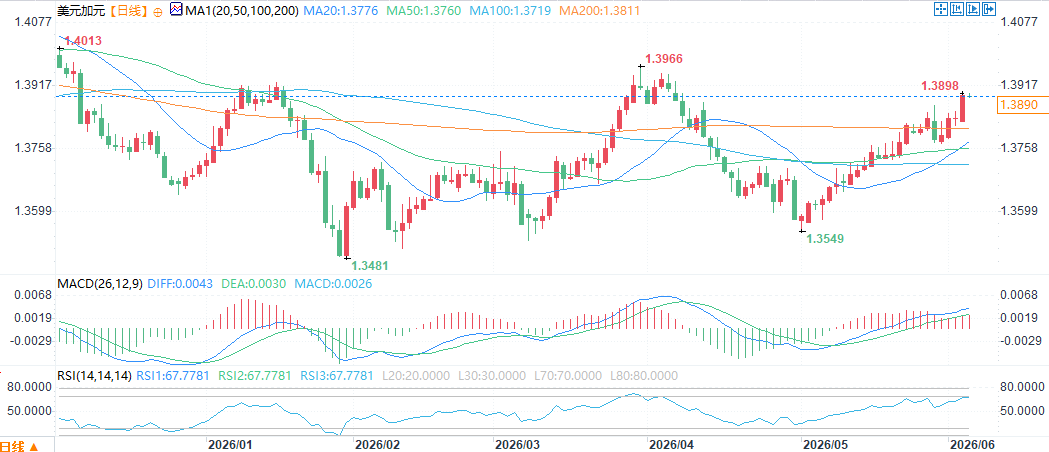
(USD/CAD daily chart, source: EasyForex)
The key resistance level is locked at the previous high of 1.3966, while short-term support is in the dense area of moving averages between 1.3760 and 1.3776. The overall market is bullish, and a pullback and stabilization would be a good opportunity to go long. A break below 1.3719 would invalidate the current upward trend.
The current Canadian dollar is exhibiting a typical "abnormal" phenomenon: as a commodity currency, the Canadian dollar typically benefits from rising oil prices, but against the backdrop of Middle East tensions pushing up oil prices, it has weakened instead. The core reason lies in the market's dominance of risk aversion: on the one hand, escalating geopolitical risks have boosted demand for the US dollar as a safe haven, suppressing risk-sensitive currencies including the Canadian dollar; on the other hand, Canada's own economic fundamentals are weak—the reality of a technical recession has dampened market confidence in the Canadian dollar. The positive impact of oil prices has been offset by growth concerns and a strong US dollar.
At 08:55 Beijing time, the USD/CAD exchange rate is currently at 1.3893/94.
Crude oil prices rose to a near two-week high due to renewed geopolitical tensions. As a major Canadian export, rising crude oil prices usually support the Canadian dollar. However, the US dollar regained favor amid risk aversion triggered by the latest war-related news.
Reports indicate that the US House of Representatives passed a resolution seeking to limit military action against Iran, while Trump stated that a US-Iran agreement could be reached by the end of the week. However, Iran's foreign minister warned that Iran would resume hostilities if Israel attacks Beirut. These conflicting signals have failed to alleviate market tensions.
A technical recession has been confirmed, but it has not yet constituted a serious crisis.
Canada's real GDP is projected to decline by 0.1% in the first quarter of 2026, and revised to decline by 1.0% in the fourth quarter of 2025, meaning Canada has entered a technical recession.
By definition, a technical recession is defined as two consecutive quarters of negative economic growth. More alarmingly, Canada has recorded negative real GDP growth in three of the past four quarters, with only one quarter barely maintaining a slight positive growth. This data series indicates that the momentum of economic growth has been weakening steadily, rather than being a short-term, occasional fluctuation.
Does this mean that the Canadian economy is really in serious trouble? The answer is no, not at the moment.
While the labor market has not yet seen large-scale unemployment, the banking system remains relatively sound, and some sectors such as energy and agriculture are still operating, the data is indeed worrying and requires immediate attention. In particular, the cumulative effect of consecutive negative GDP growth could gradually erode consumer confidence and business investment, potentially creating a self-reinforcing downward spiral.
The Bank of Canada is caught in a dilemma: a weak economy and inflationary pressures coexist.
The Bank of Canada is currently at a crossroads in its policy choices, caught in a dilemma.
On the one hand, the persistently weak economy urgently needs the support of accommodative policies. A technical recession has been confirmed, with GDP recording negative growth in three of the past four quarters. Consumer confidence is declining, business investment is suppressed, and downside risks to the economy are accumulating. Against this backdrop, interest rate cuts or maintaining an accommodative stance would help reduce financing costs, stimulate lending and spending, and provide the economy with a much-needed buffer. From the perspective of traditional monetary policy frameworks, the current economic situation should point to a cycle of interest rate cuts.
On the other hand, imported inflationary pressures from high oil prices limit the room for interest rate cuts. Although Canada is an oil-producing country, it also faces widespread cost transmission from rising energy prices. WTI crude oil has risen to $95 per barrel, and price pressures from gasoline, transportation, and raw materials are gradually being passed on to end consumers. Meanwhile, the weak Canadian dollar further amplifies the price increases of imported goods. This could keep overall inflation high, or even rise again. If the central bank cuts interest rates at this time, it could further depress the Canadian dollar exchange rate, stimulate demand, and thus exacerbate inflationary pressures, damaging policy credibility.
These two forces have pushed the central bank into a classic "stagflation" dilemma: the economy needs easing, while inflation demands tightening. Prioritizing growth by cutting interest rates could lead to runaway inflation and weaken market confidence in the Canadian dollar; prioritizing inflation control by maintaining or even tightening policy could further suppress economic activity and deepen the risk of recession. Taking a step in either direction could have significant side effects.
Under these constraints, the Bank of Canada is more likely to adopt a "wait-and-see" strategy: maintaining interest rates unchanged in the short term, neither hastily cutting rates nor rushing to tighten them, while closely monitoring changes in the external environment, including geopolitical situations, oil price trends, and the Federal Reserve's policy path. For the market, this means that policy signals from the central bank will be more cautious and restrained, and the Canadian dollar will find it difficult to obtain clear directional guidance from the domestic interest rate path in the short term.
External environment restricts policy space, and the Canadian dollar lacks domestic support.
In the current uncertain environment, how much "attention" can this issue receive?
The war continues, commitments to a peace agreement have been repeatedly delayed, and a viable solution is not in sight in the short term. Geopolitical risks have dampened global risk appetite, making it difficult for commodity currencies such as the Canadian dollar to fully benefit from rising oil prices.
Meanwhile, the Canadian government has limited fiscal space, making it difficult to launch large-scale stimulus measures. Under these circumstances, the Bank of Canada is more likely to adopt a "wait-and-see" strategy, waiting for the external environment to become clearer, rather than rushing to intervene.
For the Canadian dollar, this means that in the short term there is a lack of strong support from domestic policies, and its trend will still be mainly dominated by external risks and the strength of the US dollar.
USD/CAD Technical Analysis
The USD/CAD pair broke out of its consolidation range after forming a W-bottom pattern on the daily chart. The current price is firmly above all moving averages, indicating a medium-term bullish trend. The MACD remains above the zero line and the RSI is approaching the overbought threshold of 70. The bullish trend is intact, but there is a possibility of a short-term pullback to digest profit-taking.
(USD/CAD daily chart, source: EasyForex)
The key resistance level is locked at the previous high of 1.3966, while short-term support is in the dense area of moving averages between 1.3760 and 1.3776. The overall market is bullish, and a pullback and stabilization would be a good opportunity to go long. A break below 1.3719 would invalidate the current upward trend.
The current Canadian dollar is exhibiting a typical "abnormal" phenomenon: as a commodity currency, the Canadian dollar typically benefits from rising oil prices, but against the backdrop of Middle East tensions pushing up oil prices, it has weakened instead. The core reason lies in the market's dominance of risk aversion: on the one hand, escalating geopolitical risks have boosted demand for the US dollar as a safe haven, suppressing risk-sensitive currencies including the Canadian dollar; on the other hand, Canada's own economic fundamentals are weak—the reality of a technical recession has dampened market confidence in the Canadian dollar. The positive impact of oil prices has been offset by growth concerns and a strong US dollar.
At 08:55 Beijing time, the USD/CAD exchange rate is currently at 1.3893/94.
- Risk Warning and Disclaimer
- The market involves risk, and trading may not be suitable for all investors. This article is for reference only and does not constitute personal investment advice, nor does it take into account certain users’ specific investment objectives, financial situation, or other needs. Any investment decisions made based on this information are at your own risk.