US jobs data boosted expectations of an interest rate hike, putting downward pressure on gold prices.
2026-06-04 09:21:36
International gold prices continued their downward trend in Asian trading on Thursday, with spot gold (XAU/USD) falling back to around $4,450 per ounce. As US economic data continued to show resilience, market expectations for the Federal Reserve to maintain its tightening policy further intensified, leading to a simultaneous rise in the US dollar index and US Treasury yields, thereby diminishing gold's appeal as a non-yielding asset.

Yesterday's US employment data showed that the US labor market remains resilient. Specifically, the ADP private sector employment growth in May significantly exceeded market expectations, while JOLTS job openings data also indicated that corporate hiring demand remains strong. These data reinforced investors' assessment that the US economy remains resilient, while reducing market expectations for a near-term interest rate cut.
With the job market remaining stable, financial markets are beginning to readjust their projections for future Federal Reserve policy. Some institutions believe that persistently high inflationary pressures and rising energy prices are altering market expectations regarding the future path of interest rates.
One of the key market focuses remains the impact of the situation in the Middle East on global energy supply. As the conflict involving Iran continues to escalate, the international energy market faces new supply uncertainties. High crude oil prices have raised concerns that energy costs may continue to be passed on to end consumers, thereby pushing up overall inflation.
Against this backdrop, investors' assessments of the Federal Reserve's future monetary policy have changed significantly. Market estimates suggest that traders now expect a 42% probability of a Fed rate hike in December, a marked increase from previous levels. This rising interest rate expectation has kept US Treasury yields high, further supporting the dollar and putting downward pressure on gold.
Meanwhile, global financial markets are closely watching the upcoming US May non-farm payrolls report. The market expects approximately 85,000 new non-farm jobs to be added in May, with the unemployment rate expected to remain around 4.3%. If the employment data continues to exceed expectations, it will further strengthen market expectations that the Federal Reserve will maintain its high-interest-rate policy, thus limiting the upside potential for gold.
However, if the non-farm payroll data is significantly weaker than expected, it could reignite market concerns about a slowdown in economic growth, causing the dollar to fall and providing new support for gold. At that point, investors may readjust their expectations for future interest rate policies, thereby driving safe-haven funds back into the gold market.
From a global asset allocation perspective, the current gold market is facing a balancing act between safe-haven demand and a high-interest-rate environment. On the one hand, geopolitical risks and rising energy prices continue to support gold's long-term safe-haven value; on the other hand, the Federal Reserve's continued tightening policy has increased the opportunity cost of holding gold, putting significant pressure on gold prices in the short term.
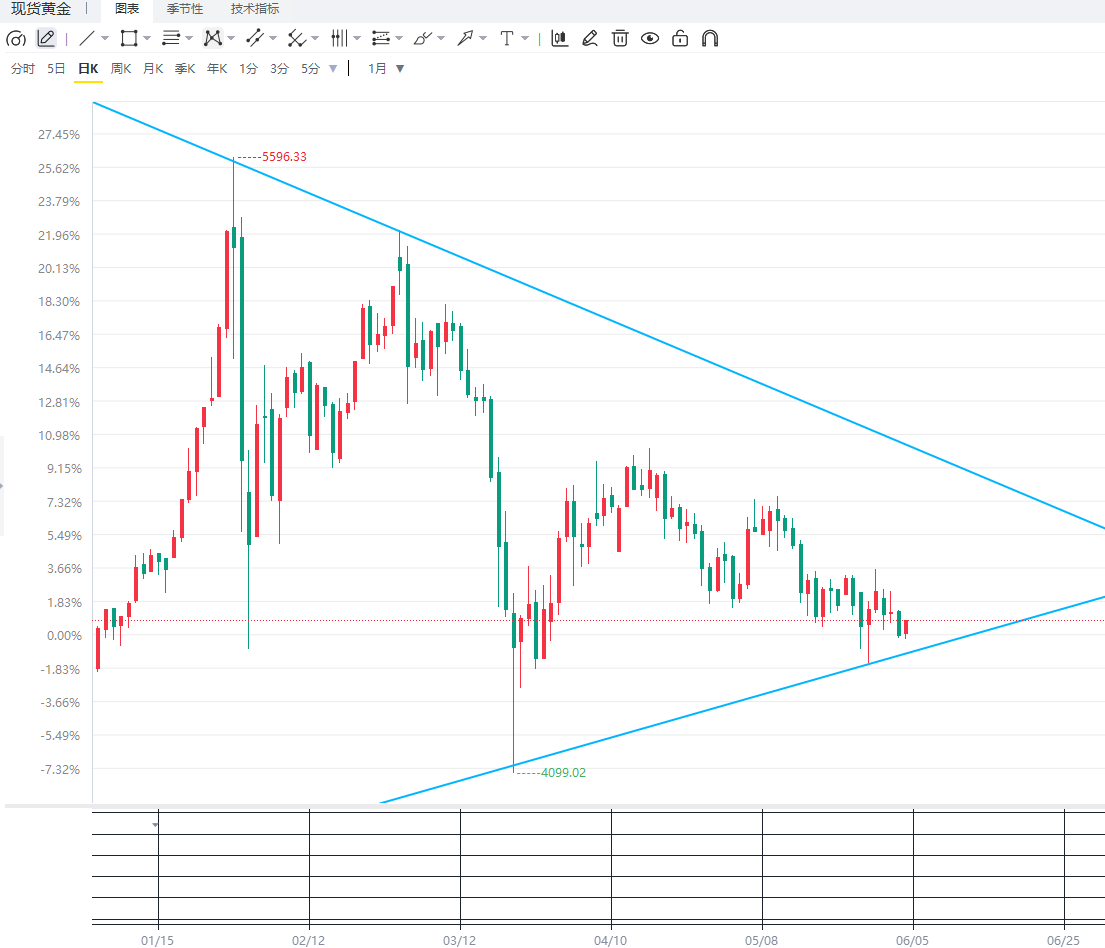
From a daily chart perspective, gold remains within its long-term upward trend channel, but recent high-level consolidation has intensified. After reaching historical highs, prices showed signs of profit-taking, and the 20-day moving average has begun to flatten, indicating weakening upward momentum. While the MACD indicator remains above the zero line, the red histogram bars are shortening, reflecting a slowdown in bullish strength. The RSI indicator has fallen back to near neutral territory, suggesting a more cautious short-term market sentiment. Key support levels to watch are $4400 and $4350, while resistance levels are at $4500 and $4580.
Editor's Summary : The gold market is currently at a critical juncture, jointly driven by macroeconomic data and monetary policy expectations. The continued resilience of the US job market has led the market to reassess the future policy direction of the Federal Reserve, while rising energy prices and inflationary risks have further reinforced expectations of high interest rates. Against the backdrop of a strengthening dollar and US Treasury yields, gold faces significant short-term pressure. However, from a longer-term perspective, the risk of a global economic slowdown, uncertainty in energy market supply, and changes in geopolitical situations continue to provide important support for gold. In the coming weeks, US non-farm payroll data, inflation indicators, and speeches by Federal Reserve officials will be key factors influencing gold's price movements. The editor believes that gold prices may maintain a high-level consolidation pattern in the short term, but as long as global safe-haven demand does not cool significantly, gold's medium- to long-term investment value remains worth considering.
Yesterday's US employment data showed that the US labor market remains resilient. Specifically, the ADP private sector employment growth in May significantly exceeded market expectations, while JOLTS job openings data also indicated that corporate hiring demand remains strong. These data reinforced investors' assessment that the US economy remains resilient, while reducing market expectations for a near-term interest rate cut.
With the job market remaining stable, financial markets are beginning to readjust their projections for future Federal Reserve policy. Some institutions believe that persistently high inflationary pressures and rising energy prices are altering market expectations regarding the future path of interest rates.
One of the key market focuses remains the impact of the situation in the Middle East on global energy supply. As the conflict involving Iran continues to escalate, the international energy market faces new supply uncertainties. High crude oil prices have raised concerns that energy costs may continue to be passed on to end consumers, thereby pushing up overall inflation.
Against this backdrop, investors' assessments of the Federal Reserve's future monetary policy have changed significantly. Market estimates suggest that traders now expect a 42% probability of a Fed rate hike in December, a marked increase from previous levels. This rising interest rate expectation has kept US Treasury yields high, further supporting the dollar and putting downward pressure on gold.
Meanwhile, global financial markets are closely watching the upcoming US May non-farm payrolls report. The market expects approximately 85,000 new non-farm jobs to be added in May, with the unemployment rate expected to remain around 4.3%. If the employment data continues to exceed expectations, it will further strengthen market expectations that the Federal Reserve will maintain its high-interest-rate policy, thus limiting the upside potential for gold.
However, if the non-farm payroll data is significantly weaker than expected, it could reignite market concerns about a slowdown in economic growth, causing the dollar to fall and providing new support for gold. At that point, investors may readjust their expectations for future interest rate policies, thereby driving safe-haven funds back into the gold market.
From a global asset allocation perspective, the current gold market is facing a balancing act between safe-haven demand and a high-interest-rate environment. On the one hand, geopolitical risks and rising energy prices continue to support gold's long-term safe-haven value; on the other hand, the Federal Reserve's continued tightening policy has increased the opportunity cost of holding gold, putting significant pressure on gold prices in the short term.
From a daily chart perspective, gold remains within its long-term upward trend channel, but recent high-level consolidation has intensified. After reaching historical highs, prices showed signs of profit-taking, and the 20-day moving average has begun to flatten, indicating weakening upward momentum. While the MACD indicator remains above the zero line, the red histogram bars are shortening, reflecting a slowdown in bullish strength. The RSI indicator has fallen back to near neutral territory, suggesting a more cautious short-term market sentiment. Key support levels to watch are $4400 and $4350, while resistance levels are at $4500 and $4580.
Editor's Summary : The gold market is currently at a critical juncture, jointly driven by macroeconomic data and monetary policy expectations. The continued resilience of the US job market has led the market to reassess the future policy direction of the Federal Reserve, while rising energy prices and inflationary risks have further reinforced expectations of high interest rates. Against the backdrop of a strengthening dollar and US Treasury yields, gold faces significant short-term pressure. However, from a longer-term perspective, the risk of a global economic slowdown, uncertainty in energy market supply, and changes in geopolitical situations continue to provide important support for gold. In the coming weeks, US non-farm payroll data, inflation indicators, and speeches by Federal Reserve officials will be key factors influencing gold's price movements. The editor believes that gold prices may maintain a high-level consolidation pattern in the short term, but as long as global safe-haven demand does not cool significantly, gold's medium- to long-term investment value remains worth considering.
- Risk Warning and Disclaimer
- The market involves risk, and trading may not be suitable for all investors. This article is for reference only and does not constitute personal investment advice, nor does it take into account certain users’ specific investment objectives, financial situation, or other needs. Any investment decisions made based on this information are at your own risk.