Trump's weekend deal was more of a pie in the sky! Congress's defection and war-limiting measures, the gold price rebound may be a trap.
2026-06-04 15:56:36
On Thursday (June 4), spot gold rebounded during the Asian and European sessions. Federal Reserve Vice Chairman Williams continued to maintain a dovish stance, downplaying expectations of interest rate hikes due to his optimism about long-term inflation. Meanwhile, Trump told White House reporters that negotiations between the United States and Iran were progressing well and an agreement could be reached by the end of the week.
Trump said, "I've heard that the negotiations themselves are going very well, actually quite well... If a deal is reached, it will probably be revealed this weekend."
When asked whether the ceasefire agreement between the United States and Iran was still in effect after the latest Iranian attack on Kuwait, Trump said, "Everything happens for a reason." The U.S. military launched a fairly heavy attack on Iran two nights ago, "so there's a reason why things happen, and that reason usually makes some sense."
He added that Iran's move was "no big deal" and that "we have the situation under control and have quickly nipped it in the bud."
However, this congressional resolution to oppose the withdrawal of troops has no legal effect. It can only restrict and pressure the White House from three directions: public opinion, partisan finances, and military spending approval.

Previously, Iran launched a nighttime drone and missile attack on Terminal 1 of Kuwait International Airport, causing casualties and damage to major airport facilities. Kuwait immediately suspended civil aviation and activated a full emergency response, with all flights temporarily diverted to alternative airports.
The U.S. military immediately took action, intercepting Iranian missiles and drones heading toward Kuwait and Bahrain, and retaliated by airstrikes on Iranian military command posts on Qeshm Island in the Strait of Hormuz.
They have repeatedly claimed that a "comprehensive agreement" is expected to be reached in the short term, and even spread rumors that "an agreement can be signed by the weekend," but this is not based on the actual progress on the battlefield.
From a first-principles perspective, the United States can neither completely destroy Iran, which has strategic depth, nor accept a half-baked compromise agreement.
The real way to break the deadlock is to “limit military strikes, maintain the blockade of the Gulf, and wear down the enemy slowly through sanctions.”
Trump's "we'll see this weekend" statement is essentially a pre-emptive expectation of peace. It can both offset domestic anxiety about the spread of the war and appease voters, while also shifting the political responsibility for a potential breakdown in negotiations onto Tehran in advance.
This kind of strategic wishful thinking exposes Trump's political weakness: ridiculously entrusting the definition of victory to his opponents.
New York Federal Reserve President John Williams stated that U.S. monetary policy is currently in the right place, and there is no clear direction for the future path of interest rates. "Monetary policy is currently in a perfectly appropriate position, and I don't think there is a need to raise or lower interest rates," he said.
"I can't see which direction we're headed in either," Williams said in an interview on Wednesday.
Federal Reserve policymakers are expected to meet in Washington on June 16-17.
Under the chairmanship of the new chairman Kevin Walsh, they are expected to discuss whether to revise the wording of the post-meeting statement.
Many officials wanted to remove wording from the statement that suggested the next step could still be an interest rate cut. Williams noted that inflation remained high, with energy prices, tariffs, and AI-related investments putting upward pressure on prices. However, he also stated that services inflation had slowed to a "considerable degree."
Amid the ongoing conflict in the Middle East, a fierce power struggle erupted in the US political arena over the authority to use force against Iran.
The House of Representatives recently passed a resolution limiting Trump's war powers to use force against Iran, marking the first time that legislation has been enacted to constrain the president's unilateral authority to wage war at the congressional level.
The vote narrowly passed with 215 votes in favor and 208 against. The defection of four Republican lawmakers to the Democratic camp was key to the bill's passage. This not only broke the Republican Party's consistent stance on the White House's Middle East policy, but also exposed deep-seated rifts within the party that are difficult to heal.
The four defecting lawmakers each had their own practical considerations: Thomas Massey lost the party primary to a Trump-backed opponent (as mentioned in a previous article, he was one of the lawmakers who lost the midterm election primaries and eventually defected) , and stated that pushing for the resolution was in line with the public's demands and urging a ceasefire;
Barrett, a veteran facing the risk of losing her seat in the midterm elections, cited constitutional evidence, emphasizing that the U.S. Constitution assigns the power to declare war to Congress, and that Trump's unauthorized initiation of war was a clear overreach of power.
Since Trump launched a surprise attack on Iran in conjunction with Israel on February 28, the entire conflict will enter its 100-day cycle this Saturday.
The White House has consistently avoided seeking legal authorization from Congress for war, repeatedly downplaying large-scale military conflicts as "short-term, small-scale operations." This approach continues to fuel discontent in both houses of Congress.
Democratic lawmakers see the war as a “political gamble” that betrays American interests.
The Democratic Party has publicly stated that Trump's current "expectations of victory" are completely unrealistic, because if the United States were to force a compromise agreement at this point in order to end the conflict, it would be seen by the international community as a tacit admission of defeat.
If the opponent holds firm and refuses to compromise, and Trump continues to indefinitely postpone the war without congressional authorization, the legitimacy of his war will be completely bankrupt.
This "strategic parasitism," which hands over the power to end the war to the adversary (Iran), is causing Trump to face unprecedented political backlash.
Data released by the Pentagon in May showed that the U.S. military has spent a total of $29 billion in this round of conflict, while Harvard University financial experts estimate that the total cost of the entire conflict may exceed one trillion dollars.
The ever-expanding military spending continues to exacerbate the pressure on the US federal deficit, directly influencing the prices of global commodities and safe-haven assets.
The continued blockade of the Strait of Hormuz is causing energy inflation to spiral out of control: As long as the US and Iran cannot reach a substantive agreement, the Strait of Hormuz, a global energy lifeline, cannot be truly opened, and the continued surge in oil prices will directly translate into persistent high inflation worldwide.
Non-US countries around the world are facing a "dollar shortage": In the context of high oil prices, non-US countries around the world must consume huge amounts of dollar reserves in order to import expensive energy.
At the same time, high inflation is forcing the Federal Reserve to maintain high interest rates, and non-US currencies are facing severe depreciation pressure. In order to protect their own currency exchange rates and pay energy bills, countries around the world will fall into a state of extreme "dollar shortage" panic.
Selling off US Treasury bonds and gold, squeezing liquidity: In the extreme "dollar shortage" tsunami, liquidity becomes the only solution.
In order to obtain valuable US dollar cash, central banks and large financial institutions around the world will have to frantically sell off their most core and highly liquid assets—US Treasury bonds and gold—both of which will suppress gold prices.
In summary: In the short term, Trump's "pie-in-the-sky" promises are affecting market sentiment, but as long as the Taiwan Strait remains open and the standoff continues, the global economy will be suffocated by high oil prices.
In this "liquidity shock" triggered by the energy crisis, the logic of "the dollar is king" will continue to suppress gold's safe-haven properties.
From a technical perspective, although spot gold has rebounded, it is still moving along a downward channel. After touching the middle line of the downward channel, it is highly likely to fall back. The current strategy is still to sell short on rallies and buy on dips in conjunction with positive news.
However, if gold prices do not fall in the near future but instead strengthen, it would be beyond expectations, and people may need to search for new reasons.
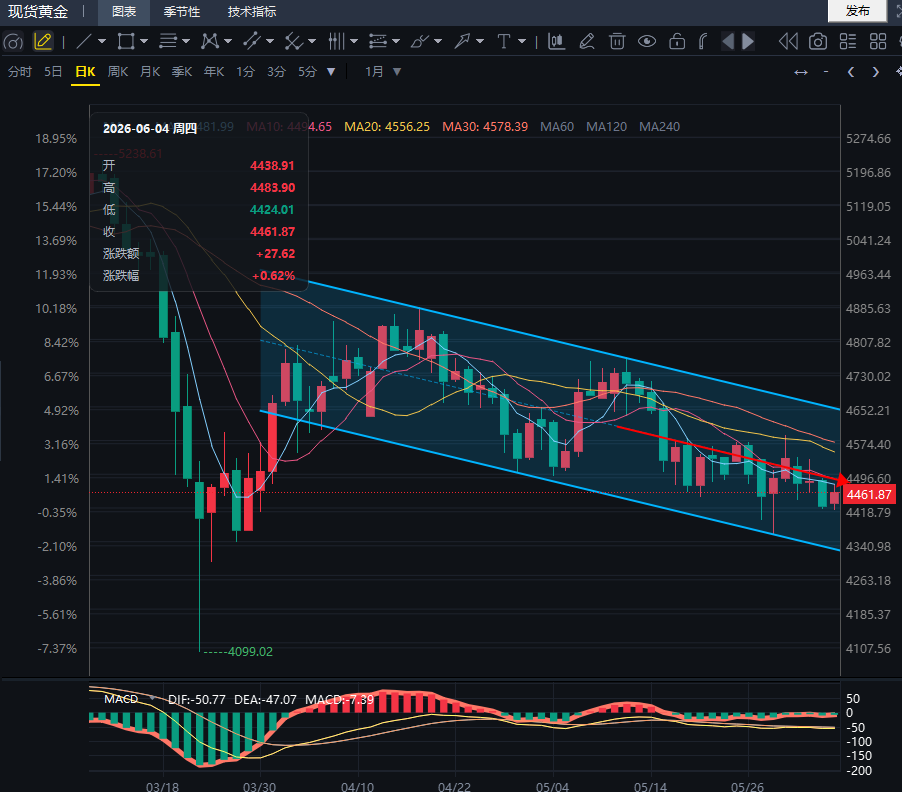
(Spot gold daily chart, source: FX678)
At 15:47 Beijing time, spot gold was trading at $4,462 per ounce.
Trump said, "I've heard that the negotiations themselves are going very well, actually quite well... If a deal is reached, it will probably be revealed this weekend."
When asked whether the ceasefire agreement between the United States and Iran was still in effect after the latest Iranian attack on Kuwait, Trump said, "Everything happens for a reason." The U.S. military launched a fairly heavy attack on Iran two nights ago, "so there's a reason why things happen, and that reason usually makes some sense."
He added that Iran's move was "no big deal" and that "we have the situation under control and have quickly nipped it in the bud."
However, this congressional resolution to oppose the withdrawal of troops has no legal effect. It can only restrict and pressure the White House from three directions: public opinion, partisan finances, and military spending approval.
Trump's eagerness to demonstrate his victory to the domestic public is not based on actual results, but rather on waging a perception war.
Previously, Iran launched a nighttime drone and missile attack on Terminal 1 of Kuwait International Airport, causing casualties and damage to major airport facilities. Kuwait immediately suspended civil aviation and activated a full emergency response, with all flights temporarily diverted to alternative airports.
The U.S. military immediately took action, intercepting Iranian missiles and drones heading toward Kuwait and Bahrain, and retaliated by airstrikes on Iranian military command posts on Qeshm Island in the Strait of Hormuz.
They have repeatedly claimed that a "comprehensive agreement" is expected to be reached in the short term, and even spread rumors that "an agreement can be signed by the weekend," but this is not based on the actual progress on the battlefield.
From a first-principles perspective, the United States can neither completely destroy Iran, which has strategic depth, nor accept a half-baked compromise agreement.
The real way to break the deadlock is to “limit military strikes, maintain the blockade of the Gulf, and wear down the enemy slowly through sanctions.”
Trump's "we'll see this weekend" statement is essentially a pre-emptive expectation of peace. It can both offset domestic anxiety about the spread of the war and appease voters, while also shifting the political responsibility for a potential breakdown in negotiations onto Tehran in advance.
This kind of strategic wishful thinking exposes Trump's political weakness: ridiculously entrusting the definition of victory to his opponents.
Williams: There is no clear direction for the future interest rate path; not too worried about persistent inflation.
New York Federal Reserve President John Williams stated that U.S. monetary policy is currently in the right place, and there is no clear direction for the future path of interest rates. "Monetary policy is currently in a perfectly appropriate position, and I don't think there is a need to raise or lower interest rates," he said.
"I can't see which direction we're headed in either," Williams said in an interview on Wednesday.
Federal Reserve policymakers are expected to meet in Washington on June 16-17.
Under the chairmanship of the new chairman Kevin Walsh, they are expected to discuss whether to revise the wording of the post-meeting statement.
Many officials wanted to remove wording from the statement that suggested the next step could still be an interest rate cut. Williams noted that inflation remained high, with energy prices, tariffs, and AI-related investments putting upward pressure on prices. However, he also stated that services inflation had slowed to a "considerable degree."
Washington infighting: Four defections tear open cracks in Republican power limits
Amid the ongoing conflict in the Middle East, a fierce power struggle erupted in the US political arena over the authority to use force against Iran.
The House of Representatives recently passed a resolution limiting Trump's war powers to use force against Iran, marking the first time that legislation has been enacted to constrain the president's unilateral authority to wage war at the congressional level.
The vote narrowly passed with 215 votes in favor and 208 against. The defection of four Republican lawmakers to the Democratic camp was key to the bill's passage. This not only broke the Republican Party's consistent stance on the White House's Middle East policy, but also exposed deep-seated rifts within the party that are difficult to heal.
The four defecting lawmakers each had their own practical considerations: Thomas Massey lost the party primary to a Trump-backed opponent (as mentioned in a previous article, he was one of the lawmakers who lost the midterm election primaries and eventually defected) , and stated that pushing for the resolution was in line with the public's demands and urging a ceasefire;
Barrett, a veteran facing the risk of losing her seat in the midterm elections, cited constitutional evidence, emphasizing that the U.S. Constitution assigns the power to declare war to Congress, and that Trump's unauthorized initiation of war was a clear overreach of power.
The Cost of Strategic Parasitism: The Democratic Party's Political Gamble to Shoot Trump
Since Trump launched a surprise attack on Iran in conjunction with Israel on February 28, the entire conflict will enter its 100-day cycle this Saturday.
The White House has consistently avoided seeking legal authorization from Congress for war, repeatedly downplaying large-scale military conflicts as "short-term, small-scale operations." This approach continues to fuel discontent in both houses of Congress.
Democratic lawmakers see the war as a “political gamble” that betrays American interests.
The Democratic Party has publicly stated that Trump's current "expectations of victory" are completely unrealistic, because if the United States were to force a compromise agreement at this point in order to end the conflict, it would be seen by the international community as a tacit admission of defeat.
If the opponent holds firm and refuses to compromise, and Trump continues to indefinitely postpone the war without congressional authorization, the legitimacy of his war will be completely bankrupt.
This "strategic parasitism," which hands over the power to end the war to the adversary (Iran), is causing Trump to face unprecedented political backlash.
The protracted war in Iraq has placed a heavy burden on the U.S. treasury.
Data released by the Pentagon in May showed that the U.S. military has spent a total of $29 billion in this round of conflict, while Harvard University financial experts estimate that the total cost of the entire conflict may exceed one trillion dollars.
The ever-expanding military spending continues to exacerbate the pressure on the US federal deficit, directly influencing the prices of global commodities and safe-haven assets.
The protracted standoff between the US and Iran is suppressing gold prices.
The continued blockade of the Strait of Hormuz is causing energy inflation to spiral out of control: As long as the US and Iran cannot reach a substantive agreement, the Strait of Hormuz, a global energy lifeline, cannot be truly opened, and the continued surge in oil prices will directly translate into persistent high inflation worldwide.
Non-US countries around the world are facing a "dollar shortage": In the context of high oil prices, non-US countries around the world must consume huge amounts of dollar reserves in order to import expensive energy.
At the same time, high inflation is forcing the Federal Reserve to maintain high interest rates, and non-US currencies are facing severe depreciation pressure. In order to protect their own currency exchange rates and pay energy bills, countries around the world will fall into a state of extreme "dollar shortage" panic.
Selling off US Treasury bonds and gold, squeezing liquidity: In the extreme "dollar shortage" tsunami, liquidity becomes the only solution.
In order to obtain valuable US dollar cash, central banks and large financial institutions around the world will have to frantically sell off their most core and highly liquid assets—US Treasury bonds and gold—both of which will suppress gold prices.
Summary and Technical Analysis:
In summary: In the short term, Trump's "pie-in-the-sky" promises are affecting market sentiment, but as long as the Taiwan Strait remains open and the standoff continues, the global economy will be suffocated by high oil prices.
In this "liquidity shock" triggered by the energy crisis, the logic of "the dollar is king" will continue to suppress gold's safe-haven properties.
From a technical perspective, although spot gold has rebounded, it is still moving along a downward channel. After touching the middle line of the downward channel, it is highly likely to fall back. The current strategy is still to sell short on rallies and buy on dips in conjunction with positive news.
However, if gold prices do not fall in the near future but instead strengthen, it would be beyond expectations, and people may need to search for new reasons.
(Spot gold daily chart, source: FX678)
At 15:47 Beijing time, spot gold was trading at $4,462 per ounce.
- Risk Warning and Disclaimer
- The market involves risk, and trading may not be suitable for all investors. This article is for reference only and does not constitute personal investment advice, nor does it take into account certain users’ specific investment objectives, financial situation, or other needs. Any investment decisions made based on this information are at your own risk.