Non-farm payrolls data pushed the dollar above 100 points, and the US and Japan are now on the verge of breaking through 160 – is the countdown to a breakout starting next week?
2026-06-06 13:10:50
This week, the US dollar index showed significant strength, driven by robust May non-farm payroll data, breaking through the upper Bollinger Band and holding above 100 points, putting downward pressure on major non-US currencies. USD/JPY approached the 160 level, while the euro and pound sterling fell after the data release, with adjustments in market expectations regarding Federal Reserve policy being the core driving factor.

Weekly Price Review <br />This week, USD/JPY maintained a high-level upward trend, gradually recovering from the previous pullback area. The current price is around 160.216, close to the previous high of 160.467, indicating continued bullish momentum. The price is now close to the upper Bollinger Band at 160.855, showing strong technical characteristics, but also accompanied by short-term profit-taking pressure. In the MACD indicator, the DIFF is above the DEA, and the histogram remains positive, reflecting that the upward trend remains unchanged.
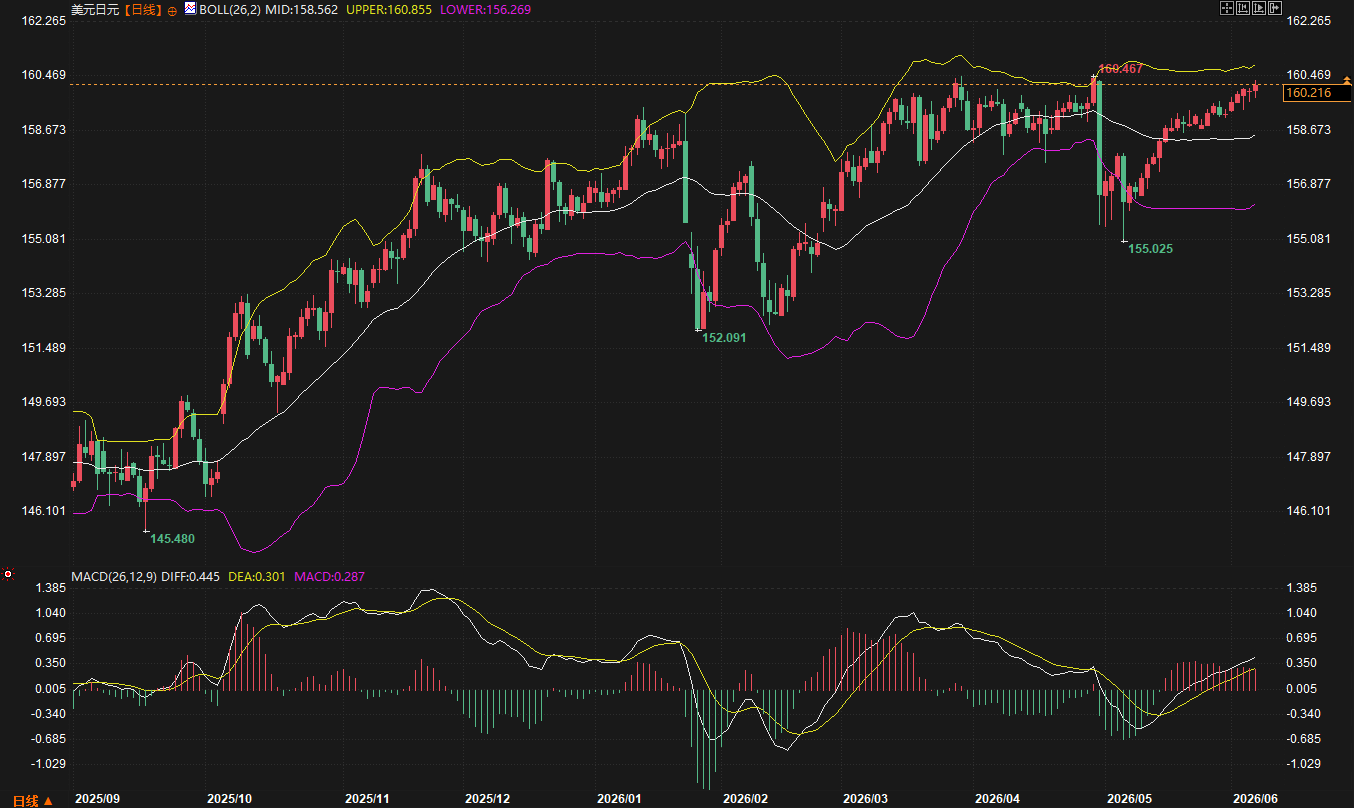
Economic Data/Event Summary : US non-farm payrolls increased by 172,000 in May, far exceeding market expectations of 85,000, and the previous figure was also revised upwards to 179,000. The unemployment rate remained stable at 4.3%. Furthermore, energy price fluctuations related to the Middle East Gulf situation provided additional support for the US dollar, while Japan continued to monitor excessive exchange rate volatility.
Summary of Analyst/Institutional Views : Major overseas institutions point out that strong employment data has reduced the Federal Reserve's urgency regarding employment, but inflation remains a major constraint. Some strategists believe that the labor market's resilience has increased, with the recruitment industry diffusion index rebounding, indicating a solid economic foundation. Japanese officials reiterated that they will retain the option to deal with excessive exchange rate volatility, and the market is focused on possible policy adjustments by the Bank of Japan to address rising import costs.
Weekly Market Review
GBP/USD has been under pressure this week, currently trading around 1.3604, encountering resistance near the upper Bollinger Band at 1.3633. Overall, it has retreated from previous highs and is consolidating, with limited upward momentum in the short term. The MACD indicator shows the DIFF line below the DEA line and the histogram in negative territory, indicating a slight advantage for bears.
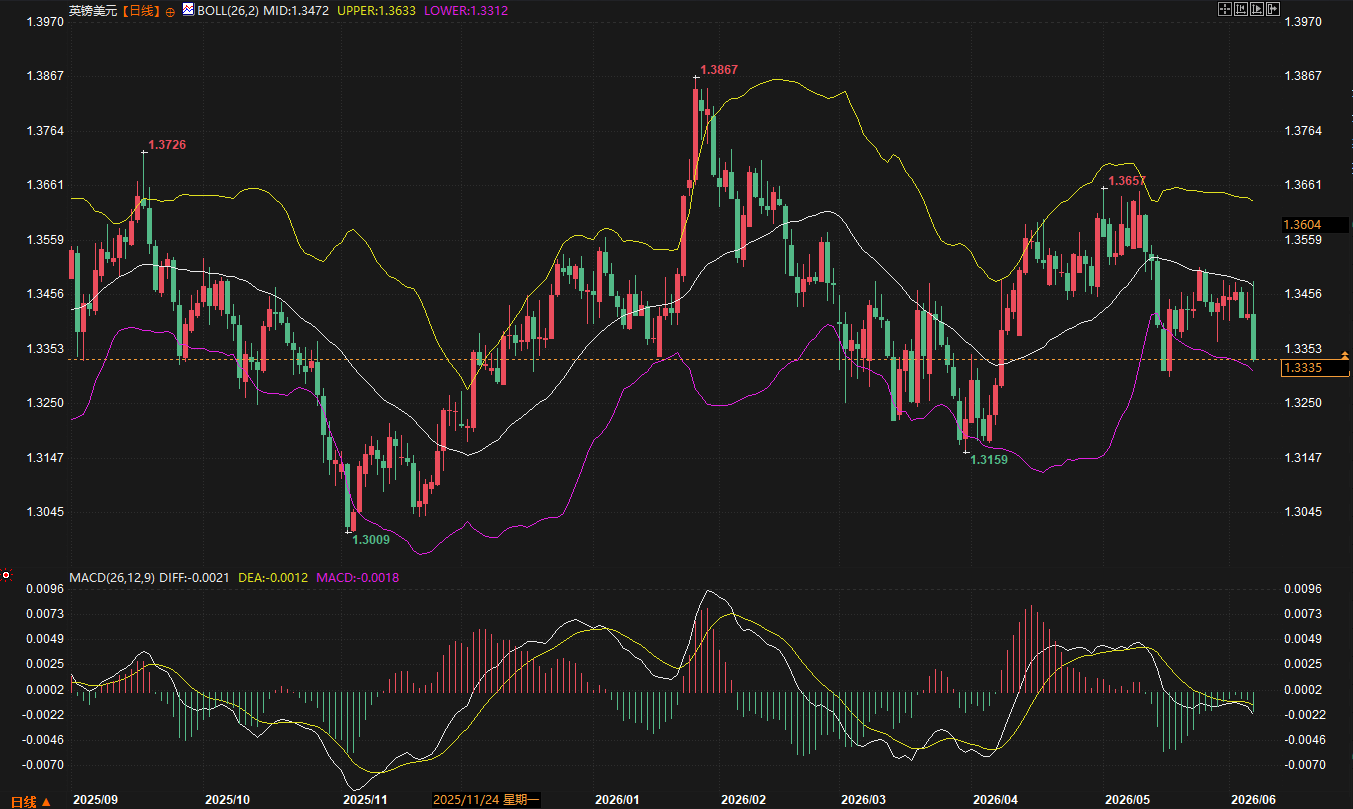
Economic Data/Event Summary : Strong US jobs data boosted the dollar, while persistent energy cost pressures in Europe weighed on the pound. Markets focused on the ECB's potential interest rate hike path, but US data dominated short-term exchange rate fluctuations.
Summary of Analyst/Institutional Views <br/>Institutional analysts believe that high energy prices continue to impact economic activity in the Eurozone and the UK, coupled with a strong US dollar, putting the pound under pressure for a period of adjustment. Some analysts anticipate multiple interest rate hikes by the European Central Bank this year, but in the short term, non-US currencies will remain constrained by US data.
Weekly Market Review
The EUR/USD pair has been weak this week, currently trading at 1.1521. It has broken below the Bollinger Band middle line at 1.1660 and is approaching the lower band around 1.1535. The decline from the year's high is evident, and a downward channel is expected in the short term. All three MACD lines are negative, indicating clear bearish momentum.
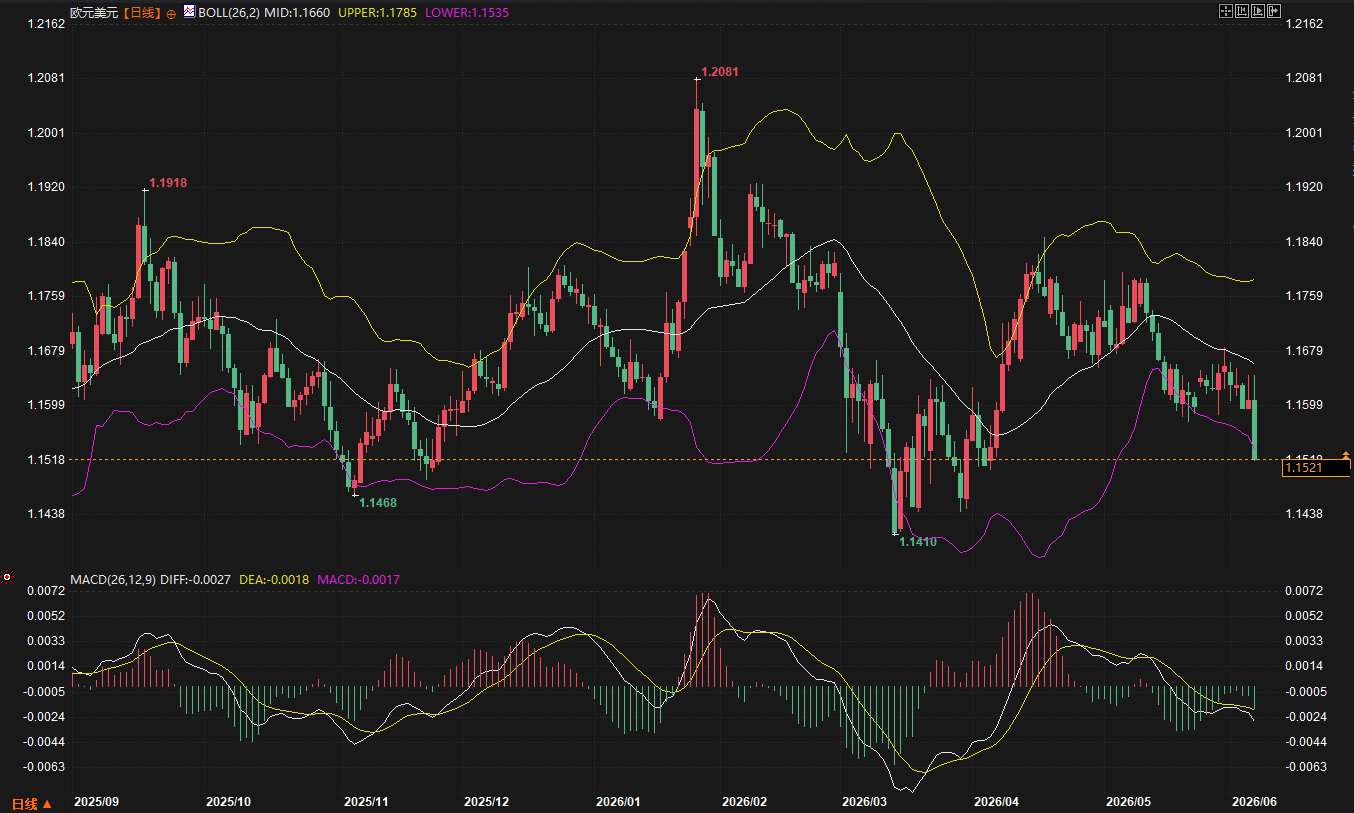
Summary of Economic Data/Events
Better-than-expected US non-farm payroll data in May boosted the US dollar, while high energy prices amid tensions in the Gulf region weighed on the Eurozone economy. The Eurozone faces the challenge of rising energy import costs.
Summary of Analyst/Institutional Views : Major overseas institutions indicate that persistently high energy prices remain a key factor dragging down local economic activity. The euro weakened after the release of US employment data, reflecting changes in market expectations regarding the Federal Reserve's policy. Some strategists caution that the European economy faces greater exogenous pressures than the US, and the downward pressure on exchange rates may continue in the short term.
Weekly Market Review <br />The US dollar index rose strongly this week, currently trading at 100.0637, having broken through and stabilized above the upper Bollinger Band at 99.9840. After a significant rebound from the year's low of 95.5660, it has maintained a high level of consolidation and is now showing bullish dominance again. The MACD indicator is expanding positively, with the DIFF line above the DEA line, indicating continued bullish momentum.
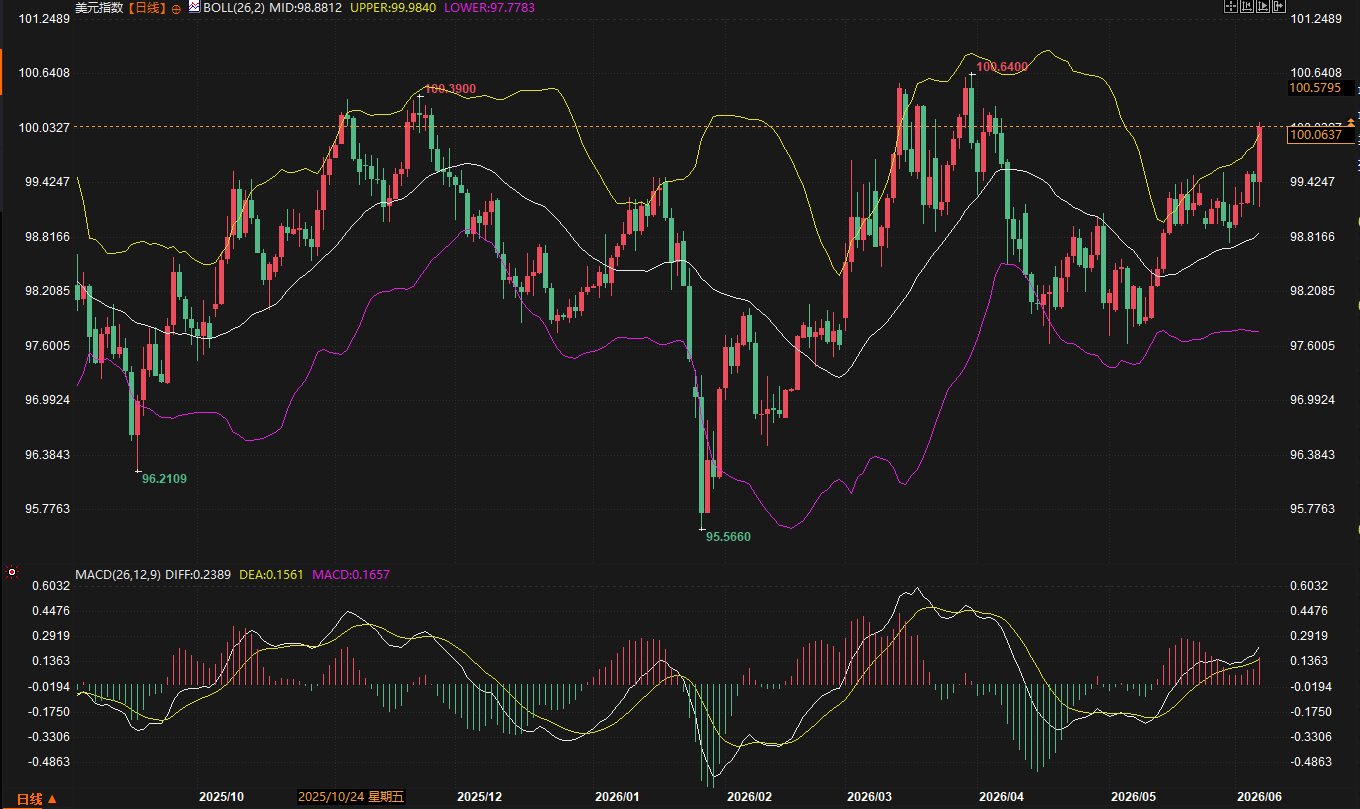
Economic Data/Event Summary : The US May jobs report was a key catalyst, with non-farm payrolls far exceeding expectations. Bond yields rose simultaneously, intensifying market discussions about the Federal Reserve's policy. The Gulf situation provided additional safe-haven support, pushing the US dollar stronger.
Summary of Analyst/Institutional Views : Multiple institutions believe that the resilience of the labor market exceeds the revised data, suggesting that the employment diffusion index has rebounded above 50. The Federal Reserve's decision-making focus remains on inflation control, and improved employment reduces the urgency for its actions on the employment side. Some opinions point out that although the current threshold for interest rate hikes is high, the possibility of policy adjustments this year still exists, providing fundamental support for the US dollar.
Overall, the foreign exchange market this week was influenced by both strong US employment data and geopolitical factors, with the US dollar index showing a clear advantage and major non-US currency pairs experiencing divergent adjustments. USD/JPY approached a key technical level, while European currencies remained weak due to both energy pressures and a strong dollar. Going forward, the market will continue to focus on the Federal Reserve meeting, developments in the Gulf situation, and the responses of central banks worldwide, and exchange rate volatility is expected to remain at a high level.
Strong US economic data, coupled with external uncertainties, has solidified the dollar's recent strength. Technically, many currency pairs are approaching the Bollinger Band's extreme range, indicating short-term pressure for directional movement, but the overall trend remains driven by fundamentals. Investors should pay close attention to the guidance provided by subsequent inflation data and policy signals on exchange rates.
Q: What is the logic behind the better-than-expected US non-farm payroll data in May driving the US dollar index?
A: The May non-farm payrolls increase of 172,000 far exceeded expectations, the unemployment rate remained stable, and the employment diffusion index improved. These signals collectively indicate a stronger labor market. The market has accordingly raised its expectations for a Fed rate hike, pushing up bond yields and strengthening the dollar's attractiveness. The dollar index breaking through the 100 mark and stabilizing above the upper rail is a direct reflection of this logic. Strong data has reduced the Fed's concerns about employment, allowing it to focus more on inflation control, supporting a medium-term bullish trend for the dollar.
Q: Where is the technical and fundamental convergence point for USD/JPY as it approaches the 160 mark?
A: Technically, the price is near its previous high and closely following the upper Bollinger Band, with the MACD remaining positive, indicating a continuation of the trend. Fundamentally, the US employment data boosted the dollar, while Japan faces inflationary pressures from energy imports. Japanese officials' statements that they retain the option of intervention are a short-term focus. The convergence of these two factors makes this currency pair a market focus this week, but specific volatility will depend on subsequent data verification.
Q: What are the main factors limiting the weakness of European currency pairs this week?
A: First, US data pushed up the dollar; second, high energy prices amid the Gulf conflict increased import costs for the Eurozone and the UK, dragging down economic activity expectations; and third, market expectations of policy divergence between the two major economies. The EUR/USD breaking below the middle band and the GBP/USD encountering resistance at the upper band reflect these combined factors. Institutional views generally believe that Europe faces greater exogenous pressure than the US, and short-term adjustment pressure remains.
Q: How do employment data affect market expectations for the Fed's future policies?
A: Improved data has reduced the urgency for action on the employment side, but inflation remains the core constraint. Institutions believe the Fed is likely to hold rates steady this month, but there is still room for adjustment this year. The steepening yield curve and changes in interest rate futures reflect this shift in expectations. The labor market is widening from its narrow 2025 state, with improved hiring diffusion supporting economic resilience, but the lag in real wage growth behind inflation is also a point to watch.
Q: In what ways does the situation in the Gulf region support the US dollar?
A: High energy prices are increasing demand for safe-haven assets, which is beneficial to the US dollar. At the same time, increased cost pressures on import-dependent economies are relatively strengthening the US economic advantage. Coupled with employment data, the US dollar receives support from this dual narrative. Analysts caution that while investors tend to believe the conflict may ease temporarily, the current energy shock still provides a buffer for the US dollar until clearer signals emerge.
US Dollar to Japanese Yen (USD/JPY)
Weekly Price Review <br />This week, USD/JPY maintained a high-level upward trend, gradually recovering from the previous pullback area. The current price is around 160.216, close to the previous high of 160.467, indicating continued bullish momentum. The price is now close to the upper Bollinger Band at 160.855, showing strong technical characteristics, but also accompanied by short-term profit-taking pressure. In the MACD indicator, the DIFF is above the DEA, and the histogram remains positive, reflecting that the upward trend remains unchanged.
Economic Data/Event Summary : US non-farm payrolls increased by 172,000 in May, far exceeding market expectations of 85,000, and the previous figure was also revised upwards to 179,000. The unemployment rate remained stable at 4.3%. Furthermore, energy price fluctuations related to the Middle East Gulf situation provided additional support for the US dollar, while Japan continued to monitor excessive exchange rate volatility.
Summary of Analyst/Institutional Views : Major overseas institutions point out that strong employment data has reduced the Federal Reserve's urgency regarding employment, but inflation remains a major constraint. Some strategists believe that the labor market's resilience has increased, with the recruitment industry diffusion index rebounding, indicating a solid economic foundation. Japanese officials reiterated that they will retain the option to deal with excessive exchange rate volatility, and the market is focused on possible policy adjustments by the Bank of Japan to address rising import costs.
British pound against the US dollar (GBP/USD)
Weekly Market Review
GBP/USD has been under pressure this week, currently trading around 1.3604, encountering resistance near the upper Bollinger Band at 1.3633. Overall, it has retreated from previous highs and is consolidating, with limited upward momentum in the short term. The MACD indicator shows the DIFF line below the DEA line and the histogram in negative territory, indicating a slight advantage for bears.
Economic Data/Event Summary : Strong US jobs data boosted the dollar, while persistent energy cost pressures in Europe weighed on the pound. Markets focused on the ECB's potential interest rate hike path, but US data dominated short-term exchange rate fluctuations.
Summary of Analyst/Institutional Views <br/>Institutional analysts believe that high energy prices continue to impact economic activity in the Eurozone and the UK, coupled with a strong US dollar, putting the pound under pressure for a period of adjustment. Some analysts anticipate multiple interest rate hikes by the European Central Bank this year, but in the short term, non-US currencies will remain constrained by US data.
Euro to US Dollar (EUR/USD)
Weekly Market Review
The EUR/USD pair has been weak this week, currently trading at 1.1521. It has broken below the Bollinger Band middle line at 1.1660 and is approaching the lower band around 1.1535. The decline from the year's high is evident, and a downward channel is expected in the short term. All three MACD lines are negative, indicating clear bearish momentum.
Summary of Economic Data/Events
Better-than-expected US non-farm payroll data in May boosted the US dollar, while high energy prices amid tensions in the Gulf region weighed on the Eurozone economy. The Eurozone faces the challenge of rising energy import costs.
Summary of Analyst/Institutional Views : Major overseas institutions indicate that persistently high energy prices remain a key factor dragging down local economic activity. The euro weakened after the release of US employment data, reflecting changes in market expectations regarding the Federal Reserve's policy. Some strategists caution that the European economy faces greater exogenous pressures than the US, and the downward pressure on exchange rates may continue in the short term.
US Dollar Index
Weekly Market Review <br />The US dollar index rose strongly this week, currently trading at 100.0637, having broken through and stabilized above the upper Bollinger Band at 99.9840. After a significant rebound from the year's low of 95.5660, it has maintained a high level of consolidation and is now showing bullish dominance again. The MACD indicator is expanding positively, with the DIFF line above the DEA line, indicating continued bullish momentum.
Economic Data/Event Summary : The US May jobs report was a key catalyst, with non-farm payrolls far exceeding expectations. Bond yields rose simultaneously, intensifying market discussions about the Federal Reserve's policy. The Gulf situation provided additional safe-haven support, pushing the US dollar stronger.
Summary of Analyst/Institutional Views : Multiple institutions believe that the resilience of the labor market exceeds the revised data, suggesting that the employment diffusion index has rebounded above 50. The Federal Reserve's decision-making focus remains on inflation control, and improved employment reduces the urgency for its actions on the employment side. Some opinions point out that although the current threshold for interest rate hikes is high, the possibility of policy adjustments this year still exists, providing fundamental support for the US dollar.
Overall, the foreign exchange market this week was influenced by both strong US employment data and geopolitical factors, with the US dollar index showing a clear advantage and major non-US currency pairs experiencing divergent adjustments. USD/JPY approached a key technical level, while European currencies remained weak due to both energy pressures and a strong dollar. Going forward, the market will continue to focus on the Federal Reserve meeting, developments in the Gulf situation, and the responses of central banks worldwide, and exchange rate volatility is expected to remain at a high level.
Strong US economic data, coupled with external uncertainties, has solidified the dollar's recent strength. Technically, many currency pairs are approaching the Bollinger Band's extreme range, indicating short-term pressure for directional movement, but the overall trend remains driven by fundamentals. Investors should pay close attention to the guidance provided by subsequent inflation data and policy signals on exchange rates.
QA module
Q: What is the logic behind the better-than-expected US non-farm payroll data in May driving the US dollar index?
A: The May non-farm payrolls increase of 172,000 far exceeded expectations, the unemployment rate remained stable, and the employment diffusion index improved. These signals collectively indicate a stronger labor market. The market has accordingly raised its expectations for a Fed rate hike, pushing up bond yields and strengthening the dollar's attractiveness. The dollar index breaking through the 100 mark and stabilizing above the upper rail is a direct reflection of this logic. Strong data has reduced the Fed's concerns about employment, allowing it to focus more on inflation control, supporting a medium-term bullish trend for the dollar.
Q: Where is the technical and fundamental convergence point for USD/JPY as it approaches the 160 mark?
A: Technically, the price is near its previous high and closely following the upper Bollinger Band, with the MACD remaining positive, indicating a continuation of the trend. Fundamentally, the US employment data boosted the dollar, while Japan faces inflationary pressures from energy imports. Japanese officials' statements that they retain the option of intervention are a short-term focus. The convergence of these two factors makes this currency pair a market focus this week, but specific volatility will depend on subsequent data verification.
Q: What are the main factors limiting the weakness of European currency pairs this week?
A: First, US data pushed up the dollar; second, high energy prices amid the Gulf conflict increased import costs for the Eurozone and the UK, dragging down economic activity expectations; and third, market expectations of policy divergence between the two major economies. The EUR/USD breaking below the middle band and the GBP/USD encountering resistance at the upper band reflect these combined factors. Institutional views generally believe that Europe faces greater exogenous pressure than the US, and short-term adjustment pressure remains.
Q: How do employment data affect market expectations for the Fed's future policies?
A: Improved data has reduced the urgency for action on the employment side, but inflation remains the core constraint. Institutions believe the Fed is likely to hold rates steady this month, but there is still room for adjustment this year. The steepening yield curve and changes in interest rate futures reflect this shift in expectations. The labor market is widening from its narrow 2025 state, with improved hiring diffusion supporting economic resilience, but the lag in real wage growth behind inflation is also a point to watch.
Q: In what ways does the situation in the Gulf region support the US dollar?
A: High energy prices are increasing demand for safe-haven assets, which is beneficial to the US dollar. At the same time, increased cost pressures on import-dependent economies are relatively strengthening the US economic advantage. Coupled with employment data, the US dollar receives support from this dual narrative. Analysts caution that while investors tend to believe the conflict may ease temporarily, the current energy shock still provides a buffer for the US dollar until clearer signals emerge.
- Risk Warning and Disclaimer
- The market involves risk, and trading may not be suitable for all investors. This article is for reference only and does not constitute personal investment advice, nor does it take into account certain users’ specific investment objectives, financial situation, or other needs. Any investment decisions made based on this information are at your own risk.