Iranian exports hit a six-year low; why did oil prices suddenly collapse? The $90 support level is on the verge of breaking down!
2026-06-06 13:16:41
The international crude oil market experienced a pattern of initial rise followed by a decline this week. Influenced by progress in negotiations related to the US-Iran conflict, oil prices initially rose due to volatility in the Middle East, but subsequently fell significantly as the market perceived a reduced likelihood of a renewed conflict. Both benchmark contracts still recorded weekly gains, reflecting temporary support from geopolitical factors, but short-term technical indicators suggest continued bearish momentum.

Weekly Market Review <br />Brent crude oil rebounded in the first half of the week due to the Middle East situation, but fell on Friday as risk expectations declined. The latest closing price was $93.09, down $1.94, or 2.04%. For the week, it rose approximately 1.18%, achieving its first positive weekly gain in three weeks. The price is currently trading in the $90-$105 range, between the middle and lower Bollinger Bands. The MACD indicator is in negative territory, and the histogram shows that bearish momentum still dominates, indicating a weak short-term trend.
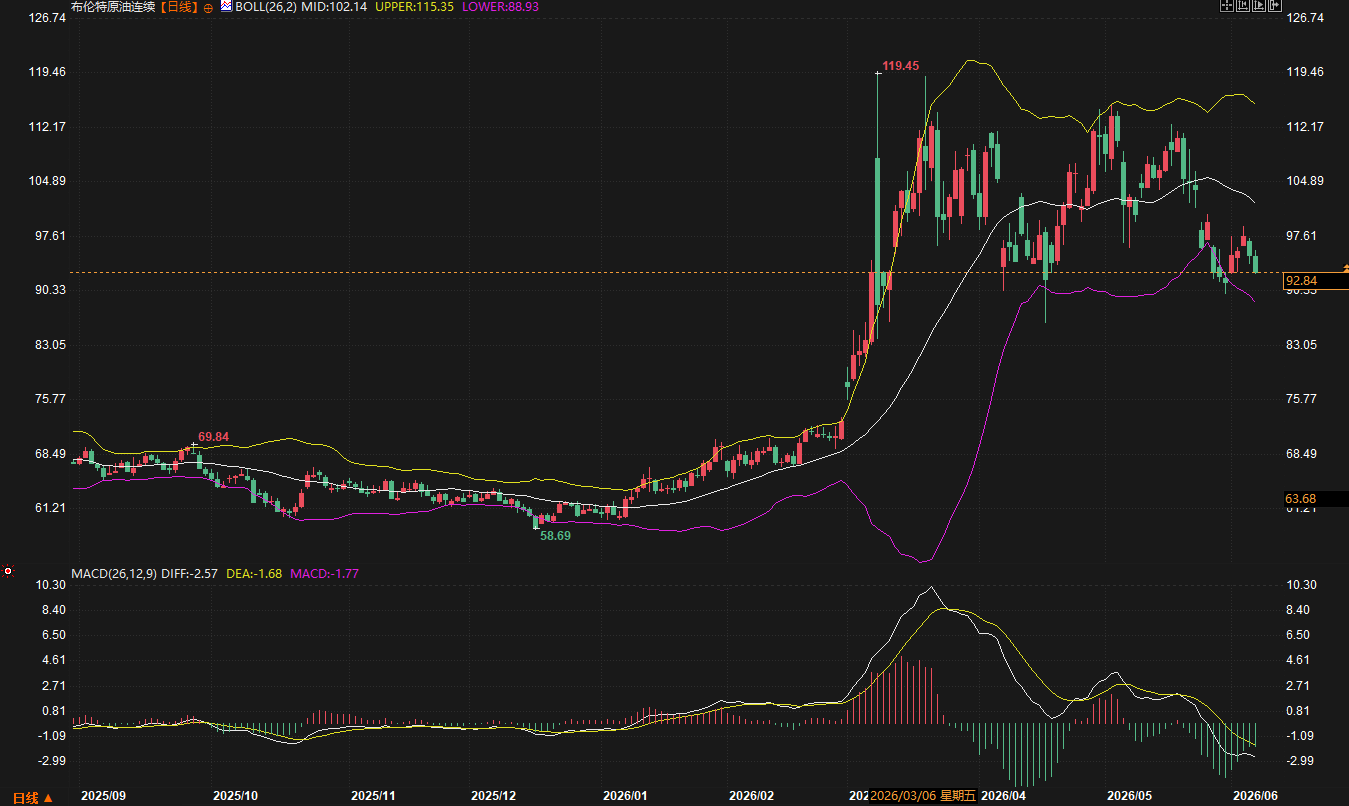
Economic Data and Events Summary <br/>This week's focus was on Middle East geopolitical developments. Hezbollah leaders rejected the ceasefire agreement in Lebanon, with Iran making a ceasefire a precondition for reaching agreements with external parties. Shipping data shows that Iranian oil exports have fallen to their lowest level in six years. An explosion was reported near a berth at the port of Minafahar in Oman, but operators stated there was no substantial impact; the port's daily exports are between 800,000 and 900,000 barrels. Shipping restrictions in the Strait of Hormuz remain in place, affecting approximately one-fifth of global crude oil transport. OPEC maintains its optimistic forecast for oil demand.
Summary of Analyst and Institutional Views <br />Overseas institutional analysts point out that the market has not yet observed any significant escalation of the conflict. Although no agreement has been reached, traders tend to believe that the situation is easing. Institutions such as Commerzbank noted that Brent crude and European natural gas prices rose slightly earlier in the week due to the stalemate in peace negotiations and restrictions on shipping through the Straits. A senior analyst at Price Futures Group believes that current pricing reflects a temporary expectation of easing tensions. Reports from well-known foreign media outlets also indicate that despite geopolitical uncertainties, demand fundamentals remain supported by OPEC.
This Week's Price Recap : US crude oil's price movement this week was highly synchronized with Brent crude. It closed at $90.54 on Friday, down $2.50, or 2.69%. For the week, it rose approximately 3.64%, marking its first weekly gain in three weeks. The current price is around $90.25, positioned slightly below the lower Bollinger Band. The MACD indicator is also in negative territory, with both the DIFF and DEA lines below the zero line, indicating continued bearish momentum, consistent with the technical picture of Brent crude.
https://upload.fx678img.com/upload/ht/20260606/2026060612213573.png
Economic Data and Event Summary <br />The US crude oil market was also driven by events in the Middle East. A sharp decline in Iranian exports, coupled with shipping restrictions in the Strait of Hormuz, created supply-side disruptions, but relatively weak Chinese demand provided some offsetting effect. The OPEC Secretary General stated that despite the Middle East conflict and shipping challenges, he maintained his forecast of 1.2 million barrels per day of oil demand growth this year. Earlier this week, the stalemate in negotiations led to volatility due to the conflict, and the market gradually digested the relevant information.
Summary of Analyst and Institutional Views <br />The overall institutional view is that the market is reassessing geopolitical risk premiums. Traders are increasingly convinced that the probability of a renewed conflict has decreased, driving a price pullback on Friday. Analysts pointed out that oil prices were initially supported by expectations of a breakdown in negotiations coupled with transportation constraints, but as signals of stabilization emerged, some gains were given back. OPEC's demand forecasts remained unchanged, providing some anchor for medium- to long-term prices.
The core driver of the international oil market this week was the dynamic adjustment of geopolitical risk expectations. Early in the week, volatility in the Middle East and transportation bottlenecks pushed prices up, but subsequent market confidence in a de-escalation led to a pullback. Both major contracts still recorded positive weekly returns, indicating that supply-side disruptions still provide support, but technical indicators suggest a short-term weak trend. OPEC maintained its strong demand forecast, which contrasts with actual data such as declining Iranian exports. The market needs to continue to monitor the progress of Middle East negotiations and the actual recovery of transportation. Overall, oil prices are likely to fluctuate within the $90-$105 range, with geopolitical factors remaining the main variable.
What was the main reason for the sharp pullback in oil prices on Friday this week?
Market traders are gradually reaching a consensus that a rapid resurgence of the US-Iran conflict is unlikely, pushing risk premiums down. Brent crude fell 2.04% and US crude fell 2.69% on Friday, reflecting profit-taking on gains accumulated earlier in the week due to the stalemate in negotiations. Although Hezbollah rejected the ceasefire agreement, there were no signs of further escalation, and the resumption of operations at Omani ports eased supply concerns. Technically, the MACD bearish alignment strengthened the pullback momentum, and prices returned to trading near the lower Bollinger Band.
How much impact will the six-year low in Iranian oil exports actually have on oil prices?
The decline in exports was mainly due to external blockade pressures, creating a supply-side contraction effect, but this was partially offset by relatively weak demand from China. In the short term, this boosted geopolitical premiums, supporting the rebound in oil prices earlier this week. However, with relatively ample supply from other global sources and OPEC's overall production policy remaining stable, the transmission of this trend to medium- to long-term prices is limited. The market is more focused on the actual recovery of shipments than solely on export data.
What is the significance of OPEC maintaining its demand growth forecast?
The OPEC Secretary General reiterated that the demand growth forecast of 1.2 million barrels per day for this year remains unchanged, providing a positive anchor for the market on the demand side. Despite the ongoing conflict in the Middle East and transportation restrictions, the organization has not adjusted its outlook. This contrasts with concerns from some institutions about weak demand, supporting confidence in the bottoming out of oil prices after the correction. Future observation of actual consumption data is needed to verify the reliability of this forecast.
How should we assess the impact of the Strait of Hormuz's restriction on global crude oil transportation?
The strait carries one-fifth of the world's crude oil shipments, and short-term restrictions have directly increased logistics costs and supply uncertainty, which is directly related to the oil price rise in the early part of this week. However, the market has observed that Omani port operations have not been substantially affected, and there has been no complete blockade, so risk expectations are gradually cooling down. In the long term, if the transportation bottleneck persists, it may be transmitted to refinery inventories and downstream prices, but current market pricing has already partially priced in this factor.
Technical indicators suggest that bears are in control. What is the outlook for the future trading range of oil prices?
Brent crude is currently trading between the middle and lower Bollinger Bands, with the MACD indicator in negative territory, suggesting short-term weak fluctuations. US crude oil is exhibiting similar characteristics. Considering fundamentals, the $90-$105 range has become the primary trading range. Geopolitical events remain the main catalyst; if conflict expectations ease further, prices may test the lower limit of the range; conversely, if new disturbances emerge, prices may return to the upper limit. Traders need to closely monitor the progress of Middle East negotiations and subsequent statements from OPEC to avoid one-sided bets.
Brent crude oil
Weekly Market Review <br />Brent crude oil rebounded in the first half of the week due to the Middle East situation, but fell on Friday as risk expectations declined. The latest closing price was $93.09, down $1.94, or 2.04%. For the week, it rose approximately 1.18%, achieving its first positive weekly gain in three weeks. The price is currently trading in the $90-$105 range, between the middle and lower Bollinger Bands. The MACD indicator is in negative territory, and the histogram shows that bearish momentum still dominates, indicating a weak short-term trend.
Economic Data and Events Summary <br/>This week's focus was on Middle East geopolitical developments. Hezbollah leaders rejected the ceasefire agreement in Lebanon, with Iran making a ceasefire a precondition for reaching agreements with external parties. Shipping data shows that Iranian oil exports have fallen to their lowest level in six years. An explosion was reported near a berth at the port of Minafahar in Oman, but operators stated there was no substantial impact; the port's daily exports are between 800,000 and 900,000 barrels. Shipping restrictions in the Strait of Hormuz remain in place, affecting approximately one-fifth of global crude oil transport. OPEC maintains its optimistic forecast for oil demand.
Summary of Analyst and Institutional Views <br />Overseas institutional analysts point out that the market has not yet observed any significant escalation of the conflict. Although no agreement has been reached, traders tend to believe that the situation is easing. Institutions such as Commerzbank noted that Brent crude and European natural gas prices rose slightly earlier in the week due to the stalemate in peace negotiations and restrictions on shipping through the Straits. A senior analyst at Price Futures Group believes that current pricing reflects a temporary expectation of easing tensions. Reports from well-known foreign media outlets also indicate that despite geopolitical uncertainties, demand fundamentals remain supported by OPEC.
US crude oil
This Week's Price Recap : US crude oil's price movement this week was highly synchronized with Brent crude. It closed at $90.54 on Friday, down $2.50, or 2.69%. For the week, it rose approximately 3.64%, marking its first weekly gain in three weeks. The current price is around $90.25, positioned slightly below the lower Bollinger Band. The MACD indicator is also in negative territory, with both the DIFF and DEA lines below the zero line, indicating continued bearish momentum, consistent with the technical picture of Brent crude.
https://upload.fx678img.com/upload/ht/20260606/2026060612213573.png
Economic Data and Event Summary <br />The US crude oil market was also driven by events in the Middle East. A sharp decline in Iranian exports, coupled with shipping restrictions in the Strait of Hormuz, created supply-side disruptions, but relatively weak Chinese demand provided some offsetting effect. The OPEC Secretary General stated that despite the Middle East conflict and shipping challenges, he maintained his forecast of 1.2 million barrels per day of oil demand growth this year. Earlier this week, the stalemate in negotiations led to volatility due to the conflict, and the market gradually digested the relevant information.
Summary of Analyst and Institutional Views <br />The overall institutional view is that the market is reassessing geopolitical risk premiums. Traders are increasingly convinced that the probability of a renewed conflict has decreased, driving a price pullback on Friday. Analysts pointed out that oil prices were initially supported by expectations of a breakdown in negotiations coupled with transportation constraints, but as signals of stabilization emerged, some gains were given back. OPEC's demand forecasts remained unchanged, providing some anchor for medium- to long-term prices.
The core driver of the international oil market this week was the dynamic adjustment of geopolitical risk expectations. Early in the week, volatility in the Middle East and transportation bottlenecks pushed prices up, but subsequent market confidence in a de-escalation led to a pullback. Both major contracts still recorded positive weekly returns, indicating that supply-side disruptions still provide support, but technical indicators suggest a short-term weak trend. OPEC maintained its strong demand forecast, which contrasts with actual data such as declining Iranian exports. The market needs to continue to monitor the progress of Middle East negotiations and the actual recovery of transportation. Overall, oil prices are likely to fluctuate within the $90-$105 range, with geopolitical factors remaining the main variable.
QA module
What was the main reason for the sharp pullback in oil prices on Friday this week?
Market traders are gradually reaching a consensus that a rapid resurgence of the US-Iran conflict is unlikely, pushing risk premiums down. Brent crude fell 2.04% and US crude fell 2.69% on Friday, reflecting profit-taking on gains accumulated earlier in the week due to the stalemate in negotiations. Although Hezbollah rejected the ceasefire agreement, there were no signs of further escalation, and the resumption of operations at Omani ports eased supply concerns. Technically, the MACD bearish alignment strengthened the pullback momentum, and prices returned to trading near the lower Bollinger Band.
How much impact will the six-year low in Iranian oil exports actually have on oil prices?
The decline in exports was mainly due to external blockade pressures, creating a supply-side contraction effect, but this was partially offset by relatively weak demand from China. In the short term, this boosted geopolitical premiums, supporting the rebound in oil prices earlier this week. However, with relatively ample supply from other global sources and OPEC's overall production policy remaining stable, the transmission of this trend to medium- to long-term prices is limited. The market is more focused on the actual recovery of shipments than solely on export data.
What is the significance of OPEC maintaining its demand growth forecast?
The OPEC Secretary General reiterated that the demand growth forecast of 1.2 million barrels per day for this year remains unchanged, providing a positive anchor for the market on the demand side. Despite the ongoing conflict in the Middle East and transportation restrictions, the organization has not adjusted its outlook. This contrasts with concerns from some institutions about weak demand, supporting confidence in the bottoming out of oil prices after the correction. Future observation of actual consumption data is needed to verify the reliability of this forecast.
How should we assess the impact of the Strait of Hormuz's restriction on global crude oil transportation?
The strait carries one-fifth of the world's crude oil shipments, and short-term restrictions have directly increased logistics costs and supply uncertainty, which is directly related to the oil price rise in the early part of this week. However, the market has observed that Omani port operations have not been substantially affected, and there has been no complete blockade, so risk expectations are gradually cooling down. In the long term, if the transportation bottleneck persists, it may be transmitted to refinery inventories and downstream prices, but current market pricing has already partially priced in this factor.
Technical indicators suggest that bears are in control. What is the outlook for the future trading range of oil prices?
Brent crude is currently trading between the middle and lower Bollinger Bands, with the MACD indicator in negative territory, suggesting short-term weak fluctuations. US crude oil is exhibiting similar characteristics. Considering fundamentals, the $90-$105 range has become the primary trading range. Geopolitical events remain the main catalyst; if conflict expectations ease further, prices may test the lower limit of the range; conversely, if new disturbances emerge, prices may return to the upper limit. Traders need to closely monitor the progress of Middle East negotiations and subsequent statements from OPEC to avoid one-sided bets.
- Risk Warning and Disclaimer
- The market involves risk, and trading may not be suitable for all investors. This article is for reference only and does not constitute personal investment advice, nor does it take into account certain users’ specific investment objectives, financial situation, or other needs. Any investment decisions made based on this information are at your own risk.